

I do not have a good sense of direction and what I do have deserts me entirely in the northern hemisphere. I may have known intellectually that travelling from Occitania (formerly Languedoc-Roussillon-Midi-Pyrénées) where my daughter is living across to the French Riviera (or Côte d’Azur) was going eastwards, but everything in me declared it was in a westerly direction.

The Riviera borders Italy and has long been the place for the rich and famous. I am not big on celebrities and my interest level in having Elton John’s villa in Nice pointed out to me is somewhere around zero. I simply felt appalled by the huge area adjacent to the airport that is set aside for the parking of private jets (it was full) and Monaco struck me as being the Dubai of the Riviera – too much ostentatious wealth, too many high-rise buildings, too little good taste and no nature left at all that I could see as we passed through.

Occitania borders Spain and also sits on the Mediterranean with equally glorious sea views and coastline, but is a lot more low-key. It has many local villages which seemed to be full of locals, not the rich and famous, so I found it more charming. I also had time there to wander and look.

In late spring and after unusual levels of rainfall, there was an abundance of wildflowers. And a clear absence of glyphosate. The countryside around where my daughter lives is predominantly vineyards and cork trees. I didn’t see any farm animals although there are wild pigs which are doubtless best avoided. Daughter’s partner was despairing at the damage the pigs caused as they cut through their garden. I am trying to remember what the sapling tree was he had just planted. Maybe a jacaranda? It had been snapped off in the night, about a metre up, in an act that looked more like spite from a pig than an accident or a search for food.


Cork is harvested from Quercus suber. Most trees will die if the bark is cut or removed from the full circumference of the trunk but not the cork oak. The ones growing in the paddocks near my daughter’s home had been harvested relatively recently. They made me think of somebody who had forgotten to put on pyjama pants, really. Apparently the cork can be harvested every 9 years once the tree has reached 25 years of age. It is probably just as well most of the wine industry has moved to screw caps rather than single use corks because that is not exactly a high yield of cork.

I have never forgotten this cork tree we saw on an earlier trip to Italy. It is not just the interesting nubbly bark. This one was home to a nest of hornets. We don’t have hornets in New Zealand and the sight of just one struck terror in my heart. Imagine an aggressive wasp over four times the size of the common German wasp we have here – that was the hornet. Thank goodness for our border control.


The countryside around Occitania was undulating to steep but intensively worked, mostly in grapes. These were not like the big commercial vineyards we have in this country – soulless expanses of tanalised timber, taut wires and grapevines trained with military precision to obedient compliance. This was more laissez faire in its approach, more traditional and I am guessing pretty much managed by hand. I can’t see that machinery could be used on the narrow, steep terraces.


One side effect of this lighter-handed touch on the environment is that wildflowers can thrive. There is something delightful about seeing an abundance of wild lavender and rosemary in flower. I picked one of each flower in the rough paddock with a few cork trees behind my daughter’s current home. Where there are wild flowers, there are of course many insects and whole eco-systems that are self-sustaining.


We went for a walk around a recently installed lake near their home. I say installed because apparently it has been specifically created as a recreational reserve. At one end is zip line and tree-top adventure course, placed somewhat discreetly. I think the lake is swimmable but only warm enough for paddling that early in the season. A low-key entry track and equally low-key parking areas belied the creation of a public facility that is designed for local families and is clearly being used extensively. Most recreational areas with a natural style that I have seen were put in many, many decades ago. Modern recreational areas seem to need acres of sealed parking and turning and the installation of sealed areas for activities like skateboarding. I found this gentler approach most charming.


Being France, there was a pop-up bar near the water’s edge. Of course there was. The French don’t seem to need to separate off drinking facilities to control adults who drink to excess. It is just integrated into the wider park. We didn’t stop for a drink because our baby was due for a sleep.

I was equally surprised by this wine bar set on a windy promontory with a look-out to the Mediterranean Sea. I can’t imagine New Zealand ever allowing a wine bar on a roadside layby.

While the French seem to manage social drinking well, the same can not be said of dog poo. I first visited Paris in the mid 1990s and, along with losing our elder daughter on the underground (she was 15 so it wasn’t too big a drama) and the Eiffel Tower, I still remember the dog poo. It seems things have not changed, at least not in the semi-rural south. Many people own dogs and these canine companions seem to be well socialised and amiable. But poo-y. Maybe it is that their owners take them out of their terrace housing and apartments to relieve themselves outside. Walking along footpaths needs constant vigilance to avoid tramping in dog shit. It is everywhere.
We could learn a few things from the French on reducing our use of glyphosate and on civilised drinking habits; the French could learn about poo bags and owner responsibility from us. A fair exchange?


 In New Zealand, it is rare to see a wine bottle with a cork these days and most of those will be plastic. This is the land of the stelvin screw top closure. But I give you the curious cork oak, Quercus suber. This fine specimen is in the garden of La Torrecchia. The switch to screw tops has done much to relieve the pressure on these trees which had, apparently resulted in too many inferior corks. It is a curious fact that many restaurants here still pour a mouthful of wine to be sampled by the patron when, as I understand it, this tradition came about because of wine being tainted by the original cork.
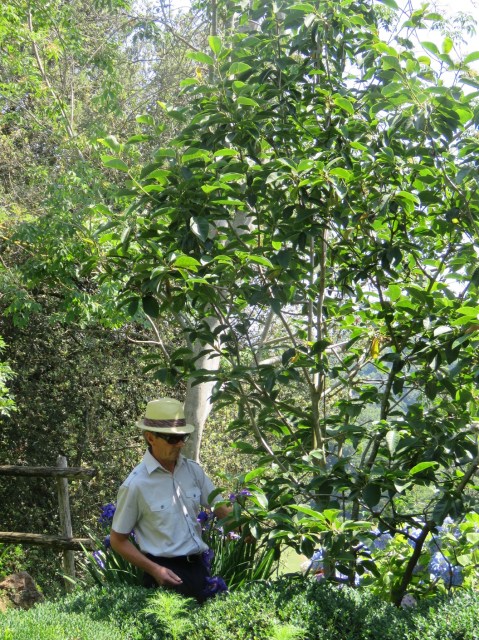


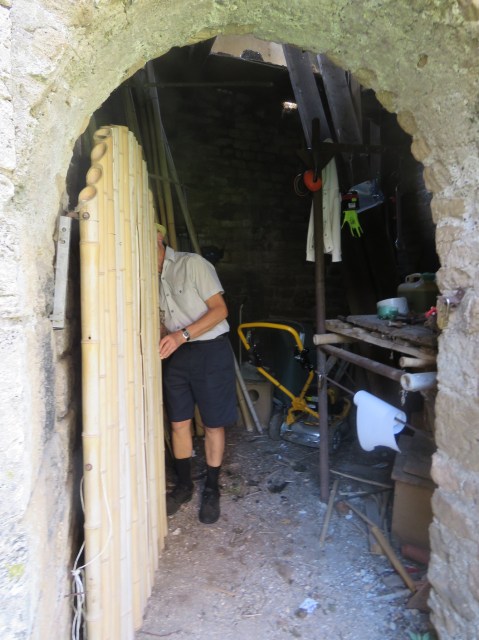 I give you the inquisitive man to whom I am married. He does like to look closely. In this case, he was interested in the construction of the bamboo door to the tool shed that he spotted at Ninfa. The bamboo will have been harvested from their own plantations in the garden and are a creative solution to crafting a door to fit a non-standard entry which likely dates back to the Middle Ages when the buildings of this town were largely constructed. I hasten to add, the door was left open. Mark may inspect but does not usually pry.

 Tikorangi The Jury Garden