Tag Archives: retirement garden

Shirley in her garden

I remembered the adage that old gardeners never die, they just turn into compost. All I could think was ‘not with our modern burial techniques, they don’t, especially if they have been embalmed’ and I wondered if my memory was correct. I typed in ‘old gardeners never die’ and Google gave me several variations.

‘Old gardeners never die, they just run out of thyme’ – a bit twee or naff, I thought.

‘Old gardeners never die. They just spade away and then throw in the trowel.’ This seemed a bit wittier.

‘Old gardeners never die; they just very slowly turn into the most magnificent compost. But what a marvellous, active brew it is!’ That is the full quote I was thinking of.

Mark says he thought old gardeners never die, they just turn into garden gnomes. This is a family joke because, as his father became older and older, he did indeed start to remind us of a gnome. As we grow older, I have reflected more on how we made it possible for Felix to stay in his home and garden until he shuffled off the mortal coils well into his 80s.

We do not see a Ryman Healthcare Village beckoning to us in our future, even though I see many advertisements targeting our demographic with what are meant to be enticing visions of a care-free ‘village’ lifestyle with folks of a similar age bracket. Not too many of them look like gardeners to me.


How to manage a completely flat area surrounded by neighbour’s fences and to give an illusion of space and distance. On the left is a bold planting of simply splendid red astelias by the house.
I need to ask Shirley which red astelia her magnificent four plants are. Mark and his father spent years working on breeding red astelias – one of our native plants – and, despite all their efforts, Shirley’s plants are better and more of a statement than any we have growing here.

No, if I am lucky enough to live long, I want to be like Stratford gardener, Shirley Greenhill. I called in to see Shirley and her garden during the garden festival yesterday and she is indomitable. Shirley has been a stalwart of the Taranaki garden scene for more decades than many of us can remember. Her previous large garden is still cited as being particularly lovely, cool climate gardening on varied terrain managed with skill and charm. As an ageing widow, she reluctantly decided to move to something more sensible, more manageable, on a town section that has largely flat terrain with an easy-care modern home.
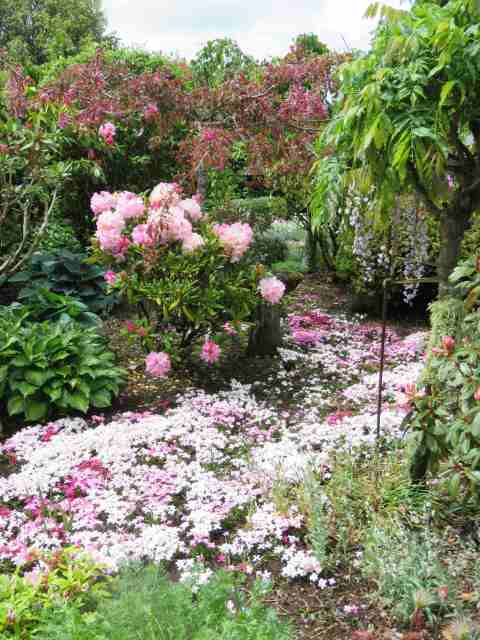
A river of rhodohypoxis is no mean feat to keep going. I should have asked what takes over from the rhodohypoxis in this area after they have peaked, because I am sure there will be something.

Shirley set about turning this ‘sensible choice’ into her own and she has certainly not taken the low maintenance option to her retirement garden. She loves plants and she loves gardening, even though she has had to scale down to a much smaller area. It is not that small though, by retirement standards. She has a lifetime of experience in active gardening and she loves many different plants and a high level of interest in her garden. I imagine there is something of interest to look at in every week of the year. If I lived a little closer, I would ask to visit to see and track it through the seasons.
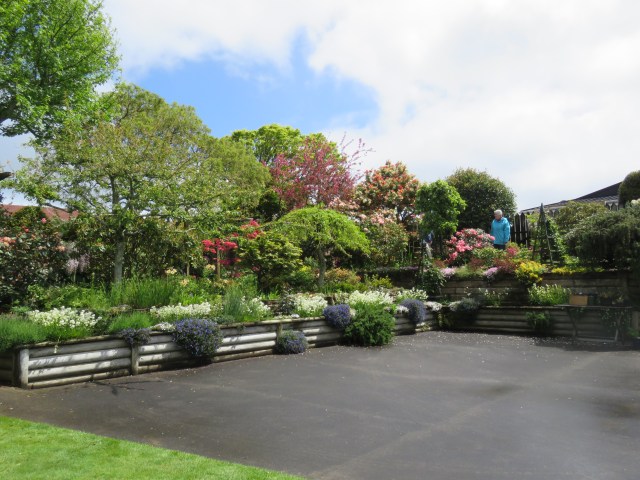
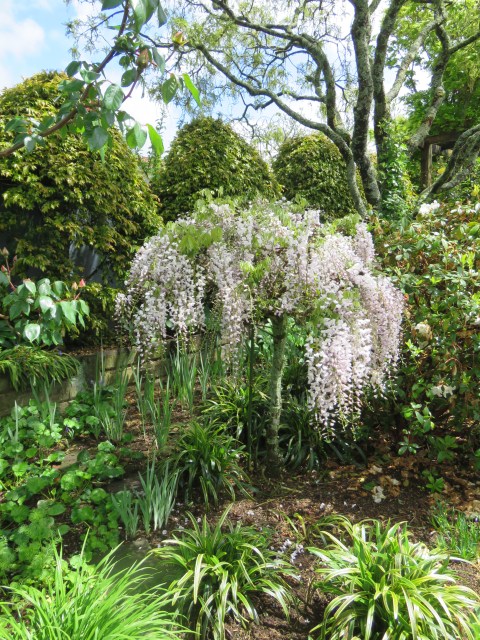
Making use of every piece of available space with just a pocket handkerchief of lawn remaining
It is not the best coloured wisteria I have seen, being neither blue nor white, but it is a very good example of managing to keep one of the word’s more rampant plants confined to a small space and still keep it flowering abundantly.

I didn’t want to embarrass Shirley by asking to photograph her but there is a charming clip of her on prime time TV show, Seven Sharp, from October 26. It is available online  here for another 20 days  and she features from 17.10 minutes on.   If I reach the age of 88 and am still active, effervescent, and clearly in full possession of all my mental faculties, I will feel blessed indeed. What a role model for those of us who are now entering that stage of being aware that we have more years behind us than we have ahead.
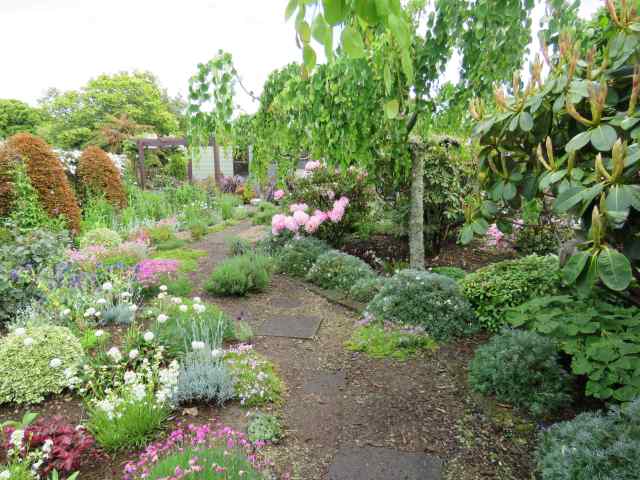
No space for lawn but the considered placement of clipped shrubs and some moderately bold choices of larger trees and shrubs gives presence to the low underplantings of assorted treasures.

I bought the very last copy of her self-published book, “I am in the garden” – a charming memoir which I felt deserved a place in our bookcase. Shirley tells me she is working on a second book in a similar vein because she just loves writing. My latest visit to her garden is a memory that I want to hold on to.
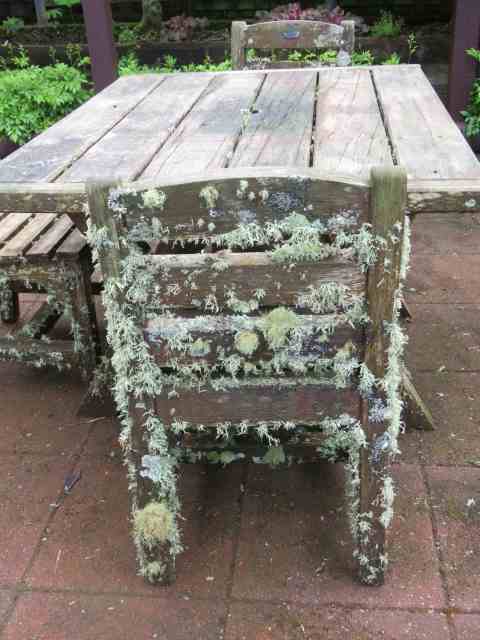
Shirley’s outdoor dining set amused me because it is a clear example of what so many of us have found in this climate of regular rainfall and high humidity – if you leave your furniture outside all year round, the lichen takes over. I always console myself with the thought that lichen growth is apparently a sign of good air quality.

A retirement garden from scratch

The garden owners know exactly what they like and how they want their new garden to look

The garden owners know exactly what they like and how they want their new garden to look

Every time I drive to town, I pass a large new garden that was started from scratch late last year. The owners are usually outside, beavering away. Curiosity overcame me and I had to stop and chat.

Ann and Maurice did not want to be identified beyond their christian names and that is fine because what interested me was to find out how they decided where to start with their blank canvas. There was just some perimeter hedging and a new house at one end of the plot when they started. It is a large section – a full acre they told me – and this is their retirement garden.

Both came from larger gardens, considerably larger in their earlier days, so the prospect of an acre held no fears for them, but the fact that it is pretty much dead flat was important. There are good reasons why most people retire to the flat in later years – gardeners’ knees for one.

I asked them how they decided where to start and the response was completely matter of fact and decisive. They wanted a garden that was fully visible from the house. There was to be no slow reveal or secret garden to be discovered. In a modern house designed for indoor-outdoor flow, they wanted to be able to survey their garden in its entirety from the living areas. There is no right or wrong way on this. It is entirely a matter of personal taste and they know what they like. The result is a large expanse of central lawn surrounded by garden borders on the perimeter.

All the garden borders are curved, serpentine even. Ann was equally decisive on this design decision. She does not like straight lines in gardens and regards them as boring. Again this is a matter of personal taste and design choice. There is no correct or incorrect way.

Where their gardening experience showed was in the generous width of the perimeter borders. Irrespective of whether your edgings are railroad straight or gently curving, one of the most common design mistakes is to make borders too narrow. In a large space, narrow borders can look mean, out of proportion to the scale of the garden. But even in a small space, it is very difficult to work with narrow borders. Plants grow – often much larger than expected and few novices can envisage the amount of space trees and shrubs will take up once established.

Scatter pavers in the middle of wide borders to give somewhere to stand when tending to the sections that can't be reached from the side (this one in my garden)

Scatter pavers in the middle of wide borders to give somewhere to stand when tending to the sections that can’t be reached from the side (this one in my garden)

We have been dogged by garden borders that Mark’s parents put in back in the 1950s, which ended up being too narrow. It is not easy to widen borders retrospectively when they have permanent concrete or stone edgings in place. We have done it to several, but getting it right from the start saves bother. Never less than two metres in width would be my rule of thumb, wider where possible. Maybe consider having fewer, wider borders if the amount of garden is scary. Scatter a few pavers in the wider expanse of the border if you don’t want to stand on the soil so that you can tend to the central area that is out of reach.

Ann and Maurice are planning their garden from the start so that they will be able to maintain it as they age. It is, after all, their retirement project. All borders have been edged with a wide concrete mowing strip, hand mixed and poured by Maurice. This gives definition to the borders and makes mowing easy. There are no island beds to circumnavigate. The lawn is uninterrupted. Maurice has given considerable attention to the lawn and they have not shied away from spending money on getting it right from the start. The level is consistent and flush to the mowing strips. It is a large area but dead flat and easy to mow with a ride-on – an important factor in longer term planning.

While the new border plantings include both perennials and annuals, the long term emphasis is on the trees and shrubs. Over time, these will grow and mature, providing a low maintenance backdrop for when hand weeding and kneeling become onerous. “It will be easy,” they explained. “All that will need to be done to keep the place looking good is to mow the lawns.”

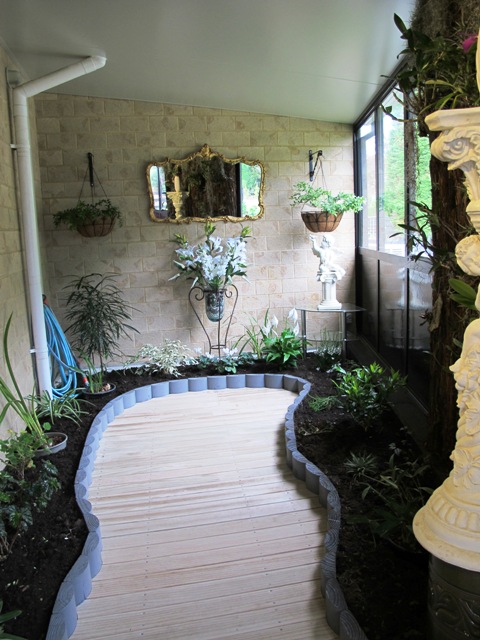
Ann and Maurice were keeping their intensively gardened areas close to the house - very close for these areas under cover

Ann and Maurice were keeping their intensively gardened areas close to the house – very close for these areas under cover

Detailed gardens have been kept very close to the house with particular emphasis on the new conservatory which sports a permanent garden.

It is difficult to imagine a time when these two will not be out in their garden. They know what they like, they know what they want and they have made plans for it to see them into the future. No matter whether one’s personal tastes and preferences differ, there is a magnificence in such confident enthusiasm backed up by hard work.

First published in the Waikato Times and reprinted here with their permission.