Tag Archives: romantic gardens

Ninfa-ish or Ninfa-esque. Sort of.

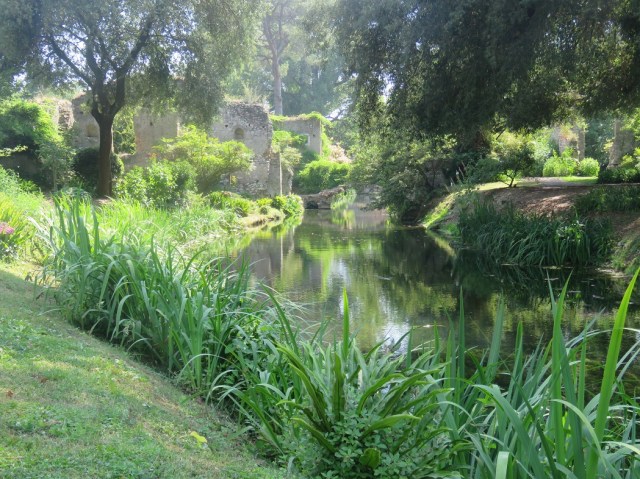
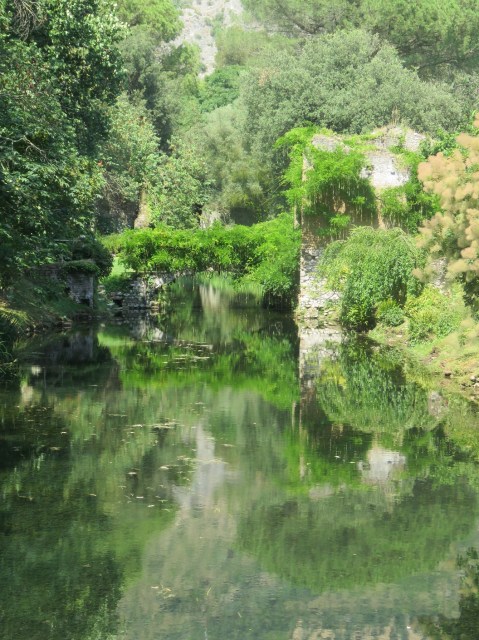
One of the iconic vistas at Ninfa

I don’t think I have ever felt so flattered in my life as when Australian garden expert, Michael McCoy came here two weeks ago saying that a Wellington landscaper friend told him he must come, that our garden is ‘like Ninfa but without the ruins’. Well, I was even more flattered when he endorsed that observation after we walked around for 2 ½ hours in rain. It took that long to get around because we found so many shared gardening values and, indeed, experiences.

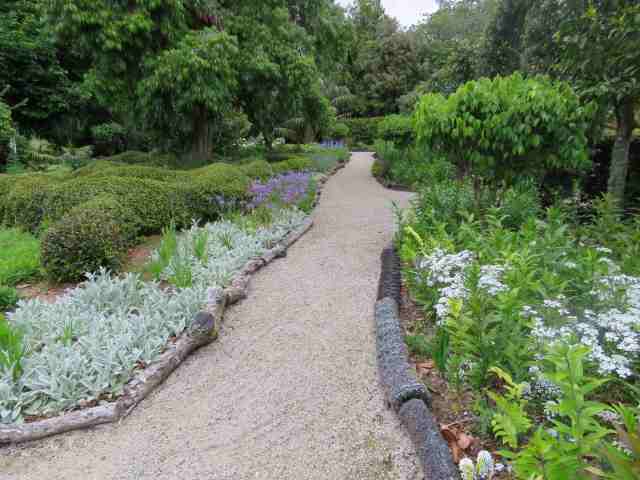
Not exactly Ninfa, our Wild North Garden, but I guess it has a similar ambience but without the ruins

Upon reflection, it isn’t so much that we are like Ninfa (and we certainly lack ruins), but that these two younger professionals in the garden design scene saw the romanticism that we have embraced in our garden. We have reached it in a different way to Ninfa but soft-edged romanticism was the goal and this was an endorsement that we are reaching that goal.
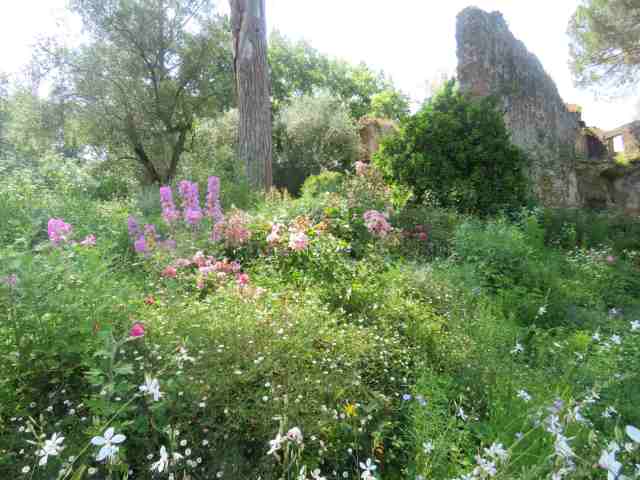
Ninfa with lush growth that is not commonly seen in the hot, dry climate of southern Italy

For those of you who don’t know Ninfa, it is a garden in southern Italy that is often hailed as ‘the world’s most romantic garden’ and it is built around the remains of an entire town that was occupied from Roman times through until it was sacked in 1370. So 750 year old ruins. Our only ruin is a collapsed low brick wall which fell back around 1960s or 70s. I don’t think that counts. Ninfa is renowned for its roses and we don’t have a mass of climbing roses. Neither Mark nor I could recall long grass at Ninfa; I went through my photos from our visit and they don’t have long grass and meadows as we do. So how are we like Ninfa without the ruins?
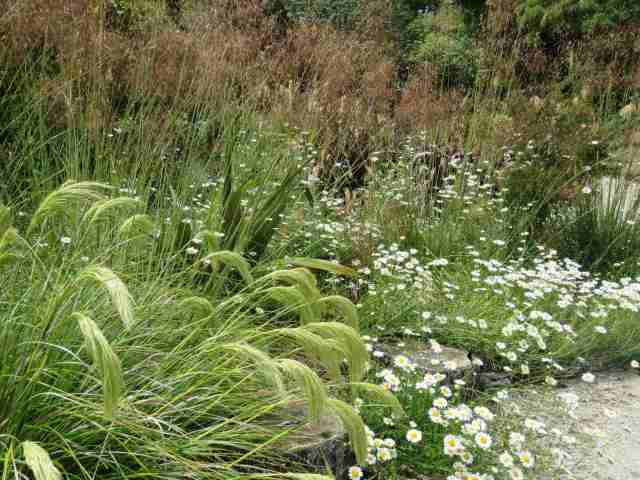
The Court Garden last week here at Tikorangi

Soft-edged gardening is what it is all about. I see I wrote a piece about romantic gardens for Woman magazine at the beginning of last year and I must be getting old because until I reread it, I had no memory of writing it at all. ‘I grow old… I grow old… I shall wear the bottoms of my trousers rolled’, to quote T.S. Eliot in his Love Song of J. Alfred Prufrock. At least I still dare to eat a peach.
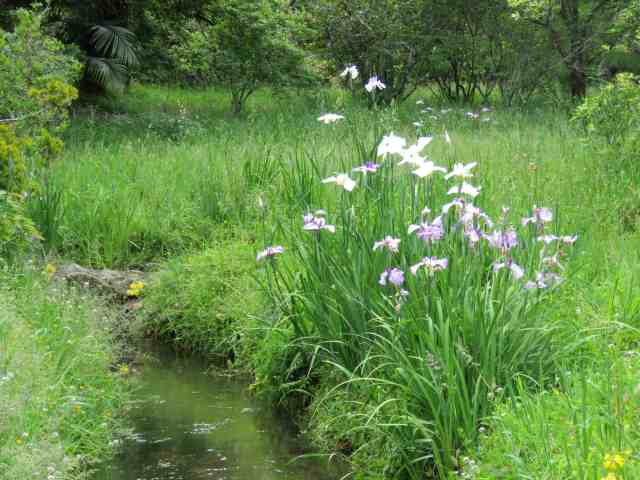
Higo iris now in bloom in our park

Before I found those earlier thoughts, I had been musing all week about what makes a romantic garden. In no particular order, I would list the following:
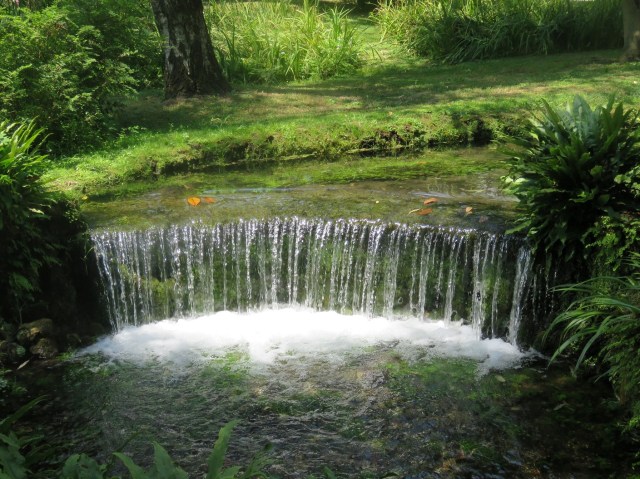
Water is an integral part of the garden at Ninfa
Same principle Mark arrived at long before we even heard of Ninfa – creating small drops to enable the flowing water to be heard as well as seen. We have so little fall from where water enters our property on one side to where it exits on the opposite boundary that this tooks some thought and effort to achieve.
  • Water – a reasonably large body of water that is moving so it brings the element of sound. Ninfa was exceptional in that it was in a dry, arid part of Italy but it had its own river which gave the feeling of an oasis in a barren landscape beyond. Years ago, when Mark was playing with our onsite water, he worked on ponds and rapids to achieve small drops in level to get the sound of flowing water.
  • Lush growth – onsite water plays a large part in being able to manage a lush garden. I don’t think I have seen a dry garden that could be described as romantic. Water and lush growth also encourage birds, flowers bring bees and other insects and these natural creatures bring more life to a garden. We do lush growth very easily in our little corner of the world where three weeks without rain has us muttering darkly about drought.
  • No straight lines, right angles or hard edges. Formal gardens may be many things, but romantic they are not. And no wretched edging plants defining the line between garden and path. To our mutual amusement, Michael McCoy and I share an intense dislike for suburban edging plants.
  • Avoid evidence of maintaining the garden with glyphosate, too. There is not much that is less romantic than edges that have clearly been sprayed, or indeed expanses of liverwort which are too often a sign of long-term maintenance with glyphosate (Round Up).
Dappled light and glimpses beyond in our Wild North Garden
  • Light and shade and dappled light which usually means some taller trees. Too often, the delight in variations of light and shade are not factored into planning gardens but they add another dimension beyond flowers, foliage and form. With light and shade come views through. Designs with tightly enclosed garden rooms may be cosy and contained, but they are not often romantic. Glimpses beyond hint at further areas to be experienced.

Romanticism at Gresgarth, Arabella Lennox-Boyd’s lovely garden in the north west of England.
  • An absence of dominating man-made features or much that is modern. As soon as you add man-made features into a garden, be it a gazebo (oft referred to as ‘gazzybows’ here), a Japanese-style bridge painted red or any other piece of brightly painted garden structure, a modern sculpture or a stark white statue, the eye is always drawn to that piece rather than to the wider environment. Old ruins or suitably aged and mellow pieces can be added but in great moderation and with care. Less is more in a romantic garden and any additions should blend and meld, not shout out to be noticed. Forget focal points which are to direct the eye – they belong in more structured garden styles. The romantic garden is more of an absorbing experience than a directed one.
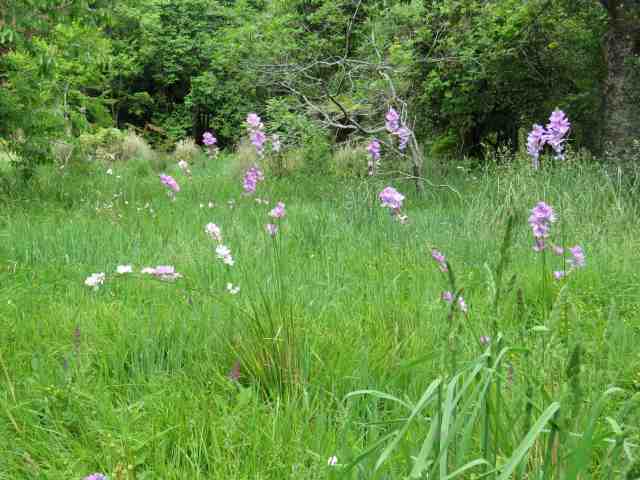
Ixias used as meadow flowers
  • Flowers are generally in simpler, looser forms. Not necessarily small but if large, they look better if they are on the blousy side. Flowers with the tight form of, say, auriculas or formal camellias are more at home in more controlled situations. The same rule of thumb applies to plants with rigid, stiff forms. Looser forms also give more sense of movement – they will sway and respond to the slightest breeze.
Mown paths give definition – in the area we refer to as the park here at Tikorangi
We have a few roses but not a lot. Because we don’t spray them, they are integrated into plantings that will hide their poor foliage and generally disappointing form when they are not blooming in profusion. The dog, as you may gather, is my constant companion.

Without ruins and rambling roses, we have basically done it with long grass and meandering mown paths following the natural contours of the land (no straight lines!). The paths are what give definition and stop the long grass from looking like the area has just been shut up and left. In our climate, the grass growth is so strong all year round that we have to mow everything down twice a year – in midsummer and midwinter so the end of January and the end of June. But long grass, flowers growing semi-wild and meadows are not a defining characteristic of a romantic garden. They are just one style that sits within the romantic genre.
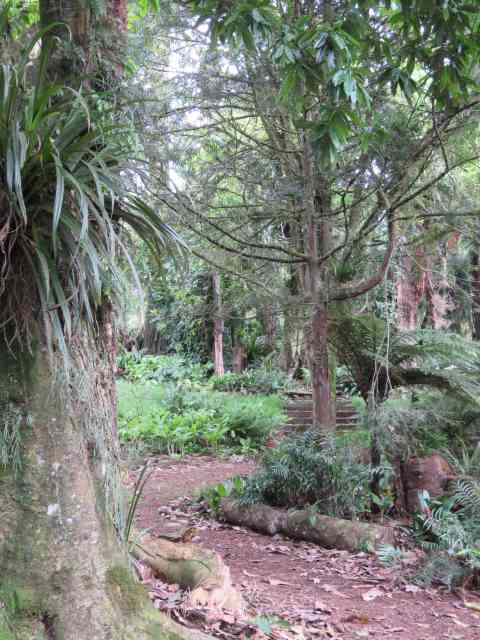
It is not all about long grass here at Tikorangi; sometimes it is about views through, gently leading from one area to another rather than straitjacketing areas into tightly defined garden rooms.

Romantic gardens come back to being in the garden, not looking at the garden, gardening with Nature more than by controlling Nature and creating gardens that sit within the landscape rather than on the land.

It is not everybody’s cup of tea.  It is bringing different eyes to a garden situation and with that, different expectations. It makes us happy,  brings us delight and, mostly, that is all that matters. But I am still honoured and flattered  that others have referenced Ninfa as a comparator.
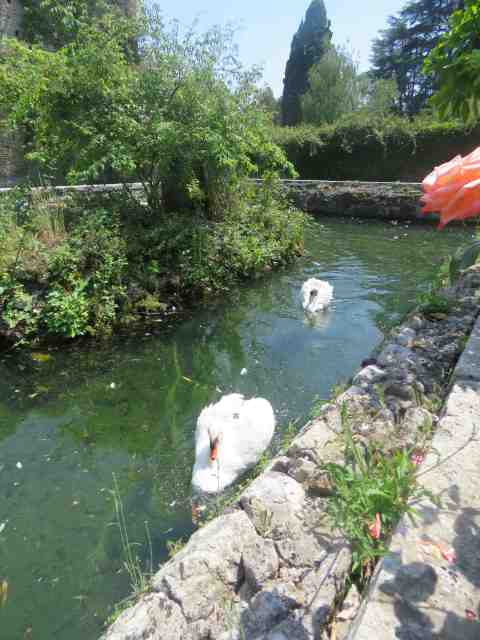
Ninfa with its moat and decorative white swans (and a distinctly vulgar orange hybrid tea rose on the right that disturbed me)
Lacking both moat and white swans, we have to make do the neighbour’s white runner ducks who visit the Wild North Garden from time to time.
Finally, just as a point of comparison – NOT romantic in our Wave Garden and lily border – too sharp-edged, too pristine, too tightly managed to be considered romantic. I like it, I like the contrast and it may be described in various ways, but romantic is not one of them.

Romantic gardening

“He leaped the fence, and saw that all nature was a garden.”

                Horace Walpole from ‘On Modern Gardening’ (1780)

In New Zealand, we tend to place a very high value on tidy gardens. Edges, hedges and lawns, as I once heard a prominent gardener espouse. Attend to those and the rest of the garden will look fine – although, if it is a garden open to the public, it must also be weed-free.

I call this garden grooming, the outside equivalent of housework. It is a never-ending task to keep a garden manicured, but it is a matter of pride for many. You will likely be judged by your neighbours, relatives and visitors on how tidy your place is.

All those sharp lines and tidy edges give a high level of definition to a garden that makes for good photographs but they do not make my heart swell with joy.

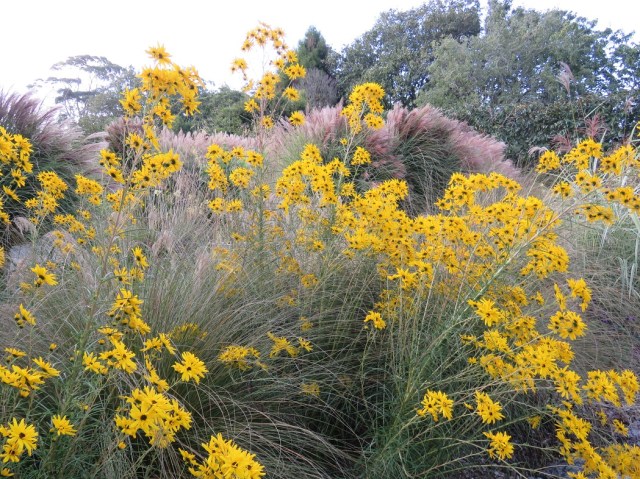
Helianthus and large grasses swaying in the autumn breeze here at Tikorangi

When I set out in 2009 to get to grips with contemporary summer gardens, primarily in the UK and parts of Europe, I was jolted out of that preoccupation with orderly, tidy gardens. There is a whole lot happening there and not much of it has to do with tidiness. I saw a generous profusion in the modern plantings, a fresh energy and vitality in the scale, the colour and the size of the plants that were never going to straitjacketed into obedience in a nice, orderly manner.

Current trends overseas are referred to as the Dutch New Wave, New Perennials, the new naturalism, naturalistic gardening, Piet Oudolf-inspired, prairie planting, the meadow revival, the Sheffield School movement and more. They all share certain features which come down to a principle of gardening with Nature, not gardening by controlling Nature. Many gardens sit on the landscape; these gardens sit within the landscape.

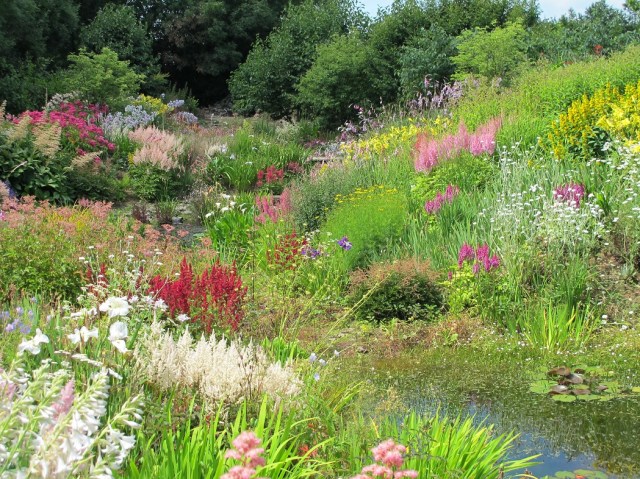
My gardening and life partner, Mark, and I landed on the term of ‘romantic gardening’ – a softer-edged, more naturalistic style that blurs the lines between the garden and the wider landscape. It is a different way of looking and it takes a different approach to managing the garden.

Ninfa Giardino di Ninfa, south of Rome, is sometimes described as the world’s most romantic garden.

“You must go to Ninfa,” English friends and colleagues said to us when we first started talking about romantic gardening. The English love Ninfa, which is in southern Italy near the charmless city of Latina. Sometimes it is even described as “the world’s most romantic garden”. Essentially, it is a looser, voluptuous style of gardening set within the ruins of an entire small town that was sacked in 1370 after being occupied since Roman times. How can the result not be romantic? It was very different to all the classic, grand Italian gardens where formality and structure gives the framework and the planting is largely an afterthought.

Torrecchia Vecchia is a modern example of what the Italians call the romantic, English style.

We also visited Torrecchia Vecchia nearby: a smaller, private garden which emulated some of the Ninfa style. It, too, was created around ruins, this time of a small village. On the day, I admit I was not blown away by its beauty, although it had some lovely areas. In retrospect, it has given me more to think about because it was a modern interpretation of what the Italians call the ‘romantic English style’. This is not surprising when you know it was created in the mid 1990s by leading English designer, Dan Pearson.

Given New Zealand’s distinct lack of abandoned villages, small towns or anything in ancient stone, we need to strip away the underpinning physical structures of these gardens to see what could work here. Trying to re-create the magic of historic Italy in tanalised timber or ponga logs is really not going to cut the mustard.

Wildside in Devon, UK, shows how a romantic garden can be created without hard landscaping

Without the human-made structures, the layers of history and romantic back stories that typically characterise ‘romantic gardens’ elsewhere, we looked to the natural landforms, plants and management strategies instead. “Enhancing Nature”, Mark likes to call it.

The simplicity of an early spring scene in the Wild North Garden is more romantic than stylish.   

For us, a romantic garden is one where the overriding sense is of being in the garden, rather than looking at the garden. English garden writer, Tim Richardson, talks about the difference between pictorial gardens and immersive gardens. Pictorial gardens are those where your eyes take in a pleasing view, where design and structure are usually the key elements. That is why they photograph well. Immersive gardens are more about the wrap-around experience, enveloping you in the movement, texture and colour of the close-up view.

This softer-edged approach of working in cooperation with Nature is underpinned by increasingly important principles – sustainability, support for natural eco-systems, better environmental practices, harmony and respect – while placing a high value on both prettiness and beauty. It is sometimes a celebration of the simplicity, rather than grandeur.

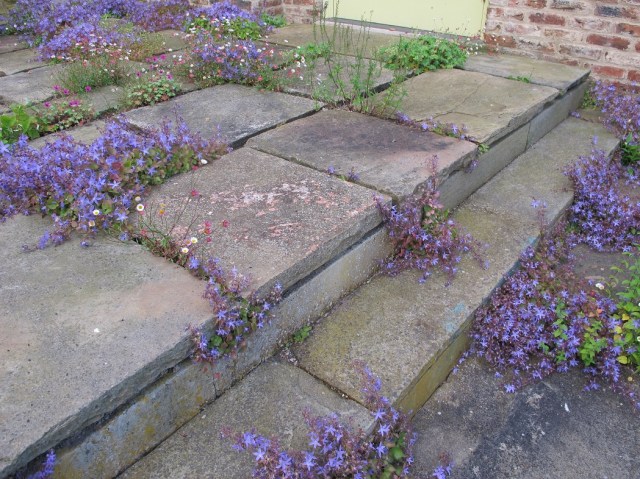
Softening hard surfaces by allowing plants to colonise the cracks and gaps

Romantic gardening is not tied to a particular garden design style: it can work with cottage-style, woodland, meadow, sunny perennials, or even just a suburban section. The exception is a formal garden which requires strict maintenance and precision for its impact.

It is a way of looking with different eyes and a different mind-set translating into gentler ways to maintain the garden. Moving away from sharp definition and excessive tidiness means a softer-edged garden, a blurring of hard lines so paths and garden are more seamless, where plants are not corseted into submission but allowed to festoon – but within reason.  Instead of focal points, we limb up taller plants to create views through and to highlight the play of light and shade. In some areas, we let the grass grow long and just mow  paths.

We still have parts of our garden that are maintained to a high level, but not too many and generally closer to the house. I may look at the tidy areas with satisfaction when they are looking spruce but it is the looser areas that can make my heart sing.

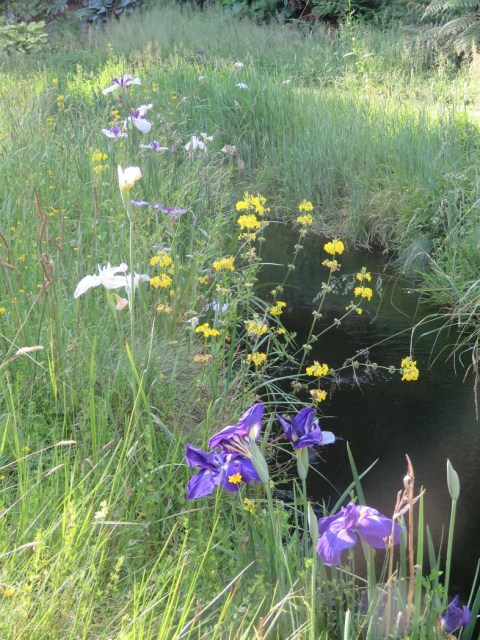
Japanese Higo iris flowering in the meadow in Tikorangi The Jury Garden

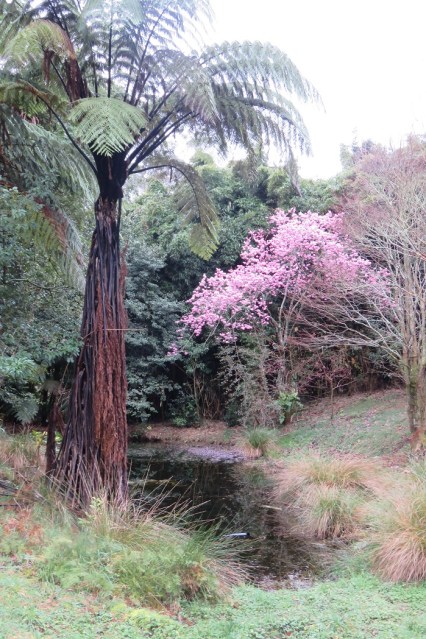
The Higo iris in the meadow down in the park, the flowering cherries in the Wild North Garden dropping their petals on the water, the voluptuous helianthus with the tall grasses flowering in autumn, the disorderly jumble of colours and blooms in the bee and butterfly garden – all these make me happy in ways that tidy formality does not.

First published in Woman Magazine March 2022 and reprinted here with their permission

A gardener’s pilgrimage to Ninfa

“You must go to Ninfa if you are interested in romantic gardens,” I was told very firmly by One Who Knows. So I obeyed. That was the prime reason we went to Italy as part of our trip just concluded. And because Ninfa has very limited opening days, the entire itinerary was organised around one of those dates.
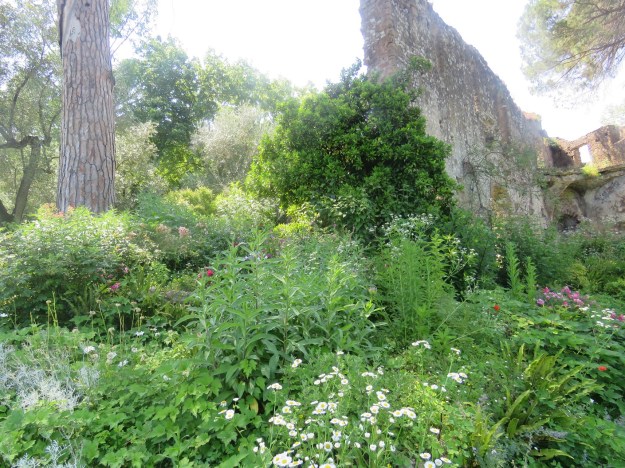
In the event, that became irrelevant. For reasons too complicated to explain, we ended up on a hot Thursday afternoon entirely alone in il Giardino di Ninfa with the run of the place. We were shown how to operate the exit gate in order to let ourselves out and left to it. To understand the nature of this privilege, I should explain that Ninfa is only open for 17 days a year for a grand total of 111 hours and that casual visitors like ourselves are generally accommodated by a one hour escorted tour.

Herbaceous planting in the rock garden was a delight

Ninfa is often referred to as “the world’s most romantic garden” – a phrase first ascribed to UK garden writer, Charles Quest-Ritson and latterly also taken up, I think, by leading gardening broadcaster, Monty Don. It would not be exaggerating to say that it has achieved international cult status and there aren’t too many gardens in that particular basket. Dating back to the early 20th century, the garden is continued these days by a foundation set up by the originating Caetani family.

It is not your classic Italian garden full of intersecting axis and formal spaces. Not at all. Indeed, it is described as being English in style – a descriptor I have met before in a northern Italian garden described to us as being in the “romantic English style”. By this is meant soft edged, informal design with more focus on plant variety, seasonal change and groupings of plants – more frou frou, as I call it, than the heavily clipped and controlled style of the usual Italian gardens of stature.

The garden of Ninfa is built around the ruins of an entire town that was sacked in 1370 after being occupied since Roman times. The scale of the ruins is nothing short of astonishing to a New Zealander unaccustomed to centuries of visible occupation. To create a garden around such imposing structures is a dream situation. In a hot dry climate, water is even more important and the abundance and sound of flowing water is integral to the magic of Ninfa, blessed as it is with the river of the same name flowing through the garden. Irrigation is necessary to achieve the lushness and growth in what is a harsh, dry environment.

A late blooming rose – most were over

I knew we would be too late for the roses and if you plan to visit this garden, if it is possible to time it right, that would add a great deal. But I imagine in these conditions, peak rose season is measured in a few weeks of May and any garden needs more to it than a short peak season based on a single plant family. And that was the case. Ninfa has a feel of its own. The water views are beautiful. We loved the soft herbaceous plantings of the area called the “rock garden”. The structure of the ruins gives a breath-taking framework. To be alone in this garden was a grand experience.

Most of Ninfa is truly romantic. This new path, not so much.

Is it a romantic garden? Yes, without doubt it is. Is it the most romantic garden in the world? I would not go as far as that but others clearly think it is. Is it flawless? No, but what garden is flawless except a static one? And that is a contradiction in terms. We were disturbed by the new lavender walk which, while well executed, was rather too amenity in appearance compared to the gentle naturalism of the rest of the garden. We weren’t too sure about the blue haze from copper spray on the ruins behind every climbing rose. If the roses had been in bloom, we probably would not have found our eyes zeroing in on that blue background. It adds a certain patina to history if you don’t know that it is caused by spraying.

The blue patina

In terms of planting, Ninfa has a much wider plant palette than most Italian gardens which tend to rely on the repetition of about 10 key plants. By international standards, it is not a hugely remarkable plant collection but in an Italian context, it is and it shows a measure of gardening skill that is not often evident in many of the famous gardens of that country. These are harsh gardening conditions which is why so many Italian gardens rely on structure, design and space for their impact, rather than plants.

The view out to the surrounding countryside

It amuses me that the Italians credit this romantic, naturalistic style to English gardening while the British (and other nationalities) flock to Italy for its romance. It is such a beautiful country. I kept thinking I was in an E. M. Forster novel (though A Room With a View was set in Florence, not nearby Sermonetta). Ninfa sits like an oasis of soft green lushness within an age-old landscape rich in history and possessed of its own natural, harsh beauty. Even the light is different in Italy.

If you want to know more about Ninfa, the official website is http://www.fondazionecaetani.org/ but a general search on Ninfa will bring up a wealth of material. It is located in the area of Latina about two hours south of Rome and requires either hiring a car (!!!!)  or sorting out a taxi transfer.

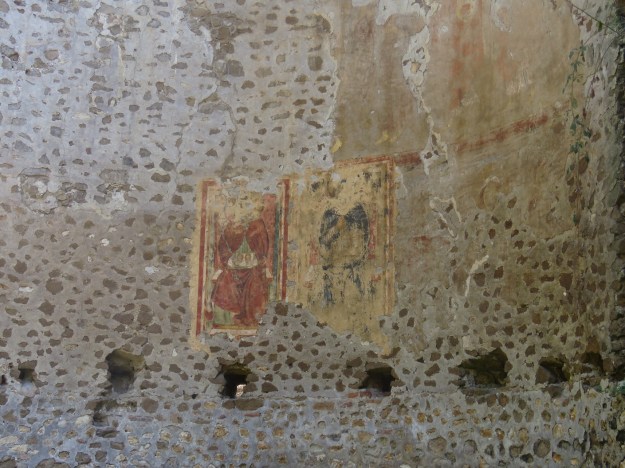
Look! Just look at the centuries old wall panels in the roofless church which may even be the one where Pope Alexander 111 was consecrated in 1159

The modern orange rose beside the moat worried me but not Mark so much. I just felt that the softer shrub and climbing roses fitted the environment better than this one.

Up, up and away. In search of modern romantic gardens.

We are off today on one of our garden visiting trips. For the first time, I have felt sufficiently unnerved by international events to register our trip on the Safe Travel site run by our government. That is so they know roughly where we are in case of catastrophe.

Overseas readers may not realise that for New Zealanders, almost every overseas flight is long haul. It is only 3 hours to Australia so that doesn’t really count and some of the Pacific Islands are not so far away. Anywhere else, it is basically 12 hours and that only gets us to refuelling stops in preparation for the second leg which is more or less another 12 hours. Unless you want to fly via the Arab states of Dubai, Qatar or UAE in which case it is over 17 hours plus a shorter long-haul leg after that.  Being an economical traveller, I have transited most airports on offer – Los Angeles, Dubai, Seoul, Tokyo, Hong Kong, Singapore, Kuala Lumpur, Bangkok, Guangzhou. They blur in the memory.

But this trip, I am really glad that we are not booked via the US (might get code-shared with United Airlines!!! Nor do we want the grief of their new visa regs), South Korea (I really like Korean Air but that is altogether too close to the odd gentleman with the bad haircut and despotic tendencies just across the border) and now via the Arab states which are looking altogether too volatile. Our Hong Kong stopovers may be hot, colourful and crowded but they don’t seem anywhere near as threatening.

We are not visiting Italy to see classic gardens of the Villa Cimbrone class this time

Wild flowers at the Palatine are more the style we are looking at these days

We land in Italy and the reason we start there is because I have been told very firmly that if we are interested in romantic gardening, we absolutely must go to Ninfa. I am obeying orders. Ninfa and La Torrecchia nearby are not the classic, formal style that most New Zealanders think of when it comes to Italian gardens. Those are the historic gardens of the rich and powerful and we have seen some of them in the past, and will go and see Villa d’Este because we will be in Tivoli some of the time. Ninfa and La Torrecchia are much more recent creations, renowned for their soft-edged profusion of flowers and foliage set amidst ruins of earlier eras.

Charmed by the villages of France – Giverny in this case. Look at that little bus shelter!

and wooed, so to speak, by the food

Then it is up to Normandie in France, to stay in Rouen and (believe it or not) in the village of Camembert. We were utterly charmed by our visit to Giverny which we tacked on to our last UK trip. Not so much by Monet’s garden itself as by the village, the countryside, wildflowers, the friendliness and the food and wine. That ooh-la-la French style is so unique. Again, we have plans to visit a modern French garden or two rather than keeping to the big budget historical attractions. I am rather hoping for some time admiring wild flowers in the land of Calvados cider and camembert.

The South African meadow was in its first season at Wisley when we visited in 2014

Crossing to the UK, we have a busy eight days planned. Again it is the modern directions that interest us – gardening in sustainable eco-systems, gently guiding nature rather than forcing it into the strait jacket of human expectations. We are really keen to see how some of the plantings we saw in 2009 and 2014 have matured over the intervening years – the Missouri and South African Meadows and Oudolf borders at Wisley for starters. We also plan to get back to Bury Court and Wildside – two of the best private gardens we have seen – but the rest will be new to us. The naturalistic plantings around Olympic Park in London have had five years to mature – we want to see how they look now that time has passed and also to see the recent public plantings around the Barbican and Kings Cross. The time of floral clocks and garish bedding plants has long passed in favour of a whole new genre of softer-edged, lower maintenance public plantings. We want to see some of it.

There may be a lull in posts over the next few weeks but we expect to come back brimming with ideas and enthusiasm.

Bury Court

Wildside

Romantic Gardens (part 2) – the grand, historic and famous

???????????????????????????????My first encounter with a garden strongly promoted for its romanticism was in northern Italy – Villa San Remigio. If you have ever been to the Italian lakes district, you will nod in agreement when I say that the whole place seems impossibly romantic. Stresa, Mennagio, Bellagio (the Lake Como one, not the Las Vegas one) – in the right circumstances these are places of charm bordering on enchantment.
Villa San Remigio had a wildly romantic back story – the love affair between a Neapolitan poet and musician and an Irish artist. If my memory serves me right, there was some sadness, earlyish deaths and childlessness. It had the mandatory handsome villa and a particularly lovely old church along with beautiful views across Lake Maggiore. But were the gardens romantic? It was all gentle decay when we were there, especially of the old concrete (and there was a lot of old concrete in larger than lifesize shrine-like constructions and terraces) and whoever managed the place was hoping to get grants for a major restoration. It may have been done by now but competition for restoration money is stiff in a country with such a long history and so many things in need of major investment.

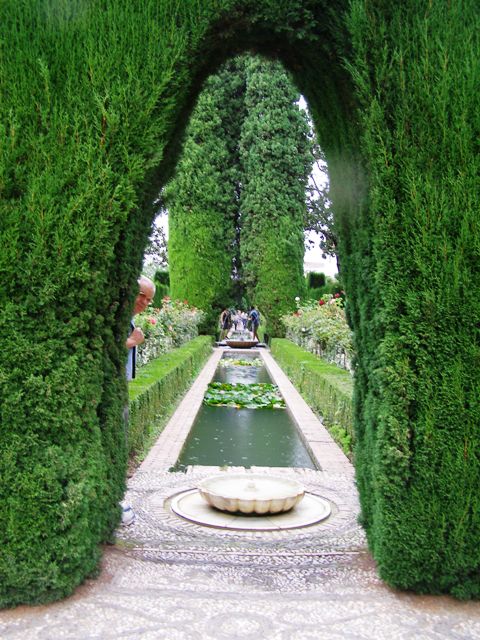
The gardens at the Alhambra are re-creations. Note the gentlemen on the left, politely trying not to intrude on my photo.

The gardens at the Alhambra are re-creations. Note the gentlemen on the left, politely trying not to intrude on my photo.

I searched on line and found an article in the UK Telegraph, listing their pick of the ten most romantic gardens. Villa San Remigio wasn’t on it, but the Alhambra in Grenada, Spain and Monet’s water lily garden in France were and I have been to both of those. The Alhambra is an amazing place but the gardens are a modern re-creation. It is the whole package there that makes the romance – the history, the beautiful palaces which are on quite an intimate scale, the light, the view across to the Albaicin (or medina)…. The garden enhances but does not generate the romance. The most recent. modernistic gardens at the Alhambra were anything but romantic.

There is nothing romantic at all about the latest, hard-edged modern garden addition at the Alhambra.

There is nothing romantic at all about the latest, hard-edged modern garden addition at the Alhambra.

Monet immortalised his garden in so many paintings which imbues the place with added mystique. An analysis of the garden itself rather belies that. However the water lily garden is loosely maintained and in a naturalistic style which contrasts with his more rigid stripes in the upper garden.

Monet’s waterlily garden is charming enough, as long as you don’t mind sharing it with many strangers.

Monet’s waterlily garden is charming enough, as long as you don’t mind sharing it with many strangers.

What these gardens have in common is a rich history, age and gentle decay, some solid architecture of note and romantic back stories. The gardens do not necessarily stand on their own merits. And let’s face it, in this country we lack most of the above although some of us can manage some gentle decay. But age is measured here in decades, not centuries.

These gardens – and most of the ones on the Telegraph list – are all well out of private ownership now but the love of romantic gardening dates back to the original visions of private owners, albeit generally ones with considerable personal wealth to achieve their dreams. These days the romance is a product of sophisticated marketing. I am yet to be convinced that an institution or business ownership model is capable of generating a romantic garden.

But private individuals can and do. I would disagree with the Telegraph’s list but that is because I am interested in the modern return to romantic gardening – what is being done here and now, not what was done last century or the centuries before.

The soft-edged naturalism, helped by French village style, showed romantic gardening at a very domestic level.

The soft-edged naturalism, helped by French village style, showed romantic gardening at a very domestic level.

We spent a couple of nights in the village of Giverny where Monet’s garden is located. I am quite willing to admit that our delight in the charm of the village may have been influenced by the departure of the daytime crowds, the soft evening light and the consumption of the fermented fruit of the French vine, but we found ourselves more engaged with the village scenes than we were with the star attraction. This was romanticism on a very personal, domestic level. The soft-edged naturalism, often with charming detail, has nothing to do with great wealth, grand vision and power. It is equally within the reach of the individual.

In the village of Giverny, even le chat français and le yellow plastic pot had a certain romantic charm in the evening light.

In the village of Giverny, even le chat français and le yellow plastic pot had a certain romantic charm in the evening light.

The Romantic Garden Part 1

First published in the Waikato Times and reprinted here with their permission.