

We are timid eaters of assorted mushrooms and fungi in this country, having been raised with a healthy fear of death cap mushrooms which look so innocent and edible. Generally we have a choice of brown Portobello mushrooms or white button mushrooms at the supermarket, so I leapt at the chance to try fresh oyster mushrooms when I saw them at the local farmers’ market.
We were a bit underwhelmed, which was disappointing. More textural than tasty, one might say. I decided to taste test the remaining ones beside the flabby brown fungus that grows freely around here and which played a very significant role in the early colonisation of Taranaki, where we live.
I am not sure that I have unravelled the complicated nomenclature of this flabby brown fungus. Mark has always known it as ‘woodear fungus’ but that is wrong. I couldn’t commit the original Maori name to my memory – hakekakeka – but it seems that is now synonymous with hakeke, which I can remember easily. It belongs to the Auricularia group, and it may be correctly identified as A. cornea but that seems to be interchanged freely with A. polytricha, which it probably shouldn’t. They are not synonymous. Anyway, it is common here and safe to eat. If you want to.
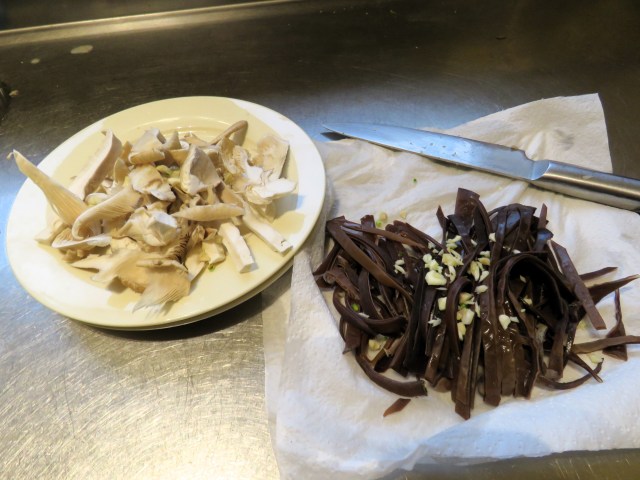
Mark found me some hakeke from the garden for my flavour experiment. I sliced both that and the oyster mushrooms into thin strips and cooked them in butter with a touch of olive oil (to stop the butter from burning) and some finely diced garlic, using separate frypans.

The verdict? Compared to the hakeke, the oyster mushroom was flavourful but it was the garlic butter that was the tastiest by a long shot. The hakeke is purely textural. The only use I could see for it in times when food is plentiful, is fried until it is crisp and then used as a garnish on, say, fried rice. I don’t think I will be adding it to our diet on a regular basis, even though we can gather it for free.
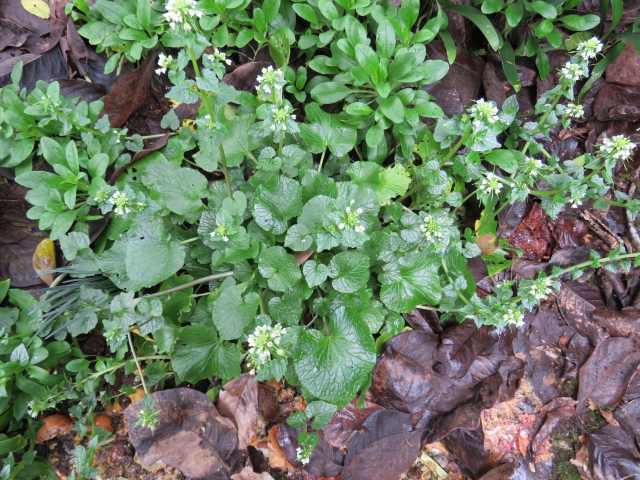
We were given a small division of a wasabi plant last year. Despite the internet saying it was difficult to grow, we hit on ideal spot (fertile soil with overhead cover from a couple of orange trees) and the clump has grown. I could see some evidence of the swollen tubers that are the part that is grated to eat so I dug it up, only to find I was being a bit optimistic. It seems it is a two or three year crop in our conditions, to get big enough tubers to grate. We now have seven divisions, five replanted and two shared with others.
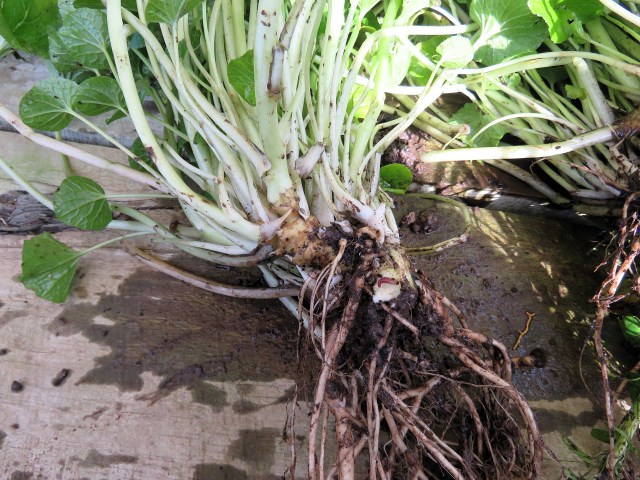
Interestingly, I doubt that I have eaten genuine wasabi before. Outside of Japan, most of what is sold as wasabi paste is in fact horseradish, mustard and green food colouring. I did grate one little bit to try but it was too small a volume to detect subtle differences in quality and taste. It tasted wasabi-ish. I am sure that in time, freshly grated wasabi will lift my summer sushi to a new level.
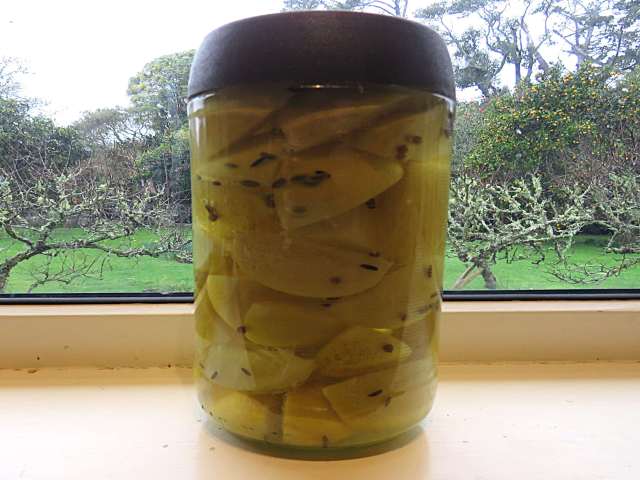
In the kitchen, I am curing a jar of salted limes. I have been doing these for years to use in cooking, particularly in Middle Eastern and southern European dishes. They also add flavour when cooking grains like wheat, be it freekeh or bulgar, quinoa, rice or couscous. I dropped couscous when I realised how processed it is, but if you eat it, I can recommend adding a finely chopped salted lemon or lime to give it flavour. Limes and lemons are interchangeable when it comes to salting; I just use limes as they turn yellow because we have more and they are a better size if I am salting them whole, rather than quartered as here. The brine is so strong that they last up to a year in the fridge.
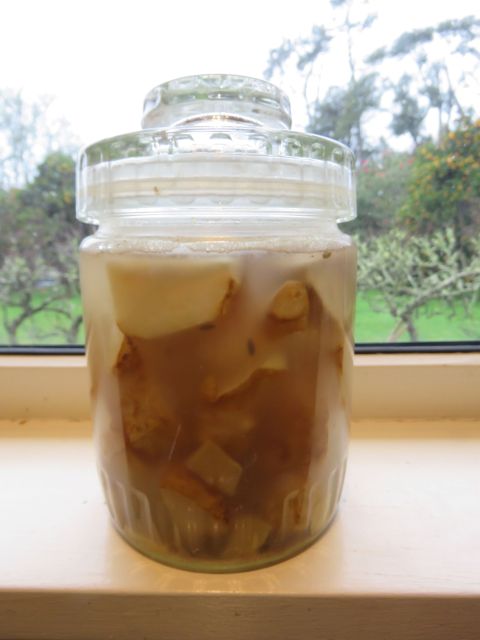
Salt also plays a role in fermenting foods. I have just completed a small jar of fermented Jerusalem artichokes and the reason to ferment this crop is that the process breaks down the inulin to a more easily digested form. It is the inulin that is responsible for this crop oft being referred to as fartichokes. Fermenting means that you can eat, sweet, crispy artichokes without the unpleasant after effects. I like the taste of artichokes and they are heavy croppers for minimal to no effort but my stomach did not like them at all. Hence the fermentation. I did a big jar last year but we didn’t eat them fast enough and they don’t store as well as salted lemons. When some questionable moulds formed, I threw out the rest but I think we will get through the smaller jar.
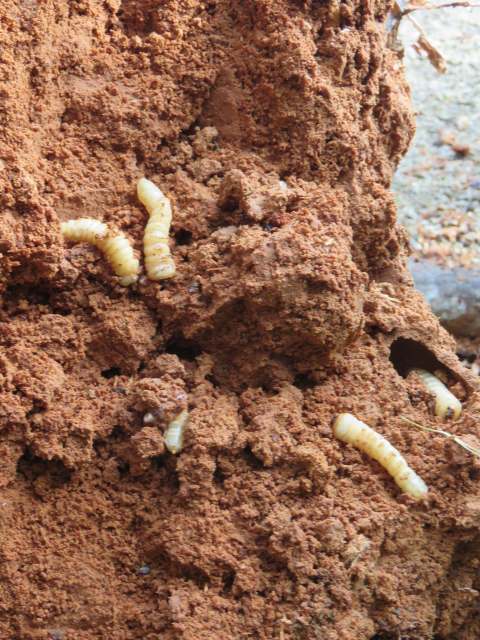
I have my limits. I know that huhu grubs, as we know them, were eaten in earlier times but I could not bring myself to gather these, even when I discovered a plentiful supply in a rotting stump. Huhu are a long horned beetle endemic to this country. We were often faced with a plate of cooked insects in the elaborate meals we were served in China and I did try a few. I think it is a cultural thing and it would take me a while to get over my gag reflex and to normalise eating insects, even while I know that they could be a valuable protein source and more environmentally sustainable than animal farming. If I am going to eat insects, I would rather start with them in a more anonymous form – cricket flour, perhaps – rather than launching straight into foraging at home and putting live, squirming bugs into a hot frying pan. I fed them to the birds.




 Tikorangi The Jury Garden