Tag Archives: spring bulbs

Plant Collector: Erythronium revolutum

The transient delight of dogs tooth violets - Erythronium revolutum

The transient delight of dogs tooth violets – Erythronium revolutum

Of all the fleeting seasonal delights, the dogs tooth violets or erythroniums might take the award for ephemera. They are so pretty and dainty and they are here today and gone pretty soon after. We probably only get ten days out of them in flower and a bad bout of weather can knock the display for the year. But we still get a great deal of pleasure from them. The flowers are like nodding hats while the compact foliage is often gently mottled or marbled in green and maroon.

There are about 20 different species, all in the Liliaceae family, but some of them just won’t perform in our climate. Many prefer cooler conditions and dry summers. As far as we know, what we have are mainly seed raised E. revolutum which is native to the west coast of USA. They thrive in humus rich conditions on woodland margins where the soil stays moist and there are reasonable light levels. The corms are interesting, being long and narrow and alarmingly easy to snap in two when disturbed. They find their own depth, often burrowing down quite deep, out of harm’s way.

First published in the Waikato Times and reprinted here with their permission.

Plant Collector – Hippeastrum aulicum


Hippeastrum aulicum

Hippeastrum aulicum

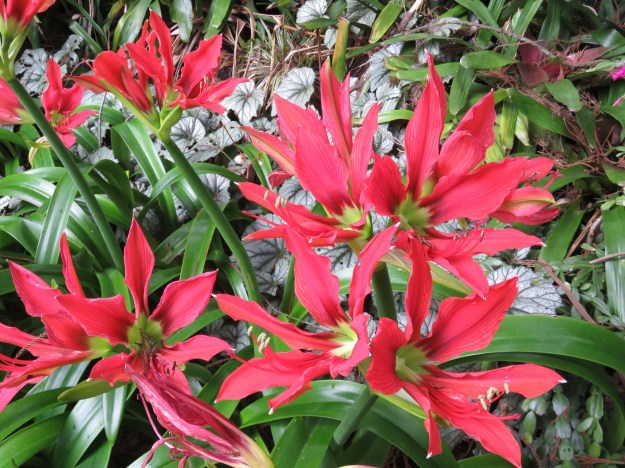
At this time of the year the big red flowers of Hippeastrum aulicum look like Jacobean lilies. We use it as a woodland plant because our past experience is that narcissi fly can devastate hippeastrums planted in the sun but the flies don’t go into the shaded areas to lay their eggs in the crowns of the bulbs. It takes a while for the bulbs to get large enough to flower but they are happy to be planted and left alone, gently increasing year by year so, after several decades, we have large clumps of them which oblige with gorgeous blooms in spring, standing 60 to 70cm high on strong stems. With us, they are completely evergreen though they may drop their foliage in harsher conditions.

A colourful woodland plant - H. aulicum

A colourful woodland plant – H. aulicum

Just for a change, the hippeastrum family doesn’t come from South Africa which is home to the majority of bulbs that we grow successfully here. Instead they hail from South America and this particular one is native to Brazil and Paraguay. H. aulicum is a species and not widely available though the curious H.papilio is sometimes offered for sale (expect to pay about $30 for a single, flowering sized bulb) and there are many hybrids which are brightly coloured, big flowered things for growing in containers. I am not so keen on the hybrids, papilio is less obliging as a garden plant but aulicum is both exotic to look at and a consistent performer.

Plant Collector: Tulipa saxatilis

Plant Collector: Tulipa saxatilis

Plant Collector: Tulipa saxatilis

I am not a great fan of the common tulip and even less so of the novelty forms so prized in colder, northern European gardens. But get back to the original species, (how they occur naturally in the wild) and it is a different matter altogether. This very pretty tulip is a combination of soft lilac with a yellow throat which is not the world’s most obvious colour scheme but generally the colours of nature do not clash. It hails from the island of Crete (the home of Zorba the Greek) though apparently it is also found in Turkey. In their natural environment, these are wild flowers and if you have ever visited the Greek islands or the coast of Turkey, you will know that conditions are hard with poor stony or clay soils, very low fertility, drying winds and next to no rain for most of the year. These are not conditions that we can replicate in the garden here but Tulipa saxatilis is not too picky and has thrived in our rockery for many years. With open conditions and excellent drainage, it is genetically programmed to be a survivor.

This is an early spring bulb, so it starts to grow in winter (triggered by autumn rains) and flowers in early spring for a period of several weeks. Each bulb puts up a stem which flowers its way down in succession so you get several blooms per bulb. It is a good example of a bulb which will find the depth it is happiest at in the soil so it will often drag itself down quite deep and it is a rarity amongst the tulips because it runs below ground. Because the foliage doesn’t hang on very long, it lends itself to being co-planted with a summer perennial which is dormant when the tulip flowers. We have had a dwarf species oenothera, better known as Evening Primrose, interplanted with our main bed of Tulipa saxatilis for many years and it comes into its own as the tulip goes dormant.