Tag Archives: subtropical woodland gardening

‘Doing the broms’

I have been ‘doing the broms’, as we say here. That is the once-a-year thorough workover in the Rimu Avenue. We have complex subtropical woodland planting throughout this area, but in square metreage terms, bromeliads are the dominant plant. This always brings back the memory of the rude old biddy who got into the garden for free on account of being brought here by a neighbour up the road. “I loathe bromeliads,” she declared as she stood in the middle of the Rimu Avenue. “Well you won’t like this part of the garden then,” I replied crisply, getting out of their company as fast as I could. When it comes to insults, I am like an elephant – I never forget.
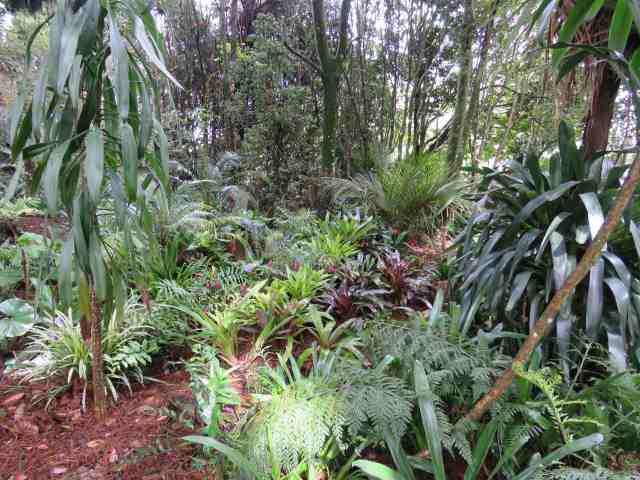
More a symphony of texture and form than bright colour for much of the year
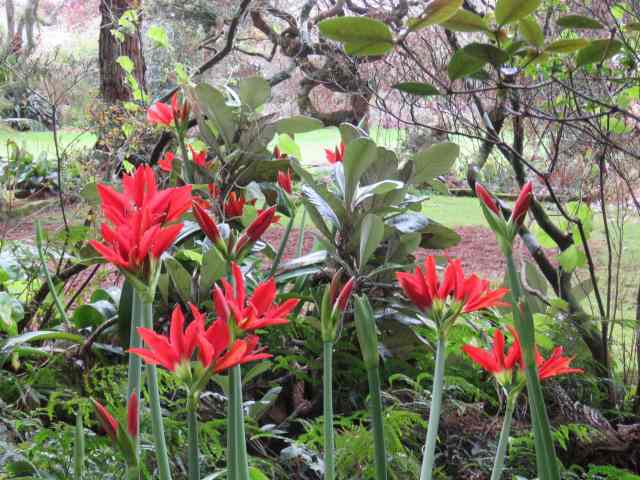
It is not entirely bereft of bright colour. The Hippeastum aulicum are glorious at this time of year and clivias in yellow, orange and red will follow

This avenue has long been one of our most admired areas. First started in the late 1950s, by Mark’s dad, Felix and then doubled in length 40 years later by Mark, it is probably unique in terms of an interesting, remarkably sustainable and low maintenance woodland garden adapted to our climate. Because it is completely frost-free, we can grow true subtropicals beneath the towering canopy of rimu trees (Dacrydium cupressinum) which are now over 150 years old. All up, it is an area somewhere over 2500 square metres, maybe even near 3000.

The Rimu Avenue is roughly 100 metres in length and variable in width

It is undemanding in terms of maintenance. During the year, we will remove dead branches and larger debris that falls from above. It is largely free of weeds, being in shade and having been gardened for so many years, although we are forever removing seedling prunus, nikau palms and wretched bangalow palms. Since we cut down the seeding bangalow (Archontophoenix cunninghamiana), the incidence of those seedlings will phase out in a few years.

We like a highly detailed garden and, while this area may be low maintenance by our standards, it remains diverse and detailed.

Once a year, I start at one end and work my way to the other end, picking over every plant. Yes, it is a big job and it takes about two weeks of intense labour but the difference is rewarding and it is not heavy work. When I say two weeks, it is probably 60 hours which represents just over an hour a week across the year to maintain a major area of garden. I admit that does not include Zachs’s time as he works along the margins or Lloyd’s time removing my mountains of debris. So maybe this annual exercise equates to an average of two hours a week, except we do it in one hit.
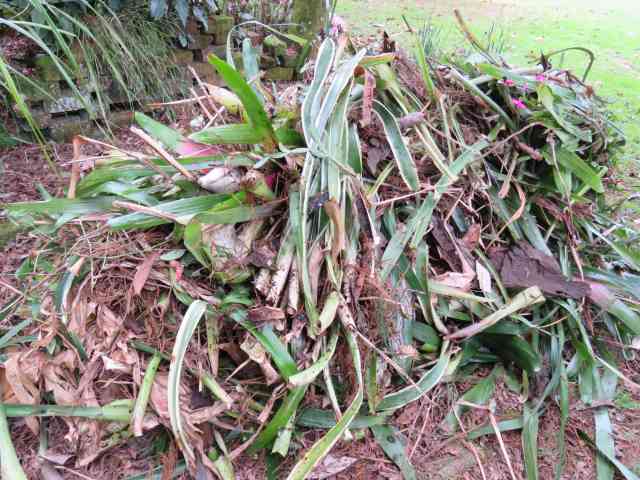
Lloyd must have dealt with about 20 times this volume so far. it is a prodigious amount.

When I say mountains of debris, I mean that Lloyd is removing about two packed wool bales a day of my prunings. We used to dump it in our bush across the road to rot down in its own time but this year, Lloyd has been putting it through the mulcher and then using it in compost which is more labour intensive, but we get to use the end result. You can never have too much weed-free compost.

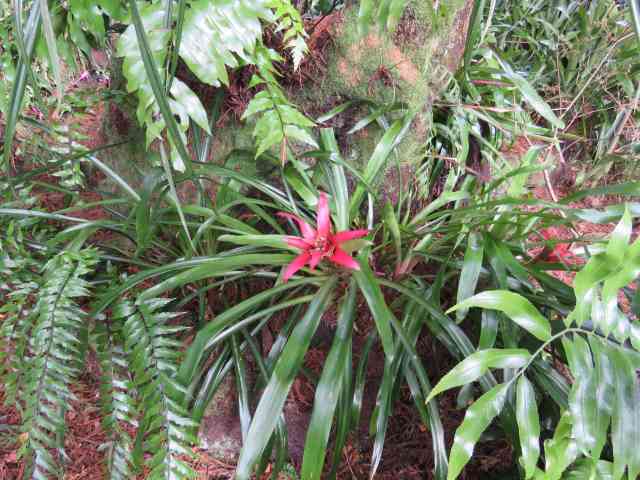
Before
and after

It is the bromeliads that generate most of the waste. Almost every bromeliad only flowers once and then the centre dies off – although the dying process can take more than a year or even three. While this is happening, the plant puts new shoots or pups out from the base of the old crown, or adjacent to it, and it is those new growths that will flower in the future. You can leave them to their own devices and the oldest parts will eventually die, dry and become dislodged but the clumps can get very congested and messy. I go through and remove the crowns that flowered last year.
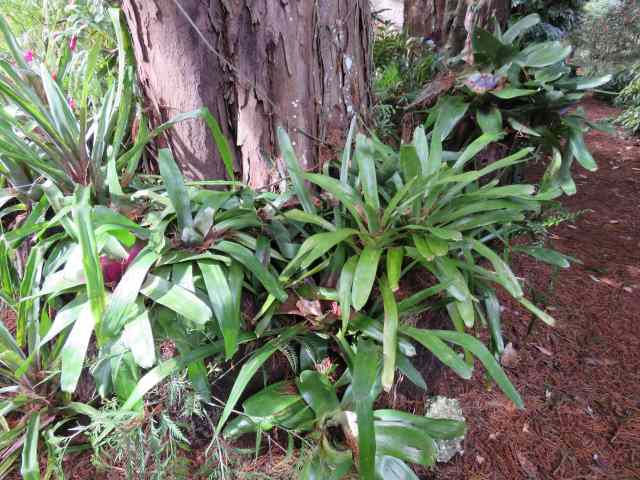
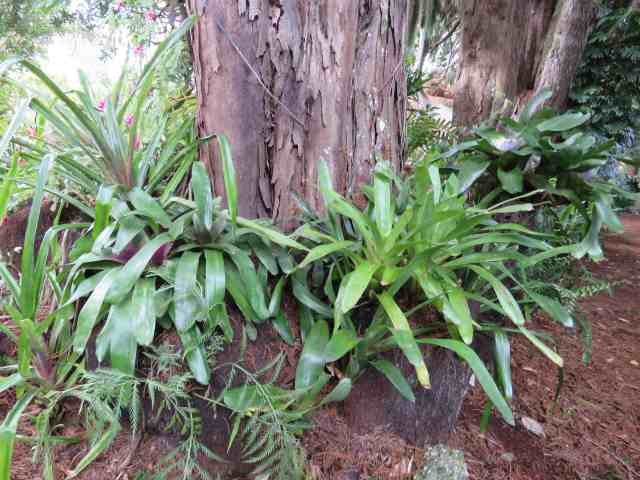
Before
and after

The strategy to removing them is to take the time to look at each variety to see where the new shoots are coming from. Some appear from inside the bottom layer of leaves so if you just cut through the base of the rosette, you are cutting off all the replacement young growths. Every variety is a bit different but that is also what keeps the task interesting. They will all be shooting from somewhere near the base if the time is right to remove the old crown.
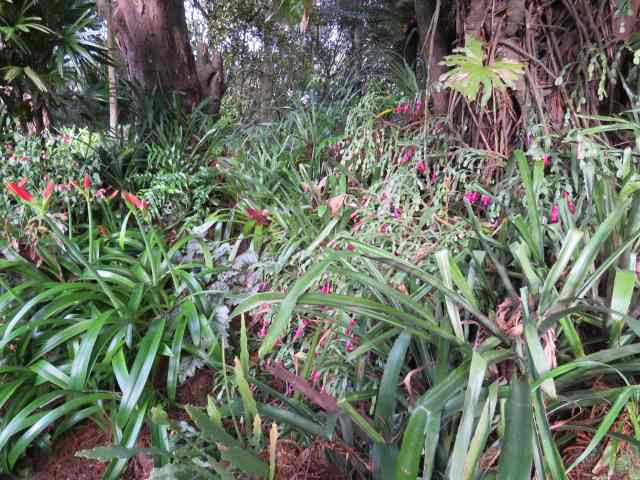
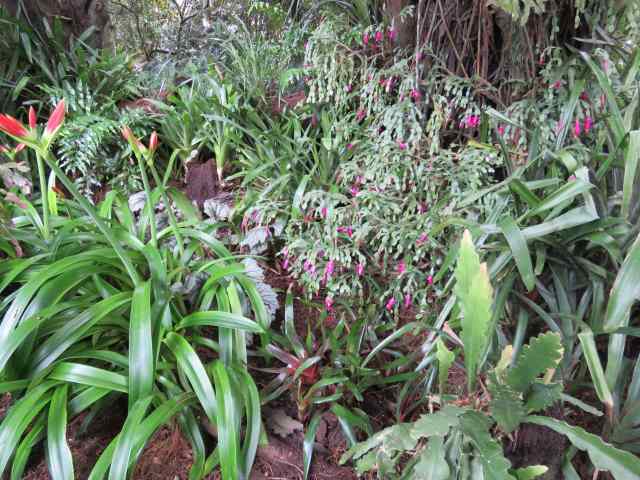
And the last before
and after.

Even though we have been doing this for years, it never fails to amaze us just how much volume is removed and yet the remaining planting never looks bare. It just looks fresh. It is one of the more rewarding garden maintenance tasks on our gardening calendar.
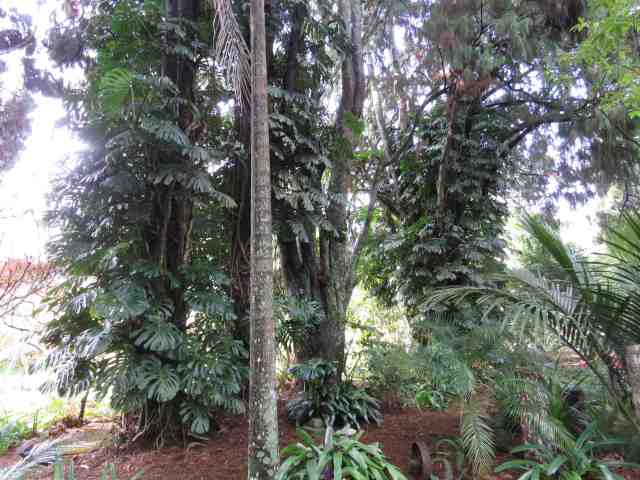
Those are monstera – the fruit salad plant – climbing up the trees. A long way up.

It wasn’t just the bromeliads. Zach and I removed huge amounts of Monstera deliciosa which had become monstrous indeed. We are fine with them climbing up; they add to the tropical look. Spreading outwards was another issue and removing most of the stems from the lower two metres opens up the views through which gives the feeling of more depth and distance in the garden. As he hauled out large amounts for mulching, many with aerial roots, Zach was musing how appalled plant sellers on Trade Me would be to see the wanton destruction of plant material they could sell at exorbitant prices!

Prickly matters

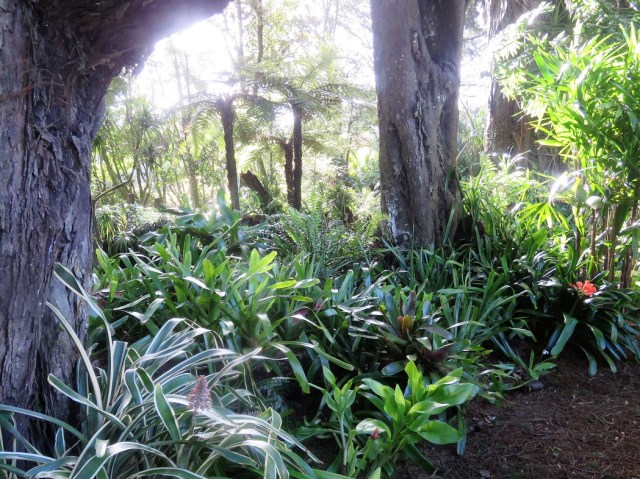
I have, as we say, been ‘doing under the rimus’. “It looks like you have vacuumed it,” said Zach and I was gratified because it is a big job on one of the key areas of the garden. The pressure is on, you understand, with just under five weeks until we open for the Taranaki Garden Festival.

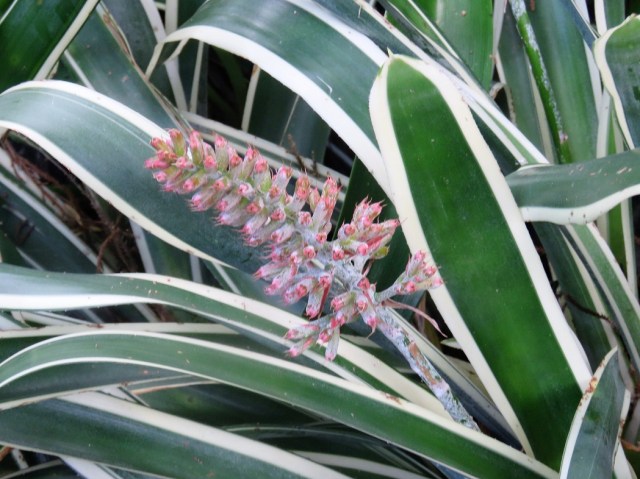
Not, as we thought, a billbergia but Aechmea coelestris var albomarginata

We have our fingers crossed that Auckland will be out of Level 3 so able to travel (looking good, Aucklanders, on Friday’s figures! The rest of us around the country are holding our collective breath for you. Well, most of us around the country).

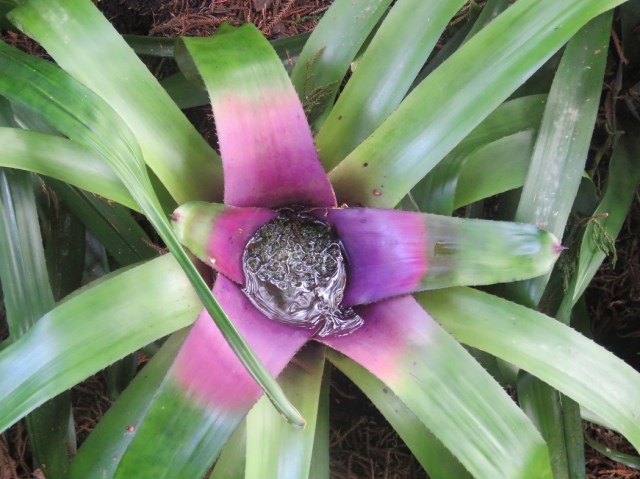
Neoregelia

Cleaning up under the rimus is painstaking work but it only needs that level of attention once a year so I generally describe it as low maintenance. I go through and pick over every plant to remove the debris that falls continuously from the trees above and to groom each plant. We are not talking a small area – maybe 100 metres long and varying from 10 to 30 metres wide. The debris is being removed by the wool bale load even though we leave the rimu needles to provide the path surfaces.

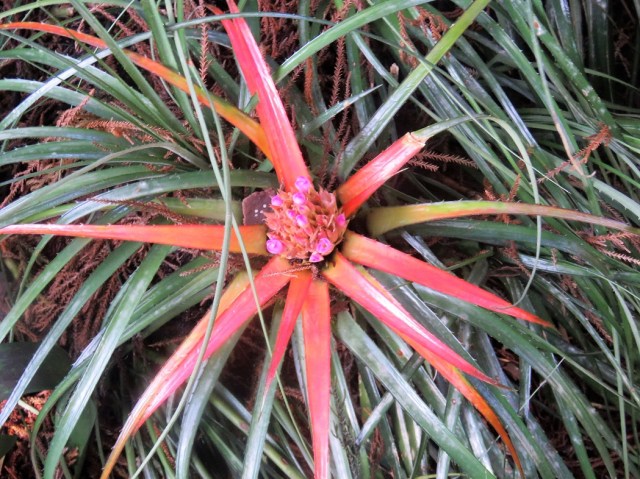
Vriesea

It is a complex planting but bromeliads feature large. It is not that we have a choice collection of bromeliads. Our interest lies solely in them as garden plants in a shaded, borderline-sub-tropical situation so that limits the range we can grow. Broms are a huge family and largely from the tropical areas of the Americas. The best-known bromeliad is of course the pineapple. I have something of an aversion to prickly plants and many broms are prickly. Their flowering, while undeniably exotic and interesting, doesn’t make my heart sing like some other plants. So my knowledge of them is limited to caring for the ones we have and I have never felt motivated to get to grips with the whole plant family, botanically speaking.

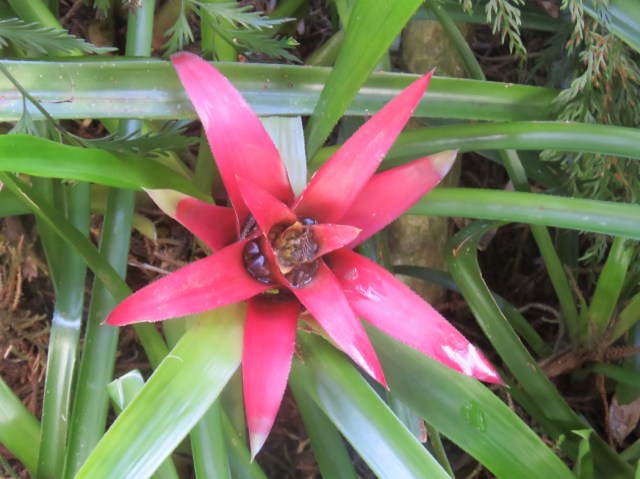
Nidularium probably procerum, I am told by one who knows more about these than I do

Most of the varieties we have flower and then put out one or two fresh shoots to the side while the flowering centre starts to whiff off and die, sometimes very slowly over a period of two years or more if left alone. Once they start to discolour, I go through and cut them off which stops the clump from looking too crowded.

A particularly prickly aechmea

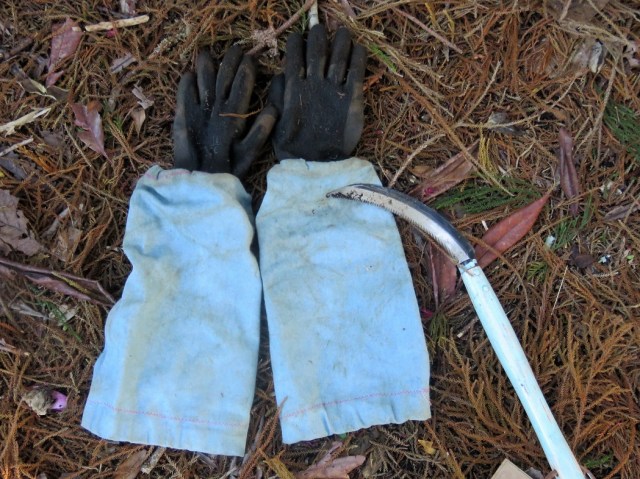
The very best implement for this is what I now see is named a ‘flax cutter’ – a small curved, serrated blade that is extremely useful for many garden tasks but probably not cutting flax. It is handy for cutting down grasses and faster than secateurs for deadheading perennials that need flowering spikes cut off. I had to go and buy a new one this week. I lost my good one somewhere amongst the bromeliads. I then went and found my old one and promptly lost that too. You would think I might have learned by now to keep better track of garden tools. This one came with a nice ash wood handle but I spray painted it before I even took it out to the garden – blue, because we had a can of blue spray paint on the shelf. I will not lose this one, I have vowed to myself.

Arm puttees and the new flax cutter

The second piece of vital gear is arm puttees. The alternative is that the prickly bromeliad leaves will shred the skin from the top of the garden gloves to the elbow. I speak from experience here. My arm puttees are simply the sleeves cut from an old denim shirt, elasticated at both the wrist and the elbow. They are worth improvising if you are dealing with prickly plants.

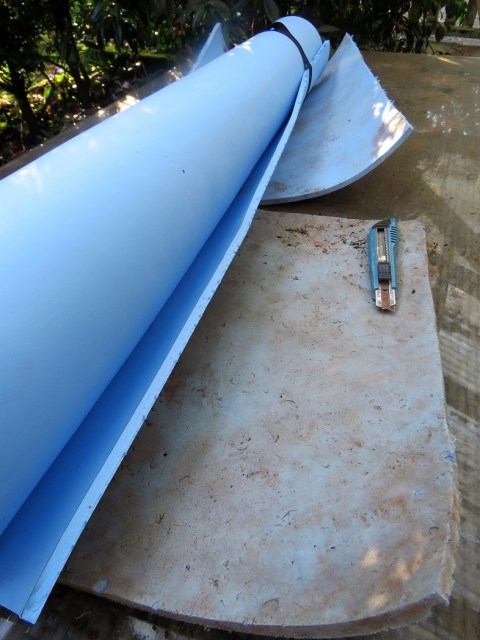
DIY garden kneeling pads

While on handy hints, I can highly recommend cutting kneeling pads from the high-density foam mats sometimes used as yoga mats or sleeping mats for trampers. One came into my possession and I can see it will last me for years. I simply cut it to the required size with what we know as a Stanley knife which is just a larger box-cutter. I find the kneeling mats sold in garden supply shops way too small but these I can make in a size that suits me. They cushion the ground and keep my knees dry, as long as I keep to the mat.

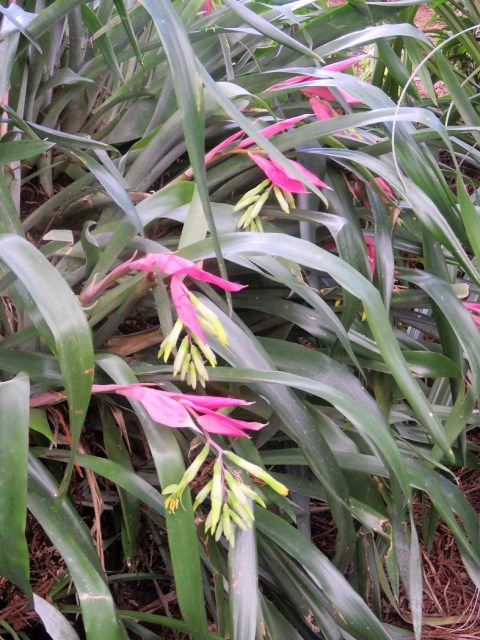
A billbergia

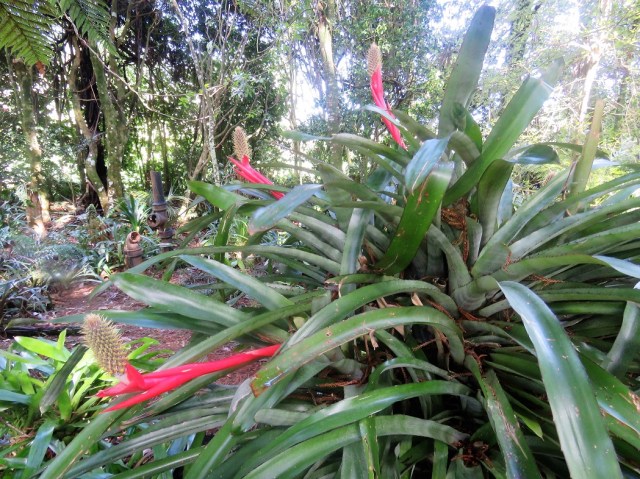
I had a mental debate with myself as to whether I could post my few photos of those currently in flower in the area where I am working without naming them – by general group if not cultivar. Well, we have long since lost the cultivar names. I have never committed bromeliad groups to memory but I feel I am lowering standards if I don’t name plants here so feel free to correct me on the classifications. We are by no means certain on them. Postscript: I have done a round of corrections on the photo caps after receiving advice from a reader who knows a whole lot more about bromeliad botany and nomenclature than we do.

What we refer to as an FIK but I am now told is Aechmea pineliana
No prickles! Aechmea gamosepala X ‘Cappuchino’