Tag Archives: summer gardening

Waiting for rain

The Court Garden has barely turned a hair – or lost a leaf – in our unusually dry summer

It is unusually dry here. In fact our province of Taranaki went into official drought declaration some weeks ago. I was woken yesterday morning by the sound of rain and my instant response was relief but it stopped and I see it was only about half a millimetre so that did absolutely nothing.
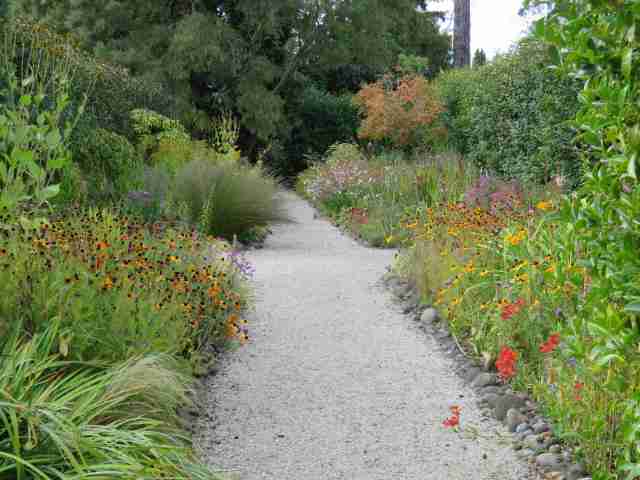
Continuing dry weather has affected the floral display in the borders

People who live in habitually dry areas may scoff at what we declare as drought but it is all relative. For many years, I have been cheerfully declaring that we get around 150 cm of rain a year (1500mm or about sixty inches) fairly evenly distributed across the year. We might complain about the dryness if we get several weeks without rain in summer but we are generally confident that the rains will arrive in time. Our prevailing westerly weather patterns tend to mean that we get moisture-laden air coming in from the ocean. High sunshine hours and relatively high rainfall is the norm. Currently, we are about 60% down on our normal rainfall in the first months of this year.

Fortunately, we source our water from our own, private bore so we are not in danger of running out. The water delivery businesses must be booming with urgent calls from those rural folk who rely on rain water tanks or surface water sources. Stream and river levels are uniformly low.
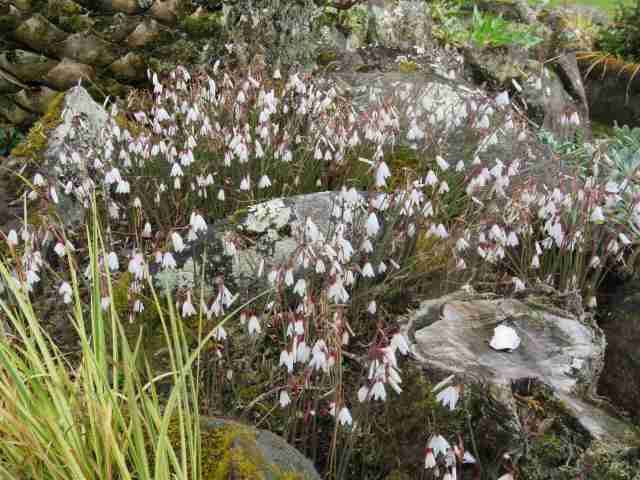
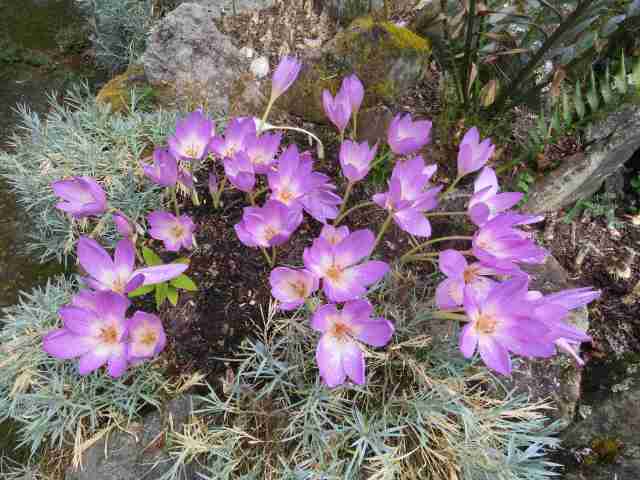
The autumn bulbs are not bothered. They received just enough summer rain earlier to trigger them into growth. This is dainty little Leucojum autumnale. Its teeny tiny flowers are not much larger than a finger nail but it increases well.

When it comes to gardening, because we live in a climate with consistent rainfall, we have no irrigation system and we can only reach a few, small areas with a hose. Extended dry periods are a good test for us. When the hydrangeas planted in shade start to wilt, we know we are very dry.

We are not unduly worried yet. The rains should come.  It is frustrating though, for people who garden every day. It feels as though much is on hold, waiting for rain. We can’t plant anything much or dig and divide. But at least Zach and I got onto a messy border immediately behind the house. There is a water tap close by so we could do more.
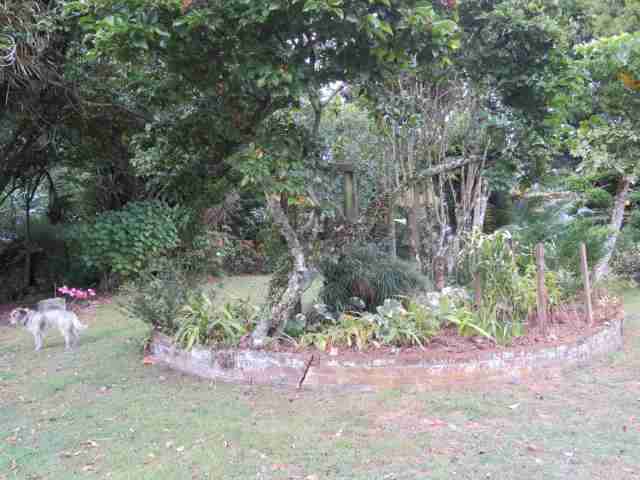
A generally unremarkable border

One might describe it as an historic but unremarkable border, most of the permanent trees and shrubs having been planted by Mark’s father, probably back in the 1950s and 1960s. Over the years, it has received little intensive care or love, confined to weeding, removing dead plants, a bit of pruning and filling bare spaces but little else. The swathe of auratum lilies were crying out for some love.
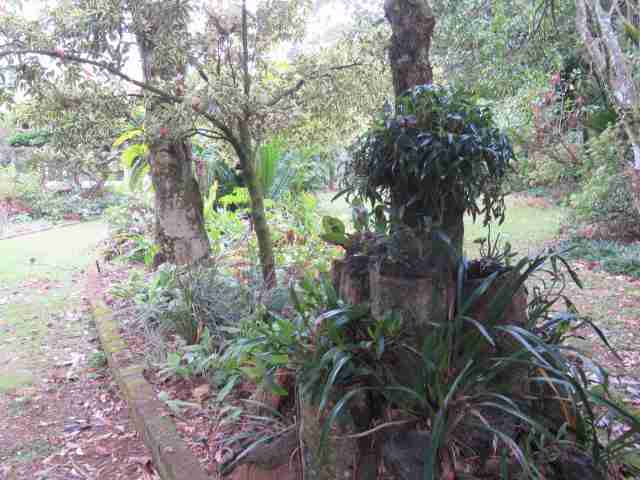
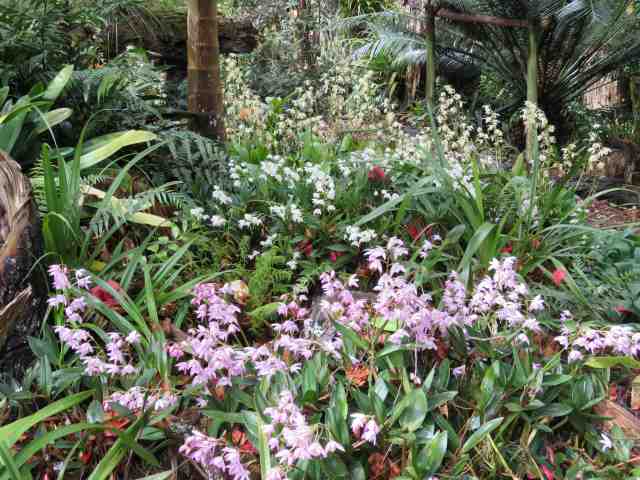
The border goes from sun to full shade. This is Zach’s orchid construction at the shady end.

I haven’t counted the plant varieties but there must be at least 50 or 60 different ones in a curved area measuring up to three metres across and twenty five metres long. We pruned almost all the trees, shrubs, cycads and the like – a tidy-up really. The work came on the under plantings – the lower growing perennials and bulbs.

My mantra is that when there is a diverse top tier planting of trees and shrubs (like, one of each specimen), bottom tier plantings need to be simpler to give some cohesion. Our idea of simple may not be the same as many gardeners, let alone designers, but what Zach and I did was to consolidate the different ground level plantings into bigger blocks, rather than drifts or random placement. We removed some entirely (yellow tigridias and every last bit of green mondo grass), reduced some (it is very nice of Geranium madarense to seed down and naturalise but we only need four full-sized ones to make a statement next spring and a few younger ones for the year following – not 40), divided hostas and farfugiums and consolidated other plants into blocks.
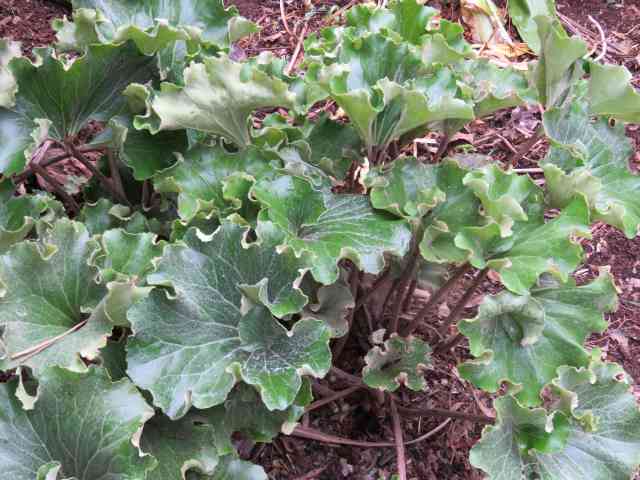
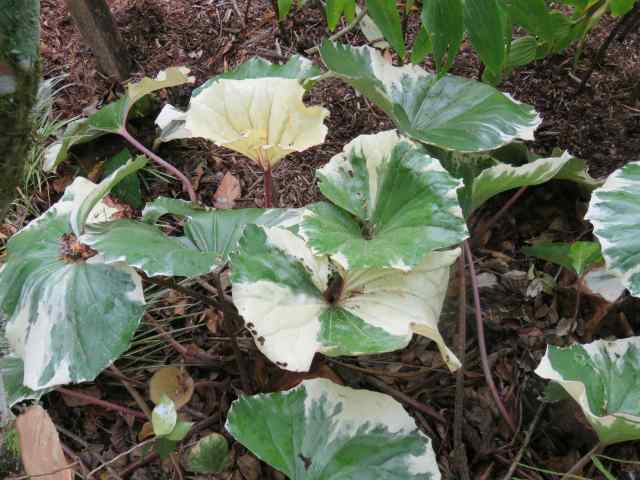
Farfugium japonicum ‘Crispatum’ features strongly. I am going with the RHS name of this plant but a net search sees it listed under assorted variants including ligularia (first word), tussilagineum (second word) and Cristata or Crispata (third word) in every possible combination of those three words plus the three words of its RHS-accepted name.
Farfugium japonicum ‘Argenteum’ is showier but also much slower to increase. Fortunately, we used to sell it commercially so we had a jump start on having sufficient plants for impact in shady areas.

All plants that were lifted were plunged into buckets of water, replanted into holes enriched with compost, thoroughly watered and mulched. If we don’t get enough rain in the next week or two, we can easily reach them with the hose.

Just a reminder not to lay mulch when the ground is bone dry. It will act as a barrier to moisture entering the soil. Mulch needs to be laid to protect existing moisture levels in the ground before it dries out.

May the autumn rains arrive soon.
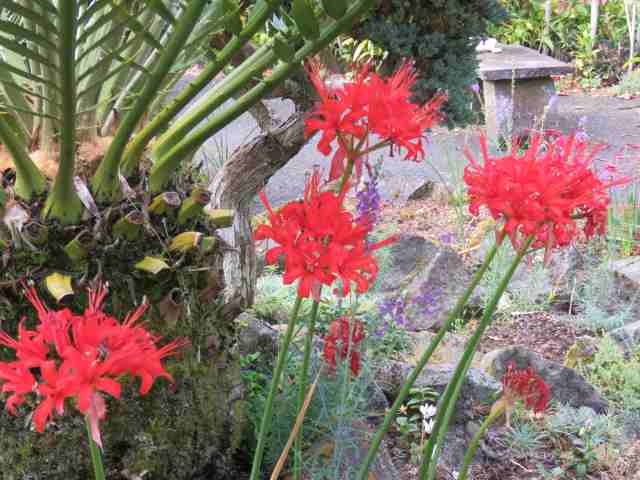
The rockery is so dry it is pretty much dust. There is no sign of life in the soils but the autumn bulbs are barely turning a hair at the conditions.

Summer gardening

Gladioli bulbs

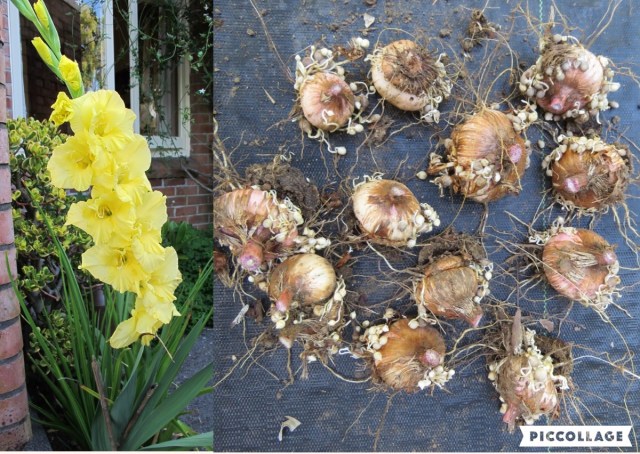
Here is a sight to strike terror in many gardeners. Those are gladiolus bulbs, in this case a yellow flowered hybrid. I knew it was a ‘vigorous’ grower, as the euphemism goes. I just didn’t realise quite how enthusiastic it was about increasing.

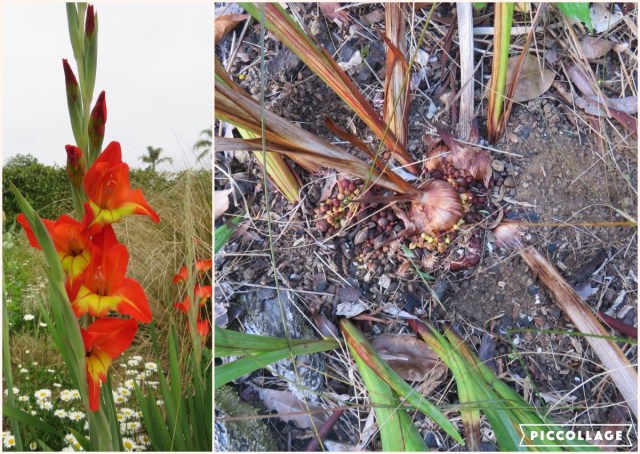
No wonder Gladiolus daleni is escaping from gardens into the wild

Some aspects of gardening are somewhat akin to micro-surgery. Removing many of those bulblets that have detached from the parent is one such activity. There is not much alternative to gently working through the soil and picking them out one by one. I had noticed Gladiolus dalenii had the same habit and I haven’t started on that patch yet. The only other plants I can think of that we grow here with a similar bulblet production are the ixias and alliums. They should come with a warning that control may require precision gardening.

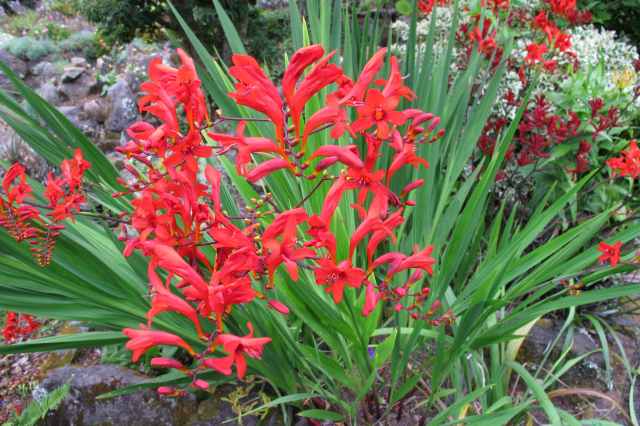
When I thought about it, I share the opinion of Crocosmia ‘Lucifer’ – foliage ratio too high, flowering season too short, rampant growth and a bad seed-setter

When I wrote recently about plants that may be good but I don’t want them everywhere,  it clearly struck a chord with a number of readers. My current bête noire is mondo grass – ophiopogon – and that means picking out every fallen seed as well all the runners. Susan, who leads the volunteers at the Te Henui cemetery, tells me she is reviewing the plant material they use and making lists of plants that she intends to get rid of and those that she wants to restrict heavily. They want the place looking colourful, vibrant and pretty all year but, while the overall area is very large, much of it is viewed close-up and they don’t have the labour to carry out the highly detailed plant care that is possible in a domestic garden. As a result, they need to use plants which will still look good – or at least not a mess – when their flowering is over. I could understand that she had the large pink watsonias on her list to get rid of; I was initially surprised that lychnis and Crocosmia ‘Lucifer’ are also for the chop. Fortunately, Susan keeps good records and I have asked her if I can use her plant list as she refines it. I think it will be a good resource for perennials that under-perform or fail to pass over gracefully in our climate. That will take time to eventuate but may be a lot more useful to New Zealand gardeners than overseas plant lists.

Yet again, I have been surprised by how much time and effort I put in over summer to keep our new perennial gardens looking good. Our experience in the past included extensive use of perennials and bulbs in shade gardens but not in full sun where perennials G R O W, spread and often flop over. In our conditions, we spend a lot of time deadheading to restrict the rampant spread and a fair amount of time staking and tying followed by de-staking. You can get rid of this by being a great deal more selective about which plants you use but many of the ones I enjoy the most need this extra attention. It can all become a bit utilitarian if plants are to be selected primarily on being low maintenance.

If you are going for a lower maintenance garden, stick to trees and shrubs, avoid bulbs and only use perennials in shady areas is my advice. Shade gardening is generally lower maintenance because the plants don’t grow as rampantly in lower light levels. We are into high-interest gardening rather than low-maintenance gardening.

It is always a bit harder working out what to do in high summer. It is the right time to dig bulbs as just a few are starting into growth but totally the wrong time to move woody trees and shrubs. I find I can move perennials as long as I can get water to the site (we don’t irrigate here) and replant them well with plenty of compost and water and then mulch. They are currently in full growth so can re-establish quickly if steps are taken to mitigate the summer dry and heat. I am chipping my way through some of the lesser borders we have in the garden.

Preternaturally tidy at this moment in time

Like many, if not most, homes in this country, we have awkward, narrow, very dry borders around the house defined by a concrete path. I find the two I have just done preternaturally tidy. This one is predominantly home to two different forms of veltheimia and I haven’t done anything with it but weed and tidy for maybe 15 years. This time, I dug everything bar the rosemary plants and two lapageria vines, saturated the poor, spent soil and enriched it with compost before replanting. As I walk past that abnormal tidiness several times a day, it occurs to me that this is what too many people judge to be ‘good gardening’. No, what is good gardening is when all the plants bed in and how it looks firstly this spring and then in 3, 5 or 8 years’ time, maybe longer.

Commonly referred to here as ‘the veltheimia border’ but I reworked it because I realised the veltheimias were in the process of going back, not thriving.

It was very gratifying in late spring to have a garden designer friend from Auckland call in with a companion he wanted to see the place. What he singled out was how well the plants were bedded in. Not tidiness, but the creation of plant communities that are established and look as though they belong together over time.

Orchids happily bedded in, seen in spring.

So much of gardening is taking the longer view rather than instant gratification. And tidiness can be over-rated.