
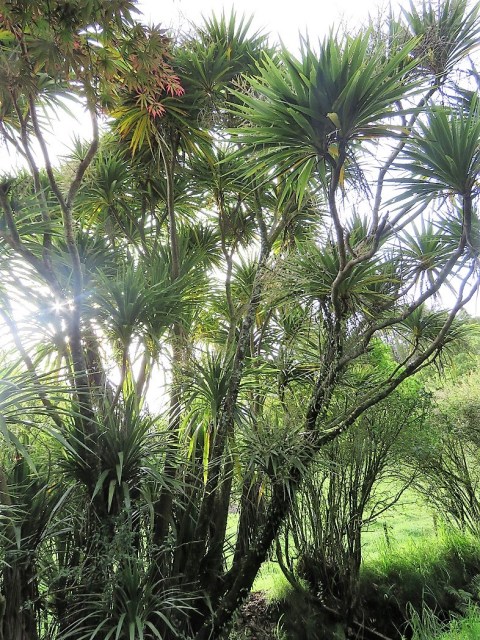
The cordyline just arrived, I think. It is growing right on stream bank at water level and I can’t think that anyone would have planted it there
We like to garden with a wide range of plants here. A VERY wide range. Not for us that prescription from some *designers* who decree a garden should have no more than ten different plant varieties in it. I can’t give the most recent reference for that because I thought it was such a remarkably stupid thing to write that I didn’t bookmark it. I guess the author was thinking of small town gardens but even so, both Mark and I would be bored stiff.
I have been thinking about the extent to which we incorporate our native flora. The purist *native garden* is not for us, nor indeed the predominantly native garden. We are too much of the complex layering, detailed planting persuasion, using an extensive range of plant material in mix and match combinations, to ever want to place that type of restriction on ourselves. But when I walk around and look, it is a surprise even to me just how many native plants we grow and often take for granted.
I figured there are at least four groups of native plants – the volunteers that just arrive of their own volition, the rare and endangered which actually owe their continued existence to the horticultural trade, the utility backbone plants that we take for granted but are actually native and the ones that are grown because they are simply great ornamentals in their own right.
A note about naming: in NZ we know most of these plants by their Maori names. While there aren’t too many truly bi-lingual speakers in this country, our every day language is peppered with Maori words, names and phrases that can confuse English speakers from other countries. I hadn’t really thought of this until I mentioned pohutukawa on a Facebook post and an American replied, “Maori common names just don’t stick in my memory, I think that’s a Metrosideros?” Botanical names really do aid international communication so I have added those in brackets below.
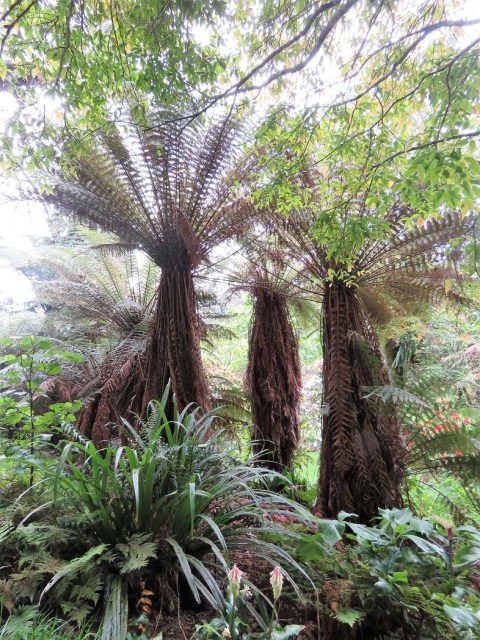
We have never planted any tree ferns. They just arrive of their own accord.
The volunteers that just arrive will vary throughout the country. Ours include the tree ferns (commonly known as pongas – pronounced ‘pungas’, botanically cyathea and dicksonia), the nikau palm (Rhopalostylis sapida) , cabbage trees (cordyline), an abundance of pepper trees or kawakawa (Macropiper excelsum) and a wide range of ferns. If they are not in the way, we just leave them to grow where they wish. Even NZ gardeners may not realise that we have three native dicksonia species and seven cyathea species. I think we just have the most common four or maybe five species seeding down in our garden.
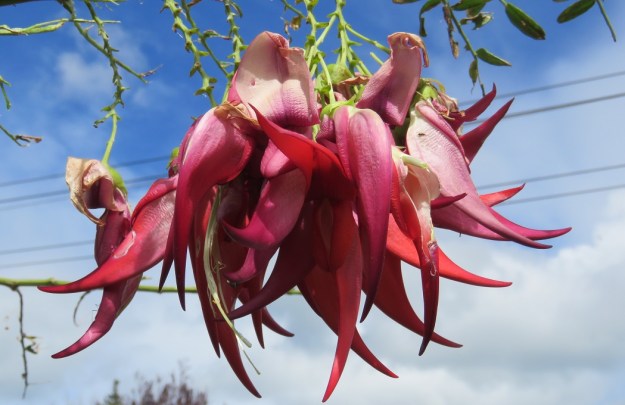
Kakabeak, growing in a town garden (hence the power lines). I have the white form in a new garden but it has its own little wire cage because pesky rabbits just about ate all of it over just two nights
The rare and endangered plants contain some special stories. The tree Pennantia baylisiana and the climber Tecomanthe speciosa were both down to a single surviving specimen in the wild but are now relatively common thanks to sustained efforts to propagate and distribute them. Similarly, the two species of kakabeak (clianthus) were at the extremely endangered status in the wild but are now widely planted in gardens. Sometimes commerce can ensure the survival of a species where protection of their natural environment has failed. Even Astelia chathamica was rated as under threat in the wild (in the Chatham Islands which are our southernmost islands marooned in the Southern Ocean) but there is no danger of it being lost these days, so widely is it grown now in mainland gardens.
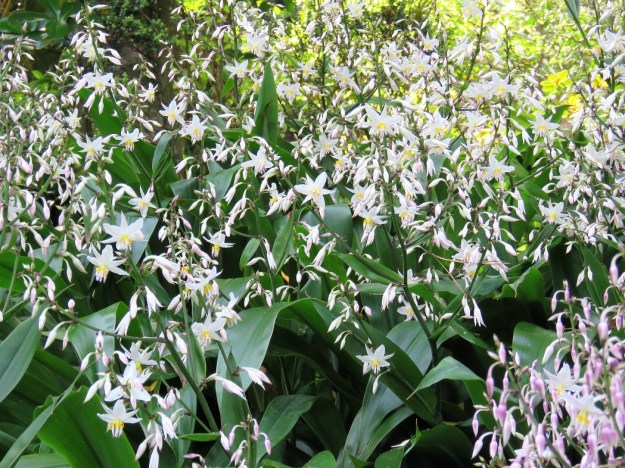
The renga renga lily, as seen in almost every garden
Utility backbone plants include a fair swag of trees grown in this country but especially the kowhai (sophora – there are eight native species though S. tetraptera is the most common) and the pohutukawa (Metrosideros excelsa). Both of these are absolute standouts in bloom. What we call the rengarenga lily (Arthropodium cirratum) is so widely grown that it is probably seen as a garden cliché. But we don’t have a whole lot of flowering herbaceous plants that are native to New Zealand when you think about it. And our gardens would be the poorer without the native astelias which are used very widely, being preferable as garden plants to our native flaxes (phormiums)
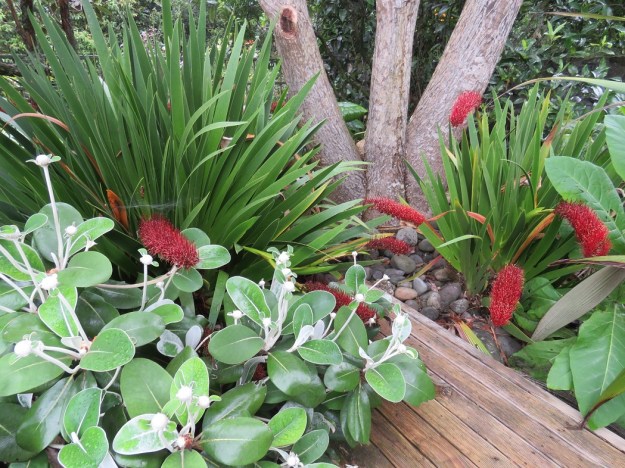
Pachystegia insignis to the left (the white buttons are the flower buds) and Xeronema callistemon with the red flower spikes
Some native plants are special in their own right as ornamentals and not necessarily easy to grow in conditions far removed from their natural environment. The Marlborough rock daisy (Pachystegia insignis) occurs naturally on exposed coastal rock faces in dry, hard conditions ; the celmisias are predominantly mountain daisies : the Poor Knight’s lily (Xeronema callistemon) comes from sub-tropical northern islands and is distinctly frost tender and needs brilliant drainage, preferring coastal conditions. These and other plants are well out of their comfort zone here but interesting, showy and still indigenous plants if you take the country-wide definition.
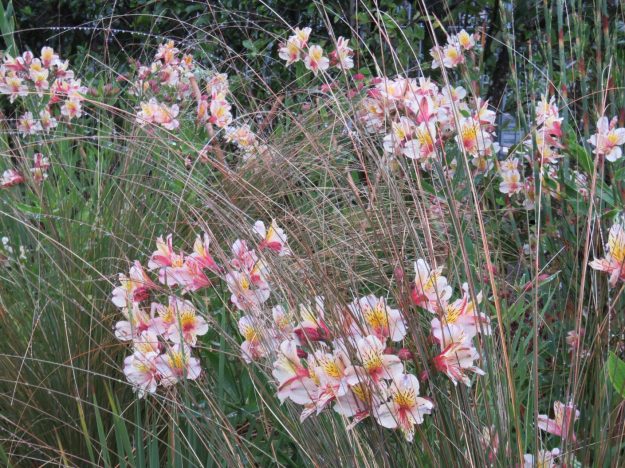
The alstromeria is certainly not native but the grass is – Chionocloa rubra
What I don’t think has been helpful is the polarised positions adopted by some. The native purist position has long been claiming the higher moral ground (but only applying that to ornamental plants, and mostly trees at that, as I wrote about here) In turn, this spawned the sniffy response that our native plants are “boring”. Neither is a logical or thoughtful position.
I will say that if we stripped out the native plants from our garden, there would be HUGE gaps, not the least being our rimu avenue (Dacrydium cupressinum) and our totara hedge (Podocarpus totara). And yet, to the casual eye, most visitors would not pick that our garden is rich in a wide variety of native plants. I like to think that is because of a seamless blending of native and exotic flora rather than any self-conscious display of indigenous plants.
The widespread use of native plants is one of the key differences in NZ gardens and that is worth celebrating. We are derivative enough here. We don’t want to be a nation of gardens that could be located in any number of other countries around the world with no unique features to define our own location and heritage.
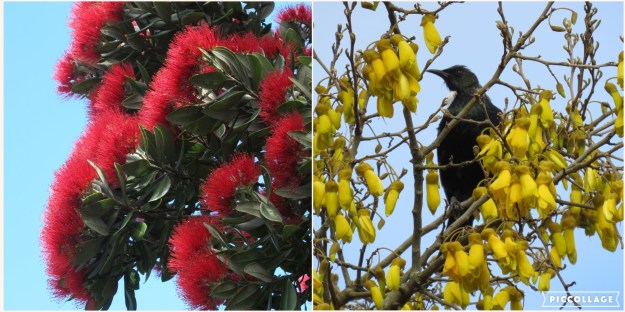
Pohutukawa to the left, kowhai with tui bird to the right
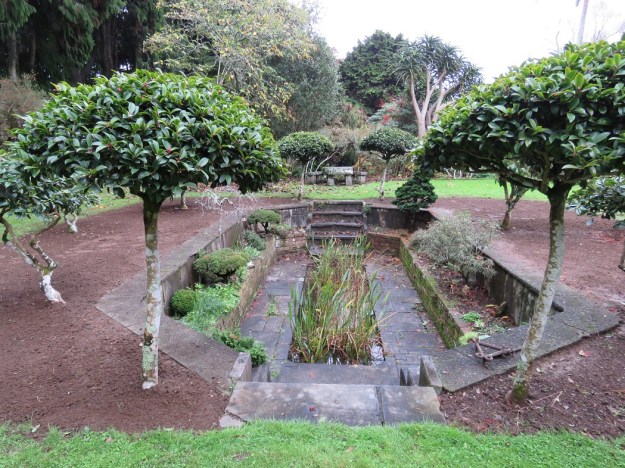
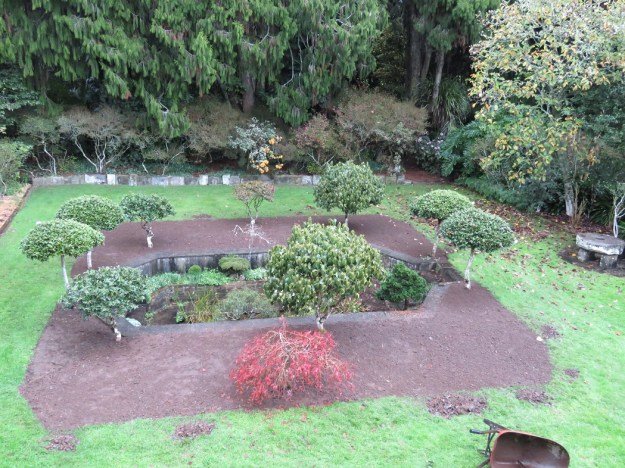 Finally, the last plants were gone at the weekend and the area was bare. Lloyd, our extraordinarily handy and obliging man about the garden, has moved in extra topsoil and raked and levelled to get it ready for sowing in grass. The eight camellias and two maples will stay and be shaped into gnarly, character, feature plants. We normally avoid growing plants in mown lawn areas and I know I will have to hand-trim the grass around the trunks but I am willing to do that. We do not like the weed-sprayed brown look of lank grass around trunks and I have no desire for the tidy, suburban look of encasing each trunk in a tidy round concrete circle planted with pansies. For those of you who want to know what the camellias are, two are the gorgeous species
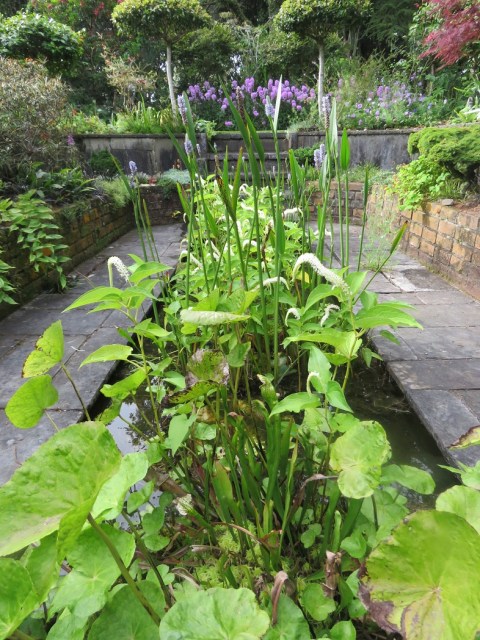 I spent a happy afternoon puddling in the goldfish pond. Every few years – well, maybe once a decade – Mark catches all the goldfish and drains the pond entirely to start again. In the interim, it needs a bit of ongoing maintenance and the pondweeds and plants were building up too densely. I try and keep the plants to a central strip. The goldfish need cover from circling kingfishers. The weed is problematic but it can be kept from reaching choking proportions by scooping with an old kitchen sieve. There are worse ways to spend a quiet summer’s day when the temperatures are not warm enough to warrant swimming.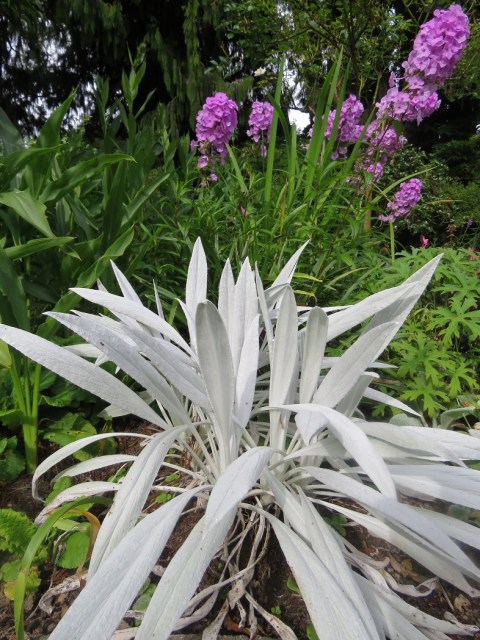
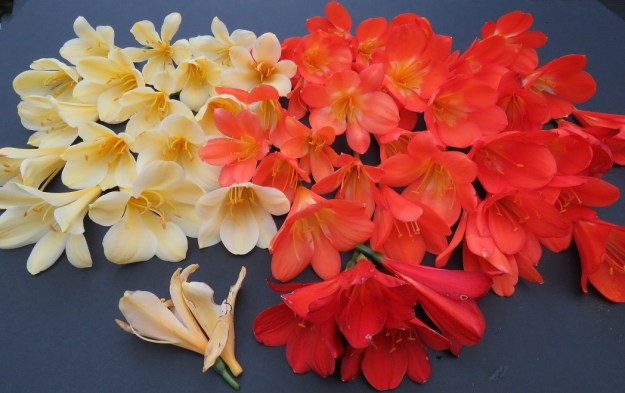 Mid spring brings us vibrant clivias in bloom. The ”contemporary” or “landscaped” look is to block plant in a single colour so you may have a swathe of orange clivias with the yellow ones segregated in a different area. This is not our style, in a garden where we strive for far more of a naturalistic, woodland look – “enhanced nature” seems to be the latest descriptor for this style though it is not a term you are likely to see me using often. We like to blend our plantings and combine the clivias with ferns, astelias, bromeliads and any and all of the other plants we use as the understorey in our shady areas.
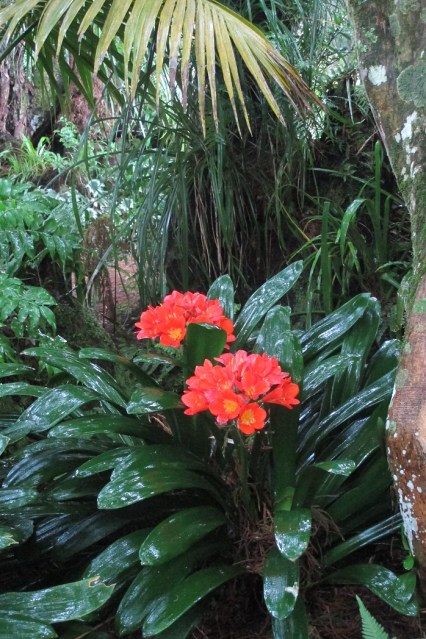 This completely confused a self-described Auckland landscaper I once took around the garden. This must have been back in the 1990s when ambitious but unqualified young people who, in a previous generation would likely have done an apprenticeship, discovered they could earn more money by dispensing advice and services to the growing wealthy of our largest city. He patronised me all the way around the garden – landscapers, you understand, rated themselves further up the social scale than mere gardeners – and at the end pronounced his surprise that we didn’t grow any clivias. I may have a been a little tart when I pointed out he just hadn’t noticed them, for they are there in abundance.
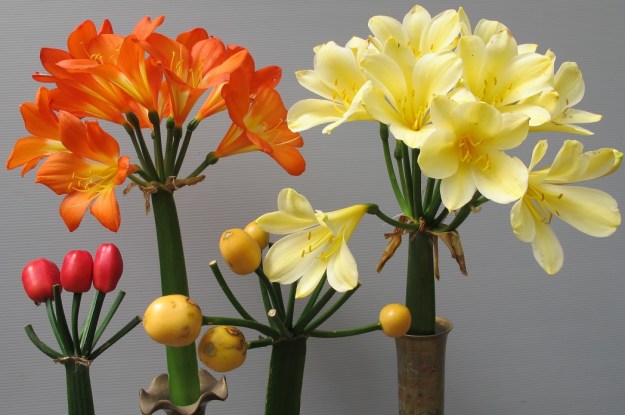
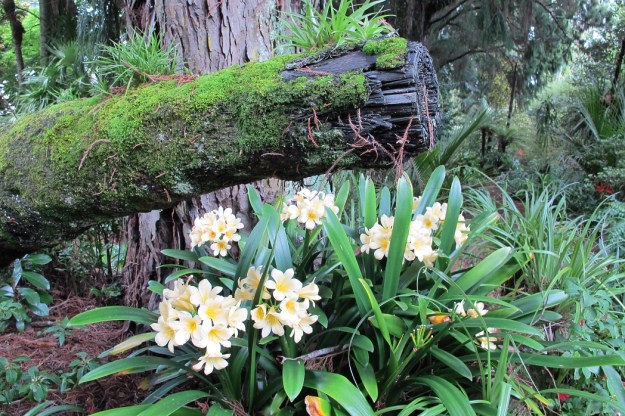 The soft yellows are still a recent introduction but already widely grown, readily available and making a huge contribution in gardens. Extending the colours into peach tones is well underway and of late the combination of white and green in clivias represents another development. One can, when all is said and done, have too much orange in the garden (NABOC syndrome – Not Another Bloody Orange Clivia) whereas the option of other, softer shades can bring welcome variety and interest. If you covet red clivias, you need to be aware that they open orange and age to red. Do not be like the gardener I heard of who bought a swag of large red clivia plants at considerable expense. When the first ones opened orange, she dug them all out.
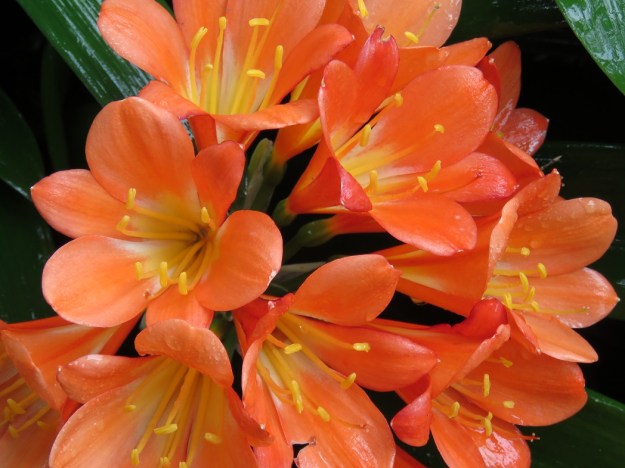 Considering the easy care nature of clivias, you may wonder why they are often relatively expensive to buy. It is all to do with time because they are slow to get established and to reach flowering size. In these days of instant gratification, most gardeners want plants that will perform and be showy in the garden from day one. In the case of clivias, be prepared to pay because it costs nurseries money to hold slow growing plants much longer to reach saleable size.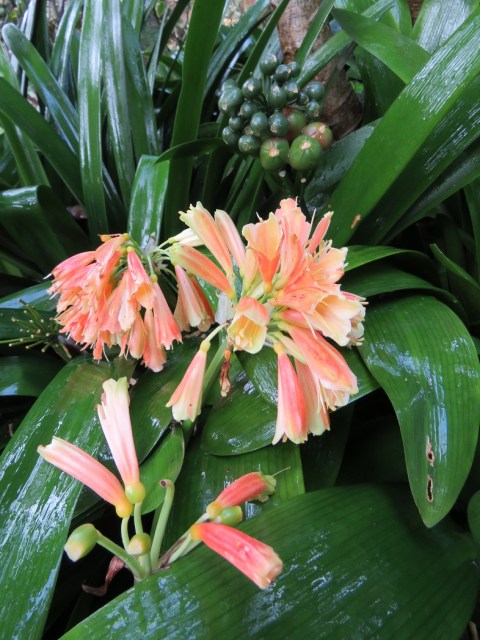
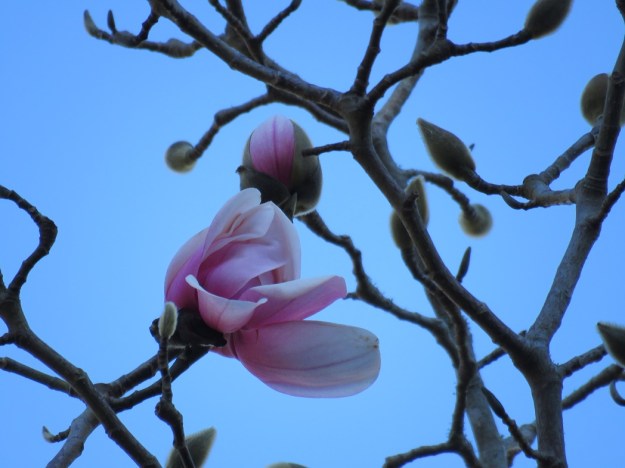
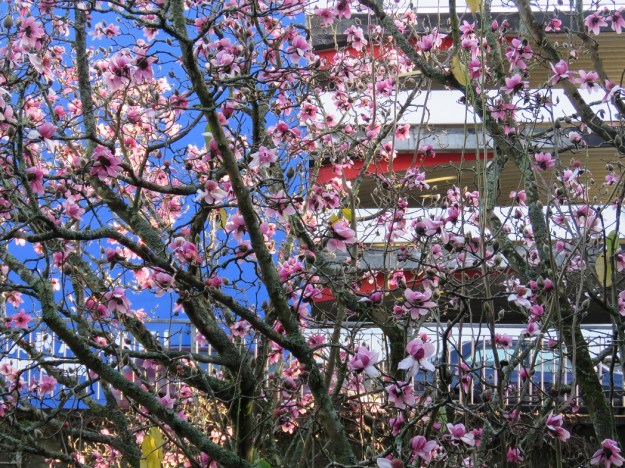
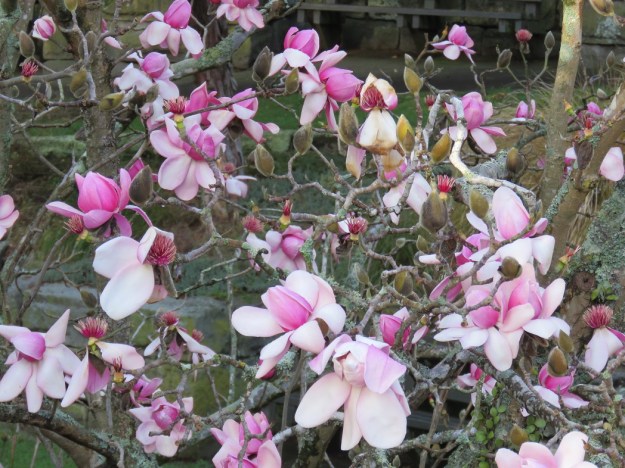
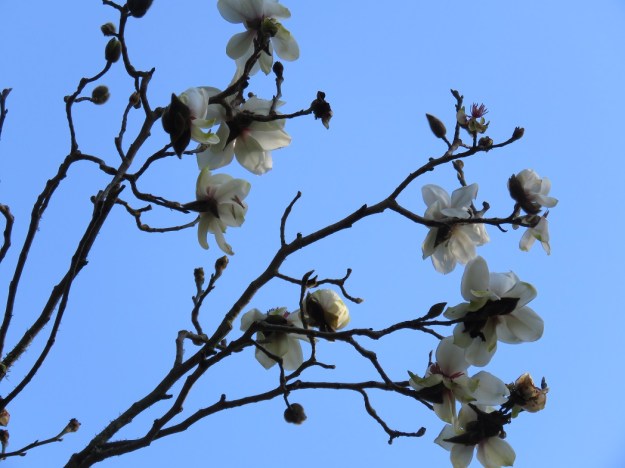
 Tupare Garden in New Plymouth has one of the oldest white forms of campbellii in our area, though the tree is not a particularly strong grower. It has a different provenance which the late Jack Goodwin relayed to Mark. Alas Mark did not write it down at the time but his recollection is that Russell Matthews, who created Tupare, bought it as a seedling grown plant from a local nurseryman who had imported seed, probably in the 1940s. This may have been James or Francis Morshead. M. campbellii is renowned for taking many years before it sets flower buds and an anecdote from another source relates the huge disappointment Matthews felt when the first blooms opened white, not pink. More a collector of status plants than a plantsman, he was apparently delighted when Victor Davies – of Duncan and Davies Nurseries – assured him that the white form was most unusual and therefore a real treasure. Only history puts this into context – that the white form is unusual for Taranaki because of all our Quaker Mason pink plants, but not at all unusual in the wild.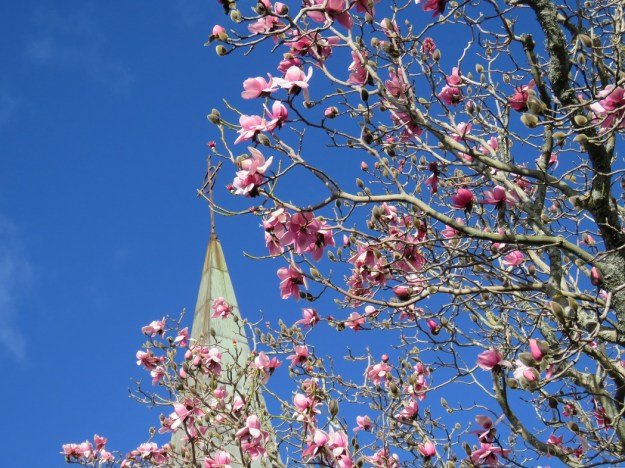
 Tikorangi The Jury Garden