Tag Archives: Taranaki gardens

In the Garden – May 10, 2012

A fortnightly series first published in the Weekend Gardener and reproduced here with their permission.

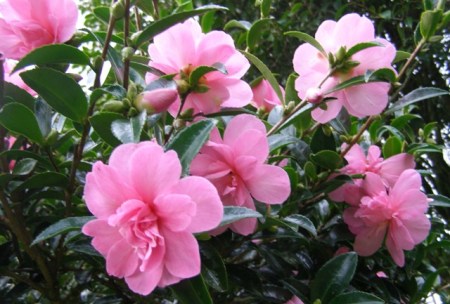
Sasanqua camellias do not have to be white - pink Elfin Rose

Sasanqua camellias do not have to be white – pink Elfin Rose

We are grateful that we live in such a mild climate where we don’t have to put our garden to bed for winter. Instead we can have plants flowering all year round and continue active gardening, even in the coldest months. At this time, the autumn flowering sasanqua camellias are in full flight. One of my particular favourites is pretty “Elfin Rose”. Too often, people get hooked on white sasanquas but strawberry pink is very cheering on a grey day. “Elfin Rose” also has a long flowering season and wonderful forest green, fine foliage. By contrast, our “Mine No Yuki” looks magnificent for a week, or until we get some heavy rain which turns the pristine white blooms to a disappointing brown mush.

We have vireyas in flower all the time. If you have plenty, there are always some blooming because these rhododendrons don’t have a set flowering season. However, they don’t tolerate more than a degree or two of frost, so you need protected sites. We also have bromeliads in bloom looking wonderfully exotic while the late autumn bulbs continue to delight. Somewhat to our surprise, the first snowdrops appeared in mid April. Maybe our disappointing summer means winter will bypass us this year? The impatiens, which are fully perennial in our woodland area, will continue in flower until the worst of the winter chill cuts them back. While we wouldn’t mind being a degree or two warmer overall, it seems churlish to complain about the colder seasons here.

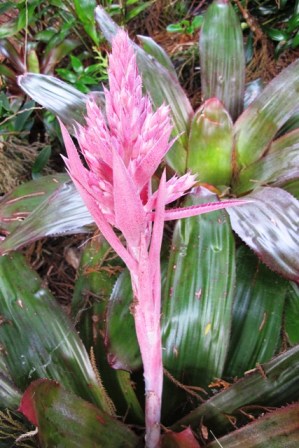
Bromeliad in flower now

Bromeliad in flower now

Top tasks:
1) The winter and spring bulbs are well on the move and many are through the ground. We need to ensure that they don’t get completely smothered by a build up of autumn leaves and to keep an eye out for marauding slugs and snails.
2) Sadly, it is time to put the outdoor furniture away for the season. It lasts a lot longer if we don’t leave out to the elements when we are not using it.
3) Continue the autumn clean up round on scruffy perennials. We make hot compost so we can put seeding plants through the compost heap but it is not to be recommended if your compost never gets hot enough to kill the seeds and any mildew or blight.

Passing the sniff measurement test – fragrance in the garden

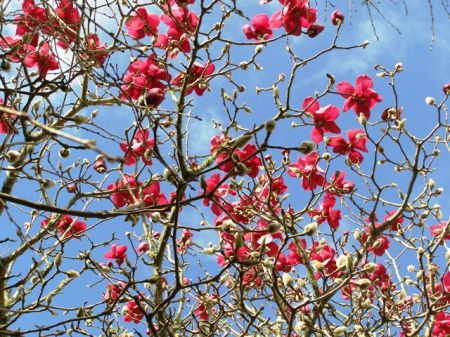
Magnolia Vulcan - spectacular and magnificent in flower but too far up to ever smell

Magnolia Vulcan – spectacular and magnificent in flower but too far up to ever smell

When I entered my teens, my mother gave me a book on charm. I can only recall two pieces of advice from it, though I read it time and again. One was to err on the side of restraint – that one white accessory with a little black dress may be stunning but three or four are bitsy (think Audrey Hepburn-esque style). The second was not to apply perfume before 10am. Until mid morning, the subtle scent from one’s morning bath should carry one through and to add perfume on top is heavy handed and inappropriate. Understatement was an integral part of charm in the sixties.

It was the perfume rule that had me thinking (though the merit of subtlety in accessorizing is a handy rule of thumb and not just for clothing). In years of plant retailing, I met a scary number of people – always women – who would only buy a plant if it was fragrant.

As a defining attribute, I think fragrance is over-rated and doesn’t stand up to logical scrutiny. It is different in cut flowers. The wafting fragrance from a vase of flowers indoors is a delight but even then you need quite a large amount of very fragrant flowers to scent an entire room.

Seriously, apply the sniff test in the garden if you are obsessed with growing scented plants. There are not that many plants that will pass the metre sniff test – that is, able to perfume the air a metre beyond the plant and that usually requires a warm, calm day. Some daphnes will do it, as will the rare Michelia alba and proper orange blossom.

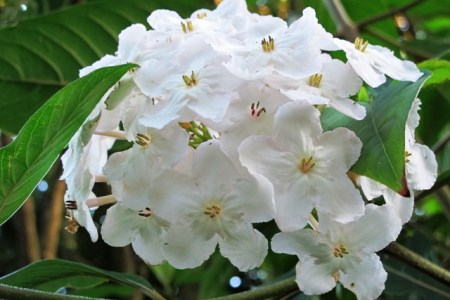
Luculia Fragrant Pearl - passing the 50cm sniff test

Luculia Fragrant Pearl – passing the 50cm sniff test

Come in a little closer and there are a range of plants which will tease you with a hint of fragrance as you pass by – philadelphus or mock orange blossom, luculia, auratum lilies, the stronger scented jonquils. But if you stop and immerse your olfactory organ (that is your nose) in the reproductive organs of the plant (that is the flower), there is a very strong perfume.

Therein lies the problem. Generally you have to stop and sniff a flower to get a true sense of its scent, or, in many cases, any scent at all. And nobody goes around their garden sniffing each and every flower every time. So the presence of perfume is often irrelevant in practice.
Some flowers are so subtly scented that you need the right conditions to get any fragrance at all. Scented camellias are of this ilk, but the public romanticism is such that merely advertising this attribute will help sales. I know.

Then there are plants where scent is related to time of day. How many people have bought the common port wine magnolia (Michelia figo) because of the promise of heady scent, only to be disappointed? The flowers are small and insignificant, the scent comes in late afternoon to night so you won’t get a whiff of anything at other times, and then the actual aroma is closer to the old Juicy Fruit chewing gum than anything else.

The bottom line is that plants have not evolved with scent to please humans. So there is no guarantee that the biggest, showiest and brightest blooms will also have the best fragrance. More often, the scent is there to attract pollinators so it is frequently linked to rather small, insignificant blooms which might otherwise pass unnoticed. There are a whole lot of scented rhododendrons and, almost without exception, they are white or pastel coloured. Bright flowers don’t need scent to attract their pollinator when they do it by colour. Night scented plants are generally pollinated by night flying insects so they don’t need to be fragrant during the day and they don’t need size and colour.

Floral scent is delightful and much appreciated. No synthetic scent can match the best natural fragrances. But those natural scents are by their very essence ephemeral. To extend their life, you have to capture the scent in oils, perfumes, pot pourri and the like. To make it mandatory that a plant be scented before you will buy it, is to elevate one characteristic beyond its merit. I regard scent as a bonus but first and foremost, a flowering plant must be interesting, attractive and appropriate to the position.

And when the next person asks me whether such and such a magnolia is scented, I may weep. We grow many magnolias here and revere them above other flowering trees. Many of ours are large now, and I can safely state that I have never stood beneath a large magnolia in flower and been amazed at the heady fragrance. Stick your nose in the flower and some are pleasantly scented, but that is pretty hard to do when the flower is five metres up the tree. Who cares when the floral display so astounding? Must the lily be gilded further with compulsory scent?

Tikorangi Notes: Friday May 4, 2012

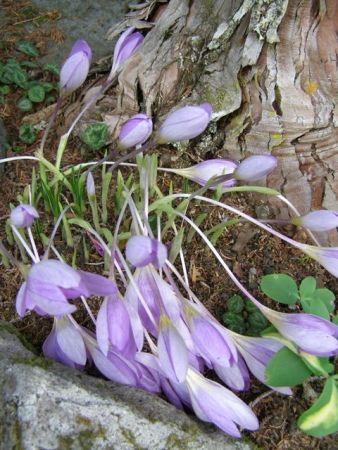
Autumn crocus - real ones

Autumn crocus – real ones

Latest posts:
1) An example of really bad naming (from a PR point of view) – Vireya rhododendron “Satan’s Gift” in Plant Collector this week.

2) Stop moaning – the weather here is not at all bad, even in the depths of winter (comparatively speaking). At least we don’t need to wrap our echiums up in individual sleeping bags.

3) Grow it yourself this week is on pumpkins (if you have the space).

4) Episode two of the serialised history of the Jury plants, as published in the RHS Yearbook for the rhododendron, camellia and magnolia group. It is on the vireyas this year (it was rhododendrons last year and will be camellias next year).

5) A slightly aggrieved post on naked ladies, autumn crocus and so-called autumn crocus (colchicums and sternbergia) and why sternbergia are no more accurately called autumn crocus than colchicums…. (We aim for accuracy here).

Being thankful for gardening in a benign climate

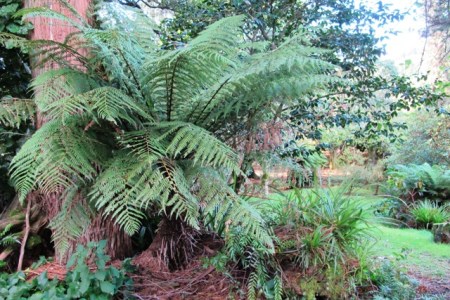
We tend to take it for granted that our gardens are green and lush all year round

We tend to take it for granted that our gardens are green and lush all year round

As the days get shorter and the nights get colder, it is easy to lose sight of quite how benign our climate really is. There is a tendency to take our bright, clear light for granted and the fact that we can sit outside for morning coffee all year round on sunny days comes as a surprise to those from harsher climates. Of course it means we have to keep mowing the lawns, though the interval between cuts will stretch.

True, down the southern half of the South Island, it is cold enough to stop growth (and therefore stop mowing lawns in winter) but at least they keep the bright light which is a hallmark of both this country and Australia. I recall visiting London one December. Quite aside from the fact that darkness fell soon after 3.00pm, when the sun did struggle above the horizon, it was a poor watery thing. On that visit, we headed out to Leeds Castle which has a notable garden designed by famous English gardener, Russell Page. It had been put to bed for winter. Literally. There was only the formal structure to see. Beds were smothered in straw to protect the plants below. Some plants were wrapped up in their own padded sleeping bags – layers of straw, sacking and insulating material and that was just for echiums which are clearly prized a great deal more there than here. It is altogether a different way of gardening.
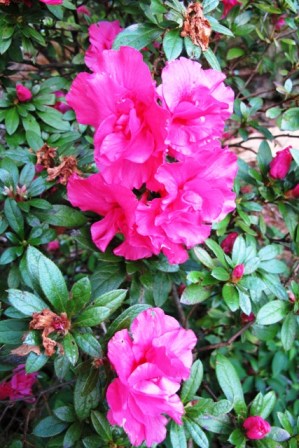
Autumn cheer in the earliest azalea flowers

Autumn cheer in the earliest azalea flowers

Here we may moan about miserable winter days, whinge about winter wind and stress over storms (enough alliteration!), but the bottom line is that we are green and verdant with flowers all year round. For most of us, temperatures are high enough to be out in the garden in fine weather, even in June and July. Autumn is recommended as the very best planting time for trees and shrubs because it gives plants a chance to settle in over winter and start getting their roots out before the spring flush. Similarly, many perennials can be dug and divided throughout winter. In cold climates, this is a spring and summer activity only because the plants can rot out when dormant in their cold conditions. The timing of pruning is a great deal more critical in colder climates. This applies to deciduous plants like roses, hydrangeas, wisterias, as well as evergreens such as hedges. Pruning can force plants into growth and, when carried out too early, the tender new growth gets burned off by frost and cold.

In cold climates where you only get to view your garden through the window in winter, design, shape and form become all because that is all you see. Most cold climate gardens have a large quantity of deciduous plants, punctuated by a few hardy evergreens such as buxus, conifers, or laurels. Even if the design is good and strong, it can be a bit bleak.

But unless you live in a really cold winter location by our standards (National Park, Ohakune or the like), it is reasonable to expect to look around your garden and see flowers and fresh foliage for twelve months of the year. Sure you may get frosts. Anywhere more than five kilometres from the coast can expect frosts, even in Northland. But we can still grow winter flowering plants.

The gordonias are opening. This is an unidentified Vietnamese species

The gordonias are opening. This is an unidentified Vietnamese species

The sasanqua camellias are opening now and will take us into winter when the early flowering japonicas open. Early season evergreen azaleas are flowering. I see flowers on the gordonias. These look like big, white camellias on steroids but they are only very distant relatives. The first of the luculias is in flower and we always have sub tropical vireya rhododendrons blooming, no matter what the season. These last two plant types are more problematic if you have hard frosts, but in favoured positions or closer to the coast, they are a delight. In the depths of winter, the Magnolia campbellii, michelias and rhododendrons will be opening. None of these flowering trees and shrubs are particularly viable in cold climates. Even the utility camellia can be hard to grow in colder parts of Britain.

There are plenty of autumn bulbs still in flower. Hot on their heels are the winter bulbs, already rocketing through the ground and some showing the first flowers. The earliest narcissi are opening. Most of the dwarf and miniature types flower much earlier than the classic daffodils. In so doing, we find they are less susceptible to narcissi fly which lays its eggs in the crowns of bulbs later in the springtime. Narcissus bulbocodium citrinus “Pandora”, the pale lemon hooped petticoat type, has its first flowers out. The peak display of our dwarf collection is in the depths of winter. The earliest of the lachenalias will be opening soon. The first to flower here is the easy to grow red L. bulbifera which has naturalised happily around tree trunks.

In some places, our common NZ pongas are so highly prized, they are lifted from the garden and moved under cover for winter. True. I have seen it done in the north of Italy. It really does seem churlish to complain about colder seasons here.

First published in the Waikato Times and reprinted here with their permission.

Plant Collector: Schefflera septulosa

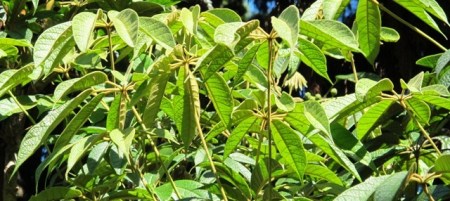
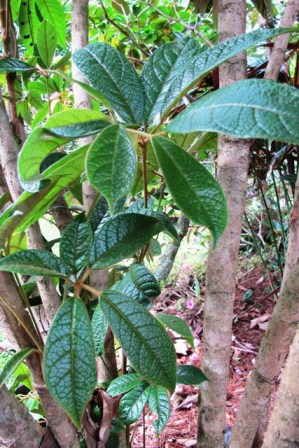
Schefflera septulosa - frost tender and rather large

Schefflera septulosa – frost tender and rather large

Back in the 1950s, my late father in law, Felix Jury, went on a plant hunting trip in the highlands of New Guinea. In those days, one could still bring new plants into this country and one of those he brought back was this very graceful schefflera which was identified as S. septulosa. After sixty years, it seems that it is still very rare in cultivation.

Schefflera septulosa from New Guinea highlands

Schefflera septulosa from New Guinea highlands

Scheffleras are a huge family belonging to the Araliaceae group (which includes ivy). Most come from tropical and subtropical parts of Asia. Some are widely grown as house plants, while some are relatively hardy to cooler temperatures. S. septulosa is neither. The original plant here is about 5 metres tall and even young plants get large relatively quickly. The surest way to knock it back and to burn off the foliage is to let frost get at it. We grow it on the woodland margins where the canopy from higher trees shelters it. But no other schefflera I have seen is as handsome. It shoots from the base so is more shrubby than tree-like in form and the leaves are large, held in a palm shape and heavily textured, matt dark green. With its brown velvety stems, it is a striking plant.

Scheffleras flower, but I have to be honest and say they are so insignificant on S. septuolosa that I have never noticed them. Mark tells me the bees are the best indicator that there are flowers because they flock in. Generally, they are regarded as foliage plants. The chances of finding S. septulosa for sale are not good, but occasionally you may find the splendid, large leafed “Condor” on offer. It is an unidentified species from Uruguay, so some distance away from New Guinea. It was introduced by Aucklander, Dick Endt of Landsendt. Both make handsome garden additions in warm areas protected from frost.

First published in the Waikato Times and reproduced here with their permission.