
- Festival gardeners have not been slacking inside during winter. Much of the preparation work is carried out while others huddle by the fire. In Waitara, Alathea Armstrong has finished her structural alterations – widening borders and altering shapes, much aided, she says, by a mild winter. Currently she is keeping track of her emerging delphiniums after the Attack of the Slugs last year. It would be a brave slug that ventured near the plants now. She has been planting a new bed using the two roses Lavender Dream and Mum in a Million and she is most enthusiastic about the Mum rose which she grew last year and describes as being absolutely gorgeous.
- Down the road, Margaret Goble says she is back on track with garden preparation after a rather bad garden accident in February took her out for some time. Family and friends rallied around, much to Margaret’s gratitude because hers is a large and detailed garden to manage singlehandedly. Rose pruning has been completed (an enormous task with her huge rose collection which is meticulously maintained) and lime and BioBoost have been added to the soil. Her window boxes and handsome hanging baskets are planted and she is eyeing up the concrete which has turned green over winter.
- Up the hill a little from Stratford, at Mountside Betty Brunton has joined the league of Gardeners on Crutches after recent surgery and is trying to work out how she can get around her garden with the spray unit while only semi mobile so that she can get Vapourguard onto her recently pruned hydrangeas, fuchsias and roses. She wants to protect the fattening buds from getting frosted. Her hellebores are looking fantastic and evoke memories of the late Jill Kuriger who was a fine plantswoman, a Festival stalwart for many years and a wonderful gardening identity. Betty says her trilliums are just pushing through the ground and she is hoping that my Mark will hurry up and have some plants of the related paris ready to share soon.
- Still in the Stratford area but across the other side, Bruce and Lorri Ellis at Te Popo had their garden routines disrupted when recent high winds swept through taking out two trunks of a triple trunked Montezuma Pine. As the tree was around 100 feet tall (or over 30 metres), this type of damage is not for the faint hearted. One trunk catapulted to earth landing with force in Lorri’s pink garden where it caused huge damage but at least that was better than the second trunk which became wedged half way down in a 50 foot (15 metres) claret ash. The surviving trunk also had to removed because it was now unstable and a threat to nearby buildings so specialist arborist services were required. Something unforeseen like that can really blow the budget and take up time. Here at Tikorangi it was one of our tawa trees we lost about the same time but at least it fell cleanly and didn’t do too much damage to the big leafed rhododendrons below.
- In New Plymouth, Alan and Cath Morris at Pukemara describe their garden activities as fine-tuning in preparation for their first Festival experience. They have finished the pruning round somewhat earlier than usual because they are having some time out in August. Alan has constructed a park bench out of marcrocarpa and sited it in their Gully Garden so that visitors will be able to have a rest and admire the outlook. They have also relocated a bed of azaleas which had been getting too shaded by adjacent rhododendrons. In fact they are quite pleased with how the garden is looking even though it is wearing its winter cloak and plan to keep it that way up until opening time at the end of October. At this stage, there does not appear to be any garden angst or panic in the Morris household.
- Also in New Plymouth at Nikau Grove, Elise Lind says her current challenge is learning to garden in shade. As all their plantings have grown, the character of the place has changed and where once there was sun, now there is overhead canopy. This is exactly what they wanted, especially on the waterfall bank but there is an ongoing process of having to find under planting suited to the changing conditions. At least, Elsie notes, there is the indubitable bonus that weeds tend to be sun lovers so they are far less of a problem these days.
Tag Archives: Taranaki gardens
Winter pruning apple trees: step-by-step guide Abbie Jury and Colin Spicer
Apple trees benefit from a little attention in winter and in summer – easy care summer strategies for apples.
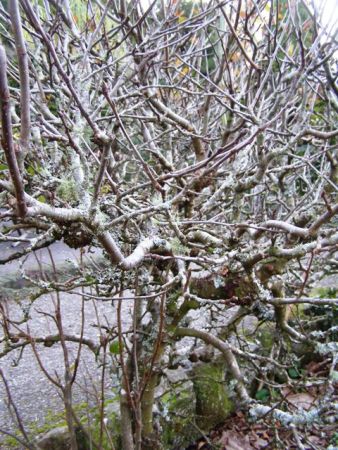
1) This dwarf apple tree has not has not had any attention other than a light haircut in winter and again in summer for many years. It is congested and overgrown and while it still fruits, the quality of the crop will improve in better conditions.
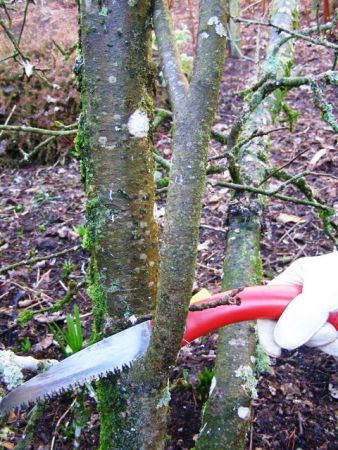
2) Select the branches which will give the tree its framework. Keep the main leader in the centre of the plant and choose branches which are well spaced to allow for air movement and maximum light. Remove all surplus growth not needed for this framework, including branches which cross each other. We are pruning for a tree which is more or less an espalier shape – two dimensional with height and width but little depth because it grows in a narrow border beside our driveway.
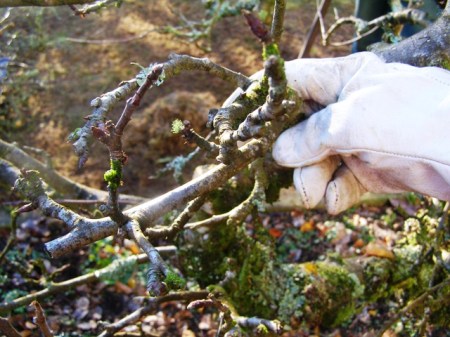

3) Now that the basic shape of the tree has been restored, thin out the clusters of fruiting spurs. Apples will continue to set fruit on old spurs for several years, but best results will be on growths from one to three years old. Where a spur is cut off, the plant will usually push out a fresh growth in spring.
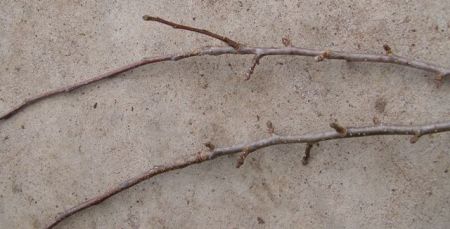
4) This shoot shows two years of growth. The lower half was new growth made in spring two years ago and the upper half is growth from last spring. You can see the fruiting spurs forming on the 2008 growth. These will flower and set fruit this year. If you make the mistake of always pruning by trimming off the long whippy new growths, you are cutting off all the fresh fruiting spurs. Try to get a mix of fresh spurs and already established spurs so that you are encouraging gradual replacement.
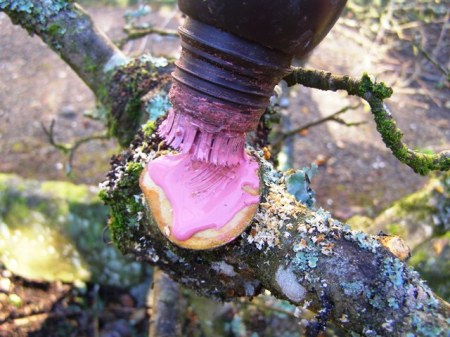
5) Sealing the cuts is optional but strongly recommended by our visiting pruning expert. He applies Bacseal which is an antibacterial sealant. Avoid getting this on your hands and always wait until you have finished all the pruning to avoid brushing wet surfaces with your skin or clothing.
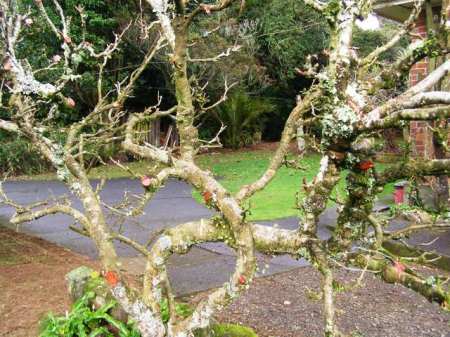
6) A spray of lime sulphur will clean up the heavy lichen infestation. Follow up with a copper spray at winter strength in three weeks time to get the tree into a much healthier state. Follow the instructions on the containers for dilution rates for both sprays.
Pruning a rampant climber: step-by-step with Abbie and Mark Jury

1) This climber has gone well past the point where a light trim will suffice and allow more light in the window behind. However, we don’t want to dig it out and cutting it off at the ground is likely to kill it. This is an ornamental jasmine (not the dangerously rampant variety) and we like the fragrance.
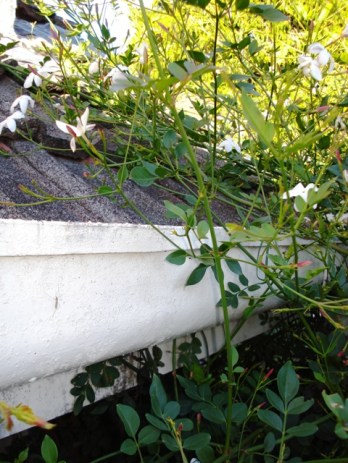

2)The tendrils going over and under the spouting, and even worse, under the roof tiles are a warning that action needs to be taken now. Looking into the mass of vines, you can see that the downpipe is under threat and also that the plant is putting out new growth from the middle and not just on top.
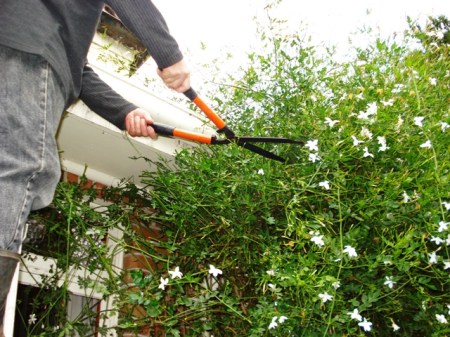
3) Cut back the foliage hard. We are aiming for a curved shape around the corner of the house. It is easier to work out which vines to keep when you can see where each one is headed. You can use a chainsaw for the initial shaping and follow up with clippers and secateurs to tidy up the rough cuts.
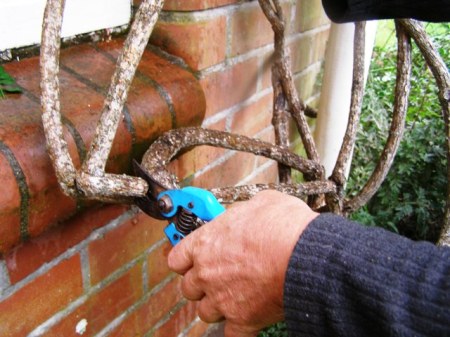
4) Trace the path taken by the vines and remove unwanted stems in sections. If you try and pull it out in long lengths, you run the risk of damaging the growths you want to keep. We are trying to protect the house and to allow the window to be opened so we are thinning extensively. More frequent pruning would have avoided this.

5) Thin out clutter and remove all dead wood.
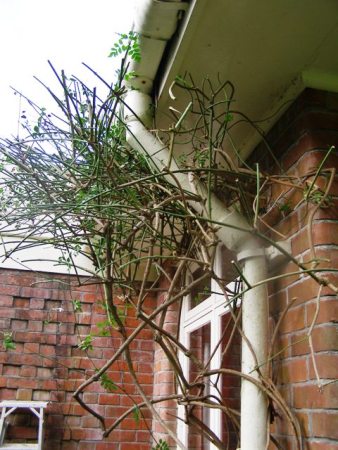
6) The finished product looks shorn and a shadow of its former self but should grow away strongly. In our mild and soft climate, we can do this type of cutting any time of the year but gardeners in cold, inland areas may wish to wait until late winter or early spring, timed for just before the plant will put on its first flush of new season’s growth.
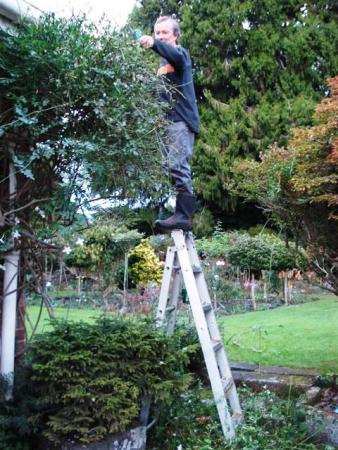
7) This is the photo that we did not use in the newspaper when this feature first ran – not perhaps the best advertisement for safe practice (though Mark asserts that he was holding on tightly with the hand which is out of sight…).
Countdown to Festival, April 2010
The Taranaki Rhododendron and Garden Festival is in its 23rd year now and will run from October 29 to November 7 this year.

The late Buffa, on guard here at Tikorangi last year
While it is still six months out from the Rhododendron and Garden Festival, dedicated gardeners around the province are hard at work already. The days when a quick spruce-up a week out from the event could suffice are long gone. The open gardens these days maintain much higher standards which in part explains the longevity of the festival and the high visitor satisfaction rankings.
• At La Rosaleda in New Plymouth, Coleen Peri is one of the younger garden openers (possibly the youngest) and is highly motivated by her large visitor numbers in her first year of opening in 2009. She has been much preoccupied by irises of late, having bought a large range from a mailorder bearded iris business that was closing down. These are all planted out and growing away well at a different location to her garden and she is hoping to have some available for sale during Festival. At home, she is impatiently awaiting the arrival of this year’s rose order in late May or early June so she can start planting out her newest area. While she has other plants awaiting in pots, she likes to place her roses first and build out from there. An avid follower of mailorder catalogues, she is pleased to have sourced at least four different varieties of large headed alliums – yes alliums are the onion family but there are some spectacular ornamental varieties with big, round flower heads usually in purple. We saw these used extensively in English gardens and covet them ourselves.
• At Te Popo, near Stratford, Bruce and Lorri Ellis were delighted to find themselves featured in a six page spread in the January edition of a French magazine, My Garden My House (or, more correctly, Mon Jardin Ma Maison). The cover even included an inset photo of Lorri. There was a slight problem in the Ellis household in that neither of them have any French so what was actually written was a frustrating mystery as they tracked down a translator but it all looked good. Whether this leads to a massive increase in French visitors remains to be seen, but it is certainly good promotion for our festival and gratifying for Bruce and Lorri.
• Festival stalwarts, John Sole and Tony Barnes at Ngamamaku in Oakura are taking a year off. Tony says they weren’t foundation openers but he thinks they have opened without fail for around 19 years. In a garden where they have used box hedging extensively to define areas, they have been hit hard by buxus blight. Indeed, they have already incinerated extensive metreage of affected hedging. It has forced them to review the structure of their garden and it seemed a good time to take a year off while they redevelop.
• In Kakaramea, Jacq Dwyer has been thinking ahead and striking cuttings of her robust lavender. She has a bed of lavender planted under the verandah where it thrives a little too much – the plants are getting trunks which are too large for the situation but she doesn’t want to do anything drastic until she has good sized plants ready as replacements. Jacq also comments that her Boston ivy is the most amazing red now that autumn has come. This is a deciduous ivy and somewhat easier to control than many others but it is the astounding red autumn colour which is its main feature.
• In town, Mary Vinnicomb has been dealing with losses in her small but perfectly formed city garden. Her pachystegia folded its leaves and died, a termination that Mary attributes to the very wet period we had in late November and December. The pachystegia is also referred to as the Marlborough rock daisy where it clings to crevices on coastal cliffs. Its big grey leaves are almost like cardboard with white velvet below and it has white daisies in summer, making it highly prized as a garden plant though not the easiest candidate to keep alive and well. The loss also of a key plant in Clematis montana Freida was overshadowed by the death of the Vinnicomb’s much loved little black 17 year old cat, Misty. Mary comments that many visitors have been enchanted over the years to be greeted at the entry archway to their garden by Misty. Her long life belied an inauspicious arrival as a tiny scrap to be delivered by caesarian and not expected to survive. She defied the odds after being hand reared and is now permanently in the garden, marked by a Chamaecyparis obtusa Lenny’s Star.
• Here at Tikorangi, we too are mourning the loss of characterful cat who has been a part of our daily lives for over a decade. However, we could not pretend that our Buffa waited to delight garden visitors. With her, it was more a case of us having to issue a health and safety warning lest visitors be misled by Buffa’s benign appearance and lulled into thinking she was a nice cat who would welcome their attention.
 Tikorangi The Jury Garden