Tag Archives: Taranaki gardens

Plant collector: Eryngium planum

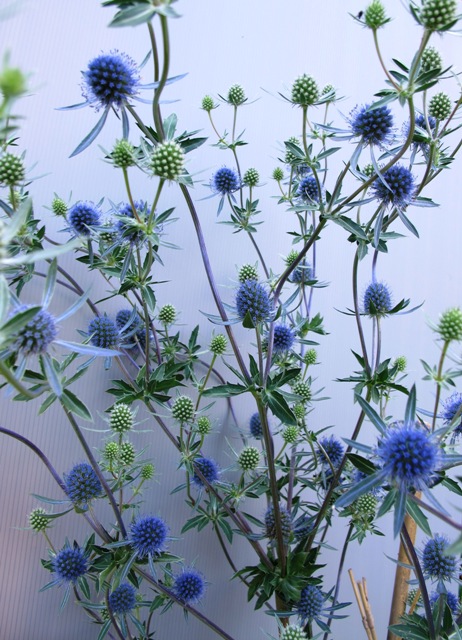
The hazy blue of Eryngium planum

The hazy blue of Eryngium planum

I thought it was going to be easy to write up eryngiums but it transpires that there are a whole lot of different ones from various habitats and climates. So I will confine my comments to the ones we are growing here. I love these ethereal thistle or teasel-like flowers in the prettiest hazy blue. We have had what I think is Eryngium variifolium in the rockery for a number of years. Despite its decidedly prickly habit and its location too close to the path, the flowers are always a summer delight. When I tried to move it back from the path, I found it had a phenomenally long and tough tap root so it defied my plans. That one has never set seed for us. Some eryngiums are propagated by autumn root cuttings so we plan to try that.

Eryngium planum is taller so needs staking in the garden. It flowers earlier in the season and grows easily from seed. We ordered it through Kings Seeds and this is the first summer we have had a good sized planting of it. I am hoping it will set seed because I think I can use lots of this plant in the summer garden. It doesn’t take up much space so can grow through other plants and the flowers last a long time. Both forms we have are perennials. E. variifolium disappears entirely in winter but neither of us can remember whether E. planum does too or whether it retains a smaller rosette of visible leaves.

Eryngiums belong to the Apiaceae family (with carrots!) not the thistle family. They are often referred to as sea holly but that should more correctly be ascribed to E. maritimum which we have seen growing wild on the coast of Cornwall.

First published in the Waikato Times and reprinted here with their permission.

Plant Collector: Solandra longiflora

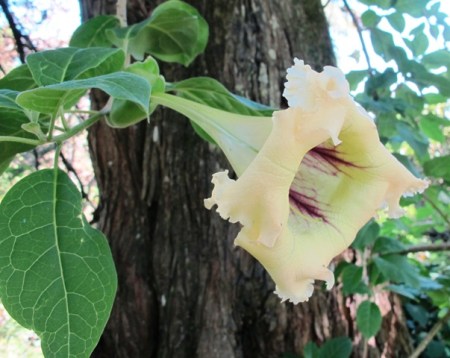
Solandra longiflora or the chalice vine

Solandra longiflora or the chalice vine

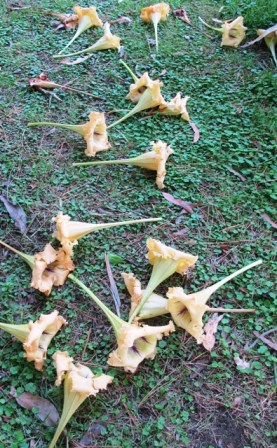
A carpet of spent trumpets

A carpet of spent trumpets

This is not a common plant at all in this country, where it has been identified as Solandra longiflora. All the solandras, of which there are around eight, appear to be variable species so not all longifloras will look the same as ours. However, they all share the common name of chalice vine on account of the large blooms that look like chalices. And they are strong climbers from the more tropical areas of the Americas, in the case of longiflora – the West Indies.

Ours has taken a fair number of years to get a good grip on the large tree we wanted it to grow up and also to produce more than just a few blooms. But this summer it is outdoing itself and we have an abundance of these large trumpets. They are an attractive amber honey colour with dark burgundy striping in the throat. At 25cm long and over 12cm across, there is quite a lot of flower.

The foliage is not exciting and bears some resemblance to woolly nightshade, daturas or brugmansias, this being because they all belong to the solanum family. It also shares some of the chemical compounds of the datura family but this is best left to the indigenous peoples who use it for a variety of purposes. Like datura, it is highly toxic and more likely to cause death in the wrong hands.

First published in the Waikato Times and reprinted here with their permission.

Plant Collector: Dicentra eximia alba

Dicentra eximia alba - a modest little plant for semi shade areas

Dicentra eximia alba – a modest little plant for semi shade areas

This particular dicentra hails from USA where it is widespread because it is not at all picky about temperatures. We use it as a ground cover in semi shaded conditions. It is fully deciduous so it disappears in autumn, to reappear with renewed vigour each spring. The foliage is technically described as finely cut and divided which means it looks ferny or maybe feathery. The flowers are little heart shaped pouches and feed the bees, particularly the humble bumbles. We have another form where the foliage is glaucous – in other words, blue-grey with the same white flowers, as well as pale pink forms. It is moderately poisonous to stock which is how it comes by its common name in USA of staggerweed, but that is not a problem in a garden situation. It forms rhizomes at or just below the soil level. Combine it with spring bulbs which flower first and as their foliage gets tatty after flowering, the fresh dicentra will mask it.

The pretty Dicentra spectabilis or Bleeding Heart with its dear little pink to red heart flowers hanging all down the stems is from Northern China, Japan and far eastern Russia – all places where it will get a good winter chill. I remember it as a common garden plant from my Dunedin childhood. Over the years, we have bought fine looking plants in full leaf and flower on several occasions but they fail entirely to reappear the second year. It is available in seed so the plan is to order a packet next season and raise a whole lot to experiment with different locations in the hope we can get it established.

First published in the Waikato Times and reprinted here with their permission.

Garden lore

The more one gardens, the more one learns; and the more one learns, the more one realises how little one knows. I suppose the whole of life is like that

by Vita Sackville-West.
(1892-1962)

Farfugium tussilagineum argenteum - standing up well after being dug and divided last autumn

Farfugium tussilagineum argenteum – standing up well after being dug and divided last autumn

Digging and dividing

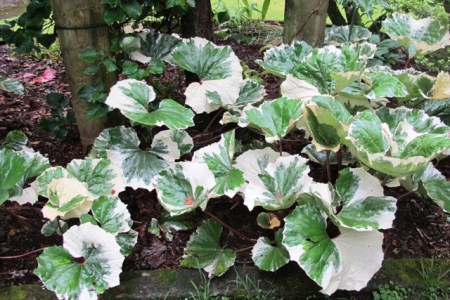
While the advice is freely given to dig and divide perennials, it is often the garden task that slips so far down that it falls off the to-do list because it is rarely urgent. If you have clumping, leafy plants which are either dying back in the centre or flopping all over the ground, that is a sign that they will benefit from being lifted, divided into smaller pieces which are then cleaned up and replanted into well dug and composted soil. This patch of Farfugium tussilagineum argenteum (some of you will know it as a ligularia) received this care and attention last autumn and now it is sitting up looking much more attractive, rather than falling apart with leaves lying on the ground.

In our comparatively mild climate, we can do this pretty much any time of the year though hot, dry summer is best avoided unless you water twice a day. In cold climates, plants can rot out if dug and divided when dormant, so times of growth in spring and summer are usually recommended.

First published in the Waikato Times and reprinted here with their permission.

The vexing issue of underplanting

A row of alternating annuals makes a statement, though it may not be the statement the gardener is aiming for

I had a day out and about looking at gardens recently and I was struck by the nature of under planting, though this preoccupation may have had more to do with my thoughts at the time. What I noticed about the under planting was how badly it was done in a couple of gardens. Bear with me, dear readers. You are going to have to imagine it because I know the garden owners so I was not going to whip out m’camera and take photos of the worst examples to embarrass them in the newspaper and on line.

Words like mishmash and hodgepodge came to mind as I looked at the bottom layer of plants in otherwise perfectly competent gardens. In other words, they had good upper layers of larger plants but when it came to the bottom layer of ground covers and under plantings, the selection criterion seemed solely that the plant should not reach more than 30cm in height. And there was one of this, one of that and one of the other, bunged in higgledy piggledy in most spaces.

Even worse, and I had to visit my local garden centre to set up a photo to demonstrate, is the horror of alternating annuals in a row along the edge. These certainly make a statement in the garden, though it may not be the statement that the gardener thinks when he or she plants them. I saw something similar (maybe with pansies and alyssum?) looking incongruous in a garden with otherwise high quality woody trees and shrubs and there were not any resident children to justify such a lapse in taste.

Nor am I a fan of edging plants, or indeed anything planted in rows other than proper hedges or vegetables, but that is a matter of style and personal taste. Fringes of mondo grass, liriope or anything else leave me cold but edging rows of matched annuals make me raise my eyebrows. Not even moderately tasteful white petunias cut the mustard when planted as an edging.

The contemporary look is to plant in blocks. The landscaper look is to plant in sharply defined geometric blocks each comprised of only one evergreen plant. Clivias are good, renga renga lilies are a bit untidy. Hellebores are probably acceptable, as is liriope or trachelospermum. Natives like prostrate muehlenbeckia are better.

Bergenia ciliata and Siberian irises – this gardener’s version of block planting

The middle ground is to gently block-plant but in more interesting combinations and in less rigidly defined grids. I am far more comfortable with that approach and it makes gardening interesting to play with different combinations. It also has advantages in making maintenance easier to group plants which require more frequent care – such as dead heading, staking, dividing, or grooming. Rectifying mistakes or bad decisions including eliminating invasive thugs is more localised if you are planting in blocks. I tend to blur the edges of my block plantings so that the overall look is softer and less delineated because that suits our style of gardening better. There is no doubt that if the upper layers of the garden are varied and mixed, some sort of unity in the bottom layer creates a more harmonious picture. I would argue that the flip side of the coin is also true: if your upper layers are rigidly conformist and consist of restrained plantings of only one or two different plants, ringing the changes with more complex and varied under plantings will make it a great deal more interesting.

Acceptable clivias

If you don’t want to go the block planting route, the old fashioned cottage garden genre may be an alternative. Essentially this is a jostle of perennials, annuals and bulbs in combination with small shrubs, often roses, where self seeding is encouraged. If you want a more modern look, you colour tone it rather than the traditional riot of random colour that nature achieves. If you like a tidy garden which is weed free, it is not an easy style to manage well. More often it is best viewed in passing, rather than looking at the detail.

Then, of course, you could ask yourself whether under planting is even necessary in some areas. The requirement that all garden beds and borders be layered with nary a glimpse of garden soil is relatively recent. In times past, it was fine to plant shrubs and trees without any bottom layer at all. It was called a shrubbery. Just don’t plant the shrubs too close together or you end up with a hedge. Each shrub needs to stand in its own space. As nature abhors a vacuum, mulch all the bare earth with something anonymous or you will grow a carpet of weeds. It is certainly easier to maintain than more complex plantings. It will probably look more attractive than the hodge podge assemblage of random plants I saw. It should look classier than the row of alternating annuals. Maybe it is time to start a movement called The Shrubbery Revival. Neo-shrubberies, maybe?

First published in the Waikato Times and reprinted here with their permission.