This article was first published in the Weekend Gardener Magazine, issue 316, June 2 – 15, 2011
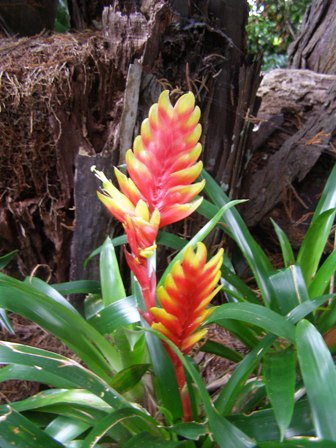
Bromeliads - a vriesea
Bromeliads
Generally speaking, I am not a fan of prickly, spiky plants (I have always felt that yuccas in particular were aptly named) but I am willing to make an exception for the bromeliad family even though it means donning protective gear when it comes to working amongst them. We use them extensively in dry woodland conditions and for much of the year they just sit around being extremely undemanding, bar the occasional clean up to remove accumulated debris.
It is when they flower, that bromeliads look exotic. The range of blooms is extraordinary and there is nothing quite like them. Some of them have strange, flattish flowers which might be cast out of thick wax, dyed in parrot colours. What is more, the flowers last for ages. I haven’t timed them but we are into months, rather than weeks. This one is a vriesea of some sort but we have never become experts on the genus, despite growing a range of different ones. Our cool, frost free, high shade conditions keep them looking particularly lush. With some of our plantings dating back to the early 1950s, we would rate them as one of the lower maintenance garden plants.
Bromeliads are readily available and many are easy to multiply for the home gardener. If you want to learn more about bromeliads, check out “Bromeliads for the Contemporary Garden” by Weekend Gardener writer, Andrew Steens.
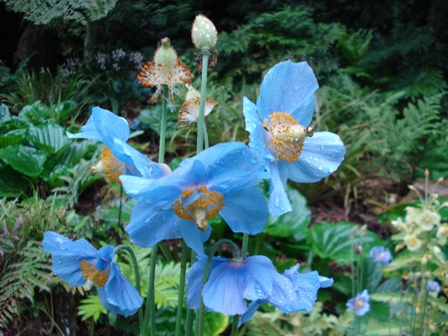
Meconopsis
Meconopsis
The simplest poppy form – a mere four petals surrounding a ring of golden stamens – is always charming, no matter the colour. When it comes in pure blue, it enters a league of its own.
Coming from the Himalayas, these are plants which are happier in much drier, colder conditions. We have to work at keeping them going here, where we have high rainfall, high humidity and generally mild conditions. They certainly don’t seed down and naturalise for us as they will in parts of the South Island but when they come into flower each spring, it is worth every bit of effort.
We don’t generally let them flower in the first year because if they put their effort into setting seed, the young plants tend to die. If we delay the flowering, we have more chance of some at least becoming perennial, albeit still comparatively short lived. Fresh seed is easy enough to raise but best done in seed trays and not merely broadcast to the ground with a wish and a prayer.
Meconopsis are available in New Zealand both as seed and as plants. If you have a choice, Meconopsis x sheldonii shows a little more vigour than either grandis or betonicifolia. All come in blue, though there are also white, pale yellow and red meconopsis which are nice to add in to a garden but no replacement for the beautiful and eye-catching blue.

Magnolia Felix Jury
Deciduous magnolias
How could I be a Jury and not put deciduous magnolias in my top favourites? These trees are surely one of the most spectacular on the planet when in full flower, though it has to be said that the bigger the flower, the better in terms of impressive display.
Magnolia trees just get better with size and age which seems entirely appropriate for a genus which is ancient – so old that it does not even have proper petals. What we usually call petals are in fact tepals. They evolved before bees so originally adapted to be pollinated by beetles – hence the fact they have pollen but no nectar.
To get maximum flowering, select a variety which sets flower buds down the stem rather than just on the tips. Some varieties like the purple Lanarth can take your breath away but only for about 10 days. Others, like Iolanthe or Felix Jury, flower over many weeks, extending the display. Indeed, spring flowering on Iolanthe extends over at least eight weeks from first to last bloom and there is the bonus of random flowers over summer.

Daphne genkwa
Daphne genkwa
A daphne with no scent? Yes, but it is so spectacular in flower that the absence of fragrance does not seem to matter. It is also deciduous, which we do not expect from a daphne and it flowers before it comes into leaf so all that is visible is a mass of graceful whips smothered in lavender blue flowers.
I think you can never have too much blue in a garden. It is a colour that complements all others and while I will admit that genkwa is not a pure toned blue, it is still blue enough for me.
D. genkwa is not easy to propagate and is generally increased from root cuttings. Neither is it easy to get established. In fact it is definitely on the touchy side. This plant was a particularly fine specimen but outgrew its allotted space so I pruned it after flowering, as you do. It promptly died, to my great disappointment. I am trying again, but this time as specimen shrubs with plenty of space to grow so they will not need to be pruned. Daphne genkwa is available in New Zealand but is not standard garden centre fare so you may need to find an obliging operator to order it in for you. It is a Chinese shrub and, being deciduous, it is generally rated as hardy.

Narcissus cyclamineus
Dwarf narcissi
In a large garden with some enormous trees, we love the tiny treasures that give detail to the bigger picture. We also have more success with the baby narcissus than with their larger cousins. They don’t seem to be quite so vulnerable to the dreaded narcissi fly, possibly because many of them flower earlier in the season.
These little cyclamineus seedlings always make us smile. With the reflexed skirt of petals, they are rather reminiscent of floppy eared dogs with the heads out the car window and ears streaming behind in the wind.
We grow a whole range of different dwarf varieties – species, named hybrids and unnamed seedlings, tucked into positions around the garden. The first to bloom are the Narcissus bulbocodium citrinus or hooped petticoat types which can show colour as early as late April while others continue the display through to late September. The best known dwarf variety is probably Tete-a- Tete, but there are innumerable others which are offered for sale from time to time.

Cyclamen hederafolium
Cyclamen species
These little treasures mostly hail from southern Europe and northern Africa but some varieties are particularly suited to New Zealand gardens.
The most widely available variety is Cyclamen hederafolium (formerly known as neapolitanum) which puts its first flowers up in our garden in January and flowers through until May or even June. After that, the marbled, heart-shaped leaves are attractive in themselves. C. hederafolium comes in shades of pink and pure white. Following on from them, we have a lot of success with C. coum in winter and C. repandum in spring.
Cyclamen are particularly successful planted in drifts on woodland margins in dappled light but they are pretty adaptable in a range of conditions as long as they have good drainage. They are easy enough to raise from fresh seed if you know of anybody with plants and they grow to form tubers which are like round, flattish discs.

Rhododendron Yvonne Scott
Rhododendrons
Unfortunately, the glory days of rhododendrons have been and gone in this country, but we would not be without them in our garden. Our particular favourites are the nuttalliitypes with their large, waxy trumpet flowers, most of which are scented. Combine that with big, heavily textured leaves (the technical term is bullate foliage) and the most beautiful cinnamon brown bark which peels off in long tendrils leaving a shiny trunk behind.
Add in the fact that these plants show generally healthy characteristics in warmer climates. They can get a touch of thrip but nowhere near as much as colder climate plants and they are not susceptible to the brown crisping round the edges of the leaves which disfigures so many varieties.
If I could only grow one rhododendron, R. sino nuttallii would be my first choice. Sino just means it comes from China (there is another Himalayan form). Fortunately we can grow many so we have a fair range of the nuttalliis and their hybrids, including the lovely and distinctive Yvonne Scott. Huge lime green buds open to lime flowers which fade out to white within two days, but keep the green flare in the throat. Mi Amor is probably the most widely available nuttallii hybrid on the market. While we might not rate it as the best, nuttalliis are not readily available so you might have to grab whatever you can find.

-39.042098
174.300314

 Tikorangi The Jury Garden