Tag Archives: The plant collector

Plant Collector – Camellia sinensis

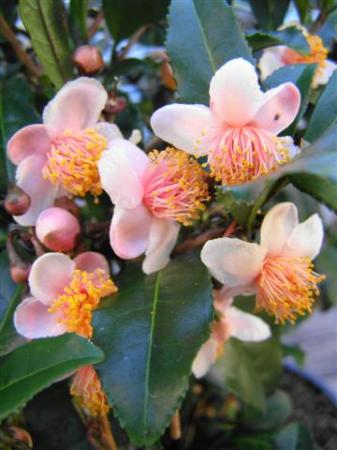
Grown to harvest for tea, rather than its floral display - Camellia sinensis

Grown to harvest for tea, rather than its floral display - Camellia sinensis

Despite being one of the first camellias of the season to flower, Camellia sinensis is not grown for its floral display but as a crop. It is the tea camellia. All tea comes from the same plant. Whether it is green tea, oolong tea or black tea depends not on the plant variety but on how it is dried, fermented and roasted. The preparation of quality teas takes a skill level on a par with roasting coffee or making wine. You can, however, harvest easily for home consumption, unlike wine and coffee. Green tea is unfermented and the leaves can be used fresh or dried. Oolong tea is lightly fermented (or sweated) and very lightly roasted. Further along the line is the fully fermented and roasted black tea. For the very best quality, you only pick the three leaves of fresh growth. By picking, you encourage the plant to continue pushing out fresh growth.

Camellias, as we all know, grow extremely well in New Zealand. The first attempts to grow sinensis commercially failed because of the site – cold inland valleys of Nelson. The frosts burned the desirable new growths. There is now a Taiwanese plantation near Hamilton which specialises in high quality oolong tea for the Chinese market. Most C. sinensis flower white. This form has flowers in dusky pink, but still tiny. The leaves are not like a common shiny japonica, being longer, crinkly and softer. We grow it in the vegetable garden and keep it to about 1.5m high x 1.2 m wide. Should Armageddon strike, we will have to drop coffee off the menu but we can still drink tea. I will just have to find out which bergamot is added in order to replicate our favourite Earl Grey tea.
Plant Collector – brugmansia

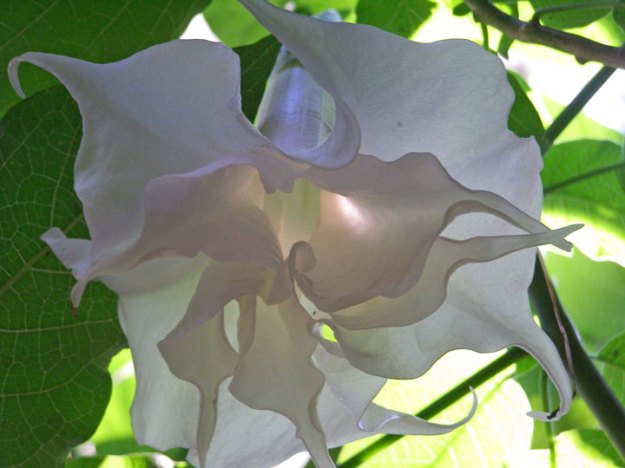
Double white brugmansia - huge, frilled white trumpets

Double white brugmansia - huge, frilled white trumpets

If you are into frills and furbelows, it is hard to go past the charm of this double flowered, pure white brugmansia. It is a member of the solanum family – as are tomatoes, capsicums, aubergines and, indeed, the dreaded woolly nightshade. None are as ornamental. The fragrant brugmansias hail from South America, mostly around Ecuador and the Andes, and are somewhat frost tender so presumably it is low altitude Andes. They are woody shrubs, around 3 metres high. This one is likely to be Brugmansia x candida (or aurea x versicolour), sometimes referred to as B. “Knightii”. We have it growing in open woodland conditions but it is also quite happy in full sun.

The differentiation between brugmansia and datura seems to be on a sliding scale. Brugmansias all used to be classified as datura. Now there is a school of thought that all datura are in fact brugmansia. What is usually referred to as a brugmansia has hanging (pendulous) flowers and woody stems whereas what are commonly called datura have horizontal or upward facing flowers and herbaceous growth. In days gone by, suicidal youths would regularly kill themselves trying for hallucinogenic experiences (now probably replaced by synthetic drugs which, while not safe, are not usually fatal). The problem is that while there are hallucinogenic properties, all parts of this plant are highly poisonous. A psychedelic trip can be a one-off experience with a high price to pay.

Plant Collector: Frangipani

The intoxicating fragrance of frangipani (or plumeria)

The intoxicating fragrance of frangipani (or plumeria)

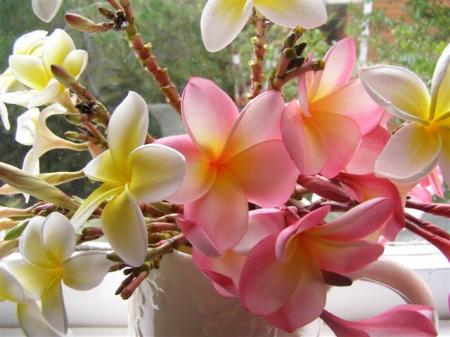
Alas, these frangipani are not growing in our own garden. We were in Sydney last week where they are common in home gardens. We have two plants here which we have managed to get to a good size in pots and we plan to give them optimum conditions in the hottest possible, sheltered position at the front of the house because the fragrance is just to die for. I am sorry we don’t have the exotic rosy pink and yellow form, but only the more common white with a golden centre, more correctly known as Plumeria rubra var. acutifolia but frangipani will do just fine, thank you. There are dark red forms too.

Despite the fact that they are common in the Pacific islands and throughout Asia, frangipani originate from Central America (think Mexico, Venezuela and the Caribbean) and therein lies the problem – they are tropical but we are not. They are of the large deciduous shrub to small tree class, but very sappy plants so more akin to some of the larger euphorbias in growth. They will grow happily in pretty tough conditions as long as they never get cold or waterlogged.

What is often called the Australian frangipani is a totally different plant. It is an evergreen tree, usually very large though there are some smaller selections becoming available, and is in fact Hymenosporum flavum. Being a Queensland forest tree, it is not quite as tropical as plumeria but neither is it as exotic and attractive in bloom. We will keep to the plumeria and hope for that unmistakable scent of the tropics in summer.

Plant Collector: Castanospermum australe

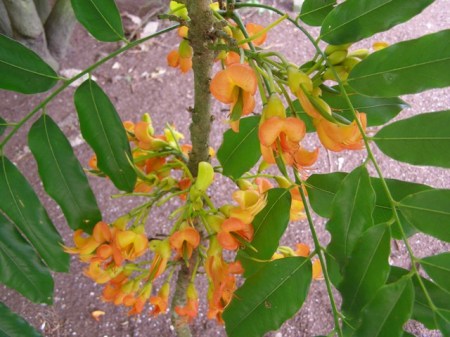
A mission requiring the tall extension ladder - gathering the Castanospermum australe flowers

A mission requiring the tall extension ladder - gathering the Castanospermum australe flowers

It was just a little difficult to photograph the orange pea flowers on the castanopsermum, owing to the fact that they are at least 10 metres up the tree and beyond the limit of my camera’s zoom. Getting this photograph entailed Mark on the end of the extension ladder cutting a branch to bring down to ground level. The tree itself is probably getting closer to 20 metres now, though it has taken several decades to get there. I was slightly alarmed to see that it has the potential to reach 40 metres high in its natural habitat of east coast Australia, particularly Queensland, but I doubt that it will reach that in our cooler climate, or indeed in my lifetime.

The common names for this plant are Black Bean Tree (on account of its large black seeds held, as legumes are, in a pod) and Moreton Bay Chestnut. Indeed castanea means chestnut in Latin and that is where it gets its name from. It has always been much on my conscience that many years ago when we sold a few of these (and painfully slow they were, to get grown to saleable size), in my ignorance I assumed that the common name of Moreton Bay Chestnut meant the seeds were edible. They can be eaten – if you are Aboriginal and understand the painstaking process of rendering toxic seeds edible (a bit like karaka berries in this country). Lacking that knowledge, poisoning is more likely. As the tree takes some time to flower, I am hoping that my incorrect plant labels will long since have faded into oblivion so nobody tries eating the seeds.

The tree is evergreen and has handsome, pale green, large pinnate leaves – pinnate meaning divided like a feather. Should it outgrow its space here, apparently the timber is attractively grained like walnut.

Plant Collector: Alcantarea regina

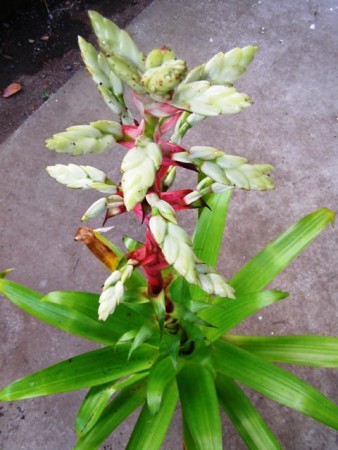
One of the most spectacular bromeliad's when in flower - Alcantarea regina

One of the most spectacular bromeliad's when in flower - Alcantarea regina

A bromeliad, or brom as they are often called, but thankfully the alcantarea family are not prickly and spiny like so many of the other species. There appears to be some debate as to whether this one is A. regina or A. geniculata – it does seem that the experts lean to the latter option but it is widely sold under the former name. Whichever, it is from eastern Brazil, as are all its alcantaera siblings. It has only been in cultivation for a little over a decade but, being easy to propagate, it is now widely grown. In leaf, it is nothing particularly spectacular – just a rosette of reasonably large green leaves. But when it shoots up a metre high, strong flower stem, it is impossible to ignore. The stem is a deep pinky red with bracts for starters, adorned by funny, waxy lemon flowers which are flat and rigid. Being a bromeliad, the flowers last a long time, after which the flowering rosette usually dies (slowly), but not before putting out pups to the side which will take over in due course.

Most bromeliads are on the tender side so we use them as woodland plants because the overhead shelter gives them protection. They have very small root systems for the size of the tops and low nutrient requirements. In other words, they need very little feeding. Most will hold water in the rosettes – which can be a breeding ground for mosquitoes as I found to my cost when working amongst ours recently. The best known bromeliad of all is the pineapple.