Tag Archives: The plant collector

Plant Collector: Worsleya procera

Worsleya procera (syn. W. rayneri)

Worsleya procera (syn. W. rayneri)

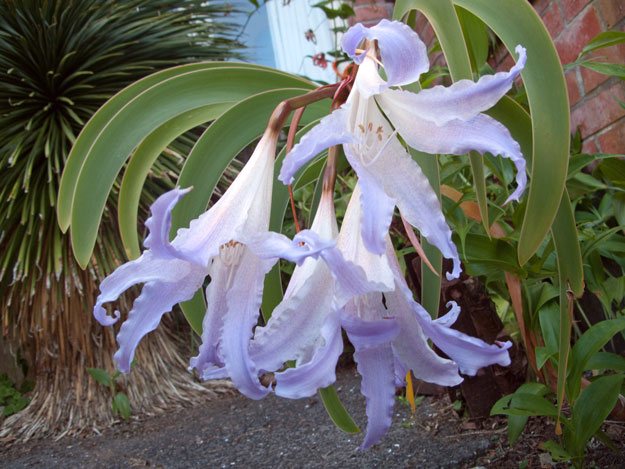
The most special plants flowering in our garden this week are the Worsleya procera (syn. W. rayneri) and they are not only special because they have the wonderful common name of Empress of Brazil (which tells you where they come from). They are also extremely rare in cultivation, a very beautiful lilac-blue in colour and generally regarded as almost impossible to grow as garden plants. We have two growing in different positions in the garden where they are just left to their own devices with no special treatment at all. When we had an international tour of clivia enthusiasts through, a number were also bulb aficionados and they were genuinely impressed that we could grow and flower this choice bulb in the garden. They are usually grown as really pernickety container plants. True, our flower spikes do not match the 150cm in height that they are reputed to reach, but the flowers are large and a most unusual colour in the bulb world.

There is only one species of worsleya but if you go back a step to the extended family, they are related to hippeastrums, crinums and amaryllis. Apparently in Brazil, they grow on steep granite cliffs beside waterfalls (where it is hard to imagine a flower spike of 150cm) but our garden conditions in no way resemble the natural habitat. The foliage is really interesting, arching in a semi circular, sickle fashion. These bulbs are not for the impatient gardener. Mark was standing looking at one of ours with Auckland plantsman, Terry Hatch, who originally supplied it to us. They agreed that was a long time ago, maybe as much as eight years. Mark found the label and it was in fact fifteen years. It had taken thirteen years to flower the first time. Time flies, apparently, when you are a gardener. Sadly, both ours are the same clone (one was an offset) and you need two different clones to get viable seed. Pukekura Park’s worsleya in the Fernery is not going to flower this year so if any local readers happen to have one in flower, we would love to swap pollen.

Plant Collector: Amaryllis belladonna

Surprising perfection in the under-rated Amaryllis belladonna

Surprising perfection in the under-rated Amaryllis belladonna

Belladonnas naturalised on a vertical road cutting

Belladonnas naturalised on a vertical road cutting

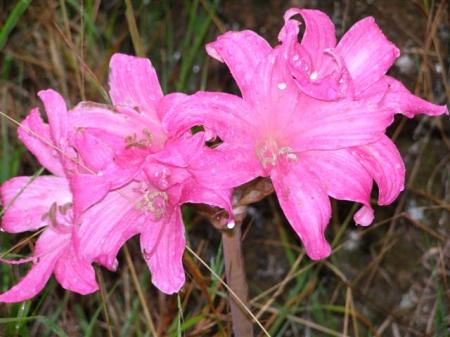
Looking at the white perfection of the bloom just opening, it is not that easy to pick it as a common old belladonna, but that is what it is and just a random seedling at that. We tend to be a bit sniffy about belladonnas here and see them as roadside wildflowers to be taken for granted. Fortunately they thrive on benign neglect, preferring to be left undisturbed and quite happy to grow in quite difficult conditions. This one is on a vertical bank where Mark broadcast some seed several years ago.

The amaryllis family has only one solitary member and that is the belladonna – which stands for beautiful lady rather than the more common epithet of naked lady. The reference to nakedness comes from the plant’s habit of flowering before any foliage appears. This is another bulb from the Cape Province of South Africa and it is summer dormant. The flower pops up well before it actually comes into growth for the season. The colour range is from pure white through a gamut of pinks – pastel to bright sugar pink to a deep cerise bordering on red.

The more common candy pink of the belladonnas

The more common candy pink of the belladonnas

Apparently there are now some double forms around but I have yet to see them. I found a tray of perfect white ones at the back of the nursery last year and made a spot in the summer garden for them but now I am wondering about revisiting some of the other clumps we have hanging around the place to feature them more as a late summer flower. Their only real downside is that they have rather a lot of foliage for much of the year so they are best planted in a position where they can be left to their own devices and their scruffier times are not intrusive. If you are planting belladonnas, they like to be baked in the summer sun and left with their necks above the ground.

Plant Collector – Helichrysum Silver Cushion

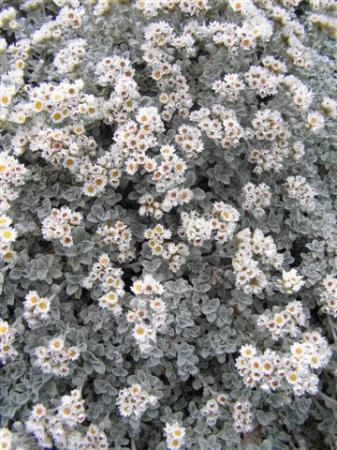
A delightful mound of silver foliage and white daisies

A delightful mound of silver foliage and white daisies

When helichrysum are mentioned, most people think of the everlasting straw flowers, usually orange and yellow, which are fun for children to grow and may have a place decorating a sunhat (preferably somebody else’s) or gathering dust as part of permanent flower displays. However the helichrysum family is much larger than that. Silver Cushion looks like a mounded silver cushion with dense tiny leaves (they are about 4mm across) and a mass of dainty white straw flowers. The flowers are daisies but tiny – under a centimetre across. It is attractive without the flowers but lovely when in full summer bloom.

This is a woody sub-shrub which will gently layer where it touches the ground. The tiny grey foliage and strawflowers give a clue that it will take hot, dry conditions. It thrives in our rockery and can make a good container plant but it did not thrive when I tried it in bone dry conditions with root competition. The plants survived there for a few years but in the end I pulled them out because they were looking pretty hard done by. Silver Cushion has been around for many years, decades even, and is still being produced commercially in NZ. My attempts to unravel its background failed and it may be that a reader can tell me more. As far as we understand, it is a native but what we don’t know is whether it is a species selection or a hybrid. My best guess is that it has at least some H. bellidiodes in its background. To make matters worse, that helichrysum now appears to have been renamed as Anaphalioides bellidioides . While I can live a happy life blissfully ignorant of the finer points of most helichrysum species, it would be interesting to know a little more about the background of Silver Cushion in particular.

Plant Collector: disa orchids

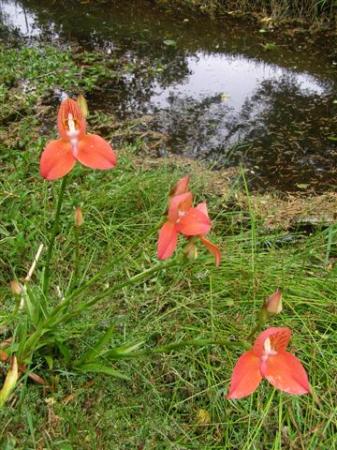
Working to naturalise disa orchids by our stream

Working to naturalise disa orchids by our stream

It was a bit of a mission earlier this week to find anything looking good after Sunday night’s fierce storm but the disa orchids held up well. Trying to get these delights naturalised on the margins of the stream which runs through our park is a recent venture. It is far too soon to decide that it is a success because this is their first season so all we can say is so far, so good. If we still have some and they are gently increasing in five years time, we will hail it as a success.

Of all the plant families in the world, orchids are by far the most complex. The sub group of disas alone has about 170 separate species and that does not take into account multitudinous hybrids. Mark is not trying to get to grips with the detail. He just accepts gratefully what local orchid expert and friend, George Fuller, gives him to try out. As far as we know, it was the dainty little Disa tripetaloides which gave us white flowers earlier in the season and these larger red ones in flower now are from the more common D. uniflora. It is the natural habitat of the disa orchids which caught our attention. They occur in damp conditions on the margins of streams and waterfalls, predominantly in South Africa. That is why we hoped they could be naturalised on the margins of the stream where they are a great deal more exotic than the thuggish yellow Primula helodoxa. You need a situation where you can control floodwaters however, as we do with a weir and a flood channel, or our frequent torrential downpours will scour out marginal plantings.

If Wikipedia is correct, the tuberous root of the disa orchid is used to manufacture maltodextrins, used in artificial sweeteners. How curious is that? Mark is a bit concerned at the absence of the Mountain Pride Butterfly here, that being the natural pollinator for D. uniflora in South Africa. We are not at all sure that our monarch butterflies, which we have in abundance, are up to taking on additional duties in this respect.

Plant Collector – auratum lilies

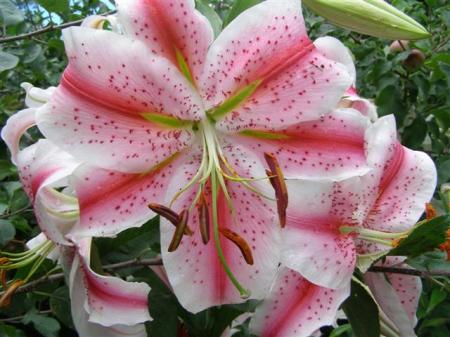
Auratum lily Flossie - one of Felix Jury's hybrids

Auratum lily Flossie - one of Felix Jury's hybrids

I don’t cut flowers to bring indoors very often. When every window of the house looks out to a garden, it doesn’t seem necessary. But as soon as the auratum lilies start to open, I reach for the kitchen scissors and head out. They are just the perfect cut flower – one stem can have up to ten flowers (sometimes even more) and put in a tall, slender vase they not only look superb, they can spread their delicious scent through an entire room.

Auratums are known as the golden-rayed lily of Japan – how lovely does that sound? The flowers are the largest of the lily family, often more than 20cm across, and they are a mainstay of our January garden. Felix Jury adored them (probably for all the same reasons that we do) and dabbled with breeding them, naming several selections. This one is the very large flowered Flossie. The upshot is that we have a lot of auratums in the garden and generally they are quite happy with benign neglect, growing in both full sun and semi shade. They prefer soils with good drainage and plenty of humus but not too rich.

The bulbs are large – fist-sized even – and we tried to get around all the plants last winter to dig and divide them. They haven’t had any attention for many, many years but when the clumps get too congested, the tops tend to fall over if they are not staked. The freshly divided patches are mostly standing up like little soldiers without any assistance. Some of the taller ones can get over 2m high and they need some support though often I will intertwine them through neighbouring plants.

You can sometimes find lily bulbs for sale in garden centres in winter. Make sure you avoid any dry, shrivelled specimens – they do not like to be dried out completely even when dormant. You may be lucky and find some auratums but they are not widely offered on the NZ market despite their spectacular summer display.