Tag Archives: The plant collector

Plant Collector: Tecomanthe montana

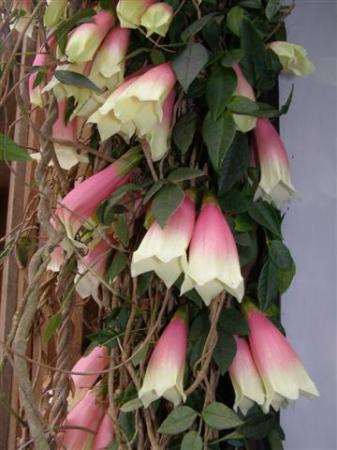
Pink and cream hanging bells of Tecomanthe montana

Pink and cream hanging bells of Tecomanthe montana

Most visitors tend to think that the dainty pink and cream trumpets mean this climber is a lapageria (Chilean bell flower) but far from it. Tecomanthe montana is a tender climber from New Guinea. We tried it in the garden and it survived a couple of years before it succumbed to winter. This plant is grown under complete cover though it has its roots in the ground. It is by far the showiest tecomanthe when in flower.

Apparently there are only five species of tecomanthe. Our own native form, T. speciosa, was found as a single plant on the Three Kings Island and has been saved by commercial production. It has much bigger leaves and is a very strong grower. Unless you train it along a horizontal frame, it tends to shoot up the tallest tree where it will produce its pale lemon trumpets right on top where you can’t see them. We also grow T. venusta under complete cover but it is even more tropical than T. montana and only occasionally flowers for us. When it does, its pink trumpets appear out of the gnarly bare wood of the climbing stems. We gave up on the Queensland species, T. hillii because it mildewed badly with us. All of the tecomanthes are forest climbers from the tropics or sub tropics. Montana came to us from former Pukeiti director, Graham Smith, who gathered the seed in New Guinea. It is not the easiest plant to get established but if you can find the right conditions, it is a winner in spring.

Plant Collector: Rhododendron Loderi Venus

Loderi Venus - still at the top of its class

Loderi Venus - still at the top of its class

If ever there was a good reason to learn to graft plants at home, it is the Loderi rhododendrons. These used to be widely available in the days when specialist rhododendron nurseries produced a huge range and when customers understood that sometimes special varieties need to be grafted, so were willing to pay a premium. These days there will only be one or two places in the whole country still producing these lovelies, which can’t, in the main, be grown from cutting.

The Loderi group date back to the turn of last century when Sir Edmund Loder of Leonardslee near London crossed fortunei with griffithianum. The results were rather large trees with exceptionally large flowers, fantastic fragrance and reasonable hardiness. Despite the passage of over a century, little has been produced that is the equal, let alone an improvement, in the big, fragrant class of rhododendrons. This one is Loderi Venus. Unfortunately our mature Loderi King George bit the dust when one a huge Lombardy poplar landed on top of it but Mark is hoping that his emergency grafts will take so that we can keep it represented in the garden. Venus has the best pink colour of the group and is a picture in full flower.

Plant Collector: Anopterus glandulosa


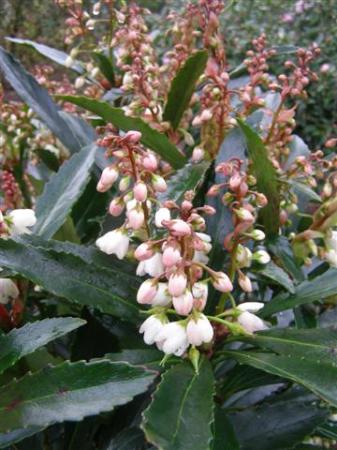
Anopterus glandulosa - a slow growing treasure

Anopterus glandulosa - a slow growing treasure

It did take a long time for our Anopterus glandulosa to do much other than just sit and put up a few racemes of flowers each spring but eventually it grew a little and after a decade (possibly more than a decade, in fact) it just gets better every year. Its flowers look like lily-of-the-valley but this is an evergreen shrub from Tasmania. The literature tells me it can make a small tree but at the rate it is growing, that might be when our grandchildren (who have yet to make an appearance) are adults. I can see why it is rated as rare because this is not a quick turn-over shrub for the trade so if you ever see it offered for sale, grab it because you may be looking a long time to find it again. The leaves are long, leathery, shiny dark green with saw-toothed edges. Even without its flowers, it is a tidy little evergreen shrub which keeps good form without needing pruning and then for many weeks in spring, it is adorned with its racemes of pink buds opening to white flowers.


There are apparently only two species of anopterus and the other member of the family must be of negligible merit because most of the references only record glandulosa. They are closely related to escallonias which readers may know for a hedging option. If you find somebody with an anopterus, you may be able to raise it successfully from seed.

Plant Collector: Calanthe orchids

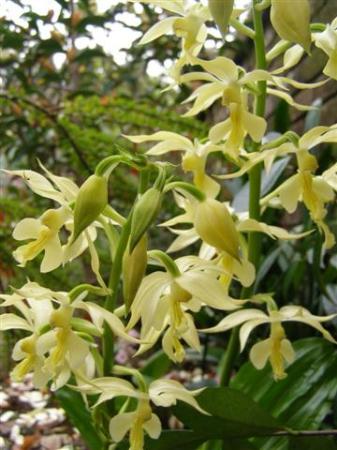
Calanthe orchids - happy growing in our woodland

Calanthe orchids - happy growing in our woodland

Orchids are one of the largest and most complex groups in the plant world – fearfully complicated to try and navigate your way through. Our interest here is in orchids as garden plants and one of the star performers is the calanthe family. These are called ground orchids or terrestrial orchids – in other words they are happy to grow in good garden soil. In the right conditions, you can plant them and leave them alone for many years where they just gently build up and make a better display with more flower spikes. There are well over 150 different species of calanthes and inevitably some will be better and showier as garden plants in our conditions than others. There is a bit of a question mark over the correct name for this lovely soft yellow one- probably a form of sieboldii or striata. Note: I have now been informed that in fact it is Calanthe ‘Higo’ (C. sieboldii x C. aristulifera) which makes sense to us.

Most of the calanthes come from tropical and sub tropical Asia and are generally evergreen. Presumably the forms thriving with us are the sub tropical types because tropical, we are not. We use them as woodland plants and have only once ever had them tickled up by a vicious frost. Their only downside is that they are quite leafy and the foliage hangs on for grim death long after it has become tatty and shredded. They benefit from an occasional tidy up. The new growth comes in spring and is quite lush so that every year garden visitors ask us which variety the yellow flowered hosta is.

Probably because orchids are such a complex plant family, orchid societies continue to grow, show and share when many other specialist groups have gone out of existence. They are a friendly and knowledgeable bunch and if you want to start building up a collection, either joining the local branch or visiting their shows is the best place to start.

Plant Collector: Magnolia Serene

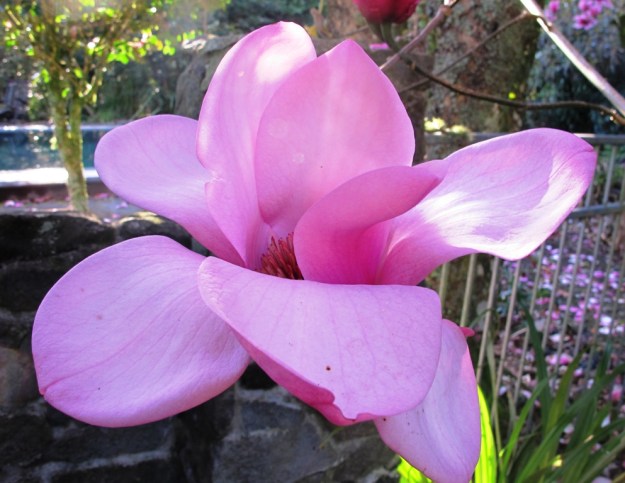
The very pink Magnolia Serene in full bloom

The very pink Magnolia Serene in full bloom

For us, Serene in full flower heralds the last chapter of the magnolia season each year. It is the latest and the last of the Jury magnolias to flower. It is also the pinkest. This is another of the series named by Felix Jury back in the early 1970s and the original tree now stands around six metres tall and is pyramidal in shape rather than spreading. In full flower, it is just a mass of large rosy pink bowl-shaped blooms.

001Being so late to flower, Serene is an excellent choice for people in colder areas or prone to late frosts. It also tends to miss the worst of the equinoctial winds. Cold conditions will make the plant adjust to blooming even later but Serene does get its flowers through before its foliage. We are picky here – we want deciduous magnolias to mass flower on bare stems before the new season’s leaves unfurl. When the leaves do come, they are a particularly good deep green and tidy in form so Serene stands out as a good summer foliage plant in a way in which few deciduous magnolias do. It will also set a flush of summer flowers which is bonus territory.
Serene was another of the series Felix bred using his wonder breeder parent, slightly embarrassingly named Magnolia Mark Jury. Its other parent is liliiflora.