Tag Archives: The plant collector

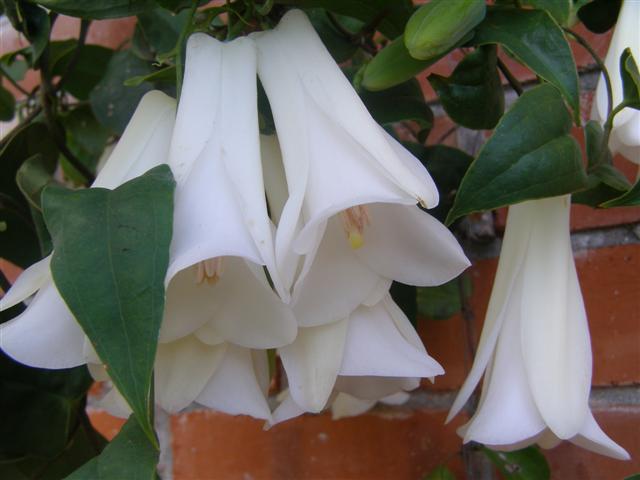
Flowering this week: Lapageria alba

The perfect white waxy bells of Lapageria alba

The perfect white waxy bells of Lapageria alba

The lapageria is commonly known as the Chilean bellflower and is the national flower for that country where it is called copihue. In the wild, reddish pink is the dominant colour though there are pure white forms, pretty pale pink forms and apparently even picotees in cultivation. The white form, Lapageria alba, is particularly prized in this country, but rare because it does not set seed to itself. You need two different clones to get viable seed. In fact all lapagerias are fairly hard to source these days because they are not an easy nursery crop. Young plants can sulk and do nothing at all for several years. They will then send out a strong fresh tendril and some wayward snail will choose that very time to pass by and eat off the long awaited fresh growth. If you see plants offered for sale, don’t set your heart on a particular colour – just take what is available.

They are evergreen climbers which, like most climbers, appreciate a cool position for their roots and their heads into the light. Being forest dwellers, they will take colder temperatures but not frost. Once established, they are enormously satisfying because they are almost never without flowers. And the flowers are beautifully simple waxy bells, reasonably long lived and apparently good for floral art. We have some huge granddaddy vines in red, white and soft pink which have been growing in the cold, narrow back border of our house for several decades where they gently flower on and on and on.
Flowering this week: Michelia alba

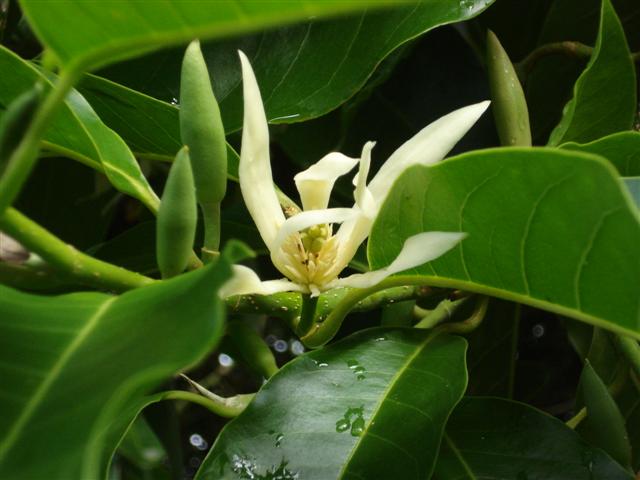
Michelia alba - grown for fragrance and foliage rather than any spectacular floral display

Probably the most fragrant tree we know, Michelia alba is in flower now and will be for most of summer. The flowers are definitely not spectacular to look at, being small and rather sparse for the size of the tree, spidery in form and cream. But for a knock you down fragrance which permeates the air all round, alba is amazing. In fact it is apparently the fragrance of Joy perfume. The tree gives us a few worries because it is growing considerably larger and faster than we anticipated and we wonder if we have it planted in the right place. Glyn Church tells us he had to cut one of his out because it outgrew its position. At least it is upright, rather than spreading and its foliage is lush tropical green all year – possibly because it comes from tropical and sub tropical areas of Asia.

Michelias have now been reclassified as magnolias – a somewhat arbitrary decision with which we do not agree so we will continue to use the former names. Alba was given to us by an elderly Chinese gentleman who told us that it was sacred and we could sell one to every Chinese family in NZ. We tried, believe me we tried but it does not set seed and it very rarely strikes from cutting so it has to be grafted and it is not easy to reproduce that way either. We have seen it used as a street tree throughout Asia and we think they aerial layer it.

For the botanically interested, current information is that alba is probably a natural hybrid from the orange flowered Michelia champaca and all alba plants throughout the world are therefore the one clone. Champaca sets seed freely but we have yet to hear of anybody who has proven experience with alba showing fertility. The plant appears to be a genetic dead end.

For a photograph of the tree in our garden, check out Magnolia Diary 14.

Flowering this week: Scadoxus multiflorus ssp. katherinae

Scadoxus ssp. katherinae is very happy in dry shade

Scadoxus ssp. katherinae is very happy in dry shade

This particular patch of scadoxus is looking very fine this week and stands around 140cm tall which is fairly remarkable given that it is growing in quite hard condtions. But then, scadoxus like dry shade and that is one thing we have in abundance in our garden.

These are very large bulbs, hailing yet again from the bulb wonderland of Zimbabwe and South Africa. Mark has always described the flowers as being like the chimney brush of the bulb world because they resemble the round brushes used by old fashioned chimney sweeps. Katherinae flowers red in mid summer. Her cousin from Natal, Scadoxus puniceus, flowers orange in spring with a similar flower form. The foliage of both is large and lush. If you know of anybody with either variety, the seed will germinate readily. It is very slow to increase from the bulb (no doubt you could twin scale it) so it is normally done from seed. You are more likely to find bulbs of katherinae for sale rather than the rarer puniceus.

Flowering this week: Eucomis or pineapple lily

Neither pineapple nor lily, this burgundy coloured eucomis is a feature in our summer garden

Our best guess is that this is a good form of Eucomis comosa, possibly a hybrid. It actually has nothing to do with pineapples or lilies because it is a bulb from South Africa and belongs to the hyacinth family. But the flower with top knot is seen as resembling a pineapple and that may be more PC than referencing caricatures of certain indigenous tribes who favoured top knots. The bulbs are big fist-sized affairs and build up quite readily in well drained, sunny positions. Each bulb makes a large clump so it is a plant for the summer herbaceous border where it has room to spread out and where it doesn’t matter that it leaves a bare area when it dies off in autumn. The long-lived flowers are apparently widely used in floral work and because the eucomis is happy to grow in covered houses, flowering seasons can be extended.

Our eucomis has leaves which are a subtle blend of burgundy and brown with a green undertone, bright burgundy flower stems and buds opening to a scented lilac flower with lovely yellow anthers. Green forms of eucomis are more common and there has been a range of dwarf eucomis hybrids introduced in recent years. This is a genus that lends itself to hybridising and it is generally an easy garden plant in our favoured conditions here in Taranaki.

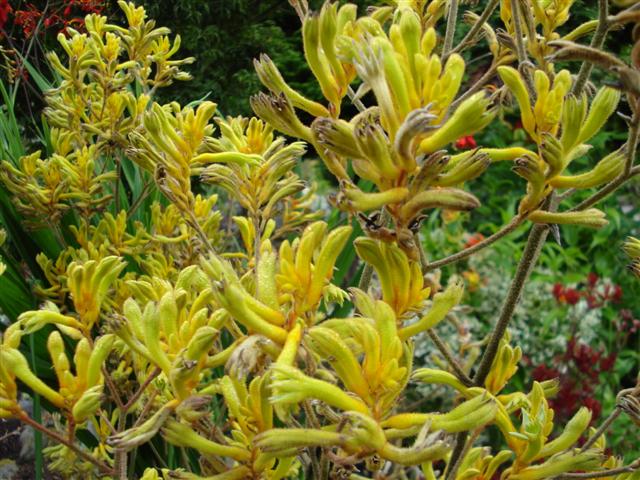
Flowering this week: anigozanthos, probably a flavidus hybrid.

The Australian anigozanthus requires perfect drainage in our conditions

I have never been up close and personal with Kanga and certainly not so near that I can examine her feet, so the reason why the anigozanthos family are widely referred to as kanagaroo paws eludes me. While the flowers are slightly furry, that doesn’t seem sufficient reason to liken the two. But these interesting clumping, evergreen perennials from South Western Australia are worthwhile additions to the sunny garden, if for no other reason than that they flower most of the year.

The critical issue with anigozanthos is perfect drainage. Apparently flavidus is more tolerant of damper conditions than the other species (which may be why this yellow one thrives where we have lost others over time) but we are only talking tolerance of Australian damp which is not at all the same thing as Taranaki damp. Perfect drainage, a raised bed and very open conditions are still recommended.

Modern breeding has led to the commercial release of a range of jewel-like colour combinations going well beyond the common red and yellow toughies, more into the rosella parrot colourings. We have tried a number of these over the years and gradually lost the lot – you should have more success if you garden in sandy, coastal conditions. But the reliable yellows and reds give consistent and curious flowers in our rockery and are also good as a cut flower. This yellow plant puts up flower spikes to around 150cm and, bless, they hold themselves up without staking. Many others are a great deal more compact and with flower spikes closer to 20 or 30cm

Anigozanthos are frequently available in garden centres.