Tag Archives: The plant collector

Plant Collector: Hydrangea indochinensis

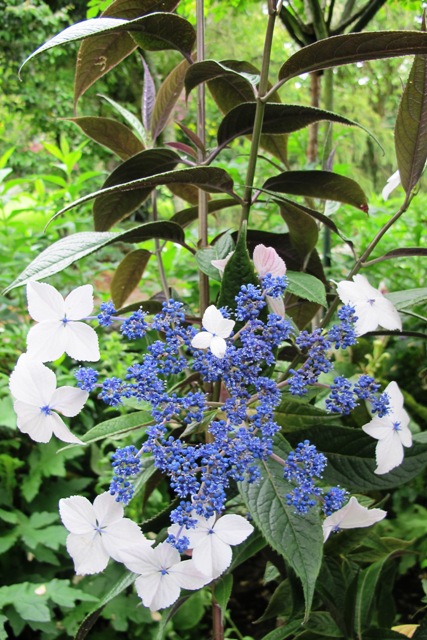
Hydrangea indochinenis - an evergreen lacecap

Hydrangea indochinenis – an evergreen lacecap

The vast majority of hydrangeas are deciduous and not many people realise there are a few evergreen ones. H. indochinensis a relatively recent introduction and has been collected from areas of Vietnam and southern China. It is quite variable but the form we have has lovely pointed leaves with dark maroon on the underside and attractive blue and white lace cap flowers. In these types of hydrangeas, the fertile true flowers are the little ones in the centre whereas the outer layer of larger petals are mere sterile ornamentation.

We have found it quite difficult to grow well and this plant is much happier having been moved to a more hospitable position with plenty of compost. It is not rated as hardy which means that it is unsuitable for cold, frosty situations and gardeners in inland areas will need to find a favoured, sheltered position to grow it. Our plants have never reached much over a metre tall and maybe 50cm wide.

H. indochinensis is available in New Zealand but you will probably have to find a hydrangea specialist because it is not a standard garden centre line.

First published in the Waikato Times and reprinted here with their permission.
Plant Collector: Cardiocrinum giganteum

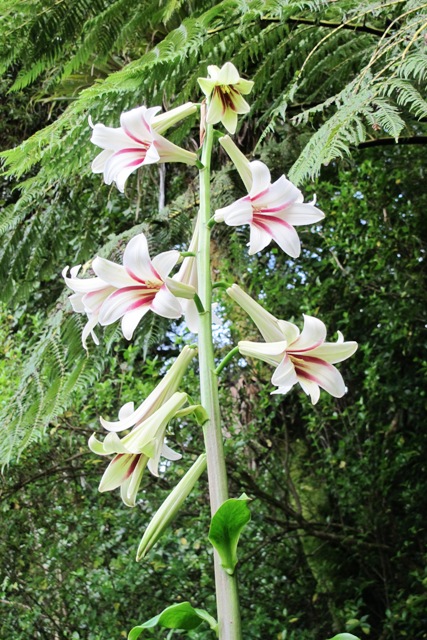
The three metre flower spike of Cardiocrinum giganteum - worth the wait of up to 7 years to bloom

The three metre flower spike of Cardiocrinum giganteum – worth the wait of up to 7 years to bloom

If any bulb were to be the king or queen of wow, it is this giant Himalayan lily in full bloom. That is because these flowers are on a hefty stem that is around three metres high. Add to that the fact that it takes somewhere around seven years to flower and each bulb only flowers once. It then sets large amounts of seed and forms offsets around the base of the original bulb, each of which will take another five to seven years to flower. That life cycle must offer a metaphor for something. In the interim years, it just forms a seasonal clump of large, luscious, heart-shaped leaves reminiscent of an arum lily. This is a plant for cool, open, woodland conditions with soils which never dry out and are rich in humus. It does not perform in warm regions and won’t take much wind because of that great height in flower. We grow the plants in a cold, south facing border.

Cardiocrinums are very fragrant but the flowers are a fair way up in the air so to get the full impact of the scent, one possibly needs a veritable grove of them to walk through. The scent is stronger in the evening.

First published in the Waikato Times and reprinted here with their permission.
Plant Collector: Kalmia latifolia “Nipmuck”

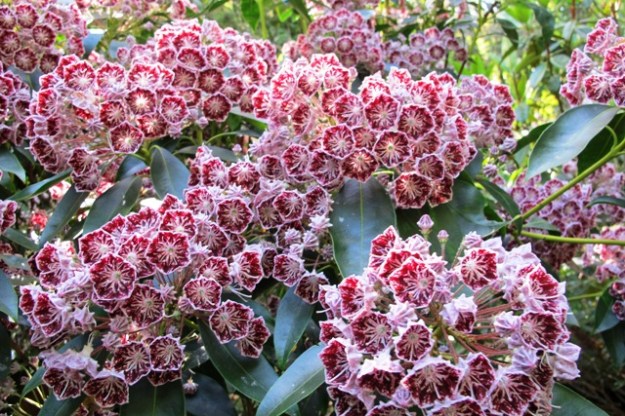
Kalmia latifolia “Nipmuck”

Just when all the spring flowering trees and shrubs have passed over and we move into early summer, the kalmias open. They look as if they belong in the spring group and they like to grow in similar conditions to rhododendrons and camellias but their blooms take us into December. This one has the rather odd name of “Nipmuck” and is the darkest variety we grow. I failed to find out how it came by its name but would guess it may derive from the indigenous people of America.

In leaf, these slow growing, evergreen shrubs are pretty anonymous. But when the buds appear, they look like piped icing such as often adorns wedding cakes, opening to little cups, chalices maybe. The backs of the petals are white with just the red shading through from the inside.

Kalmias are native to North America, though only to the east coast where they stretch from Canada to as far south as Mexico. Locals call them the Calico Plant or Mountain Laurel. Most of the prized garden selections are forms of latifolia which is hardy. In other words it won’t be harmed by cold winters of the type we get in New Zealand, even inland, southern areas. They belong to the ericaceae family.

There is nothing rare about kalmias but they are very difficult to propagate from cutting so you may find them hard to source. When you do find them for sale, be prepared to pay a decent price for one. Cheap plants are cheap to produce so difficult ones should command a higher value.

From 2009, Kalmia Ostbo Red.

First published in the Waikato Times and reprinted here with their permission.
Plant Collector: Ananas sagenaria

Ananas sagenaria - hardier than a tropical pineapple

Ananas sagenaria – hardier than a tropical pineapple

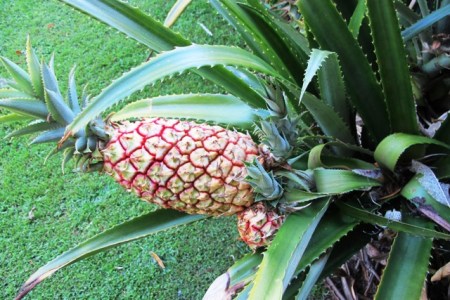
My photograph of a ripe pineapple attracted considerable comment last week and I am pleased to report that it was tasty and sweeter than usual when it came to eating. We have had this pineapple growing in a warm spot against a brick wall for over 50 years now. Its productivity is closely linked to how much care we give it and that is negligible most years. It wants maximum heat, good drainage and plenty of compost but it will survive on benign neglect. It is fiercely prickly.

Pineapples are bromeliads and Felix Jury received A. sagenaria as part of a collection of bromeliads that he imported from Florida back in the late 1950s. It originates from large parts of central and eastern South America and is from the same family as the commercial pineapple – which is usually A. comosus. It is not as good to eat as the tropical pineapple, but it is hardier.

Ananas sagenaria was marketed widely a few years ago, but not by us. We had a wry smile as we watched a Northlander come in, brashly confident that there was a gold mine in it which we had failed to realise. He advertised it widely as the red pineapple and described it as hardy. To us, hardy means it will grow in Christchurch and Invercargill. All we would say about A. sagenaria is that it is hardier than the tropical varieties.

First published in the Waikato Times and reprinted here with their permission.
Plant Collector: Acer Senkaki or A. 'Sango-kaku'

Acer Senkaki, as it is commonly referred to in NZ

Acer Senkaki, as it is commonly referred to in NZ

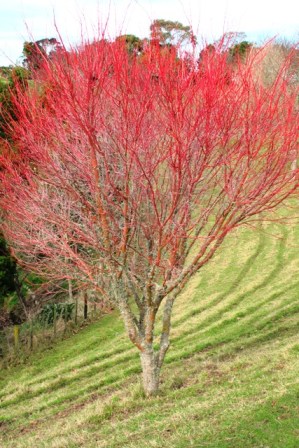
These vibrant red branches belong to what is commonly known as Acer Senkaki, or the coral-bark maple. I will go with Britain’s Royal Horticultural Society’s note that in fact, the correct name is Acer palmatum var. dissectum ‘Sango-kaku’. I wonder if Senkaki is the anglicising of Sango-kaku? The RHS gave it their prestigious Award of Garden Merit.

This is one of the Japanese maples with finely cut leaves (which explains the dissectum bit of the name), in five lobes or fingers (hence palmatum). The leaves are pale green tones throughout most of the season, colouring to gold in autumn. However, mostly one grows it for the glorious winter bark. It is a tree, albeit a smallish one. Over time it will get maybe five metres high by three metres wide.

I photographed this specimen in a country garden, Puketarata, where it stands as a splendid feature all on its own on a hillside, so it is able to viewed in its entirety. It really lit up a bleak winter Sunday afternoon.

Most maples need to be out of the blast of winds because their foliage is soft and relatively fragile. If the roots dry out over summer, the plant shows stress by burnt edges to its leaves. So positions which are well sheltered and moist all year round without getting waterlogged will give the best results. Grown well, the Japanese maples are lush and lacy in appearance and give superb autumn colour.

First published in the Waikato Times and reprinted here with their permission.