Tag Archives: The plant collector

Plant Collector: Crinum moorei variegated

Fragrant Crinum moorei var.

Fragrant Crinum moorei var.

Crinums are a large family, belonging to the amaryllidaceae group so having some botanical connection to the likes of belladonnas and nerines. But despite there being over 130 different crinum species, not a lot make good garden subjects in this country. Sometimes you will see different crinums being grown in the tropics but the common form in this country is C. moorei which is a South African plant. It has big strappy green leaves, largely evergreen so it can get a bit scruffy, and big, strong spikes of scented flowers in shades of pink. It is a very easy plant, tolerant of woodland shade and near total neglect.
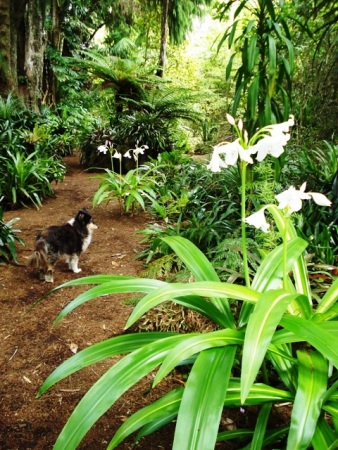
Tall, white punctuation marks in summer along a woodland walk - Crinum moorei var

Tall, white punctuation marks in summer along a woodland walk - Crinum moorei var

This is a variegated form and rather more desirable. It is deciduous which solves the scruffy problems. When the fresh growth comes in mid spring, it lights up a dark area with its bold pale gold and green striping. By mid summer, the variegation has toned down considerably to green which gives a splendid foil for the lovely tall spires of predominantly white scented blooms. These are around 150cm high but so strong, they don’t need staking. They are a wonderful late summer accent plant for shade gardens. The bulbs can reach extremely large proportions and are relatively slow to increase. As with a number of the amaryllis family, the bulbs sit half in the ground with necks exposed. We have never seen this variegated form set seed though the usual green moorei can be grown easily from fresh seed. We have to wait for our plants to form offsets on the bulbs in order to increase them, though enthusiasts could increase them by twin scaling.

First published in the Waikato Times and reproduced here with their permission.

Plant Collector: Lepidozamia peroffskyana

Lepidozamia peroffskyana - an Australian cycad

Lepidozamia peroffskyana - an Australian cycad

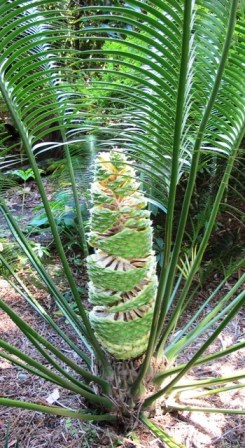
Difficult name, I know, but this plant does not appear to have a common name. It is a cycad and one native to Australia at that. Some mistake it for a palm because it grows a trunk and sprouts it leaves in a palm-like habit, fountaining from the top as it matures. Those leaves can be up to 3 metres long, which is extremely large when you think about it. But it is a cycad which is an entirely different plant family to palms. This particular plant is a seedling from a mature specimen we have and I photographed it because of its spectacular cone which has split open in a wonderful spiral. This split is to release its pollen, rather than to create a perfect pattern.

Lepidozamia peroffskyana cone

Lepidozamia peroffskyana cone

Normally we remove cones to stop the plant putting its energies into trying to set seed. It is suspected that forming the cone robs the plant of too many essential micro nutrients which can lead to yellow banding disfiguring mature leaves. It looks like sunburn. Our mature plant suffered badly in the past from this yellowing but it is still a little early for us to be able to state with confidence that de-coning it solves the problem, though it is looking hopeful.

This is an east coast rainforest plant from northern New South Wales through to Gympie in Queensland (I have been to Gympie though I cannot say I recall seeing lepidozamia there). In our conditions, it will tolerate light frosts and cooler temperatures overall. The natural rainforest habitat gives an indication that it likes fertile soils rich in humus, growing in company and in ground that never dries out. I had to go searching to find out for whom this plant was named – Count Peroffsky, a Russian nobleman and benefactor of the St Petersburgh Botanic Garden where this plant was first cultivated beyond its natural habitat. First in gets dibs on the naming rights even now.

First published in the Waikato Times and reproduced here with their permission.
Plant Collector: Ulmus elegantissima “Jacqueline Hillier”

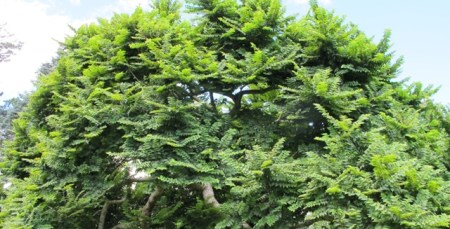
Ulmus (should that be elegantissima, minor or x hollandica?) "Jacqueline Hillier"

Ulmus (should that be elegantissima, minor or x hollandica?) "Jacqueline Hillier"

It’s an elm but from there on there seems to be some debate. We received it under the species classification of elegantissima. The Hillier Manual of Trees and Shrubs lists it under the species name of minor with elegantissima added as a synonym. A quick net search and I see others now list it as Ulmus x hollandica which is a natural hybrid of minor and glabra. In other words, nobody knows for certain so we will stick with Hillier’s own classification.

The reason nobody knows for certain is that it was found in a garden in Birmingham in the early 1960s and it was visibly different. Most elms are renowned as handsome, large trees, though they have suffered hugely in the UK and Europe since the 1970s from a major outbreak of Dutch Elm disease which kills them. “Jacqueline Hillier” is smaller growing. In fact it came to us under the descriptor of dwarf. It has tiny, sawtooth leaves and very fine tracery of branch structure whereby the leaves are held in fan shapes. This means it is extremely attractive when it is a bare skeleton in winter. It is delightful when flushed with bright spring growth and it is lovely and lush in summer until the predations of the red spider sometimes defoliate it.

Dwarf it is not. I planted a specimen in our rockery where it set out to prove it belongs to the large shrub category. We have to keep working on it extensively every year to keep it down to about 3 metres x 3 metres. It also seeds and suckers but not in a dangerous way. Had I realised it would grow to that size, I would have planted it somewhere with more space – but I would definitely still have planted it.

First published in the Waikato Times and reprinted here with their permission.

Plant Collector – Pinus montezumae

Pinus montezumae - just one of the more special pines

Pinus montezumae - just one of the more special pines

The pine tree family is a great deal more extensive than the common radiata pine we know so well in this country. Perhaps it is because the timber tree is such a widespread and drearily predictable planting that we tend to take little note of the other 100 or so species in the group. The beautiful Pinus montezumae is a case in point. It comes from Mexico and into Central America (think Guatemala) though usually growing in areas with some altitude which cools temperatures. Despite this origin, the Montezuma is hardy for our New Zealand conditions.

What sets the Montezuma Pine apart as a specimen tree is its very long needles which give the appearance of a pendulous or spreading habit of growth. The needles can be 25cm or even more, whereas most pine needles are in the 10 to 15cm range. Because they are so long, they appear to curve and drape themselves in a most elegant manner. They are also of what is called glaucous hue. This simply means they are toned to a bluish-grey in colour, not the forest green we associate with common pines.

You do need space. It will make a large tree, over 30 metres or more so it is not one for the back yard. As with all the pine family, it likes open, sunny conditions. It is not a forest or woodland tree. What about the pine plantations, you may ask. They are planted at the same time and at prescribed spacings which allows equal sun to all the plants. A plantation is different to a forest. With hindsight, I would plant the Montezuma in splendid glory all on its own. We have a few lower, evergreen shrubs beneath ours and they tend to look a bit scruffy when the falling needles catch in their foliage. At least keep underplanting deciduous for easier grooming.

First published in the Waikato Times and reprinted here with their permission.

Plant Collector: Rhododendron diaprepes

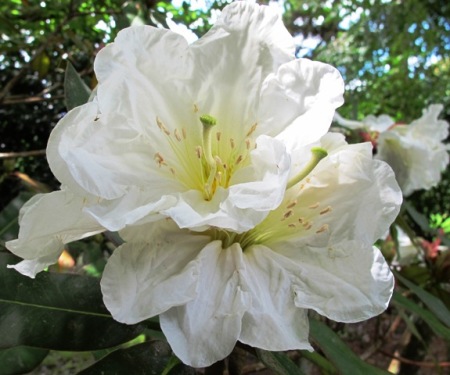
Flowering in the height of summer - R. diaprepes

Flowering in the height of summer - R. diaprepes

A rhododendron flowering in late January? Yes, and a big, fragrant white one at that. It is something of a visual surprise each time I look at the curved border of rhododendrons, all resolutely green with their spring foliage still fresh and bright. There, in their midst, is a large plant flowering freely.

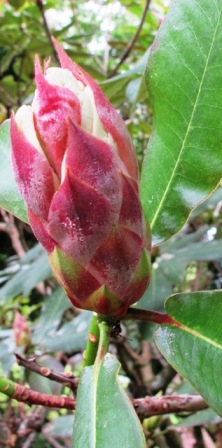
Big buds open to big fragrant flowers - R. diaprepes

Big buds open to big fragrant flowers - R. diaprepes

R. diaprepes is one of the Rhododendron fortunei group. Any plant which bears a variation of the word fortune in its name has been named, and in most cases was first collected by, one of Britain’s foremost plant collectors – Robert Fortune. He was also responsible for getting tea out of China and into British control in India but that is another story. However, it was not he who collected R. diaprepes from the Yunnan area of China. It was found later. He did collect the species, R. fortunei which has a sub species in the form of R. decorum (which flowers earlier and is a little smaller than diaprepes but otherwise similar). Then R. decorum has a subspecies in the form of diaprepes. Got that? Our rhododendron is a sub sub species (or ssp). It probably does not matter unless you are into the botany and taxonomy of rhododendrons.

R. diaprepes has big flowers, big buds, big leaves and is several metres high. Although it has a little thrip (which is what causes silver foliage), it is not too bad in that department and overall, the foliage is pretty clean and healthy. This is a collector’s rhododendron. The chances of finding it offered for sale these days are probably zero in this country. It is a good reason to learn how to do your own propagation if you want the unexpected delight and fragrance of such a late flowering cultivar in your own garden.

First published in the Waikato Times and reprinted here with their permission.