Tag Archives: The plant collector

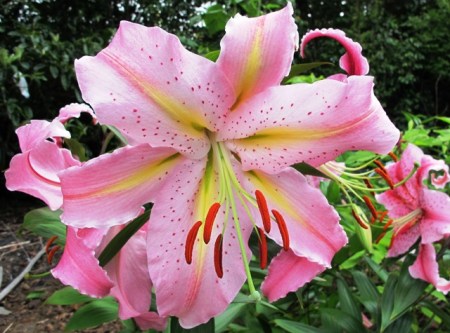
Plant Collector: The golden-rayed lily of Japan (Lilium auratum)

The wonderfully fragrant auratum lily hybrids - hybridising and raising from seed keeps the plants healthy and reduces problems with virus

The wonderfully fragrant auratum lily hybrids - hybridising and raising from seed keeps the plants healthy and reduces problems with virus

The golden-rayed lily of Japan – what a beautifully evocative common name. We grow quite a few lilies here but it is the auratum hybrids that are the mainstay of our summer garden. These are the results of decades of breeding, first by Felix Jury and now by Mark. This particular pink one is a pleasing new selection from that breeding programme. There is no commercial gain in breeding these auratums. The aim is to extend the colour range and vigour so they perform better as plants in our own garden as well as keeping them free of virus, which is common. We also prefer outward facing flowers (rather than the upward facing blooms used in floristry) because that gives more protection from the weather.

The hybrids are bigger and showier than the species. This flower is over 30cm across so not for the shy or retiring gardener. The species are predominantly white with yellow or red streaks and crimson spotting. Hybridising extends that colour range into pure whites, white with dominant yellow markings, reds and pinks. We also want strong growing plants that can hold themselves up without needing to be staked every year and which will keep performing under a regime of benign neglect (which means digging and dividing every decade, not every second year). We grow them both in sun and on the woodland margins – wherever there are reasonable light levels, good drainage and soil rich in humus.

Auratums are offered for sale as dormant bulbs from time to time but they don’t like being dried out and dessicated so try and find ones which are plump and firm.

Saving the best for last: oh, the fragrance. The auratum lilies are one of the flowers I cut to bring indoors. A single stem has multiple blooms and can scent a large room all by itself. I remove the pollen which will stain everything it falls upon.

First published in the Waikato Times and reprinted here with their permission.

Plant Collector: Cyanella capensis

Cyanella capensis - described by Mark as appearing like a blue gypsohila in the garden

Cyanella capensis - described by Mark as appearing like a blue gypsohila in the garden

There is some debate as to whether this plant is accurately named as Cyanella capensis and whether that is in fact synonymous with Cyanella hyacinthoides, but there is no doubt that it has been a quiet star in the rockery for nigh on two months now. Many bulbs are a wonderful, quick, seasonal flash. Plants like the cyanella which just keep going week after week are considerably rarer.

The “capensis” part of the name gives a clue – South African again, from the Cape Province. It is not a big show-stopper. Like some of the species gladiolus and the ixias, the foliage starts to die off and look scruffy as the flowers open but in this case, the flowers have continued long after the foliage has withered away and disappeared. Each six petalled flower is about 15mm across, lilac blue with golden stamens and masses of them just dance on the leafless branch structure, reminiscent of a blue gypsophila.

We have had this cyanella in the rockery for many years now. I have ferreted around looking for the bulbs to spread further afield but clearly they are of the type which can find its own depth and in this case, that is deep. I have failed to find them. Apparently they are edible and somewhat oniony in flavour, also used in times past as a poultice, so they must be a reasonable size. I may have to have another dig to see. The flowers are pollinated by bees and can set viable seed.

There are different species of cyanella – about seven in fact – and we were given the yellow form, Cyanella lutea but it failed to last the distance with us.

First printed in the Waikato Times and reproduced here with their permission.

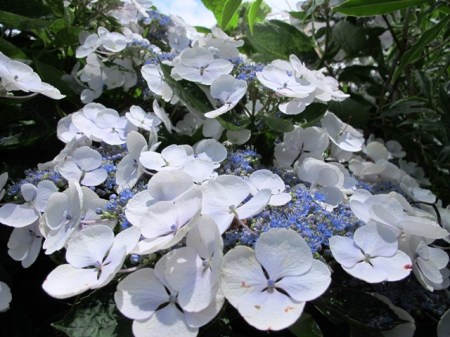
Plant Collector: Hydrangea Libelle

Hydrangea Libelle

Hydrangea Libelle

Were we to host garden weddings here (which we will not), I would be targeting white hydrangeas for easy care summer display in semi shaded areas. The compact white moptop Immaculata is very, very good but perhaps just a little clichéd in a bridal sense. Hydrangea macrophylla ‘Libelle’ is looking equally good this week.

Libelle is a large grower. This plant is well over two metres even though I prune it every winter and it is growing in competition with an adjacent tall hedge. Its flower heads are appropriately large and abundant. It is a lacecap which means it has a flat head. The true flowers are the small blue clusters in the centre. The outer rim of large, white individual flowers are sterile (which means they do not set seed) and technically they are sepals. The blue and white contrast is a very clean and attractive combination. Later in the season, the white will turn to pink tones in that olde-fashioned antique colour range that hydrangeas do so well.

Hydrangeas are a wonderfully obliging plant family that is often taken for granted. But after the unrelenting rains of last week, when pretty much every other bloom was sodden and disintegrating, the hydrangea flower heads just serenely continued as if nothing would bother them. They can last for a long time on the bush and make a splendid cut flower as well.

First published in the Waikato Times and reproduced here with their permission.

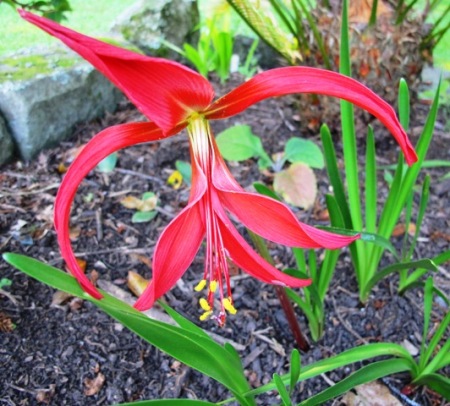
Plant Collector – Sprekelia formosissima

The Sprekelia formosissima or Jacobean lily

The Sprekelia formosissima or Jacobean lily

You learn something every day. This bulb is what is commonly known as the Jacobean Lily, even though it has nothing to do with the Jacobeans and it is not a lily. For years I have freely tossed the descriptor around, “it resembles a Jacobean lily”, thinking more of William Morris textile design than botany. And all the time, there is a wide level of agreement internationally that the Jacobean lily is Sprekelia formosissima. Added to that, when a species name is formasana or formasanum, it usually means that the plant comes from the former island of Formosa (now Taiwan). But the unwieldy formosissima means, loosely, beautiful. In fact it comes from Mexico.

It is indeed a beautiful flower with its rich red strappy petals and elegant form. A member of the amaryllis family, it is closely related to hippeastrums. It grows on quite a tall stem, around 30cm, with just a single flower per stem but fairly long lived. Aside from the genuine lilies, there aren’t a lot of bulbs that flower in early to mid summer. It is not particularly rare but it is one of those collectors’ items that is getting ever harder to source with the shrinking plant range offered for sale these days. If you find a plant with seed, it germinates easily when fresh.

As with all bulbs, the sprekelia likes well drained, friable soils and good light levels. It can get attacked by bulb fly (as can the hippeastrums) so we go for the woodland margins to outwit the sun-loving bulb fly. Despite its Mexican origins, sprekelia is regarded as half hardy which means that it can tolerate cool conditions and light frosts.

First published in the Waikato Times and reproduced here with their permission.

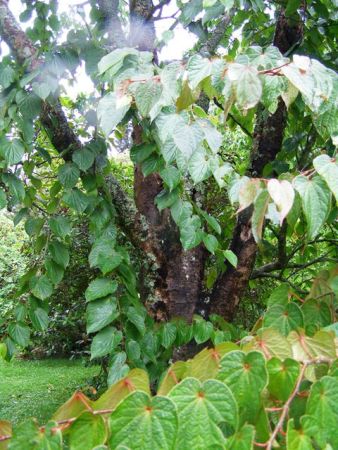
Plant Collector: Tetracentron sinense

Tetracentron sinense

Tetracentron sinense

The Tetracentron sinense growing in our park is a pretty special tree for us. We rate it as a small tree – after five decades it is still only about six metres high and with a graceful, arching habit of growth. It is deciduous and the fresh spring growth emerges pink which seems appropriate for heart shaped leaves, but only briefly before it turns green, though keeping the red stems.

Sinense means it comes from China, on the western reaches where it borders with Nepal. It is a relatively late discovery, dating to 1901. As far as is known, there are no other members of the Tetracentron family (which makes it monotypic – meaning one of a kind). Our tree grew from seed collected in the 1950s. Frank Kingdon-Ward (often incorrectly referred to as Kingdom Ward) was an intrepid British plant collector and, like many of his forbears, financed some of his expeditions by selling subscriptions in return for seed. Mark’s father, Felix Jury, subscribed though we don’t know now how much he contributed. He received the tetracentron and a rhus which we could have done without.

It flowers in summer with relatively insignificant yellow catkins, though loved by bees. In our climate we don’t get autumn colour and I can’t find any mention in the literature so I would guess nobody else does either. I did find wildly varied accounts of its ultimate size – up to 40 metres in fact which is enormous. I can’t think that our specimen, rated by international experts who have seen it as a large example, is ever going to get to that stature. However it is apparently rare in the wild (sightings are recorded) so perhaps the heights are more a case of guesstimates.

First published in the Waikato Times and reproduced here with their permission.