Tag Archives: The plant collector

Plant Collector – Higo Iris

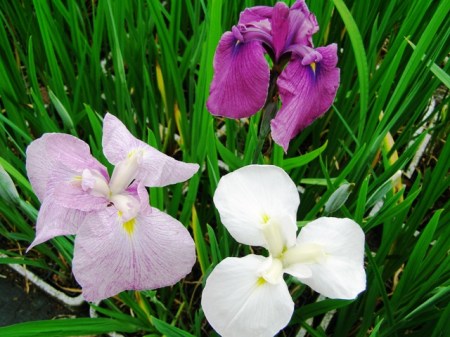
Remarkable seedling variation in the Higo Iris
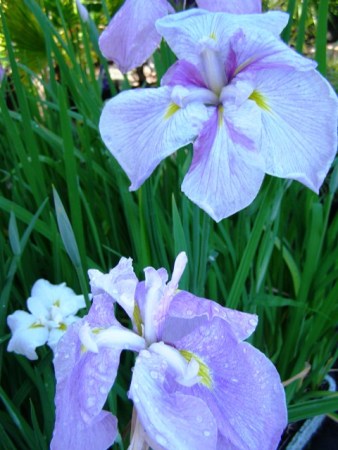
Remarkable seedling variation in the Higo Iris


We are particularly delighted with the Higo irises at the moment, all 700 of them which are in small pots in the nursery awaiting planting out. These are often called the Japanese water iris because they are happy to live in pretty soggy situations.

Unravelling the family tree of Higo is not straightforward. Japanese water iris all descend from I.ensata but around 500 years of breeding has seen different strains developed – Edo, Higo and Ise. Many of these hybrids resulted from a search for perfection in a single bloom, to be brought indoors and contemplated as a transient thing of beauty. This does not necessarily make for garden plants. Mark had tried some large flowered Higos in the past and not had success with them. Not only did the blooms weather damage too readily for our climate, the plants could not cope with anything other than optimal conditions in very well cultivated soil.

Wanting a strain which is closer to the original species and therefore likely to have smaller flowers and maybe a more robust nature, Mark was delighted when Auckland plantsman, Terry Hatch, offered him a tray of plants reputedly derived from wild collected seed. It has taken a little effort to pot on the plants and grow them to flowering size but this spring it has all been worth it. There is a huge range of flower size, markings and colourings coming through in the plants though we doubt that they are anywhere close to the original species which grew in the marshes near Tokyo 500 years ago.

Most of the 700 are destined for planting in swathes on the margins of our ponds and stream though I shall get down on a few and experiment with growing them in garden borders. The critical issue appears to be ensuring that they never dry out completely.

First published in the Waikato Times and reproduced here with their permission.
Plant Collector – Rosa Roseraie de l’Hay

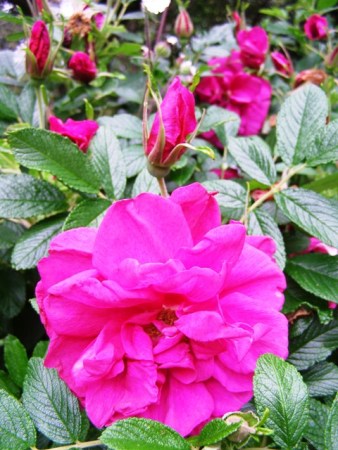
Rosa Roseraie de 'Hay

Rosa Roseraie de 'Hay

I think this is what is called an oldie but a goodie. It has been around since 1901 when it was bred in France and is still widely offered for sale. What is more, it has an Award of Merit from the prestigious UK Royal Horticulture Society. It is relatively large growing and tolerant of mistreatment, which is just as well because I planted it in the wrong place to start with and had to move it. In the two years it took me to find it a suitable forever home (as the Living Channel terms a permanent location), it just sat in our heap of old potting mix and it didn’t turn a hair.

The rugosas are a rose group from the coastal areas of China, Japan and Korea. They are renowned for being tough, hardy, tolerant of wide range of conditions (including salt laden winds) and high health. They don’t generally suffer from pests and diseases and stay looking good, even if you never spray. We even get the bonus of late autumn colour when the heavily ribbed and crinkled leaves turn golden yellow. The flowers are deliciously fragrant.

On the down side, they must be one of the prickliest of all the rose groups and they are not a good cut flower. It is hard to find the perfect plant. Rugosas are sometimes used for hedging and they will certainly provide a fierce burglar deterrent but you have to accept their winter dormancy when there are no leaves. Roseraie de l’Hay is sometimes optimistically described as purple or even red. Colour is subjective but I would call it indubitably deep cerise or crimson. If that is not a colour that appeals, the white equivalent which shares the same attributes, is the equally lovely and reliable Blanc Double de Coubert whose flowers are a bit like scented, crumpled tissue paper.

Roseraie can be translated as rose garden. The rose is named for the famed rose garden de l’Hay near Paris.

First published in the Waikato Times and reproduced here with their permission.

Plant Collector: Dracophyllum latifolium (or neinei)

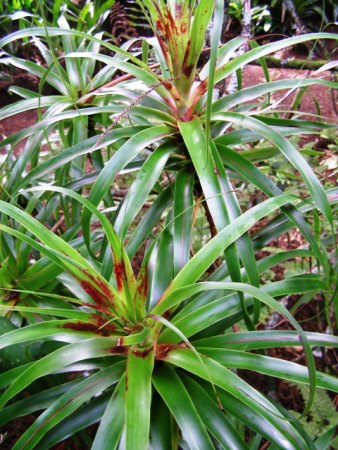
This is a seriously cool small tree to have in the garden. What is more, it is a native. It is often referred to as a grass tree because the long, thin leaves grow in tufts at the tips of branches but Mark has always thought of them as being like the trees from a Dr Seuss picture book with their wavy candelabra branch structure.

D. latifolium is reasonably widespread across the upper half of the North Island, occurring naturally as far south as North Taranaki but you don’t see a lot of them in the wild. They are an under canopy tree but not in dense forest as they prefer more light and less competition. In a garden situation, this tends to translate to woodland conditions – never too wet but never drying out and with filtered light. They are happier in company, so even though they are curious enough to warrant pride of place, they don’t want to be specimen trees standing alone. Apparently they have been recorded up to 10m high in the wild but our specimens have never got much over 2.5m in several decades.

The particularly curious Dracophyllum latifolium

It is now thought that our dracophyllums originated in Australia and arrived here (presumably by wind blown seed) a mere few million years ago, since when they have evolved into 40 different species. They have alkaloids in the foliage which make them unpleasant to browsing animals and these also inhibit fungal growth so the fallen leaves don’t break down but instead form long lived carpets beneath the tree.

The trick to gathering seed is all in the timing. Gather it too early and the seed will not be ripe. If you leave it too late, the seed pod will have dehisced – cracked open on the tree and released the seed. If you do gather seed, sow them immediately in seed trays and be patient. We do not get seedlings sprouting up naturally in our garden, despite having several trees.

First published in the Waikato Times and reproduced here with their permission.
Plant Collector: Geranium maderense

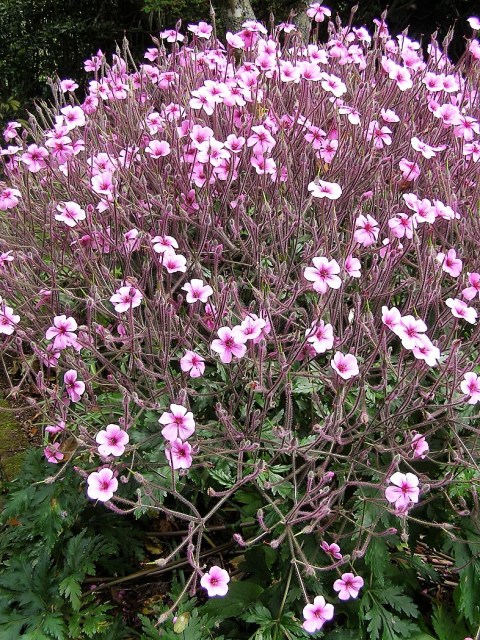
Geranium maderense

There is nothing rare about Geranium maderense but it is certainly eye-catching if you have not seen it before. The only tricky part seems to be getting the first plant to grow. It then sets seed prolifically and it will continue coming up for years to come. I weed out most of them, leaving two or three to grow on to flowering size each season.

This is the largest of the geranium family and it is biennial. It doesn’t flower until its second year and then it puts on a huge show, sets seed and dies. By this point it is at least a metre high and a metre across so it does require space. Curiously, its lower leaves (which are large and attractive in their own right) become elbows resting on the ground to enable the plant to stand upright without support when flowering time arrives. It comes from the island of Madeira and to save you looking it up, this island group belong to Portugal and is located southwards to the west (or left) of North Africa. So this geranium comes from a hot, dry, maritime climate and is not particularly hardy to cold areas but it seems to be resilient in a range of soil conditions.

Elbows!

Apparently the Romans used to call Madeira the Purple Isles which seems appropriate given the most common form of G. maderense is in cerise to purple tones. There is a white form available. Terry Hatch from Joy Plants on the northern border of the Waikato gave us three plants of the white form but, alas, they failed to survive with us. This may be because we didn’t get around to planting them out quickly enough though others have told me they have tried and lost the common purple form too. If you are going to try growing G. maderense, go for a position which offers warmth, sun, good drainage and space.

First published in the Waikato Times and reproduced here with their permission.
Postscript: I have just been alerted to the existence of an endangered geranium in Hawaii which would almost certainly beat G. maderense on size. Geranium arboreum can reach up to 4 metres high, though it does not appear to be as showy in bloom as the second place-getter in the big geranium stakes.

Plant Collector: Hippeastrum papilio

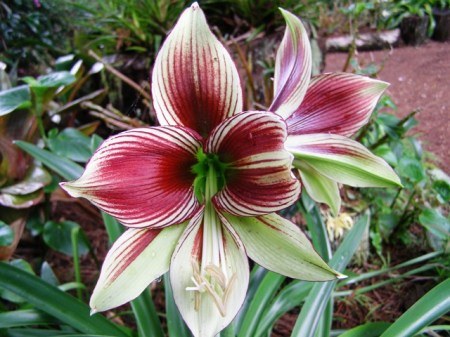
The exotic looking Hippeastrum papilio

The exotic looking Hippeastrum papilio

Papilio is Latin for butterfly, though it would be a pretty spectacular butterfly to rival this lovely bulb from Brazil. I think it is more orchid-like in its markings and colouring of burgundy, green and cream. In fact it is positively exotic and is a showstopper if you can get it flowering in the garden.

Hippeastrums are often misnamed as amaryllis. They belong to the Amaryllidaceae family but that does not make them amaryllis – that would be like saying parsley is the same as carrot because they come from the same botanical family. H. papilio is a species (which is as it occurs in the wild) although much hybridising has been done within the wider hippeastrum family to get spectacular named cultivars for showy pot plants. It grows from large bulbs and there are usually two flowers to each stem, each bloom being about 18cm across and held up well, without needing support.

The biggest problem here is the dreaded narcissi fly which lays its eggs at the base of the leaves. The larvae hatch and burrow down, eating the bulb from inside out. For this reason, we grow H. papilio as a woodland plant in a raised bed rich in humus. The narcissi fly seem to prefer the sunshine. The raised bed means excellent drainage which solves the other problem which is the bulbs rotting out in wet and cold winter conditions. We find it is largely evergreen here, keeping its foliage all year in normal conditions.

The bulbs are large and slow to increase so best left undisturbed for several years. H. papilio is sometimes offered for sale in garden centres but be prepared to pay a fair amount for it because it can take several years to get the bulb to flowering size.

The other hippeastrum species that we have great success with in the garden here is the beautiful winter flowering H. aulicum, also from Brazil.