Tag Archives: The plant collector

Plant Collector – Azalea mollis

Look at me! Look at me! Azalea mollis

Look at me! Look at me! Azalea mollis

The mollis azaleas can be such a wonderfully flamboyant addition to a garden with strident colours which shout “look at me”! They are members of the rhododendron family but deciduous, cold tolerant and more forgiving of less than ideal soil conditions, particularly wetter and heavier ground. Many have fragrance which is gilding the lily further. Not all of them are such loud colours. You can get pastels, whites and subdued shades which show more refined taste, perhaps. But the vibrant oranges, yellows, reds and colour mixes have an intensity which is unrivalled in other members of the rhododendron family, magnified by the fact that they flower on bare wood, before the new season foliage appears.

Azalea mollis used to be very popular but are nowhere near as readily available these days. Their habits don’t suit modern nursery growing practices and they are only saleable when in flower so garden centres often shy away from them. In winter they are just bare sticks and in summer they are relatively anonymous and prone to mildew in warmer, humid climates. Their comparatively short selling season does not suit modern plant retailing so you may have to search them out and grab them when you find them without worrying too much about particular named cultivars. They are easy to raise from seed and often what is sold are just seedlings. Plant them in sunny positions where they can star in flower and not be too obvious when they aren’t.

Azalea mollis are not a species (which is how they occur in the wild). They are hybrids from controlled crosses, initially between the Chinese and Japanese azaleas but now pretty mixed in their genetics.

First published in the Waikato Times and reproduced here with their permission.

Plant Collector: Scadoxus puniceus

Scadoxus puniceus - another gem from the bulb wonderland of southern Africa

Scadoxus puniceus - another gem from the bulb wonderland of southern Africa

The bulb wonderland of southern Africa gives us this mid to late spring flowering treasure from Natal. Scadoxus puniceus is not often seen in the country and rarely offered for sale but well worth having if you find it. The bulbs are large fist-sized affairs and slow to increase, but if you find somebody with a plant, it sets seed and as long as you are working with fresh seed, it germinates readily.

Usually the flower stem appears first in late winter, followed soon after by the lush pale lettuce green foliage. The relatively large flowers consist of a mass of orange stamens surrounded by a maroon outer petal casing, which is not a common colour combination in any plant. It is happy in woodland or semi shade conditions which never get hot and dry in summer or cold and wet in winter. The former will force it into early dormancy whereas the latter will rot out the bulb.

It is the same family as Scadoxus multiflorus ssp. katherinae which is far more readily available. Katherinae has large spherical flower heads in red which look like a mass of spidery stamens and runs about three months behind puniceus. It is just coming into growth now and will flower in mid to late summer making a real feature in the summer garden.

Plant Collector: Arisaema sikokianum

Arisaema sikokianum

Arisaema sikokianum

You have to love arisaemas. They are notable for their ability to change sex. When immature or not growing strongly, they are male. When romping away with vim and vigour, they become female and capable of setting seed. The poor weak male will still flower but is only suitable as a pollen donor. Should the female weaken itself by setting too much seed or coming under stress, it will have a little rest, becoming a male again. Is this a commentary on the human condition, I ask.

A. sikokianum is a Japanese species, remarkable because it is one of the few which holds it head above the foliage. Most varieties hide coyly beneath a canopy of leaves but sikokianum stands erect and proud, and somewhat phallic in appearance even when female. It grows from a flattish, circular corm but the problem is that, unlike most corms, bulbs and tubers (including most other arisaemas), it doesn’t multiply and set offshoots. You have to gather seed to increase it by raising them in pots or seed trays. But it is worth the effort to get a little clump or drift because the flowers last for weeks and are truly eye-catching. These are woodland plants, happiest with a light canopy of trees above, and humus rich soil which never dries out but which never gets waterlogged.

Arisaemas belong to the Araceae family which also includes arum lilies and the mouse plant (arisarum). You may have picked certain similarities in appearance, though they are not close relatives. A. sikokianum is available in New Zealand though you will have to search it out. These treasures are not standard garden department fare in this day and age. We also have quite a bit of success with A. speciosum (which is easy to grow and multiply) and A. candidissimum, if you find them available but we struggle with some of the showy varieties which need more of a winter chill.

Rhododendon johnstoneaum “Ken Burns”

Rhododendron johnstoneanum "Ken Burns"

Rhododendron johnstoneanum "Ken Burns"

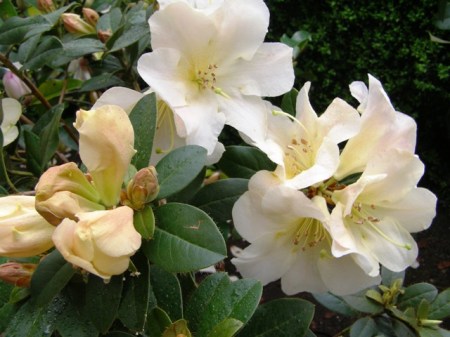
October is the peak time for rhododendrons and while this group of plants has seen a considerable slide in popularity in recent years, there is delicious anticipation in watching buds fatten, show colour and then gradually open. We would not want to be without plenty of them in our garden and this week it is “Ken Burns” that is looking delightful. It is hard to describe the colour. I would call it honey buff, others describe it as champagne. The buds are buffy yellow with a pink flush and the fully open flowers fade out to a cream with a yellow throat. It is even lightly scented. The leaves are quite small and slightly hairy and the plant stays well furnished and compact to about 1.2 metres high and a similar width. But for those of us living in warmer parts of the country, one of the real stand-out features of “Ken Burns” is that it stays healthy and rarely gets affected by nasty thrips (which turn the leaves silver and weaken the plant) or by sun scorch.

I had always thought that this is just a superior selection of the species R. johnstoneanum (which is as it occurs in the wild – raising species from seed gives variation within the seedlings), but it appears that there is a school of thought that it may be a natural hybrid (in other words, R. johnstoneaum crossed with something else unknown). The story goes that the original plant was growing in the garden of Mr Ken Burns who lived near Timaru and it was nearly lost when a bullock leaned too heavily on the fence and inflicted major damage on it. Somebody salvaged the plant and named it for Mr Burns. It is not at all the done thing to name plants after oneself. Since then, all plants bearing this name have been propagated by cutting which keeps the plant true to name. To raise it from seed would be to give rise to more seedling variation so it would no longer be “Ken Burns”.

Cyrtanthus falcatus

Cyrtanthus falcatus - more a curiosity than a beauty

Cyrtanthus falcatus - more a curiosity than a beauty

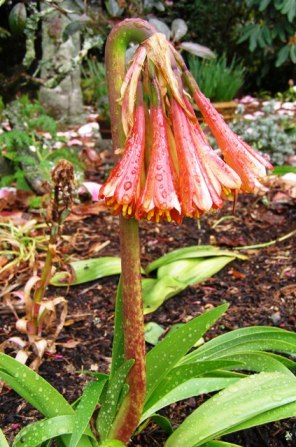
We are rather delighted with our Cyrtanthus falcatus this week. It is not that it is a flower of great beauty in its own right, more that it is a plant of great curiosity and a bit of triumph to grow in the garden.

The cyrtanthus family come from South Africa. By far the most common form is the one widely known as the red vallota (Vallota speciosa, often called the Scarborough lily though it is a member of the amaryllis family and not a lily at all). We also use the dainty but sweetly scented evergreen Cyrtanthus mackenii in the rockery. It will not stop you in your tracks. But C. falcatus will attract anybody who is interested in plants.

We first saw it flowering in the UK in a glasshouse at Wisley back in the mid nineties and have never seen it flower in this country. That is not to say that it hasn’t ever flowered here, just that we haven’t seen or heard of it flowering. Auckland plantsman, Terry Hatch, listed it many years ago and Mark bought several bulbs. Only one survived. He had been trying to grow them in containers but in desperation planted the last remaining specimen into the garden where it has thrived and multiplied. The original bulb is now about the size of a belladonna bulb, so large, and has at least three visible offsets. But this is its first flowering. We have only waited well over a decade, maybe even fifteen years for this event. The mottled stem is about 30cm, strong and curved at the top like an upside down umbrella handle so the reddish pendant flowers face downwards. Who knows, given another decade or two, we may have a whole drift of them and they will undoubtedly be more spectacular when there is more than one. Good things take time.