Tag Archives: Tikorangi: The Jury garden

Plum Summer

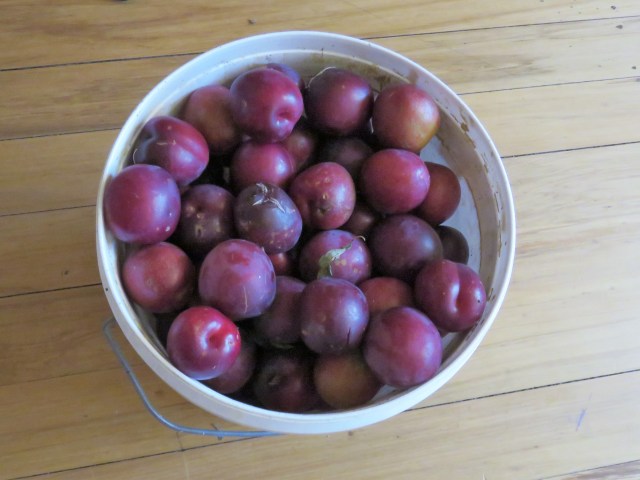
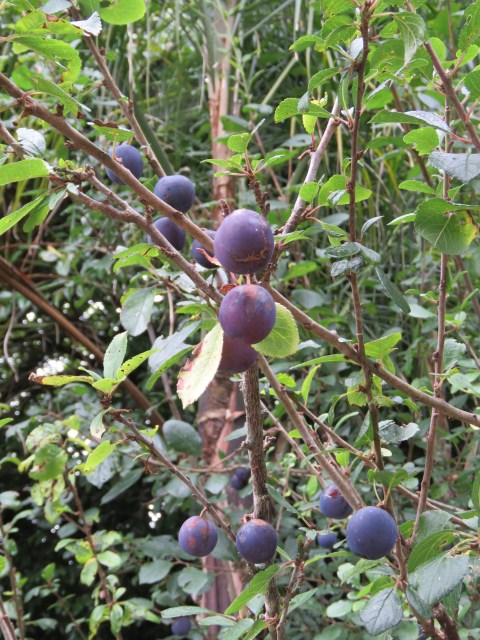
Plums by the bucket-load. Literally. These ones are ‘Hawera’ which I presume is a local selection from the South Taranaki town of the same name.

A plumcalypse! We must have had good weather around plum-blossom season because the crop is prolific this year. My will to ensure that no plum go to waste is fading fast. It is becoming more of an endurance test than a triumph of my inner Squirrel Nutkin instincts.

Many New Zealanders will remember the children’s book named ‘Jam’ by the late, great Margaret Mahy. The online blurb reads: “A delightful tale by Margaret Mahy about an industrious stay-at-home dad who is on a mission to ensure his family gets the most out of their plum harvest.” I can relate. I went looking for our copy of the book which dates back to when our children were small but as I couldn’t find it, I assume I sent it to Canberra daughter who went through a similar plummy summer, as I recall.

What to do with plums in a household where we don’t eat jam and where dessert is generally confined to Christmas dinner? I certainly never cook plum crumble, pie or duff and jammy sandwiches or jam on toast are not part of our diet here.

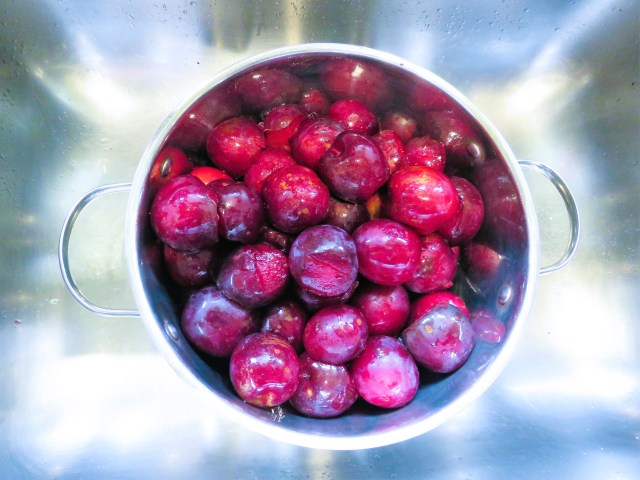
I add just enough water to stop the plums from burning on the bottom of the pan before they release their juices but I don’t add sugar until I get them out of the freezer to use.

I have frozen as many lightly stewed plums as I think we will consume over the next year. Stewed fruit is never the top of my list – I would rather eat fresh fruit. But we eat fruit every morning with muesli and I find that Alison Holst’s vintage rhubarb sago recipe works very well with plums. It is very simple: add a scant ¼ cup of sago to a 2 or 3 of cups of fruit with sugar to taste and cook it until the sago grains are expanded and clear. I find the microwave is better than the stove element because the time between the grains being still hard and them softening enough to stick to the bottom of the pot is very brief. The result is a sort of jellied version of the fruit which I enjoy with muesli or yoghurt.

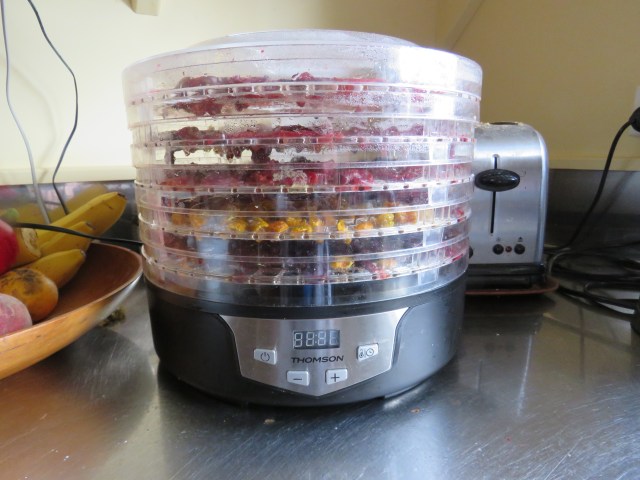
I have dehydrated a swag of plums. It condenses the fruit down to a very small space – a full bucket  can reduce to four tiny snack bags. I bought a cheap dehydrator in the first year of Covid, as we now refer to 2020, and I have never regretted it. It was about $40 online and, unlike the early behemoths of dehydrators, it is small enough to fit in a cupboard and it has temperature controls. It is probably only worth owning if you grow your own fruit and vegetables but I no longer buy dried fruit for baking, although it means I substitute the variety of fruit specified in recipes. We now have plenty of dried and semi-dried plums.

Yesterday, I made spicy plum sauce but as a household of two, we don’t need litres of plum sauce so that only used 500 grams of plums.

And still the plums come.  I have given them away by the bucket-load but now, when I ask others around me if they want some plums, there is a hesitancy in their replies which tells me they, too, have reached the point of over-load. But the last heavy-fruiting tree, the ‘Hawera’ is now past its peak so the flush is over. Just the damsons to come.

I am not going to cut the damson out but if it died, it is unlikely I would bother replacing it.

I differ from my colleague, Lynda Hallinan, in that I do not rate the damson tree highly. It really isn’t a good plum for eating fresh. It makes good jams and jellies. It dehydrates well. I take the stones out first so it does require a bit of faffing around because the fruit are so small. Beyond that, its main use seems to be making damson gin. I have made damson gin in the past but, along with shunning jam and desserts, we don’t like sweet drinks and damson gin is essentially a sweet liqueur. I would rather drink the gin without the long steeping in damsons and sugar. But I am not averse to pink gin and flavoured gins so I think I may try steeping the damsons in gin without the addition of sugar. Topped up with soda water, I think it might lift a cheap gin to a new level of interest and flavour. It leaves the problem of what to do with the byproduct of damsons pickled in gin in a dessert-free household. I will face that problem when I get to it.

The bottom line is that I wouldn’t recommend planting a damson tree where space is limited. There are many better eating options. ‘Hawera’ and ‘Sultan’ are our best eaters. The failure of the ‘Omega’ crop again is likely related to its location. The ‘Phillips’ plums are not the most exciting plum by any means but they are reliable, prolific croppers and early season. Sadly, we cut out the Blue Gage and the Green Gage because they didn’t crop in our climate. They likely prefer drier climates with more winter chill. So too do the apricots and cherries that I would prefer to grow.

Helpful readers identified the plum I photographed last week as a ‘Luisa’. I was all for buying one until I questioned myself as to whether we actually need yet more plums. Maybe not.

Marigolds! And a community orchard.

On Friday, our weeks of fine weather broke and it was grey and starting to rain as I headed into our local town of Waitara for essential supplies like gin and dogfood.

Marigolds have never featured on my list of plants to grow but this display in a front garden was so joyously eye-catching that I turned the car around and went back for a second look. I knocked on the front door to ask permission because, even if it is legal to photograph from the footpath, it feels a bit rude to be in front of a stranger’s home taking photos. Permission was granted readily and with evident pride.

For those of you who don’t know the place, Waitara is a small coastal and river-mouth town of about 7000 people. I will brook no argument when I declare that it has the best climate of anywhere in Taranaki, but it has long been seen as a lower socio-economic area and never as desirable as other satellite areas of New Plymouth. So far, it has largely escaped gentrification and it certainly has a character of its own with a rich pre-colonial history and a complicated and often tense history in times since colonial settlement started. It also has a community orchard.

It is a bit hard to read but the faded sign says ‘Welcome to the Waitara Orchard’

The orchard is low-key, as illustrated by the only sign I saw. It is not flash and clearly the maintenance regime is fairly light but it is remarkably extensive and undergoing expansion yet again. We are not talking just a few fruit trees. I am pretty sure that it is supported by the local council and community board who presumably provide the land, a bit of financial support and some level of essential maintenance while the rest is carried out by volunteers.

There is a lot of orchard at varying degrees of maturity

We don’t need the fruit ourselves and it would drive me nuts because I bet people pick a lot of the fruit before it is fully ripe. If I lived nearby, I would be eyeing up a tree thinking the fruit needs another week before it is ready to pick and somebody else would swoop in and pick it while I waited for optimal timing, but that is the way of an open community garden. Judging by the very few remaining windfalls beneath the plum trees that had finished fruiting, most of it is being collected by people whose needs are greater than ours.

Can anybody identify this variety? It will have been purchased locally.

Nothing is labelled. There were a couple of trees heavily laden with what look to be a plum hybrid which were still too firm to test for flavour. I would like to know what variety they are because they are performing very well.

There is a good project there for somebody to map the orchard and track the performance of all the many different cultivars, providing a resource of information that would be both helpful and relevant to local residents who may be thinking of planting their own fruit trees. If I lived close by, I would start doing it.

The fig trees were looking good and are a good fruit option where there isn’t much maintenance of plants going on
The bridge could do with a bit of repair

The figs were growing well. There were a lot of citrus trees (wrong season for those but plenty of small green fruit set for later in the year). The apples were patchy in fruit set. Some had lots of fruit, others needed a spray and some pruning. I am sure that various stone fruit have been planted – peaches, apricots and nectarines – but I would have to live closer to monitor those to determine which varieties were fruiting and growing well in our climate which is distinctly marginal for any stone fruit other than plums. I would guess there were pear trees there too, but the rain was getting heavier and a collapsing bridge discouraged me from exploring further.

Citrus are a good crop in our benign climate and not at all demanding in terms of general maintenance

Maybe it is because it is so low-key and community-based that this orchard can not only survive but also expand. What a wonderful resource it is, even more so in a small town with a median income well below the national average.

The marigolds and community orchard made my morning.

I would guess that wood chip mulch or maybe compost has been supplied by the local council

Summer time

Gazanias, I think – though I confess to knowing nothing about gazanias – growing amongst the retaining rocks at Urenui Beach

It has been a busy couple of weeks. Well, busy in a high summer, low-key, somewhat retired sort of way. We had a small UK garden tour through on Friday and we wanted to present our best face while managing to find time for activities and family while our eldest child is home for a summer holiday with our only grandchild.

A small UK garden tour, led by our most favourite tour leader of all, Trevor Edwards wearing his trademark pink scarf

The tour is done and dusted and the daughter and grandson fly back to Canberra tomorrow. Come Tuesday, I may be wondering what to do with myself. Hosting a garden tour is different to opening the garden to the general public because we get to determine which route to take around the garden and it is possible to skirt certain areas if necessary. When the garden is open to all comers and people wander where they like and take as long as they like, everywhere has to be presented well. This means tours are less stressful in terms of preparation but it still takes a sustained effort just to add that extra polish. That is it for visitors now until October and November when we have a conference and a couple of overseas tours booked.

Tongaporutu Beach on a crowded Saturday afternoon
Fish and chips at Urenui Beach – a family tradition

In-between, we have been out and about. Daughter has been keen to introduce her six-year-old to the experiences she remembered from her childhood summers. Taranaki beaches, she comments, are different to the Australian beaches that he usually visits. There is nothing but ocean between us and Australia and our beaches are often big, wild and with very little development – and usually without many people. And black iron sand, of course. Taranaki children learn from a very young age to wear sandals to cross the dry sand on sunny days because that sand heats up to a burning temperature. We know from past experience that if you take a dog with you, it is often necessary to carry it over the dry sand sections. Fish and chips at Urenui Beach are a family tradition, though I did remind the daughter that when she was little and we were a great deal poorer, it was in fact the cheap hot chips without the fish.

*Our* beach at Tongporutu

Tongaporutu has the best beach, in our books. We regard it as *our* beach. Mark’s parents built a modest little holiday house there (known as a bach in the North Island of NZ, a crib in the South Island). We lived there for the year when our daughter was born and spent a fair amount of time there when the children were young. We knew pretty much every nook and cranny. Daughter noted it had clearly become an Instagram location, to the extent that you can now buy a latte coffee or Kapiti icecream in a cone now. But the beach itself is large enough to never feel crowded, even on a busy Saturday afternoon.

The six-year-old was not as keen on the visit to the field of sunflowers, although a little mollified when he was allowed to cut one head of his choice from the picking field. But daughter and I were charmed, even as she commented that it was another particularly Instagrammable attraction. I don’t use Instagram but as soon as she said that, I could see how much of the set-up was designed for that perfect picture that others seek to post.

Grandson was happy with buying just one selected sunflower but others splashed out on more as they posed on the old tractor or the hay bales for the Insta shots
Summer in Italy, 2017. On the road to Giardino di Ninfa.

It reminded me of the fields of sunflowers grown as a commercial crop that I stopped to photograph in Italy, on the road between the garden of Ninfa and the hilltop village of Sermoneta where we stayed on a particularly memorable visit we made in 2017. I felt a passing pang that our days of international travel are likely over now but at least we saw quite a bit when we could.

This was one of the more low-key vistas of the Festival of Lights, taken from the Poet’s Bridge in Pukekura Park but it was also one of the most charming

No summer visit to our area is complete without an evening jaunt to the Festival of Lights in our New Plymouth city park – Pukekura Park. I admit that it is many years since Mark and I have been and it is certainly an upgraded version these days with technological advances in lighting and a bigger budget. It was a magical experience, albeit one shared with hordes of others. As a free event every evening, it is hugely popular with locals and visitors alike.

The waterfall verged on tacky, perhaps, but high tack at least and it was quite mesmerising

For those who want a bit more plant interest from my posts, look at this wisteria in the park, toilet sign and all. I want to know how they stop that massive trunk from getting infested with borer beetle. I am guessing there must be some intervention to have enabled the wisteria to get to this size.

Tomorrow I will be sad as we put our grandson and daughter on the plane to start the long journey back to Canberra. On Tuesday, who knows? It is summer. I may pick some lilies.

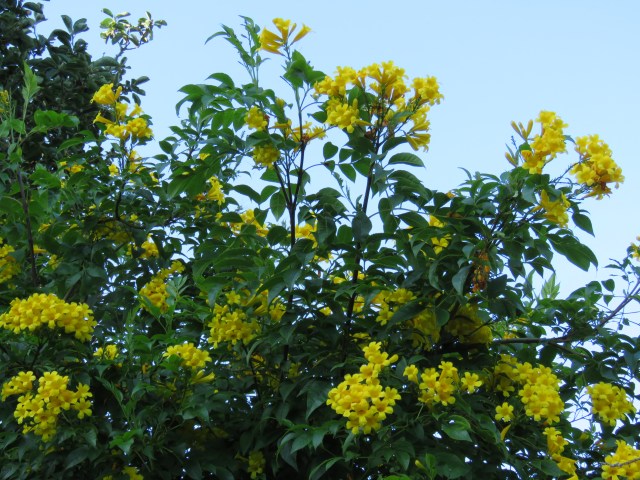
Irrelevant to this post but the Tecomanthe venusta – a tropical climber from Papua New Guinea is putting on an astounding show on the wall outside my office window.

Golden orbs of summer

Golden Aurelians in the summer borders

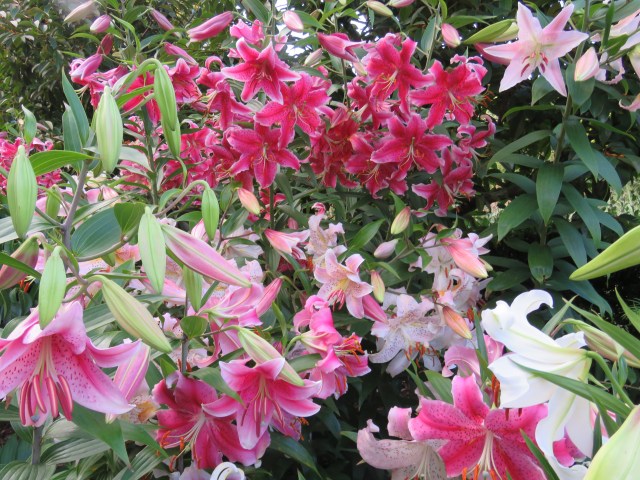
Auratum lilies may carry the moniker of the golden rayed lily of Japan but it is our golden Aurelians from China that are lighting up my week. It hadn’t really dawned on me that our Aurelians, which are all either golden yellow or rich apricot, are not the same as many others’ Aurelians. This is entirely due to Mark’s efforts many years ago.

We only have two colours. Most are golden yellow but the apricot orange ones are closer to their ancestor, L. henryi.

An internet search showed me an array of Aurelians which are much more varied in colour and not all are as good as ours. Because we only had them in two colours, I somehow assumed that they only came in two colours and, because most of ours are in sunny yellow, I vaguely thought that would be the dominant form. Not so.

Mark’s father, Felix, had one named Aurelian in soft orange. Mark acquired some pollen from a third party and he is a bit vague now as to who it was because it was so long ago. Our plants are all the result of that effort, and not only are they very good, they are also consistent.

In the absence of my own photos, I had to source these species from Wiki Commons. Lilium henryi to the left and L. sargentiae to the right – the original parents of our Aurelians.
Nothing to do with Aurelians, but just because I have a nice photo of it, the tiger lily or Lilium lancifolium also known as Lilium tigrinum growing through an apple tree

I disentangled the heritage of the Aurelians some years ago and it seems that they are all hybrids starting with Lilium henryi from China, originally crossed with another Chinese species L. sargentiae. We don’t have L. henryi here any longer. Mark says he was once given a good form of it but he lost it. It is sometimes referred to as the tiger lily (probably because of its dark spots) but the tiger lily is more commonly used as shorthand for Lilium lancifolium syn. L. tigrinum which we do have. They are similar in flower form with reflexed petals but different shades of orange. L. sargentiae brought in the trumpet shape and the scent and the ever-handy internet shows me that it is a similar type of lily to what we often refer to as the Christmas lily (on account of it flowering at Christmas in the antipodes) or the regal lily – Lilium regale. Since then, the genetics have become ever more mixed as other species have been used in breeding but the ancestors of our golden and apricot delights lie back in the mists of time with those two species, henryi and sargentiae.

I see I planted a few Aurelians in the Iolanthe bee and butterfly garden but I had forgotten about that until they flowered again this year.

Their bulbs are enormous – larger than the auratums – and the stronger the plant is growing, the more flowers there will be. I see I have counted up to 18 in the past but the strongest growing stem this year is 14 flowers. I have interspersed them through the summer borders where some, at least, are held upright by other plants. I have to stake the others because the weight of the flowers pulls them over and they can be up to 2 metres in height. Their flowering season is maybe not as long as the auratums but they come into their peak earlier in the season. They are scented but not with that heady fragrance that hangs in the air like their big show-off auratum cousins. When they started life on the fringes of Mark’s vegetable garden, I used to cut them to bring indoors and they cut and hold very well. These days, I just enjoy them in the garden.

Agapanthus must be the most universally despised flowering plant in Aotearoa New Zealand but I have a patch in the summer garden and I always love the combination of blue and yellow.

Aureum is  Latin for golden and Marcus Aurelius was a Roman emperor whom history records as somewhat more benign than many other emperors and indeed he made a significant contribution to philosophical thinking.

To me, the Aurelians are like golden orbs of summer.

Gardening – more about moments in time than achieving goals

🎵If I could save time in a bottle

The first thing that I’d like to do

Is to save every day till eternity passes away 🎵

Only some photos serve as a reminder of a point in time when the delight was so strong that it sparked a response that is felt physically as much as emotionally

My (very) late mother used to remark how rapidly time passes as we age and I certainly know what she meant. But even when I was younger, I could see how our perception of time changes. When we are seven, a year is a seventh of our lifetime which seems a remarkably long time. When we are seventy – not quite yet in my case but looming ever closer – a year is but a seventieth of our time spent so far on earth. And time does indeed seem to pass at an alarming rate.

A moment in time in September 2019 that seemed perfection – Magnolia Iolanthe in bloom

I find it almost beyond comprehension that we are coming to the end of the third year of the pandemic that turned our world inside out. Three years? Already? Three years in March in this country since the then deputy prime minister issued an alarming warning to New Zealanders abroad to get home now while they still could. It sounded overly dramatic at the time but within just a few days, borders started closing and flights ceased.

Thank goodness for the garden which is our anchor and our refuge.

An April experience I remember well – helianthus, Stipa gigantea and miscanthus moving in a fairly strong breeze in the Court Garden which seemed like the successful culmination of a mental vision at the time.

It was thinking about those who want to freeze time in the garden that brought Jim Croce’s song to my mind. I must have said it before, but I will say again: gardening is a process not a product that can be frozen in time. I fully understand that it is not everybody’s cup of tea. There are many things in life that are of little interest to me. Activities like golf, going to the gym or All Blacks rugby bypass me entirely. I am not a fan of mosaics and I very rarely go to the movies. I garden almost every day. I don’t garden with a view to reaching the final goal of getting the place looking exactly how I want it and expecting it to remain like that.  If that is a personal goal, take up interior design instead, is my advice. It is easier to stage a scene and freeze it in time indoors.

For me, it is often the wilder areas of the garden that spark a response that goes beyond quiet satisfaction or contentment, going more into joyous end of the spectrum.

But there are moments in time when I look at the garden – sometimes a full scene or vista and sometimes just a close-up of a small section – and I sigh with joy. ‘Ah,’ I think, ‘that is just perfect.’ It is a physical reaction when I feel my heart is singing.

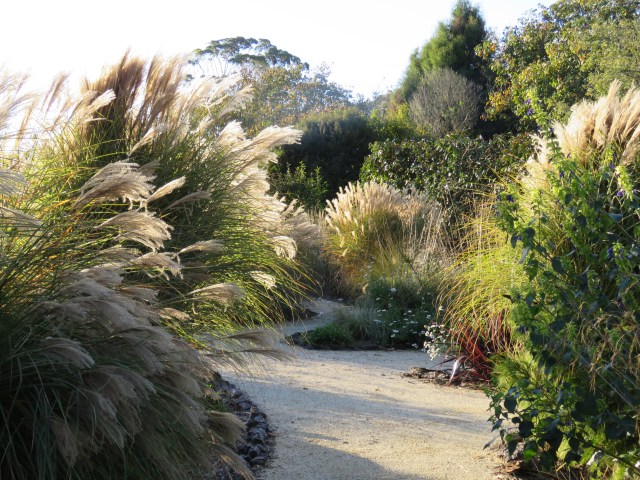
Late afternoon autumn light falling on the flowers of Miscanthus ‘Morning Light’

Those are times I would save in a bottle if I could. All I can do is to save them in my memory or sometimes capture the moment on camera to remind me later. Those moments are the gardener’s adrenaline, in a low-key sort of way. We know that the scene will change – very rapidly if it is dependent on a particular quality of light, a couple of weeks if it is dependent on recent garden maintenance, more slowly if it is a case of a composition of plants that works brilliantly for part of the season.

Gardening could be likened to a journey with no set destination but plenty to see along the way. If you are goal-oriented, you may be better to take up golf. Or mosaic-making.

May your gardening year have moments of utter magic, joy and contentment that you, too, wish you could bottle and save.

Postscript: We once, and only once, visited a garden that on the day we went was as close to perfection as we have ever seen. It was a private garden in the Cotswolds, UK, and it remains fresh in our memory years later. https://jury.co.nz/2017/07/31/a-perfect-garden/

January – the Scadoxus multiflorus ssp katherinae at the end of the Avenue Garden rarely fails to astound me.