Tag Archives: Travels

Thinking Small in the Big Country

We had cause to travel to Australia a couple of weeks ago for a family celebration. Fortunately, given our timing, we were in Wollongong (south Sydney) and Canberra and our paths only crossed with the 125 000 Catholic pilgrims when it came to flying out of Sydney airport. We avoided the chaos of Sydney, which also meant we missed the Pope. But as I noted the austerity of St Peter’s Square and the near total absence of any vegetation in the Vatican City when I was there a month ago, I doubt that we would have been able to discuss gardening with him.

We have never been to Wollongong before and despite it being a somewhat industrial area, we were rather taken by it. Its location ensures a higher rainfall than many other parts of Australia and the climate was almost balmy. The soulangeana magnolias were at their peak (little sign of them showing colour here) and the presence of sub tropical plants, including an abundance of frangipani, indicates that the area never gets particularly cold. The beautiful blue sky and expanses of pristine beaches had us thinking that maybe Australia is indeed the lucky land. Certainly we did not hear the doom and gloom talk of home. Mind you, that may be a superficial judgement because the TV only showed wall to wall happy, smiling pilgrims.

After a tiki tour of the area which involved much bonding with her father identifying and discussing the multitude of exotic Australian birds, Elder Daughter drove us to her second home in Canberra. I have been to that city before but it was a first for Mark and he was a little shocked at the harshness of the climate. In winter it is very dry and very cold while in summer it is very dry and very hot. He whispered to me that he much preferred Wollongong. Gardening as we know it just is not possible in Canberra.

Daughter commented that none of the Aussie TV gardening gurus she has seen appears to have come to grips with practical design suggestions for front yards. The private courtyard out the back has been done to death, but there is a dearth of ideas when it comes to dealing with the waste of space out the front. Irrigation is on a semi permanent ban so the front lawn and garden does not survive. The only alternatives appear to be green nylon lawn (!) or dyed bark chip mulch (referred to as tan bark). Daughter was suggesting that if she had a front yard, she would be looking at buying a truckload of massive rocks and establishing a rock garden (more rock than garden). Or maybe try a meadow of anigozanthus (kangaroo paws) which, being native, might fare better.

Nylon lawn at up to $120 a square metre

Nylon lawn at up to $120 a square metre. Photo Abbie Jury

Post celebrations (no, neither a wedding nor a grandchild), Daughter and her partner indulged us by taking us to the somewhat remarkable Cockington Green Gardens which had possibly more than a nodding affilation to the genre of Fred and Myrtle’s paua house in Invercargill. No paua, but scaling hitherto unconquered heights of being twee to the point where it takes on a life of its own. It was started by a passionate Anglophile model maker and has recently been expanded with an international section (mostly sponsored by foreign embassies). Leaving aside the plethora of miniature scale buildings, cricket match, soccer match and all the rest of it (and there was a lot of the rest of it including fairy garden and miniature trains), the gardening was dominated primarily by dwarf conifers and clipped and topiaried buxus. Alas we can not get that excited about masses of dwarf conifers, but it was certainly clear that in a much colder climate the conifers colour up a great deal better. The silver blues and burgundies made our few at home look very subdued.

The Treaty House at Cockington Green

The Treaty House at Cockington Green. Photo Abbie Jury

New Zealand was represented by a model of the Treaty House at Waitangi. If I remember correctly, it was the only one not sponsored by the Embassy but I think by an individual instead, which may possibly be an indication that our ambassador to Australia has better taste. After our initial amusement, we were underwhelmed by the gardening at Cockington Green but envious of the evidence of large tourist numbers. Given that Canberra is hardly a tourist hotspot, it makes you realise how few we actually get in Taranaki.

Conifers and buxus and a toy train at Cockington Green

Conifers and buxus and a toy train at Cockington Green. Photo Abbie Jury

As an antidote to the OTT naff nature of Cockington Green, we headed off to the botanic gardens which are devoted entirely to native Australian plants with a purity of purpose which is not necessarily a populist position with locals, who may well prefer some bedding plants and colour. And the dry, open areas were a little arid with no underplanting at all. The hardy natural flora of Australia is nowhere near as exotic as their fauna and around Canberra is heavily dominated by hardy eucalypts. It wasn’t until we reached the bushland plantings that we went: oh yes. As New Zealanders, we take for granted our lush growth, both in the natural environment and in the contrived garden. It is a concept largely foreign to those who live in much harsher environments.

Mark was grateful for the relative absence of plant eating fauna at home. We would be less than impressed to have kangaroos peering out from the understory of the garden and effortlessly hurdling our fences. Possums here are a pest but at least we can shoot them – they are a protected species in Australia. The rosellas, vast flocks of sulphur crested cockatoos, crows and an abundance of other birdlife can wreak havoc in an environment where their main of source of food includes your garden plants. And at least we never got foxes courtesy of the British settlers. We saw tree ferns (yes, Australia has a range of tree ferns of their own) where the new growth had been stripped bare by rosellas in search of the spore.

There really is no place like home and the verdant green environment that we take for granted here is really quite rare. We would rather be here than there. They may be the lucky country economically, but we are the lucky gardening land.

A Garden with a View (in Italy)

I would like to say I am fresh back from the south of Italy, but fresh might be slightly overstating the case. Safely back perhaps. I have never been to this southern area before. We didn’t find anybody who spoke English in Palermo (Sicily), either local or traveller. No English at all and no understanding of any English which gave some impetus to learning a few basic words and phrases in Italian from the back of Lonely Planet Guide.

On a previous visit, Mark and I tripped around the lakes district in the north and saw grand established gardens in the Italian tradition. I had been anticipating similar evidence of great wealth in pockets of the south at least, but if they are there, we did not find them. Sicily, it must be said, has a much hotter and drier climate, more akin to its close neighbours in North Africa, which makes gardening difficult and it remains an area of considerable poverty.

I photocopied the relevant pages from renowned garden writer Charles Quest Ritson’s weighty tome, Gardens of Europe, and following his advice, we sought out Orto Botanico di Palermo (the Bot Gardens). I had thought to find a little more than we did in terms of style and presentation. They hold a notable collection of cacti and succulents which was displayed with all the panache of a working nursery. All plants were in matched terracotta pots serried along wire shelves. If you have a passion for cacti and succulents, there may have been much of interest but I find them distinctly less than riveting.

Plants in serried ranks at Orto Botanico

Plants in serried ranks at Orto Botanico

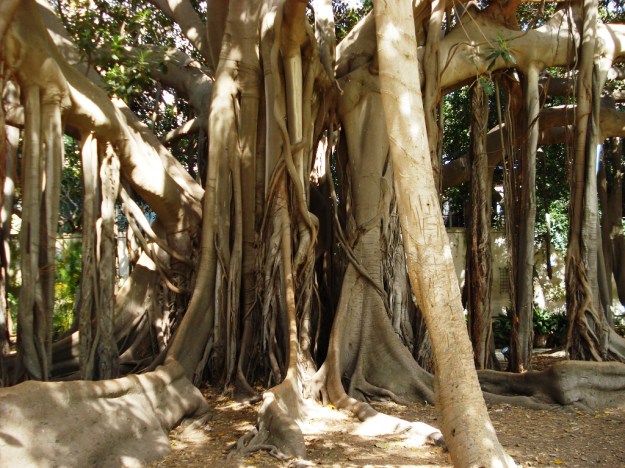
The glasshouses were sparsely furnished with more plants on wire shelves. There were some fine trees growing amongst the dry dust outside but most looked a little hard done by. A recent planting of cycads in the tough kikuya grass was just getting established, although there were more mature specimens of both palms and cycads. A most remarkable plant was a fig tree (ficus macrophylla). Now over 160 years old, it was of enormous proportions and clearly working on a bid for total domination. It puts roots out from on high (known as aerial roots) and when they reach the ground, they bed in giving a multi stemmed effect on a rather intimidating scale.

The ficus bid for total domination at Orto Botanico

The ficus bid for total domination at Orto Botanico

The avenue of false kapok trees (Chorisia speciosa) was attractive but overall I was a little underwhelmed by Palermo’s Orto Botanico.

On the mainland, we sought out Villa Cimbrone in Ravello on the Amalfi Coast. It was a slight mission to get there. The public transport is frequent and cheap, but not for those of a nervous disposition. In this area, the roads are extremely narrow, bordered on one side by an unprotected drop of hundreds of metres to the sea, extremely winding with corners so tight that at times the buses have to reverse up and make more than one attempt to get around, all the while being challenged by speeding Vespas, Fiats and Smart Cars driven by fearless locals.

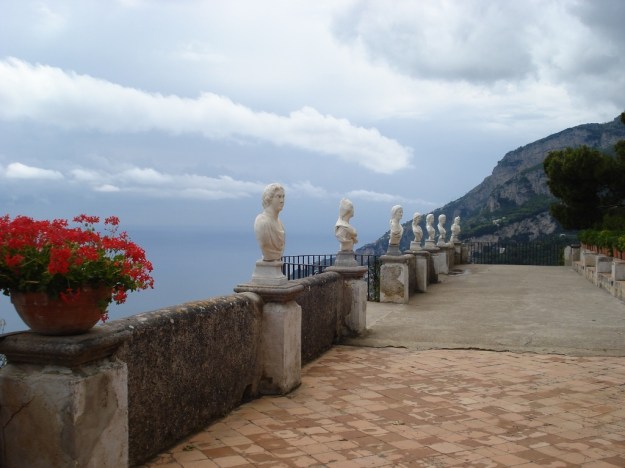
Villa Cimbrone was actually landscaped by an Englishman at the turn of the twentieth century on the site of a neglected Roman estate and is still hailed as a significant garden in the English-Italian style. Now a hotel, I can only say that it must have been grander in its early days. The Avenue of Immensity formed the central axis and it was certainly impressive. It was an extremely long and wide sweep which led us down under festoons of wisteria, flanked by pinus pinea and platanus orientalis, statuary and terracotta pots. It culminated in an open Doric temple leading to the Terrace of Infinity. This was a large belvedere balcony adorned by eighteenth century marble busts, with an astounding view of the Amalfi Coast and the hugely charming villages and citrus groves which tumble down the near vertical hills.

The Terrace of Infinity at Villa Cimbrone

The Terrace of Infinity at Villa Cimbrone

But that was as good as it got. The brochure claimed “an infinite variety of exotic flowers and plants” beside the Avenue of Immensity – but these were mostly agapanthus, with, from memory, some cleomes. The Seat Of Mercury, a large bronze statue of the gods’ messenger at rest, was set in a dirt bowl. The rose terrace was so poor it was ludicrous. Even allowing for the fact that it was only late spring, I could not believe that the roses were ever going to impress and row upon row of pink and red bedding begonias are too municipal altogether.

The gothic crypt (now a functions centre) was magic. I do like the gothic style. The cloister was attractive – a Norman-Sicilian-Arabian courtyard. The traditional Italian statuary fitted right in to the whole environment and gave me cause yet again to reflect that it is no wonder that it looks so out of place in New Zealand gardens where we lack the history and the tradition which anchors this ornamentation in context. But it is the architecture and the setting which are the redeeming features of this garden, certainly not current gardening practice.

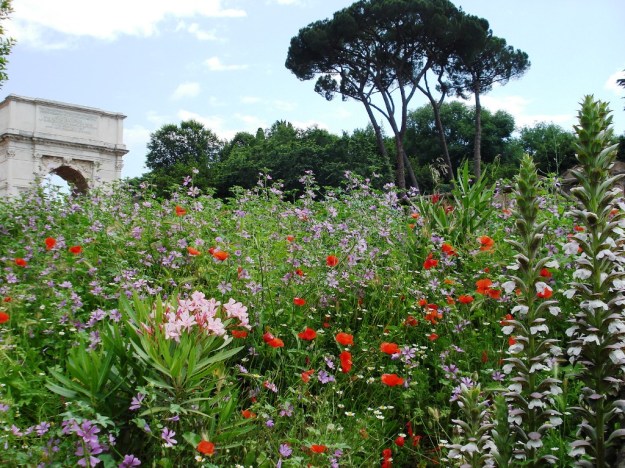
In terms of gardening, the most charming sight I saw was a simple scene of wildflowers at the Palatine in Rome and that was clearly serendipity.

Serendipity at the Palatine in Rome

Serendipity at the Palatine in Rome

I did feel a little vindicated on another score. A month or two ago, I wrote a column debunking the myth of Marlborough’s vineyards being romantic and evocative of rural Italy, an opinion which caused a colleague to take umbrage. The vineyards, olive and citrus groves I saw in Italy bore no resemblance at all the sterile mono culture of Marlborough with its rows of tanalised posts and wires and not a single stray plant allowed to creep into the environment. Italy does not appear to have our obsession with Round Up so there is a profusion of growth and the vineyards and orchards are small, mixed and cheek by jowl. Instead of milled, tanalised timber, supports were crafted from branches which looked similar to our native manuka. While I may not have been impressed by the formal gardening efforts I saw on this visit, the agriculture and rural landscape were impossibly romantic and about as far from New Zealand practice as you can get. Given that Italy has been that way for a very long time, I suspect that their approach is considerably more sustainable than the green desert technique we favour in our own countryside.

Earl Grey or Assam?

Elder Daughter gave me a pedometer one birthday and I was a little surprised to find that in the course of a normal day, I cover around 8km. When I come to London, I am deeply grateful that I am used to being on my feet. It prepares me in some way for the great distances I end up walking.

With a few days before London daughter and I brave Ryan Air (even more budget than EasyJet) for a flight to Sicily, I decided to follow up some of the private gardens open under the National Gardens Scheme. We have followed this with interest on the Living Channel, where the programme Open Gardens charts the process of assessment, selection and open day.

There is real status in being accepted by the NGS, even though it is entirely charitable and garden owners may open for as little as three hours on one particular day of the year. On Sunday afternoon, I braved pouring rain and shoes that leaked to find my way to Chiswick on the banks of the Thames where there was a cluster of four gardens open for the afternoon. I think this enclave of antique real estate is referred to as a mews. Highly valued terrace houses. Terraced housing means that the only access to the rear garden is … through the house. Fortunately the rain stopped. It certainly gives opening one’s garden to the public a new dimension, having a few score of people tramping through your home. This being London, the gardens are the width of the house – in other words, as little as one room and a passageway wide or maybe five to seven metres. One garden was serving teas in a miniscule back plot where six people were a crowd. But old style. Nobody asked here if you wanted gumboot tea or Earl Grey. No, in a line which I must store away for future use, I was offered Earl Grey or Assam.

Earl Grey or Assam?

I was interested in the whole process of assessment and selection of the NGS gardens (it can be a bit of a thorny issue, that one, as some of us know well in Taranaki) and also to set benchmarks and establish points of comparison for our festival gardens, both on that Sunday and the following day when I travelled to another small garden which opened by appointment. As a garden visitor, I certainly felt privileged to gain entry to private gardens which would otherwise be closed to me. These are domestic gardens which don’t even pretend to sit up alongside the renowned top end UK gardens of private origin, such as Sissinghurst and Great Dixter. And what can I say? It was a privilege. They are different to gardens at home. Our Rhododendron Festival gardens can hold their heads up high. I will say no more.

I had planned to finally make my pilgrimage to Wisley, the Royal Horticultural Gardens south of London. Their website showed much improved public transport links but once here, I realised that even so a day visit was going to involve five hours of travel and multiple changes. I was not that determined after all. Fortune may favour the bold but I am not suicidal so I won’t drive in London and from the tranquillity of home in Tikorangi, I tend to underestimate the effort it takes to travel across and through this city, let alone heading out to farther reaches. So I compromised with a return visit to Kew, the Royal Botanic Gardens which are easily reached by public transport.

I doubt that Kew could ever disappoint. They are botanic gardens on a grand scale. The British were great collectors and while I feel uncomfortable at some of the museums which represent acquisition and at times pillaging and theft from around the world on a scale which defies comprehension, the plant collecting and botanical classification work is much safer territory.

Walking in the tree tops at Kew

There is something for everyone at Kew. On an early summer’s day when the forecast was for temperatures around 25 degrees, it was in fact closer to about 12 degrees but the place was still teaming with people, including many children (it is mid term here) most of whom seemed to be called names like Oscar, Imogen and Henry and who were extremely well behaved. However, Kew is very spacious and can accommodate large numbers of people, although I probably met a goodly proportion of them on the newly opened treetop walkway. Treetop walkways are remarkable feats of engineering and Kew’s one has apparently been installed with minimal damage to the environment, avoiding even the visually polluting oversized pylons which seem to be a feature in others. For mild sufferers of vertigo such as me, they lose a little impact because one avoids looking straight down, preferring instead the safety of long views, and they are perhaps more novelty than revelation. But Kew must be leading the way in making public gardens and parks educative and everywhere the drive to inform and to conserve is threaded through the garden visitor experience. I can understand the use of some novelty and gimmickry if the outcome is positive. The importance of places such as Kew, set in incredibly overcrowded and hyped cities, can not be overstated, let alone the contribution to global conservation through the botanical research and collections.

The Kew experience

I was most delighted by the woodland plantings of herbaceous material, by the alpine gardens and, surprisingly, by an open air photographic exhibition. The International Garden Photographer of the Year is available at www.igpoty.com if you want to see some lovely imagery. The alpine gardens are interesting because our climate at home is just too warm and humid to manage this restrained style of display but the woodland and herbaceous plantings are an area where I gathered ideas and learned from established practice.

And nothing to do with gardening, but I was amused to see Harter and Loveless Solicitors on Caledonian Road. I wonder if Mr Harter does matrimonials while Mr Loveless is forever destined to do neutral conveyancing?

Gardening in Greece

Greek gardening. Now there is an oxymoron. Combine arid, poor, stony soils, six months with no rain at all during very hot summers and some islands with no fresh water – the range of plants that can be grown is pretty limited. That is not to say that people do not surround themselves with some foliage and flowers but it hardly warrants the term “gardening”.

In late September, the flowers were almost exclusively oleanders (I recall admiring these in flower in Gisborne one January), bougainvillea (I hadn’t seen the golden orange form before but I remain unconvinced that it is of great merit), hibiscus, jasmine and geraniums (99% the common red one). Second Daughter, who was travelling with me, commented that she had never liked the red geranium before she went to Italy and now Greece, but it is wonderfully evocative of Continental summertime. If my memory serves me right, prominent Taranaki gardener, Gwyn Masters, used red geraniums in terracotta pots in her Italianate garden created in a disused swimming pool. It helps to have the panache of Mrs Masters to avoid it merely looking cliched or tatty in our gardening environment.
Continue reading