
The San Pedro cactus or echinopsis pachanoi (syn. Trichocereus pachanoi)
During summer this amazing plant flushes over several months, sprouting a profusion of sweetly scented, large and exotic flowers. Each bloom lasts a couple of days, after which it shrivels up and falls to the ground where it then resembles something unsavoury left by a visiting dog.
This South American cactus is best not planted where visible to passers-by lest horticulturally enabled young people with extremely strong stomachs, no taste buds and a thrill seeking disposition raid your plant. In a sunny position with excellent drainage, it stands bold and tall and distinctly phallic in a spiky sort of way. Like most cacti, San Pedro is easy to propagate. Cut a short length from the end, leave it to dry for a few days and then stick in a pot or the ground. The trick is keeping it upright because it is top heavy and may rot if you plant it too deeply. If you use a length cut at both ends, it will sprout two new shoots and resemble rabbits’ ears but it tends to be weak at the point of the fresh growth.
Left to its own devices, it will tower and sway to around 4 metres, putting out side growths and clumping from the base over time. Should you happen to have a problem with tinea in the hooves of your cattle or goats, the San Pedro cactus is a traditional medicine for dealing to this affliction – just add alum and lye.
For the botanically precise, there is a bit of a question mark over the finer differences between echinopsis pachanoi (syn. trichocereus pachanoi) also referred to as the San Pedro cactus and echinopsis peruviana or the Peruvian torch cactus. The differentiation is not helped by the possibilities of plants being hybrids between the two closely related forms. We tend to call ours the Carlos Castaneda trichocereus for reasons which will be understood by readers who have encountered the works of Castaneda or indeed Aldous Huxley.
-39.042098
174.300314
 Latest Posts: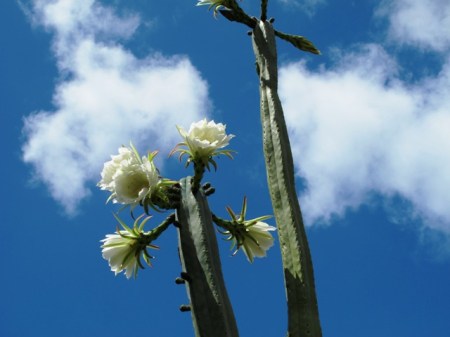
 Tikorangi The Jury Garden