Tag Archives: winter garden tasks

When your gardening life lacks a handy takahē or two

Time for the winter clean-up in the Court Garden

I have spent the last week on my knees. Not praying, you understand, but grooming the large grasses in the Court Garden. “What you need,” said Mark, helpfully, “is a takahē.” He had read or heard somewhere that in the wild, takahē  get right into the crown of grasses and clean the debris and dead patches out. That would be a fine thing. Besides, takahē  would look very handsome browsing amongst the chionochloa although we might have muzzle Ralph.
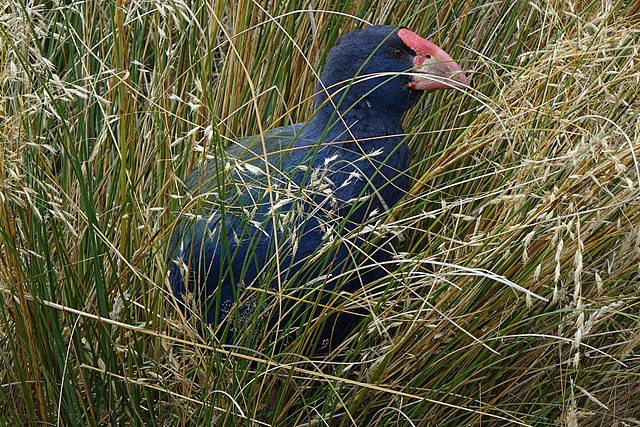
Takahē (photo credit: John Barkla via Wiki Commons)

The takahē is a large, flightless bird belonging in the group unromantically named swamp hens or rail. The North Island takahē  was likely extinct by the time European settlers arrived although the South Island takahē is something of a miracle story. It, too, was thought to be extinct by the end of the nineteenth century until its rediscovery in a remote Fiordland valley in 1948. Latest figures show there are 440 live takahe, every one known individually, as a result of human intervention to save this handsome bird from extinction. There are now enough for breeding pairs to be cautiously relocated to safe sanctuaries which are free from predators.  Their status has been changed from Nationally Critical to Nationally Vulnerable so they are a shining success story of saving a species in a country where we have managed to lose too many due to human settlement.
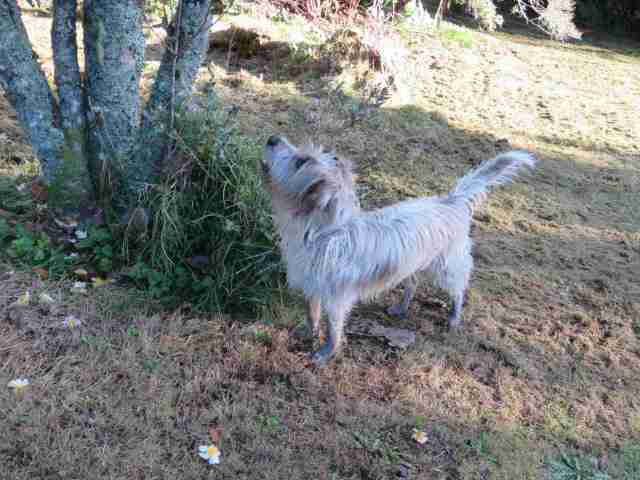
Ralph, wondering about his lack of ability to fly

I fear Ralph would deal to any that crossed his path. Given that his biggest regret in life is his failure to master the art of flying despite all his best efforts, I do not think he would be able to resist taking down a ground bird. Indeed, dogs are one of the biggest threats to takahē, along with contracted shooters who can’t tell the difference between a pukeko and a takahē.
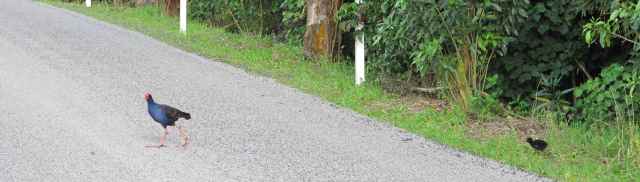
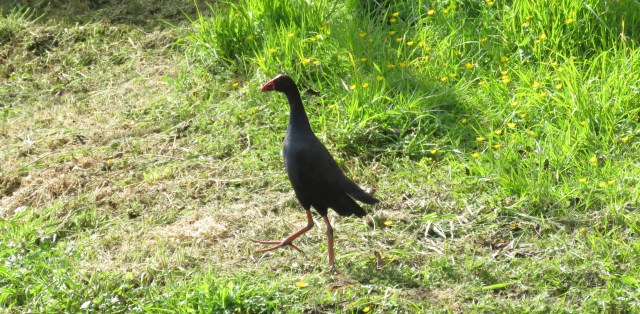
Pukeko which we have in abundance in this country
Takahē – spot the difference? (Photo credit Judy Lapsley Miller via Wiki Commons)

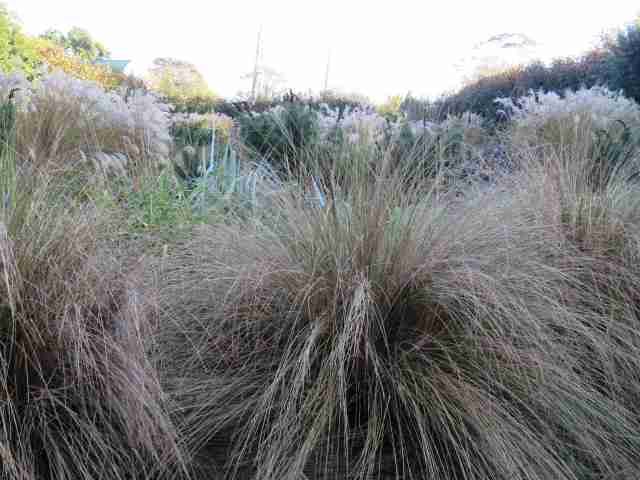
In the absence of such handy helpers, it is I who is on my knees with my trusty tools. My theory is that the native grasses we have which have a reputation of not being long lived as garden plants have an issue with a build up of debris that rots down and keeps the centre of the plant so wet that it can rot out. This is of course because our native grasses are all evergreen so they don’t shed their spent foliage. The amount of debris I pulled out from the large toe toe (Austroderia fulvida) was prodigious and there was certainly evidence of growing tips rotting out beneath the debris so I am hoping that the plants will heave a sigh of relief and stay healthy.
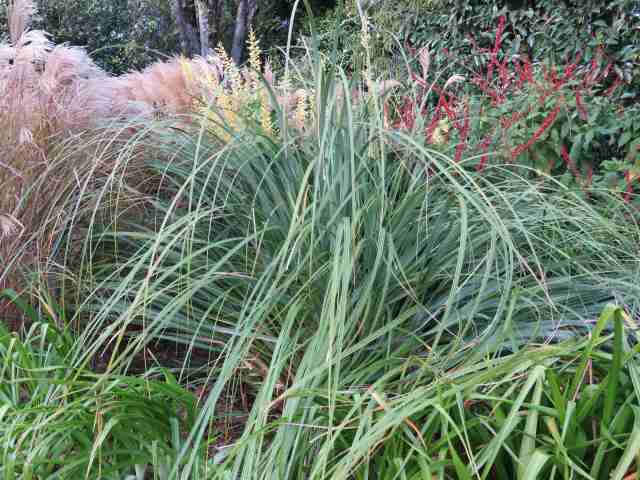
I probably cleaned out a third the volume remaining in dead and spent foliage – our native toe toe or Austroderia fulvida

I wrote about cleaning up the grasses last year so in brief summary, it is:

  • Deciduous plants like the miscanthus get cut to the ground when the feathery plumes all start to fall over and lose their charm.
  • Semi-deciduous plants which just look scruffy and awful – particularly the calamagrostis – also get cut to the ground.
  • Evergreen grasses – which are all our natives plus the non-native Stipa gigantea – are dead-headed and individually groomed to remove spent foliage. The exception is the smaller carexes, particular C. buchananii and C. comans. These just get left alone with excess seedlings thinned out. They are such enthusiastic seeders that if any of them kark it, there are plenty there to take over and fill the space.
  • The advice to leave these plants until spring in order that birds may find winter feed belongs in the northern hemisphere where most of their birds are grain feeders and winters are so cold that birds can die of starvation. Our winters are mild enough that there is plenty of feed and almost all of our native birds are nectar or fruit feeders.
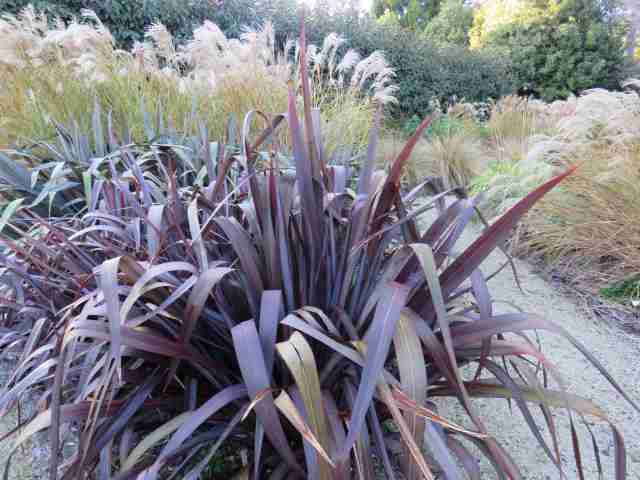
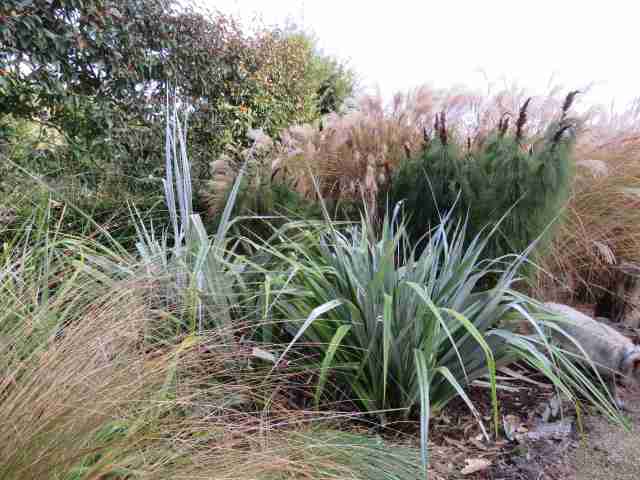
Two different named phormiums (flaxes) backed by Miscanthus ‘Morning Light’. We have just lost the names of the flaxes but they are very good.
Astelia chathamica looks a bit like a silver flax but is a different plant family. With Ralph emerging by the Elegia capensis

While I was down on my hands and knees, I also groomed the native flaxes and astelias growing in that garden, cutting off spent and damaged leaves at the base and they look a whole lot better for that. And I thinned the Elegia capensis, knocking off some of the new shoots that are appearing beyond their allotted space. No wonder it all felt quite a major clean-up this year.

Mark often refers to gardening as the act of tidying Nature. But after our discussions on the takahē, he noted that my recent efforts were ‘not so much tidying Nature in this case, as filling in an ecological gap left when humans squeezed out the birds that would have done this in the past’.
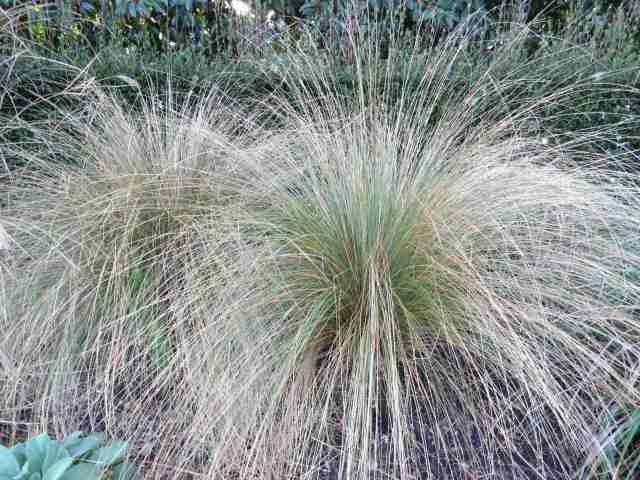
Have chionochloca. Just lack takahē.

Tikorangi Diary: Sunday June 25, 2011

The wisteria festooned bridge in spring

The wisteria festooned bridge in spring

I have pruned the wisterias. I have a bit of a love-hate relationship with wisterias which seem to make a leap for freedom the moment my back is turned, but they certainly add to the spring display. The blue (sinensis Blue Sapphire) and white (floribunda Snow Showers) which festoon one of our bridges in the park look terribly romantic in flower, but they are inclined to try and join hands across the middle. And I am worried that some of their thicker branches are threatening the bridge timbers. We don’t worry about the borer attacks. Wisteria are not shy and backward plants which need nurturing so I just cut out badly affected branches as need be. Mark’s mother had a lovely blue wisteria up the wall of the house outside her bedroom window but Felix took it out. I can’t recall now whether he waited til after she died (when the climbing roses went west) but I can remember being a little sad at his actions. These days I know exactly why he removed it. I have had the spouting cracked outside my office window. The last thing we need is a rampant wisteria lifting the concrete roof tiles on the house and cracking our vintage spouting there.

I am also pruning the roses and my relationship with these leans more to hate than love. Yes they have beautiful flowers and fresh foliage in spring. Because we don’t spray, come summer they have some beautiful flowers but cruddy foliage. In winter, all they do is try and ensnare me as I work around the areas where they are planted. I do not feel the need to plant more roses until breeders start to offer us more options in beautifully full, fragrant blooms (of the David Austen type) on bushes that repeat flower and don’t get diseased, preferably without thorns. By far and away, the best performers here are Rose Flower Carpet white and coral, the rugosas and one called, I think, Golden Celebration which has fearsome thorns but very good habits otherwise. But none of these give me the soft and subtle flowers of the lovely Austens.

I had a matched pair of standard Mary Roses of which I was very fond. Note the past tense. Today I dug out the one that is all but dead and which has for a long time persisted in putting out strong shoots from the root stock. And therein lies a demonstration of the problem of matched, formal plantings. What do you do when one dies or ails badly? It is much easier to get the formal look with inanimate objects. I could probably source a replacement standard but I am not going to. I do not think anyone but me will notice that there is one half of a pair missing. It is a garden which, at its best, is full of froth and flower within a formal setting. I think the setting is enough – I will not worry about trying to repeat the formality in framework planting.

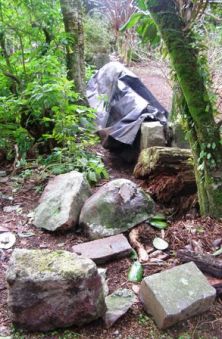
Repairing the stone wall (a pine tree fell on this section some years ago)

Repairing the stone wall (a pine tree fell on this section some years ago)

Shamed by a current shortage of greens, Mark is out planting a large quantity of broad beans and peas. I could tell he is going for overkill when he wanted to discuss whether broad beans would freeze well if picked young. The deep freeze is currently full of his frozen corn which, he pointed out to me, we need to be eating at the rate of one packet every 72 hours if we are to get through it before the next crop comes in. The garlic is long planted and is well into growth. These days, he takes Kay Baxter’s advice (from Koanga Institute) and aims to get it planted in autumn so it gets away before sodden winter conditions set in. He is also trying her recommended approach to plant it in a metre grid on a 10 x 10 arrangement (so at 10cm spacing) which is a great deal more economical in space than the usual rows. Keeping it to a metre square means it is easy enough to reach into the middle to weed. I am hoping Lloyd is going to remember that he said he would smoke me some garlic while we still have plenty of last summer’s crop hanging in good condition. Lloyd is the one who owns a smoker here. Smoked garlic is particularly delicious when raw garlic is called for in recipes such as aioli.

When not fluffing around with his vegetable garden, Mark has been giving his attention to his michelia propagation trials. With the flowering season just starting, the hybridist’s hat is back on his head and we face many months where the first call on his time will be his plant breeding. It is easy to underestimate just how much time and energy goes into a controlled plant breeding programme as opposed to people who just pick out chance seedlings (or worse: copy what other breeders have already done successfully. Expect to hear more on this topic, which is a sore point here).

Lloyd is continuing with repairs to our stone wall. I did say last week that these activities are best measured in terms of results, not costs….

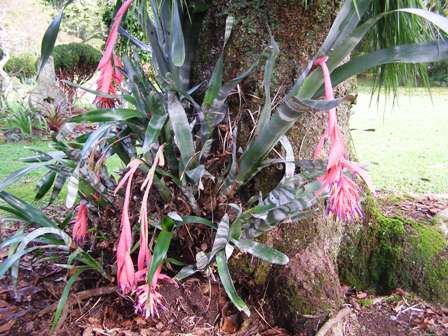
And while the winter/early spring bulb season is just starting (Narcissus bulbocodium, galanthus, leucojums and the early lachenalias), it is the bromeliads which are the unsung hero for winter colour this week. If you can grow broms, they sure are eye-catching in bloom.

Bromeliads for winter colour. This one is a Bilbergia.

Bromeliads for winter colour. This one is a Bilbergia.