Tag Archives: woodland plants

Plant Collector: Trillium sessile

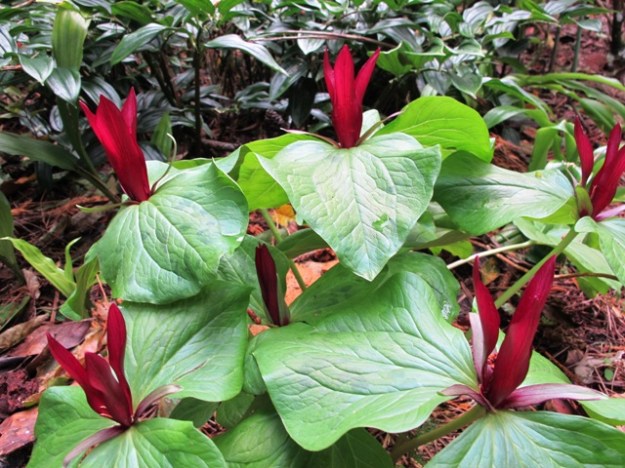
Trilliums! Not common in gardens in our area. T.sessile

Trilliums! Not common in gardens in our area. T.sessile

In the world of status plants for the garden, trilliums are right up close to the top. I am not entirely sure why. They certainly have a quiet charm and are a delightful addition to the spring woodland garden. They are not at all easy for most people to grow and are hard to source, but even that combination of factors does not explain the reverent awe accorded to their presence in a garden.

There are a relatively large number of trillium species (somewhere over 40) and most are native to North America, with just a few from Asia. They are deciduous perennials forming rhizomes below ground. The foliage dies down each autumn, to re-emerge the following spring (one hopes – it is not guaranteed) with fresh leaves and flowers – hence their common name of ‘wakerobin’. At times they are also referred to as ‘tri flower’ on account of their wonderful symmetry of threesomeness. Three heart shaped leaves hold three narrow sepals in the centre which surrounds the three petalled flower which has six stamens. How perfect is that? The dark red trilliums (usually T. sessile or descended from that species) are usually the most highly prized as garden plants, although different species introduce white, pink and yellow to the range.

Being woodland plants, trilliums want ground rich in humus and leaf litter which never dries out. They tend to do better in inland areas with colder winters where the clumps can get more size to them than we see in our coastal conditions. They can be raised successfully from fresh seed if you find a friend with a plant.

First published in the Waikato Times and reprinted here with their permission.

Plant Collector: Monstera deliciosa

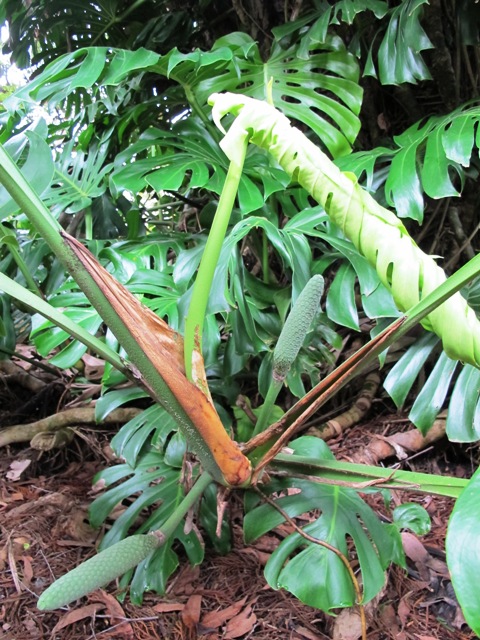
Monstera deliciosa - commonly known as the fruit salad plant

Monstera deliciosa – commonly known as the fruit salad plant

Most people know this as the fruit salad plant, widely grown as an indoor plant though more likely in commercial spaces because they grow quite large. However, it isn’t completely tender and can be grown outdoors as long as it is free of frost or snow. It puts out aerial roots and climbs without doing damage to the host tree. Some of ours are now maybe 10 metres up, giving a luxuriant, tropical effect. Each leaf is about 70cm across and lengthways.

If you look carefully, you can spot the fruit in the photo. There are two green phallic shapes, not to be confused with the unfurling leaf. The fruit is more a curiosity for us than anything else. It takes a year to ripen, at which point the green scales that form the outer casing start to split and peel off, revealing the creamy centre. It is variously described as tasting like a pineapple, jackfruit, mango or banana – in other words, exotic-ish. Because we lack the heat for proper ripening, the natural oxalic acids remain high so the fruit is more akin to eating tropical textured and flavoured fine shards of glass.

Hailing from tropical rain forests of northern South America (Colombia to Mexico), the monstera is a member of the arum family, which is very apparent when you see the hooded creamy flowers. You are most likely to find small monstera plants in the house plant section or if you know of someone with one, a length of stem with some aerial roots will grow away.

First published in the Waikato Times and reprinted here with their permission.

Our world of azaleas here

Our sky carpet of Kurume azaleas in September

Our sky carpet of Kurume azaleas in September

I have never tracked the flowering season of our evergreen azaleas. Generally we would say they are spring flowering and the peak is in September. But this year, I have become aware of them coming into flower already and I have been snapping a few photos for several weeks. When I looked around, plenty have blooms out.

I googled and found references to them having a flowering season of a week or two in spring. Not here, is all I can say. For us, they are unsung heroes in the background of our garden. We have lots of evergreen azaleas and they are rarely foreground stars. But they are such an obliging plant because they grow in semi shade to shaded areas (of which we have plenty), they never get too large, they are wonderfully unfussy, don’t need deadheading and they gently flower on… and on… and on.

The evergreen azaleas are gently flowering already and will continue through til spring

The evergreen azaleas are gently flowering already and will continue through til spring

You can make them stars. You can turn them into bright, colourful clipped mounds of bloom if that is what you want in your garden. You can tastefully plant the same cultivar (to keep uniformity) as an edger alongside a driveway or path. You can colour tone for variation and mass plant out a gentle incline. Or you can ignore fashion and plant a mismatched collection as a vibrant statement of mushroom shaped mounds out in the open. With any of those options, you will probably get peak flowering for a couple of weeks and have relatively anonymous, small leafed green shrubs for the other 50 weeks of the year.

We have plenty of star plants in our garden, so we lean more to using the evergreen azaleas as understated support plants throughout. They are so obliging by nature. Even if you cut them back very hard, most will just come again. You can raise your own plants from seed if you are a patient gardener. They are widely available for sale and generally you decide what you want by leaf and flower size – some are much smaller in both than others – and by colour rather than searching out particular named cultivars.
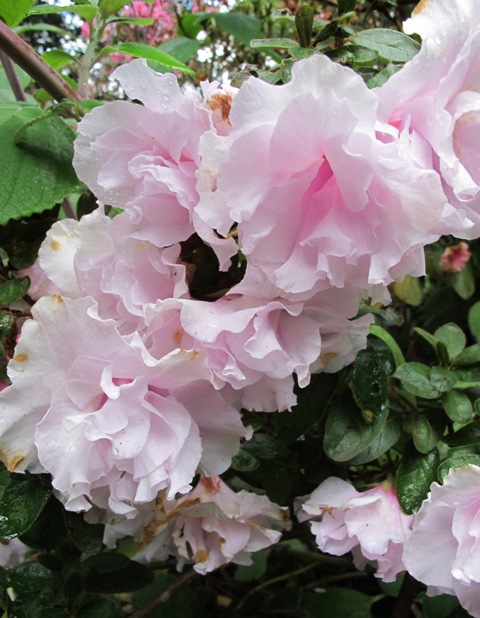
???????????????????????????????Colours are from white through the whole gamut of pinks to pure reds. The closest to blue is lilac and the closest to orange is more coral in tone. Nor are there pure yellows. Just white with a green or yellow toned throat.

We have plantings of the fine leafed Kurume azaleas from Japan which are now over 60 years old. At about 45 years of age, Mark decided they needed some attention and rather than cutting them back hard to rejuvenate them, he set upon a course of limbing them up. It is a constant task but we take out all the lower growth and have them as an undulating carpet of blooms just above head height.

A garden visitor from Kurume came a few years ago. He spoke no English and we speak no Japanese but he managed to convey the information to us that our Kurumes were simply astounding for their age. But, and there is always a but, we should be taking better care of them. I have spent a prodigious amount of time grooming out dead twiggy bits and an excess of lichen ever since. Some gardeners choose to use copper sprays or lime sulphur to combat lichen build up on older plants.

All azaleas are rhododendrons but not all rhododendrons are azaleas. In other words, azaleas are a separate section of the rhododendron family. They then divide further into the deciduous azaleas (botanically Pentanthera) and the evergreen azaleas (at least mostly evergreen, the Tsutsuji or Tsustusti azaleas originating from Japan).
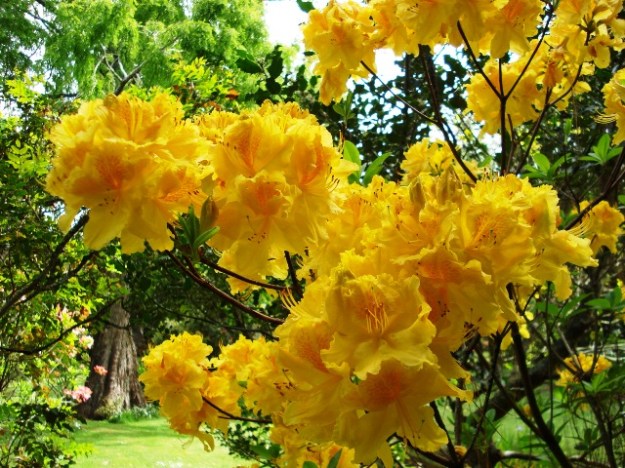
Vibrant colour in late October from deciduous azaleas

Vibrant colour in late October from deciduous azaleas

Deciduous azaleas are a different branch of the family altogether and many look more like rhododendrons with their full trusses. They are often referred to as Azalea mollis or Ilam azaleas in this country. Some bring the most wonderfully vibrant colour into the spring garden, bordering on vulgar if not placed well. You don’t get the same bright oranges in any rhododendron that I know of and the intense yellows, tangerines and reds make a big statement. For those of more refined sensibility, there are also pastels and whites. Many are strongly scented.

Deciduous azaleas are more tolerant of heavy, wet soils – even occasional flooding – and of full sun than their rhododendron cousins. Surround them with lots of green is my advice, and let them have their time to star in all their glory.

The problem with deciduous azaleas is that when they are not in flower in mid spring, they tend to be pretty anonymous plants. And in humid climates, they are inclined to get mildewed foliage by the end of summer so are not plants of great beauty in small gardens.

Nor are they always easy to source. Garden centres really only have a three week selling time on them when they are in flower because few will impulse buy outside that show time. So buy plants when you see them on offer, is my advice, rather than waiting until the precise moment you are ready to plant them.

Our garden might look a bit sad and empty without the strong showing from the azaleas.

First published in the Waikato Times and reprinted here with their permission.

Plant collector : Helleborus x sternii

IMG_9684

Helleborus x sternii

There are more hellebores than just the common H. orientalis and sternii is one we appreciate in the winter woodland. It has distinctive green flowers, sometimes flushed purple, and lovely glaucous foliage which is finer in appearance. Glaucous just means it has a blue or grey cast to the colour. It is more upright in growth and does not make as dense a clump as orientalis. In addition to that, it holds its flowers in a cluster above the foliage and many of them are outward facing rather than all nodding (or facing downwards). So it displays its flowers a little better than H. orientalis.

The x sternii means it is a hybrid – in this case a cross between H. argutifolius (from Corsica and Sardinia) and H. lividus (from Majorca). From those origins, you can guess that it is quite happy in hot, dry conditions and the information is often given that it is suited to sunny positions. In our garden, sunny positions are at a premium whereas we have woodland in abundance so we are always after plant candidates for shadier positions. Plants like this hellebore which are not at all fussy, are very handy to add winter interest.

Sternii can be raised from seed or by division. There are named selections of sternii around – the seed from these won’t come true so they need to be divided or increased by cutting if you want to keep their special features. It appears that many of the newer forms are extending the colour range into purer pinks, burgundy, slate and white – akin to the orientalis colour range. We only have the original green flowered forms and have not seen the other colours in this country yet.

First published in the Waikato Times and reprinted here with their permission.

Plant Collector: bilbergia

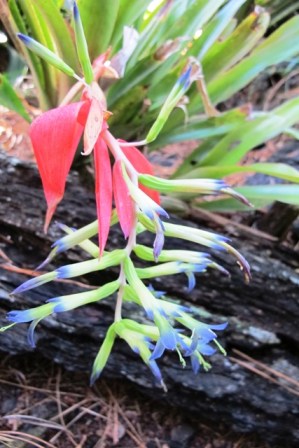
Bilbergia flowering in the winter woodland

Bilbergia flowering in the winter woodland

On a chilly mid winter day, there is nothing more exotic than a bilbergia flowering in the garden. It is a bromeliad, in case you can’t recognise it, and bromeliads can flower through winter when they look impossibly out of context and wonderfully bizarre.

Easily the world’s best known bromeliad is the pineapple, introduced to Europe from South America by none other than Christopher Columbus. All bromeliads are native to the Americas from Virginia south to the northerly reaches of Argentina, with most bilbergias coming from Brazil.

We have never had names on our bromeliads. This one may be Bilbergia distachia – although equally it may not. There are a fairly large number of species and named cultivars to choose from. Bilbergias often have quite a deep cone of foliage and their flowers are pendulous. The downside is that the flowers usually only last a few weeks instead of the months of some other types.

We like them through our evergreen woodland areas which remain frost free. Most are epiphytic, holding water in their vase shaped leaf rosettes and they are a really easy care plant. In more shaded areas, the foliage tends to become more muted but a plainer green backdrop highlights the exotic flowers wonderfully well.

Collecting bromeliads can become quite addictive. If you get keen, there are two comprehensive books on the topic by NZ author, Andrew Steens. Bromeliads for the Contemporary Garden will get you started, then you progress to Bromeliads, The Connoisseur’s Guide. We have a strong preference for using them in mixed plantings so there is not a whole stretch of just bromeliads looking spiky and alien. We find they combine well with clivias, ferns, orchids and other lush shade loving plants which provide a foil to show off their exotica.

First published in the Waikato Times and reprinted here with their permission.