
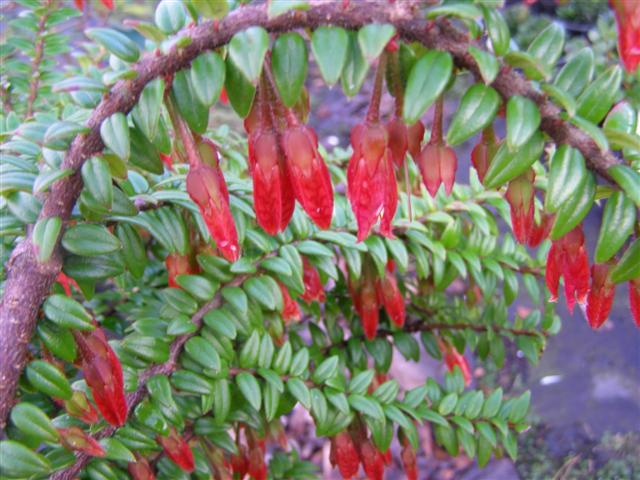
Agapetes serpens - attracts nectar feeding birds in winter
Agapetes serpens is a surprisingly hardy woodland plant from the Himalayan region and there we have been for years thinking it was a somewhat tender plant from India! Right general geographic area at least (she says in self defence). It is an evergreen shrub but with arching growth – aptly described by another as being like a vegetable octopus. What is really lovely through winter and spring is the prolonged flowering season when the branches are festooned with tiny hanging red bells with cute little chevron markings which Mark always thinks resemble Chinese lanterns and these must contain nectar because the wax-eyes come in to feed regularly. Mark was delighted to see even a bellbird come in to feed on one of our plants.
In the wild, A.serpens is often epiphytic which means it grows perched in the embrace of a larger tree. Consequently, in a more suburban environment, it is equally suited to growing in a container or a hanging basket. As the plant matures, its roots develop into big nubbly, woody protruberances pushing themselves above the soil, which we assume is for water storage. We grow serpens both in the shade where its foliage stays predominantly green and in full sun where it tends to be red-toned. I am still a little hesitant about declaring it as totally hardy so in colder, inland areas it would probably be wise to treat it as a woodland plant which needs some overhead cover rather than using it out in the open.
Agapetes are related botanically to the vacciniums (which includes proper cranberries) and all are members of the wider ericaceae family which takes in the heaths and heathers as well.
 Tikorangi The Jury Garden