Yearly Archives: 2013

Blue sky gardening rather than feeling blue

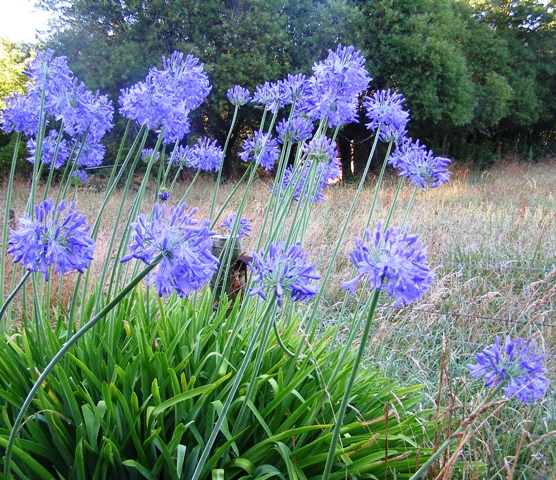
Weeds maybe, but pretty on summer roadsides - agapanthus

Weeds maybe, but pretty on summer roadsides – agapanthus

There I was, having decided to write about blue flowers this week, when I opened the latest issue of NZ Gardener and Lynda Hallinan had beaten me to it. But that’s all right. She was mainly looking at annuals with just a few perennials and one shrub.

It is the sight of the blue jacaranda in full flower which makes me fall in love with blue blooms all over again. It is the first thing I see out the window every morning and I sit and drink my early morning tea admiring it and reflecting on how much I love the colour.

Where we live, blue is the dominant colour of the roadside flowers in summer. I know agapanthus is a weed and difficult to eradicate but our verges would be the poorer for its absence. Plants have to be tough in that situation and the agapanthus is a showy survivor. Beacons of summer, here.
The simplicity of chicory

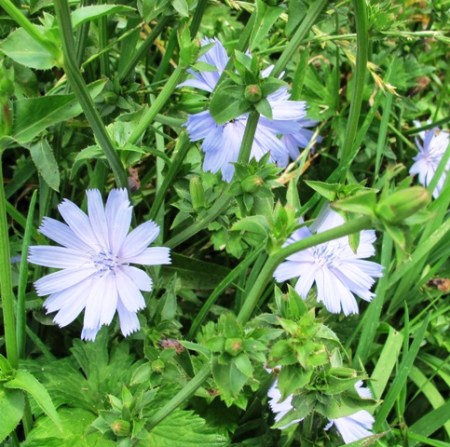
The simplicity of chicory

The wild chicory is pretty as a picture with its soft blue daisies. In the garden we grow blue asters with a similar flower but in long grass, the simplicity of the chicory is more fitting.

We are blue hydrangea territory, being acidic in soils. With regular summer rain and mild, humid conditions, the blocks of blue flowered hydrangeas tend to mean we take this plant for granted. Go to more alkaline territory and they turn pink as readers may have noticed in other areas, but they add to our blue palette here. As we fluff around our garden hydrangeas, pruning each year to tidy them up and promote good flowering, it is interesting to reflect that those roadside wildflowers are never touched yet bloom faithfully. As a general rule, if you don’t prune a hydrangea, you get more flowers but they are smaller.

Impressed by the garden performance of the You-Me hydrangea series

Impressed by the garden performance of the You-Me hydrangea series

When it comes to the garden, those big blue moptop hydrangeas (the macrophyllas) are okay as a backdrop but they lack refinement as garden plants. We have been most impressed with the more delicate appearance of the recent introductions from Japan in the You-Me series. We collected several from hydrangea expert Glyn Church a few years ago and have lost the names but they are all quite similar so I’m not sure that any one is better than the others. Look for them branded under the You-Me group and they carry individual names like “Forever” and “Eternity”. If you can’t find them in your local garden centre, then you can get them on line from Woodleigh Nursery. Be warned, however, that they are apparently not colour stable so if your soils are more alkaline, they won’t be the pretty blues we have here. Presumably they will be pretty pinks instead.

What is it about blue? For me, I think it is that the blue as blue skies are such a mood enhancer. It may have something to do with the dreaded holes in the ozone layer (though I hope it has more to do with our isolation and low population) but we have a clarity and intensity of light in this country that most of us take for granted until we travel overseas.

I have commented before on the fact that we treat green as colour neutral in the garden. All those monochromatic garden schemes are in fact bichromatic because they are one colour plus green.
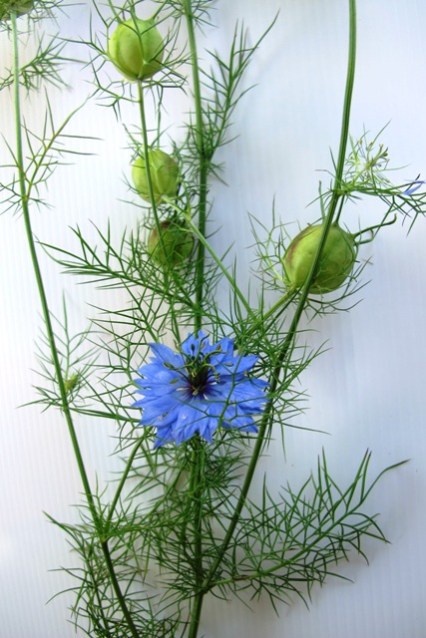
Nigella damascena - a personal favourite

Nigella damascena – a personal favourite

Blue is not colour neutral as such, but it sits happily in any colour combination. So if your garden bed is hot colours of reds, yellows and oranges, blue will sit in that mix quite happily. In you have gone instead for pretty pastel pinks and whites, blue does not shout when included. Of the primary colours, it is the easiest to blend. It can lift a tightly controlled, colour managed garden out of the blandness that sometimes afflicts them, by adding just a little zing.

I don’t understand why “feeling blue” is a reference to feeling sad. In my books, you can never have too much blue in a garden and lifting one’s eyes to the blue sky above is a celebration of life.

First published in the Waikato Times and reprinted here with their permission.
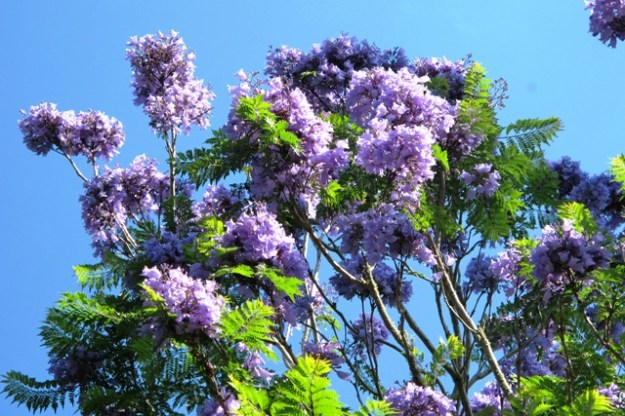
Plant collector: Jacaranda mimosifolia

The summer delight of the jacaranda

The summer delight of the jacaranda

South Africans could be forgiven for thinking that this tree is one of their indigenous species. Pretoria has so many planted that it is apparently a haze of blue in late spring to early summer. In fact it comes from Bolivia and Argentina but is a worldwide hit because blue flowered trees are not common at all when you think about it. Nearer to home, when we last visited Whakatane, they too had used this summer flowering delight as a street tree. But it is nowhere near as common where winters are wet or in inland areas because it is a subtropical plant. Our tree is growing in a protected position, surrounded by other trees, rather than standing in solitary splendour so its blue-as-blue floral display is best seen out of our upstairs windows.

Jacarandas are deciduous and make an airy, open tree. After many years ours has reached around nine metres high, though it will have been stretched up by the trees around it. The flowering season lasts many weeks but it does appear that cooler temperatures delay the season until mid summer. In less than ideal conditions, it will need a sheltered, favoured position with excellent drainage in the warmest possible situation. It is classified as a member of the Bignoniaceae family though most gardeners will just recognise it as a legume.

Garden lore

“The gardener has a great faith in names; a flower without a name, to put it platonically, is a flower without a metaphysical idea; in short, it has not a right and absolute reality. A flower without a name is a weed.”

The Gardener’s Year
by Karel Čapek (d. 1938)

001 - Copy

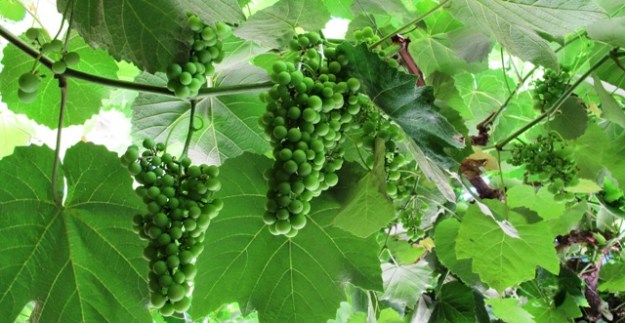
Summer grapes

Grapes are not a fruiting vine that can be left to their own devices if you want a harvest. They need hard pruning in winter and a follow up in summer. If you haven’t yet summer pruned your grape, then get onto it immediately. Cut all the laterals (side growths) back to six leaves. This allows light to reach the bunches of fruit and concentrates the plant’s energies on ripening the fruit rather than supporting extra foliage.

At the first signs of the fruit ripening, get bird netting on. Our feathered friends rarely wait for fruit to ripen to the stage humans prefer. If you can keep the birds from pecking the fruit, it will reduce their attractiveness to wasps.

By far the most successful, outdoor grape variety we have found in our marginal conditions is Albany Surprise. It is an American hybrid and should grow well in areas which are not known for grape growing because of humidity, rainfall and mild temperatures.

First published in the Waikato Times and reprinted here with their permission.
Not one but three new Jury magnolias this year

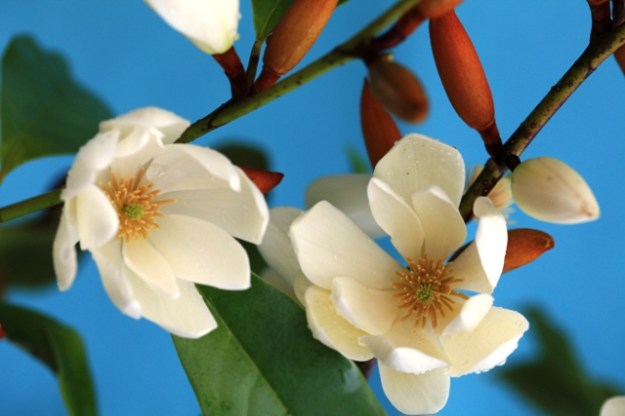
The sublime blooms on Fairy Magnolia® White

The sublime blooms on Fairy Magnolia® White


It is not often that we have three major new releases coming out in one year. And, to be honest, it takes so many years of trialling and then building up that by the time they are released, they no longer feel “new” to us. But there is a surge of pride with these three hybrids of Mark’s breeding.
Magnolia Honey Tulip, our new yellow version of Black Tulip

Magnolia Honey Tulip, our new yellow version of Black Tulip


Mark is very particular about deciduous magnolias and had only named three – all in red tones. The fourth, to be released this year, is his first in the yellows. Honey Tulip™ is a golden honey version of Black Tulip. Given the somewhat floppy nature of most yellow magnolias with their soft petals and tendency to become paler as the flowering season progresses, we think Honey Tulip represents an advance in flower form, petal substance and retention of its colour intensity through the season. In New Zealand, where most yellow magnolias flower at the same time as they come into leaf, it is to Honey Tulip’s credit that it flowers on bare wood. Trials suggest that it will remain a smaller growing tree.

Fairy Magnolia® is the branding attached to our new range of michelias. These have been reclassified as magnolias but we wanted to differentiate these new michelias from the usual evergreen magnolias which are the leather-leafed grandiflora types. These are much lighter in growth and fill a different role in the garden and landscape. The first release was Fairy Magnolia® Blush.

Fairy Magnolia Cream - many flowers over a long season

Fairy Magnolia Cream – many flowers over a long season


Fairy Magnolia® Cream is a free flowering, strongly fragrant pure cream, opening in early spring. While of similar breeding and performance to Blush, its foliage is a brighter green and its peak flowering season extends into months. Each bloom measures at least 10cm across. Cream will take clipping well to keep it hedged, compact or topiaried or it can be left to form a bushy ,large shrub around 4 metres tall by 2.5 metres wide.

Fairy Magnolia® White (pictured at the top) comes down a different breeding chain and is a selection from a run of seedlings we have been referring to as the Snow Flurry series. The fragrant, purest white flowers are sublime, opening from brown velvet buds. It flowers earlier than Blush and Cream, starting in winter, so it is not likely to be as hardy as those two. However, we think it will prove to be hardier than existing doltsopa selections, making a garden friendly, improved substitute for “Silver Clouds”. The foliage is smaller and the plant shows no signs of defoliating after flowering (a major drawback to many doltsopas). It is much bushier in growth and will ultimately reach around 5m by 4m if not trimmed.

All plants will be available in New Zealand in limited quantities and some will be available overseas. These plants are produced under licence (in other words we only have small numbers to sell to personal customers later in the year when we open for plant sales) so ask your local garden centre. Overseas readers may like to check out Anthony Tesselaar Plants for availability.

Magnolia (deciduous) Honey Tulip

Magnolia (deciduous) Honey Tulip


Fairy Magnolia Cream

Fairy Magnolia Cream

Plant collector: Eryngium planum

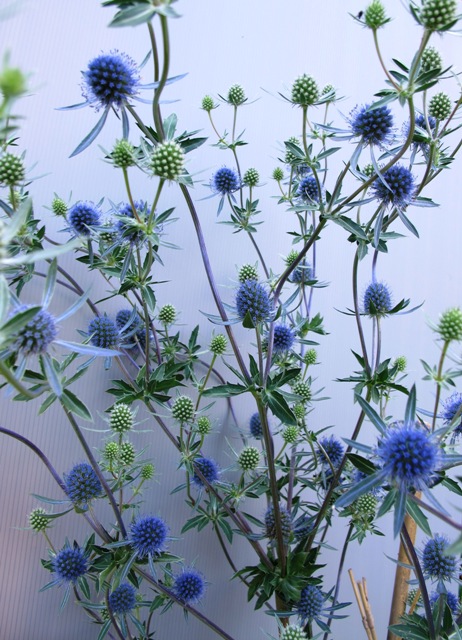
The hazy blue of Eryngium planum

The hazy blue of Eryngium planum

I thought it was going to be easy to write up eryngiums but it transpires that there are a whole lot of different ones from various habitats and climates. So I will confine my comments to the ones we are growing here. I love these ethereal thistle or teasel-like flowers in the prettiest hazy blue. We have had what I think is Eryngium variifolium in the rockery for a number of years. Despite its decidedly prickly habit and its location too close to the path, the flowers are always a summer delight. When I tried to move it back from the path, I found it had a phenomenally long and tough tap root so it defied my plans. That one has never set seed for us. Some eryngiums are propagated by autumn root cuttings so we plan to try that.

Eryngium planum is taller so needs staking in the garden. It flowers earlier in the season and grows easily from seed. We ordered it through Kings Seeds and this is the first summer we have had a good sized planting of it. I am hoping it will set seed because I think I can use lots of this plant in the summer garden. It doesn’t take up much space so can grow through other plants and the flowers last a long time. Both forms we have are perennials. E. variifolium disappears entirely in winter but neither of us can remember whether E. planum does too or whether it retains a smaller rosette of visible leaves.

Eryngiums belong to the Apiaceae family (with carrots!) not the thistle family. They are often referred to as sea holly but that should more correctly be ascribed to E. maritimum which we have seen growing wild on the coast of Cornwall.

First published in the Waikato Times and reprinted here with their permission.