

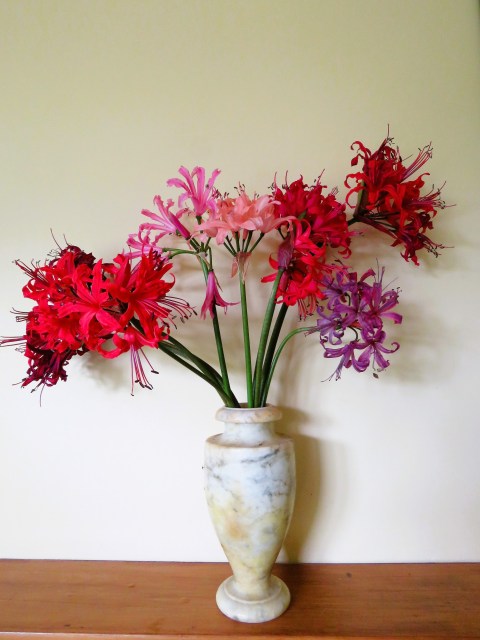
It is nerine season and they certainly put on a great display. I don’t love them in spring when the foliage is slow to die off and looks scruffy as all the spring bulbs light up the rockery, but, come April, all is forgiven.

Most of our nerines are sarniensis hybrids which give the range of colours and full heads of flowers. Often referred to as ‘Guensey lilies’, their connection to Guernsey is solely due to the cut flower trade because they are native to the Cape area of South Africa.
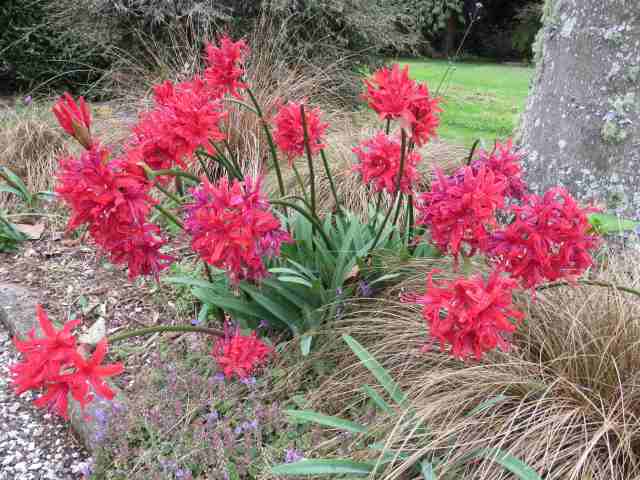
The sarniensis hybrids need really good drainage, open conditions and sun. Because they are in leaf in winter, they aren’t suitable for areas that get heavy frosts. These are bulbs that want to grow where their bulbs can bake in the sun so the rule of thumb is to plant them to a depth of no more than half the bulb with the other half and the long neck above the soil. They are also happiest in a crowd and can form a clump above the soil. I will divide the clumps when they get too congested and I discard the many small bulbs before replanting the larger ones close together.
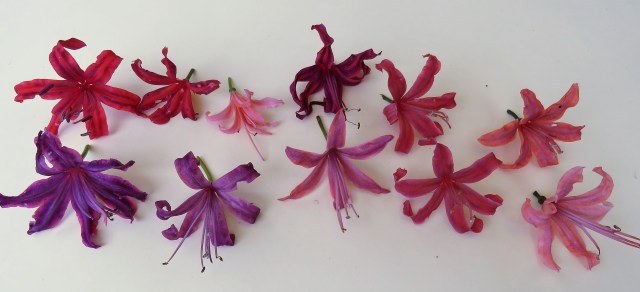
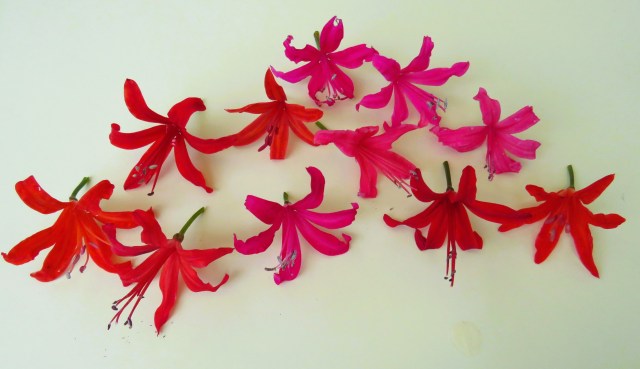
We have a few of the early Exbury hybrids and the rest are all the result of Mark’s dad, Felix, hybridising to get a wider range of colours, along with some by Mark in days gone by. Felix particularly liked the smoky shades and they have a subtle charm of their own, as do the ones that mature to blue-purple shades. That said, the vibrant orange, clear red and highlighter pink ones are unashamedly bold and make a loud statement of their own.

The sarniensis hybrids are not that easy to find for sale. Local readers might like to hop in their car right now and head out to the Inglewood Sunday car boot sale because I saw somebody selling a really good selection of different colours in bloom there last Sunday. It is likely they will be there again today and maybe next week while we are at peak bloom. Beyond that, I don’t know where they are available but don’t expect them to be cheap like mass produced daffodils and tulips.
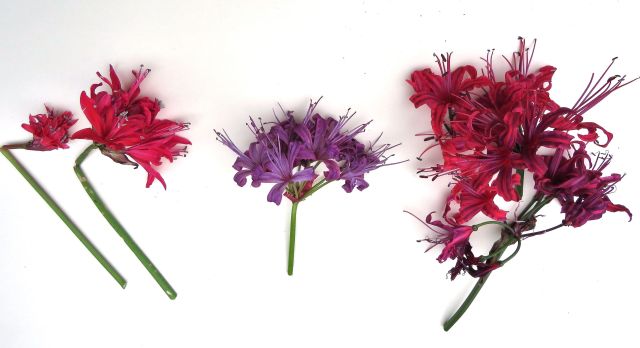
As I gathered single flowers to show the range of colours we have here, I picked up a few that had been snapped off. The one in the centre I think I can blame on Ralph dog who is no respecter of gardens. The ones on the right were clearly leaning over onto the grass where they fell victim to the lawnmower. The ones on the left are weevil damage on the rockery. If you zoom in on the second left, you can see the telltale damage on the stem which eventually weakened it to the point of breaking and flopping near the flower. Notwithstanding an exuberant dog, lawnmower and our localised patches of weevils, there isn’t much else that attacks these plants.

While we favour the sarniensis hybrids as garden plants, we also have a fair swag of N. bowdenii seen here on the right. There was only stem open so far two days ago when I took these photographs because it comes into bloom a little later than the sarniensis. It is easier to grow with stems that are strong enough to hold up the truss of flowers and is certainly more widely available than most others. On the downside, its truss is not as full of flowers and it basically comes in shades of hot pink although there is a white form, the internet tells me.
On the left in the photo above is N. pudica which I had forgotten about until this stray pot in the nursery opened its blooms. Several years ago, I planted a whole lot out, mostly in the rockery, and I had forgotten about them because I can’t recall them ever flowering there. I think I have found one patch of them which I shall watch to see if they do bloom. The same thing happened with the Lycoris aurea that I planted in the rockery a decade ago. They have never flowered again which is a pity because they were lovely – a most attractive shade of yellow and looking just like a yellow nerine except they are a lycoris, not a nerine. I live in hope that they are still there and pretending to be a mound of non-flowering nerines, so they can spring forth one year and delight me.

Nerines became popular as a cut flower because they have long stems and last well in a vase – hence the ‘Guernsey lily’ moniker. I rarely pick them because they last longer in the garden and, when a bulb only puts up one flower stem, it feels like flowercide to cut it to bring indoors to die. They are not as easy to produce as many other flowers for the cut flower trade so I would not expect them to be cheap to buy.
 Tikorangi The Jury Garden
Good Morning Abbey I have a collection of Sarniensis hybrids including 2nd year seedlings from Exbury imported as seed from Nico de Rothschild, a collection of NZ cut flower cultivars and a few gifted to me from Terry Hatch. I understand from Terry that Mark is unwell, other wise I would have arranged a visit to meet Mark and talk Nerines, as I am up from the South Island.. Is there and Chance of buying individual specimens of of Marks nerine breeding??. I would pay a royalty if they entered commerce
Best Regards
Craig Benson
027 900 8916
craig@aeroflora.co.nz
If you are here, you are welcome to call in and chat nerines with Mark although he hasn’t done anything with them for many years. They are at their peak now.
HI Abbey, Thankyou for the invite I am leaving Te Awamutu in 5 minutes and should be down at your s by 2 oclock or there abouts regards Craig Benson 027 900 8916c
That is fine. I will tell Mark you are coming.
Wow – you are so good at Nerines!! I think you gave me a bulb or two once, but sadly they have disappeared. I think the the Taranaki climate must really suit them. Once they take hold here in Canterbury, they are fine, but it’s getting them there!! I do have the common pink one and the white one as well as the scarlet one which flowers just a little bit earlier, but in my small garden they are so easily swamped with bigger thugs which shade them – and they need an open spot in full sun if poss. However I do find that established clumps are OK under deciduous trees. But only OK!!
I can remember them flourishing in Invercargill gardens when I was a child!
I think we are a bit damp for them but they do well in the rockery, even though they are the thugs in that situation.
The variety is impressive. Nerines and their relatives are generally uncommon here, although a few are popular. I briefly grew what we knew simply as ‘nerine’ as cut flower in the summer of 1986, but it was merely a single cultivar that was bright pink, comparable to Amaryllis belladonna. It was an expensive flower.
Probably Nerine bowdenii.
Oh yes, that was it!
I should have remembered that from earlier.
Although, I do not remember it looking quite like this one. It seemed to be a bit more stout.
There will be different forms and grown in a hotter, drier climate than ours could well result in shorter, stouter stems.
I have not seen one as a cut flower in many years. I sort of like them because they were so typical of the 80s.
The nerines obviously grow fabulously for you and make a brilliant display. N x bowdenii is the one which does best here and gives a good display. I was delighted that an online friend, Carol Hickey, enjoyed a visit to your garden recently. She was delighted with it.
Such a small world, we live in!
Hello Abbey.
Many thanks for allowing the time I spent with Mark this afternoon. I enjoyed and appreciated it very much
Thank you
Best Regards
Craig Benson
Wonderful to see so many variations,I remember that Terry H had done a lot of hybridising years ago and we used to be able to buy some lovely ones however he lost many of them to Pheasants when they moved to their current property .So hard to find different forms now -thanks for showing them all 🌻
There will be better collections than ours, but we enjoy those we have. They are not exactly a commercial line these days so definitely hard to source.
Hi Abbie
<
div>I love your gardening notes. They give me lots of ideas for our place