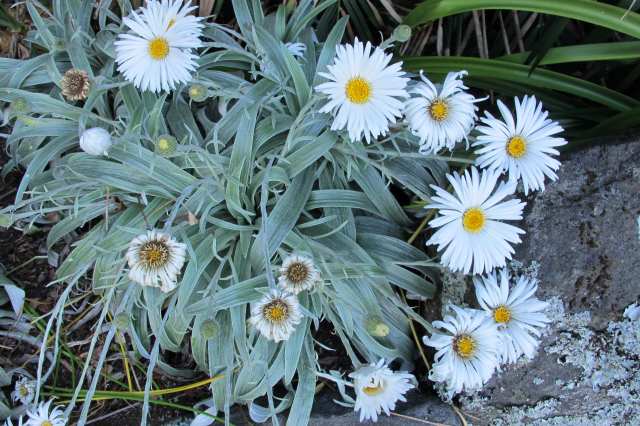
Celmisias are our very own mountain daisies. They have never been a common garden plant because they aren’t easy in nursery production and rarely thrive in the average home garden. It is likely that their greatest fans are trampers and botanists but that should not blind us to their charm. Many people just don’t know of them. And I suppose, when you think about it, quite a lot of our native plants have white daisy flowers.
I was surprised when I looked them up and found a far greater number of species than I ever knew existed. Some dedicated botanists have clearly spent a lot of time unravelling this genus.
When Mark’s father, Felix, was still alive, he became very interested in seeing whether he could hybridise different species to get plants that would thrive in our lowland, humid conditions. Most celmisias are subalpine to alpine plants. I remember Felix and Mark heading up our maunga, Mount Taranaki, in search of the form which grows there naturally – Celmisia major var. brevis – and being thrilled to find some flower variations into pink. This was about 40 years ago, you understand, when people didn’t feel so bad about collecting plant material in a national park. They collected some plants, including a few of the pinks which they only saw growing in one area.
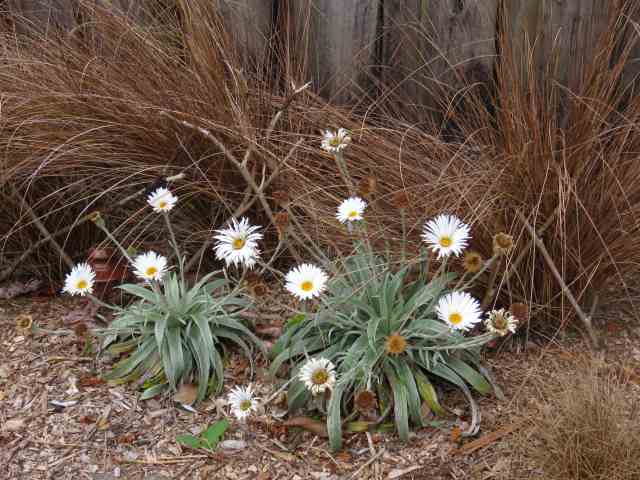
Felix set about crossing three species – C. coriacea which comes from Fiordland, C. hookeri from the Otago area and the aforementioned C. major, in various combinations. Forty years on, we still have some of those hybrids growing and flowering in the garden here. It is the three way cross which gave us the broader leaves in distinctive silver all year round. Over the decades, we lost many of them, including all the pink ones, and have, at times, run close to losing the lot but for a bit of quick intervention. They have never seeded down for us; we have to increase them by division. They do set seed which we could gather and sow in seed trays but, in a busy gardening life, we don’t seem to get around to it. These are plants that need to be lifted and divided every few years or they rot out and fade away so we can never claim that they have naturalised here.
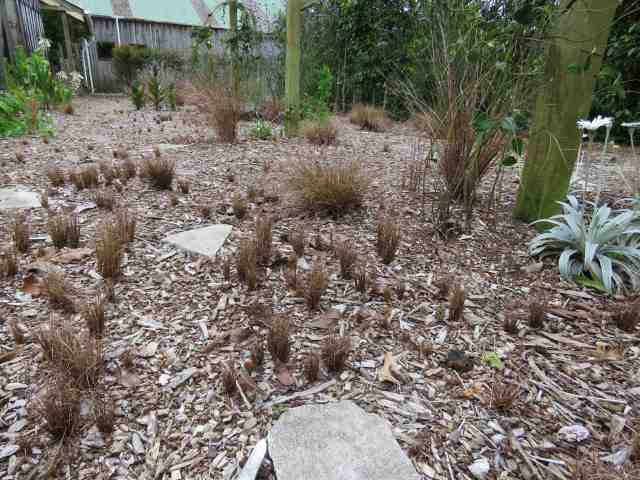
When I planted my tawny brown area of two native carex grasses, C buchananii which is specific to our maunga and C. comans, I envisioned a simple breathing area of just those two plants. Mark looked at it and wanted more detail and colour. He suggested moving some of the celmisias which we were in danger of losing, into the newly cultivated area. So I did. There weren’t many left to play with. In the first year, I probably only had half a dozen divisions. That was in 2022. It was like they breathed a sigh of relief and set about growing with renewed vigour. Last year I divided a few clumps that were large. This year, I divided most of them and I lost count around 58 or 60 plants. Some are small but they are surviving and I have done my best to give them optimal growing conditions. It was enormously satisfying. There aren’t many perennials I am willing to lavish such frequent and individualised care upon but the rewards feel worth it with the celmisias.
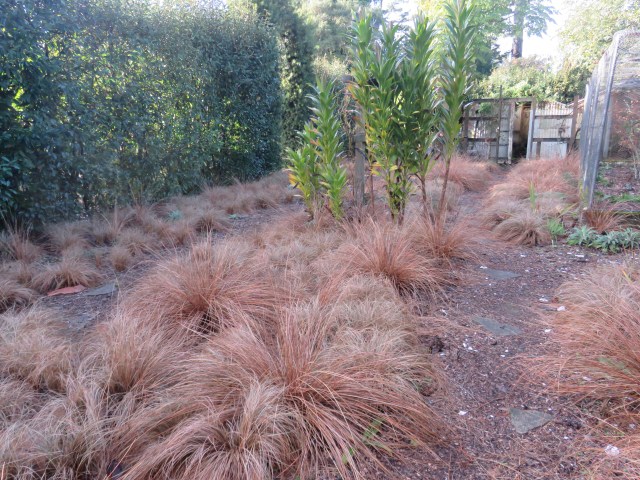
It is mighty hard to be original in a garden. Pretty much everything has been done before, some time, some place. I always scoff silently to myself when I hear the occasional gardener declare that somebody ‘stole their ideas’ or copied them. “But who influenced you in the first place?” I want to ask (but never do). However, I doubt that the celmisia and carex combination will be replicated soon, at least not locally. It is a successful subalpine planting in coastal, subtropical conditions and I am moderately chuffed by its unexpected nature in that context.
 Tikorangi The Jury Garden