

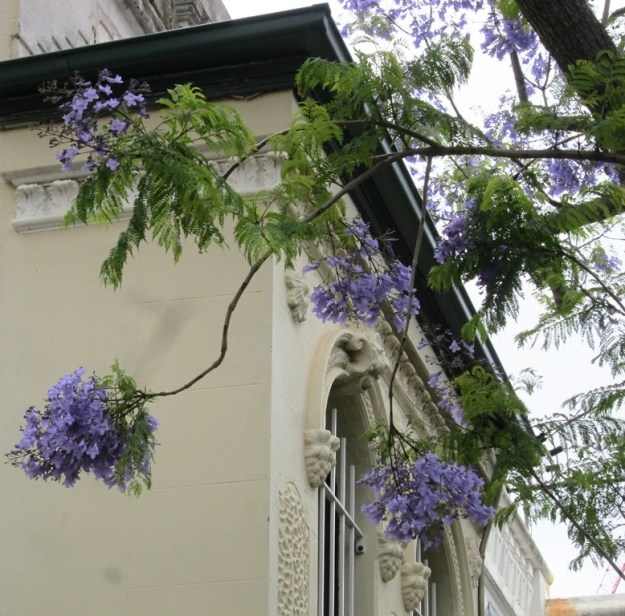
 I spent the past week in Sydney, helping our second daughter move into her new apartment. This was a larger task than either she or I had anticipated so left little time for things horticultural. But oh the jacarandas were lovely, used widely as street trees and in front gardens in the eastern suburbs. Sydney is a great deal warmer than Tikorangi – our jacaranda will not bloom here until mid summer.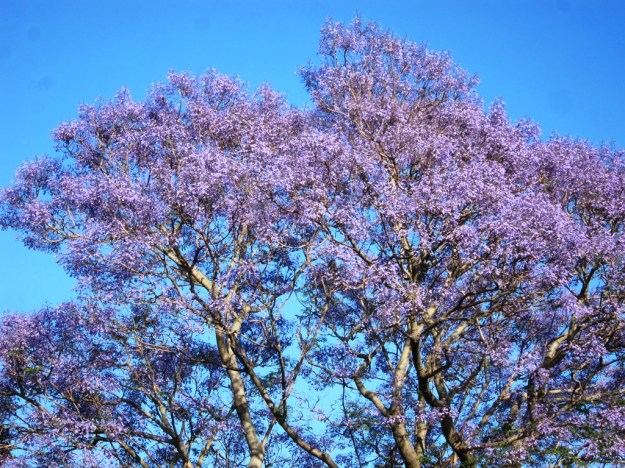
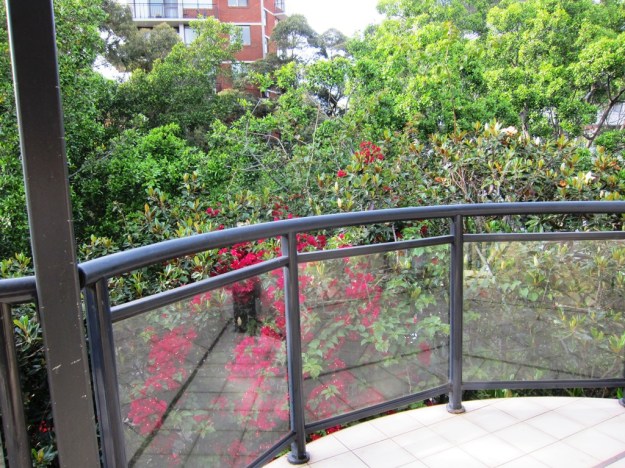 Daughter’s apartment is on the third floor. No lift. It’s not too bad – the stairs are well designed to make it easy. But I mention the third floor because that is several Magnolia Little Gems and a handsome red bougainvillea growing level with her apartment balcony. I have written about this evergreen magnolia before and have for many years suggested that its name is only ‘Little Gem’ as compared to a hypothetical Extremely Giant Gem. Three stories high so far, and these trees are not fully mature. What is more, whenever you see it photographed, it is usual to see a pristine white bloom and it certainly has a beautiful form. Alas each flower only lasts a day or two so one ends up with brown blooms – still with an attractive form – until they disintegrate, but never a tree covered in a mass of pure white.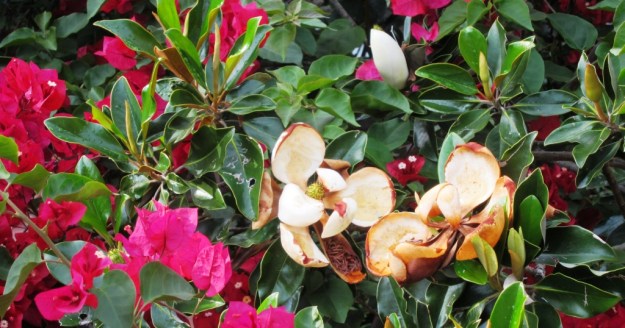
 Over the years I have seen a number of small English backyards where the only access way is via the house and thought that would be tricky. I can now say that these are eclipsed by apartments with no lift. ‘I will repot her container plants while I am here,’ I thought. Or at least the kentia palm and the tired peace lily which looked as if it was on the point of surrendering. I briefly toyed with carrying the plants down to the potting mix where there was a bit of communal garden so the mess wouldn’t matter, but decided it would be easier to carry the potting mix up and do it on the balcony. I wasn’t sure there was an outdoor tap and the rootballs needed a good soak. Logistically, it is harder than you think. Believe me. I was trying to contain the mess but even so some of the debris and the water went over the edge and I worried about alienating the lower apartment residents. The spent potting mix then had to be carried downstairs to spread. These were new challenges for me and I will look upon apartment gardeners with even greater respect. Undeterred, Daughter reclaimed her closed unit worm farm from a previous dwelling and located it discreetly at the back of the ‘landscaped’ communal area. Her kitchen scraps need to be carried downstairs anyway, so she figured she might as well keep them separate, feed the worms and use the liquid fertiliser they generate. It makes you proud to be the parent.
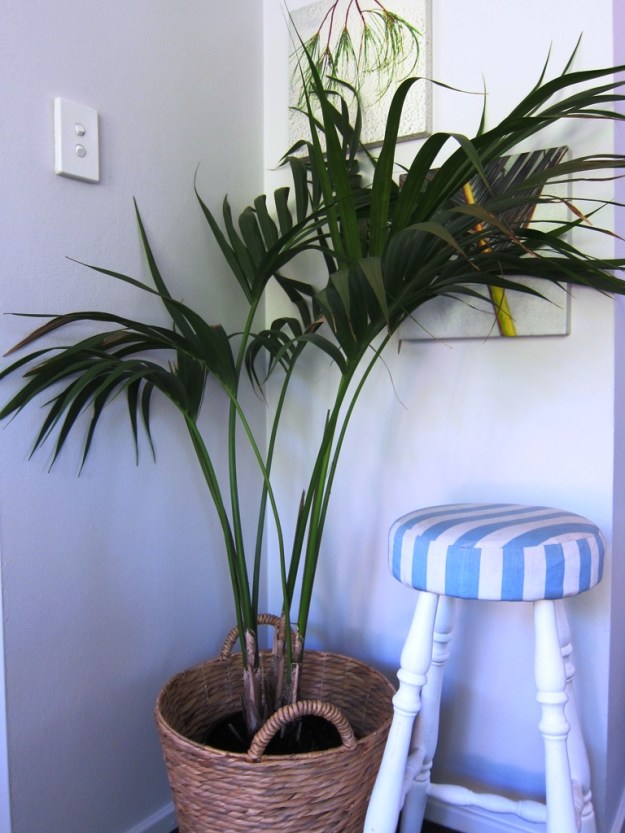 The kentia palm, I noted, is in fact three kentias (Howea forsteriana from Lord Howe Island) and there were at least five seeds sown in the original pot. That is a nursery technique to get a larger plant in a shorter space of time. Naturally I wondered about separating them but daughter needed one attractive kentia, not three smaller ones going into shock from such brutal treatment.
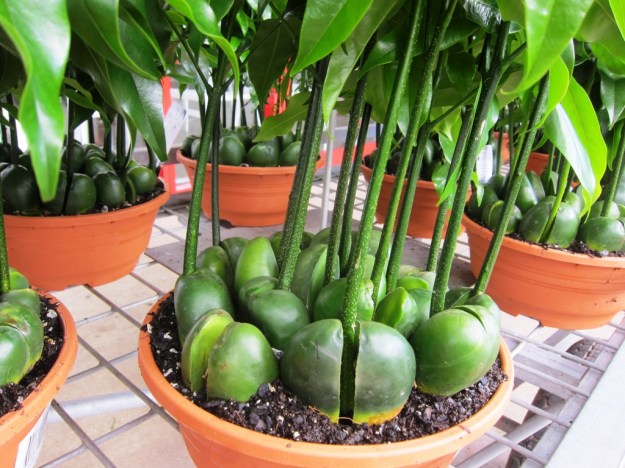 Greater love hath no mother than shopping for plastic items in Kmart but I did also get to wander through the plant section of a Bunnings store while we were doing a mission in search of home handyperson supplies. For $A26.90, you can buy a novelty houseplant of germinated “Black Bean” seeds. These are Castanospermum australe. I use the word novelty because these are not designed to grow to maturity but to be a disposable houseplant. More gratifyingly, I spotted a stand of small plants of Mark’s new daphne, Perfume Princess.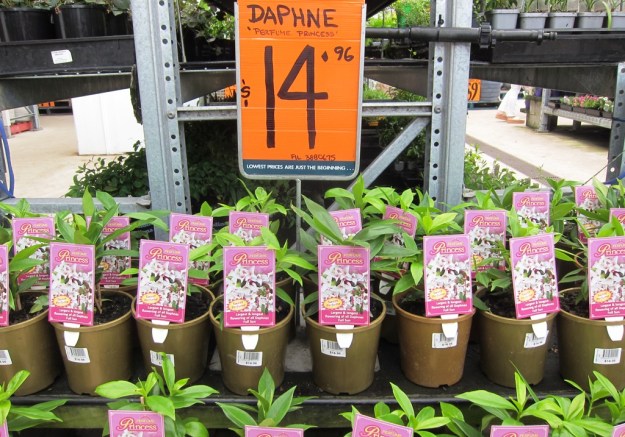
There is nothing quite like finding a little bit of home in a Sydney garden centre.
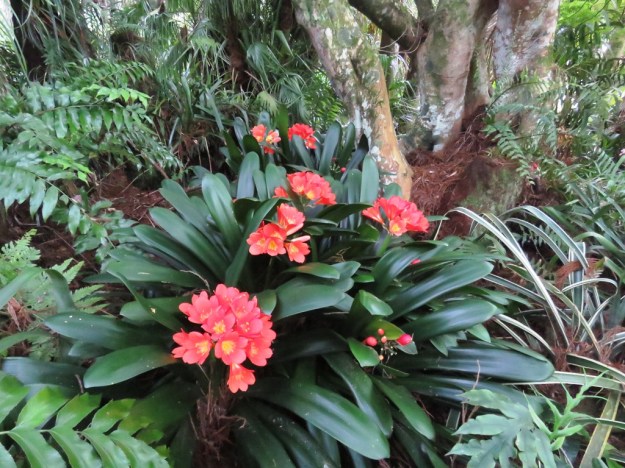 Clivias sure do light up a dark spot at this time of the year, for those of us who live in climates where they grow. This is not a family that will take much at all in the way of frost, though their preference for shaded, woodland conditions gives some protection against cold.
 I headed out with my flower basket to gather a single flower from a range of plants around the garden, feeling a little as if I was doing a geriatric Milly-Molly-Mandy impersonation. Given that ours are almost all seedlings, I was a little surprised at how consistent the flowers are when I started sorting them by colour. The variations are… subtle, shall we say?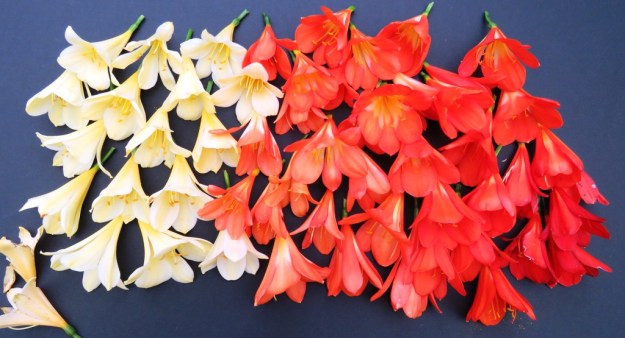
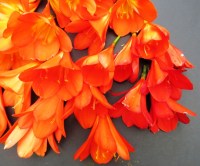 To the right, we have the ones that age to red. Do not be like the novice gardener I heard of who ordered a swag of expensive red clivia for a mass planting in her ‘designed’ garden. They opened orange, so she dug them all back up again, complained and wanted them replaced. We have not seen clivia that actually open to pure red – some age to red.
 On the left, very battered by bad weather, are a couple of examples of blooms heading to what are called the peach tones. Like many other clivia enthusiasts, Mark has been playing around crossing different plants to try and extend the colour range and the peachy ones are certainly different to the yellows which are the comparator. We have yet to acquire any of the green throated clivia which would add a worthwhile variant.
 Earlier articles include a step by step guide to
 Starting with a small brag photo: michelias used to be white, in the main. At least the hardier varieties are generally white. Sure the tropical M. champaca is orange and
 Glaucina is our stand-out blue, and we once gathered as many different blues as we could. It is variable in colour and somewhat frost tender, but it does at least stay within the blue spectrum (some of the other alleged blues faded out to cream or very pastelle mauve) and it increases well for us.



 I mentioned the
 Tikorangi The Jury Garden