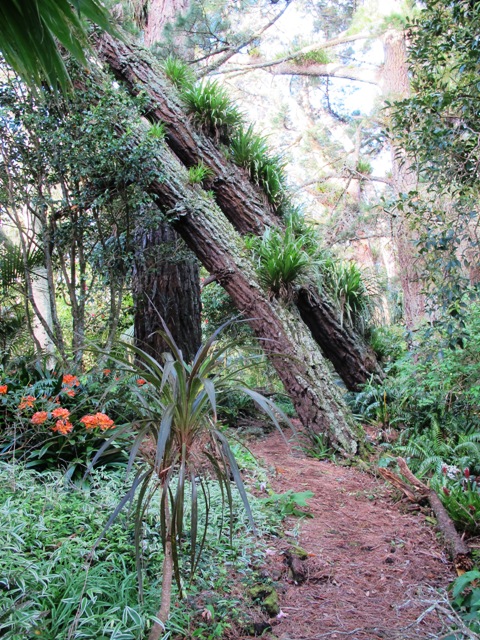
Over the decades, the angle of lean increased past the point of balance. After 80 years, these two pines fell.
There I was mentally prepared to write on an entirely different topic this week when yet another tree fell here yesterday. One large old tree falling is bothersome and relatively major. Four in under four months is unprecedented here. While we possibly have more very large trees in our garden than most, thanks to Mark’s forbears, my conversations on the social medium of Twitter last night made me realise that there are a fair number of other people who are worried about large specimens at their places.
First to go here were two 80 year old Pinus radiata last October. They had been on a lean for decades but one Saturday I suggested to Mark that the lean had increased. He scoffed but on the Sunday, he conceded I might be right. On Monday he thought maybe we should be barricading off the area because our garden was still open to the public but they fell by lunchtime. We did the immediate clean up but the large trunks are still blocking one path and need some attention.

At least when the gum tree fell over, it ripped its roots out. A brave clump of clivias is unscathed.
Ten days ago I heard a crash in the night but no whump at the end (falling trees crack, crash and then whump when they hit the ground) so I thought it must be a large branch. Mark heard nothing and was sure I had imagined it until we found the fallen gum tree the next morning. It had been planted by his great grandfather around the late 1870s so it was quite large but it fell down the hill, mostly out of harm’s way, although another path is now blocked.
Yesterday I heard the ominous sound of cracking and looked up to see one of our largest pines coming down. These are about 50 metres tall and 140 years old. That is a lot of pine. It is a bit more problematic to clean up because it has not uprooted but instead snapped without fully detaching, maybe 6 metres up where Mark’s grandfather had topped the pines back around 1900.
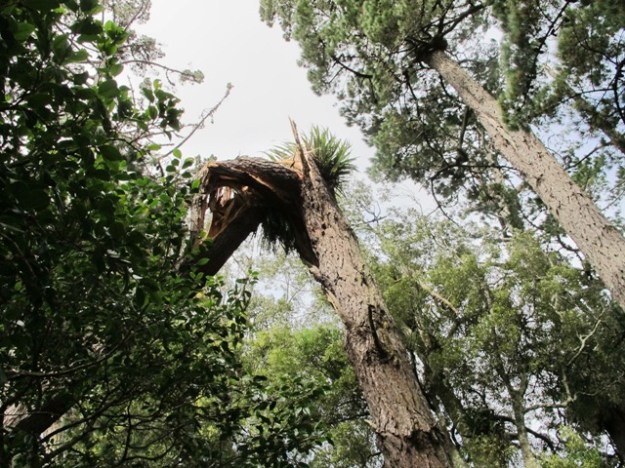
The latest pine to fall, failed to snap off cleanly, maybe 6 metres up.
Even I am surprised at the philosophical and matter of fact approach adopted by the two menfolk in my life (the one I am married to and the one we pay wages to). The cleanup has started. We will have sufficient pine cones to last us several winters and there is no fear of running out of firewood here despite the fact we burn prodigious amounts.
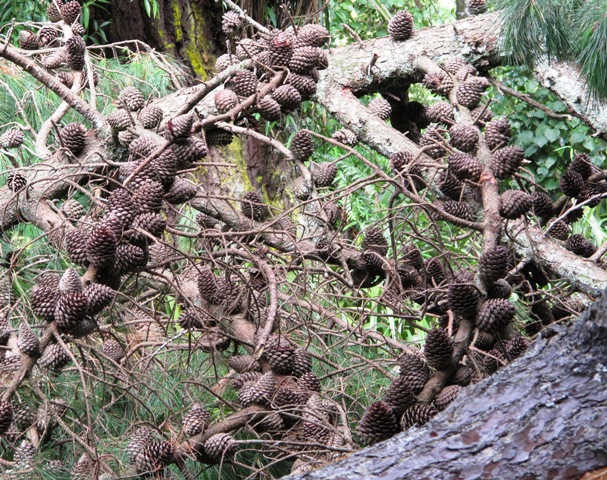
We have pine cones for eternity here. Or at least several years.
We have so many big trees, we let them fall in situ. Mind you, we have had discussions as to what to do should one start to go beside us. Run to the trunk, is my as yet unproven theory, and jump left or right at the last minute. I say this because the trunk is the narrowest part. I am hoping we never have to test this theory.
In a smaller garden, the damage from a falling tree will probably be much larger than here and the damage from the clean up may well be greater still. We avoid this by doing a reduced clean up. We do not try and remove the trunks. We remove the side branches and the litter and tidy up any plants damaged in the fall. Paths need to be cleared but, once stripped, the main trunk remains where it fell and we garden around it. It is part of nature’s cycle. Trunkeries, I have decided to call these areas – a variation on the idea of stumperies. They give height to otherwise flat areas of the garden.
It is a different matter entirely when large trees threaten either buildings or power lines. The lines companies would, of course, like all trees over the height of about 3 metres felled immediately. While it can’t be fun being a linesman called out in atrocious conditions to restore power cut by falling trees, I recoil from the thought that overhead power lines be allowed to dominate our landscape. Our lines company will do the first trim at their cost to trees that are threatening their lines but after that it becomes the landowner’s responsibility, even when they don’t have a legal easement to have their lines crossing private property. We know quite a bit about this because we have problematic power lines taking a short cut across our place and have sought legal opinion. I don’t know if this is standard policy with other lines companies.
Sadly, unless you are highly skilled with chainsaws and tree felling, if you are in the position of an at-risk tree endangering your house or power lines, you are going to have to pay someone to deal with it and it is likely to be very expensive. In this case, get some good advice first on the stability and health of the tree and get it from a tree person, not a chainsaw operator. There are truly terrible stories about amateurs with chainsaws so make sure you employ a reputable operator to do potentially dangerous tree work. The consequences of getting it wrong can be extremely expensive or even fatal in worst case scenarios.
For all their problems, we would not be without our big trees. They give shelter and add stature to the landscape. Some are magnificent specimens in their own right. I do not want to live in an environment where nothing is allowed to grow more than 2 or 3 metres high.
First published in the Waikato Times and reprinted here with their permission.
-39.042098
174.300314

 Garden lore: raising dahlias from seed

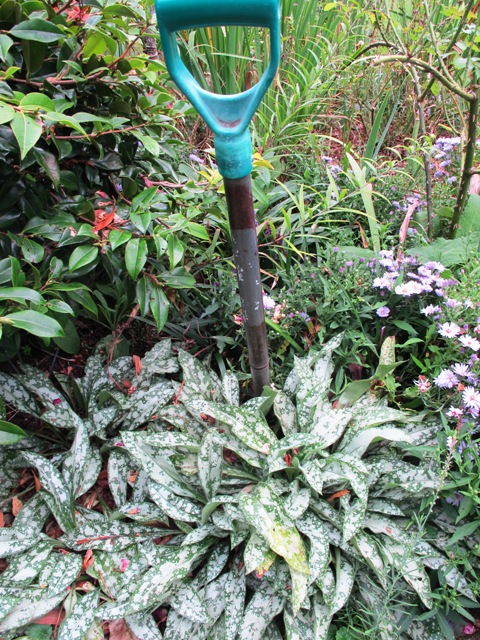 1) Clumping perennials can get overcrowded and start to deteriorate over time. Some will stop holding their flowers up well, some can die out from the middle while others just look tired and messy. Some need digging and dividing relatively frequently to stay looking their best. This clump of pulmonaria (unromantically known as lungwort) probably started as a single crown two years ago but grows rapidly.
 2) Dig out the clump, shaking off the soil. If you are not sure what you are doing, hosing off the dirt can make it easier to see the structure of the root system which varies between different plants.
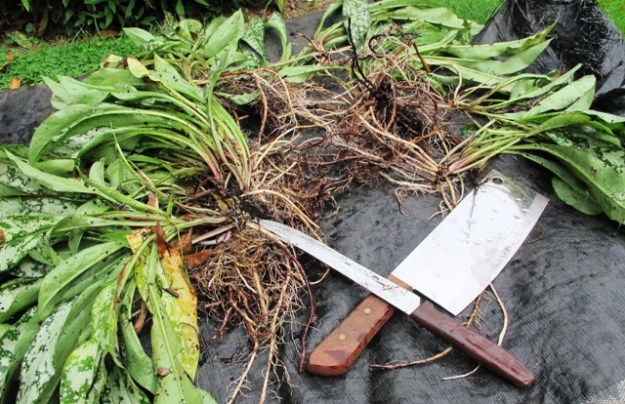 3) Part the leaves to find the separate sections growing from the centre or crown of the plant. Some plants just pull apart. An old carving knife is helpful and a meat cleaver is good for larger clumps with tough crowns. You can use a spade but it is hard to get accurate cuts. The pulmonaria yielded at least 15 divisions, all of which would grow as separate plants if I wanted that many.
 4) Replant the strongest divisions into soil which is well dug and friable. If you are only lifting and dividing every 10 years or longer, this can be a major task as soils compact over time. If you are doing it more often, it is easy as the soil stays looser. Spread the roots evenly and cover to the same level it was earlier. We like to add compost mulch and then water thoroughly but gently. Removing some leaves reduces the stress on the plant.
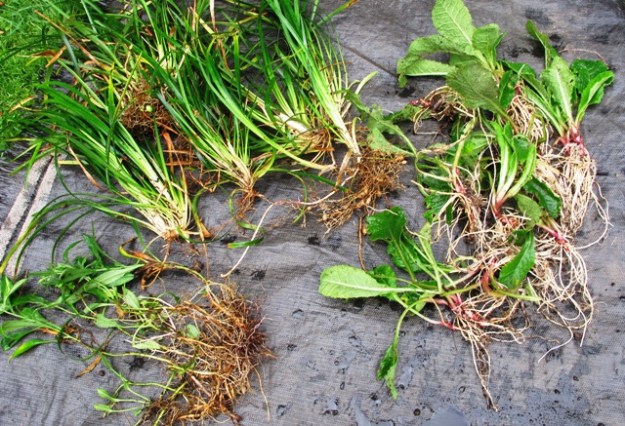 5) These three perennials also benefit from lifting and dividing every few years. From left to right: an aster which just pulls apart into separate sections, mondo grass (ophiopogon) which also pulls apart but sometimes needs the runners snipped, and polyanthus which usually needs to be cut through the crown to ensure that each piece has roots attached.
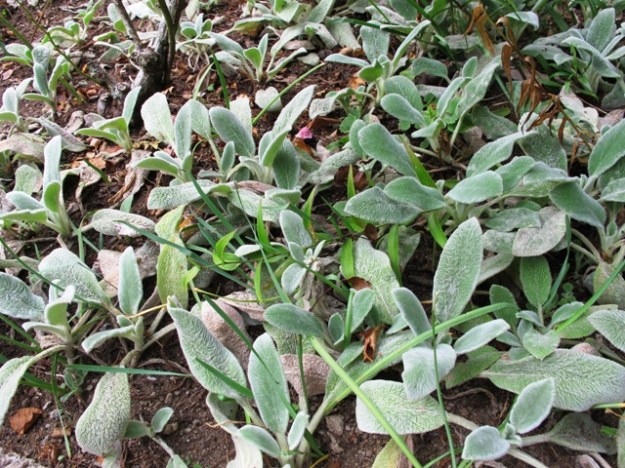 6) This patch of stachys (lambs’ ears) was dug and divided three weeks ago and has already recovered well because it is in full growth. Timing is not critical in our mild climate but done in midsummer, care needs to be taken to avoid the roots drying out and plants will need thorough watering for the first week.
 Tikorangi The Jury Garden