Author Archives: Abbie Jury

Unknown's avatar

About Abbie Jury

jury.co.nz Tikorangi The Jury Garden Taranaki NZ

Plant Collector: Pachystegia insignis

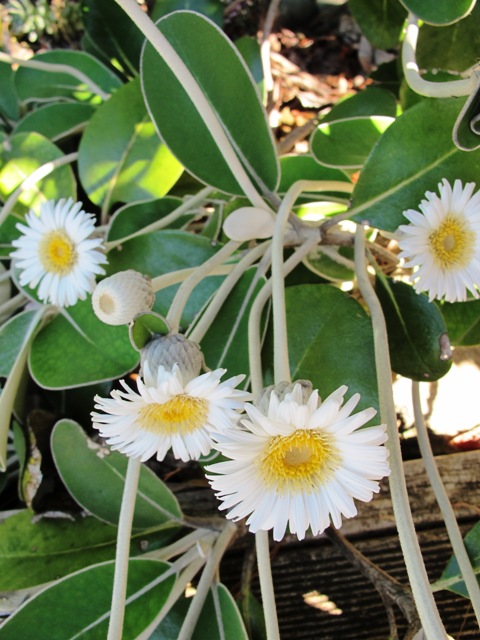
Pachystegia insignis - one of our loveliest native plants

Pachystegia insignis – one of our loveliest native plants

We do a good line in native daisies in this country but few, if any are lovelier than this Marlborough rock daisy. The flowers are pristine white, but even when it is not flowering season, the leaves are big, rounded and heavy textured – glossy green on the upper side and felted white on the under side. That felting is called indumentum (sometimes tomentum).

In the wild, P. insignis grows on the eastern side of Marlborough. Apparently you can see it as you drive down the state highway but the only times I have driven it in recent times, I have been behind the wheel with my eyes fixed firmly on the road. It hangs onto the rocky banks, coping with drought and salt spray. This means it is not the easiest of plants to grow in a lush garden situation. It needs perfect drainage and an open, exposed site. Even then, we find mature plants can keel over and suddenly die from time to time.

To our ongoing embarrassment, our particularly good form here was stolen by my late mother from the Dunedin Botanic Gardens. She died 12 years ago (almost to the day), but her legacy lives on here. Pachystegias are small shrubs belonging to the asteraceae family. The “insignis” seems to mean distinguished or remarkable in this context.

First published in the Waikato Times and reprinted here with their permission.

Toxic plants and natural remedies

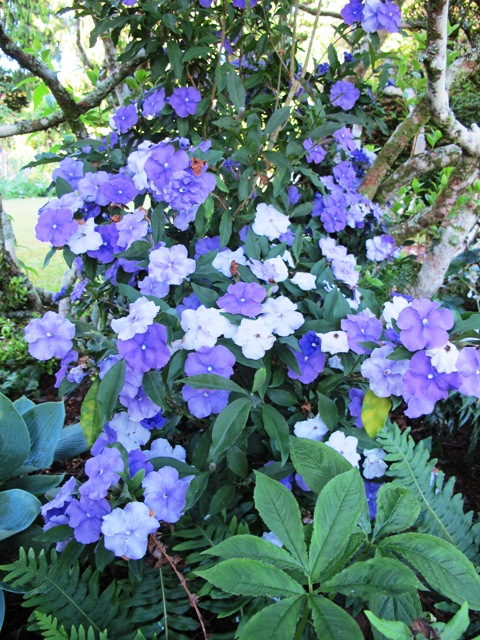
Brunfelsia, or the Yesterday Today Tomorrow plant, is highly toxic to dogs but fortunately few dogs eat flowers.

Brunfelsia, or the Yesterday Today Tomorrow plant, is highly toxic to dogs but fortunately few dogs eat flowers.

My mention of the toxicity of oleander in Plant Collector last week yielded the following comment via Twitter:
I remember seeing a photo as a kid of someone who had made a bonfire with oleander. Poor guy looked like he had been doused in acid. He inhaled some smoke and wound up in intensive care with lung damage.

Before you rush out to dispose of your oleander – if you have one – you may like to ponder that if you are determined to rid your garden of all poisonous and therefore dangerous plants, you will have to remove all daphnes, laburnum, alocasias, rhus, karaka, brunfelsia, aroids, colchicums, tulips and a whole lot more. You will end up removing half your garden. There is a certain folly to thinking that you can make your garden safe for small children and dogs by only growing non-toxic plants. Goodness, even oak and yew can be toxic to dogs.

The plant kingdom is still the prime source for most of our pharmaceutical compounds and our poisons. Aspirin was derived from willows, morphine from poppies. When a natural compound to treat cancer was isolated in Taxus baccata, British gardeners were urged to deliver their yew clippings to depots for a few years so researchers could isolate the relevant chemical compound.

Fortunately for the plant kingdom, scientists then set about re-creating the desired plant sequence in laboratories to avoid the problems of depleting natural resources.

I am sure it was Agatha Christie who alerted her readers to the fact that laburnum seeds are highly toxic and can in fact be used to poison off one’s enemy. But there are so many other sources of poisons. Cyanide is a natural compound, found in peach and apricot kernels, cassava, even apple pips along with many other sources. Ricin, one of the deadliest natural toxins, is derived from the seed of the castor plant (Ricinus communis) – as indeed is castor oil. The castor plant is highly decorative and still found in some gardens and public plantings. It was ricin that was used to murder Bulgarian dissident, Georgi Markov, in London back in 1978. He was poked with an umbrella spike in the street which transferred the poison capsule into the back of his thigh. It took three days for him to die.
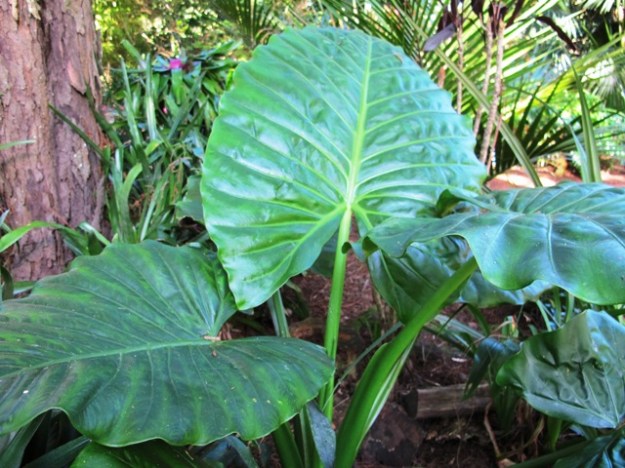
Most of the alocasias are toxic but this one particularly so. We are cautious handling it in the garden

Most of the alocasias are toxic but this one particularly so. We are cautious handling it in the garden

All this gives lie to the feel-good myth that “if it is natural, it must be good for us”. These can be powerful substances with unexpected side effects for the unwary. The potential for enthusiastic amateurs to get it wrong is just as great today as earlier.

The world has been grappling with the thin line between safety and danger in plants for over two millennia. It was the Ancient Greek Theophrastus, back before Christ was born, who is credited with first starting to try and sort out the plant kingdom into some comprehensible form, a task that was not completed until Carl Linnaeus in the 1700s. When humankind depended entirely on wild-gathered plant material for medicine, the potential for matters to go badly wrong was enormous. The majority of the populace has some difficulty in recognising different plants, even more so if they look similar. It is highly likely that there were a fair number of people out there a-diggin’ (for roots or bulbs), a-cuttin’ (for foliage or flowers) and a-gatherin’ (seeds) who subscribed to the “near enough is good enough” school of thought, especially when collecting for payment.

The pharmaceutical industry comes in for a huge amount of bad press but at least it has standardised product removed from the vagaries of human error. My elder daughter is a synthetic organic chemist who spent her later university years working on replicating a compound of great potential that had been identified in a plant native to Thailand. I was discussing herbal remedies with her recently and her comment was that, certainly when it came to ingesting a remedy, she’d rather buy it ready-made because then there is more certainty about the accuracy of the source plants and the dosage. For of course the time of the year when plant material is gathered can have a dramatic effect on the concentrations of a desired compound, let alone growing conditions. There will be much greater margin of error when it comes to home-prepared topical applications – in other words applied directly to the skin. But I would be very cautious and want certainty when it comes to swallowing or inhaling.

We are raised in this country to fear most mushrooms and toadstools. The dangers of misidentification can be fatal when it comes to eating them. That caution is not always extended to the plant world. Natural is not a synonym for safe and healthy. If you want wild gathered food skewers, use sticks of a rosemary bush not daphne or, as mentioned last week, oleander.

First published in the Waikato Times and reprinted here with their permission.

Garden Lore

“May I assure the gentleman who writes to me (quite often) from a Priory in Sussex that I am not the armchair, library-fireside gardener he evidently suspects…and that for the last forty years of my life I have broken my back, my fingernails and sometimes my heart, in practical pursuit of my favourite occupation!”

Vita Sackville-West (1892-1962)

Ready to use weed killer

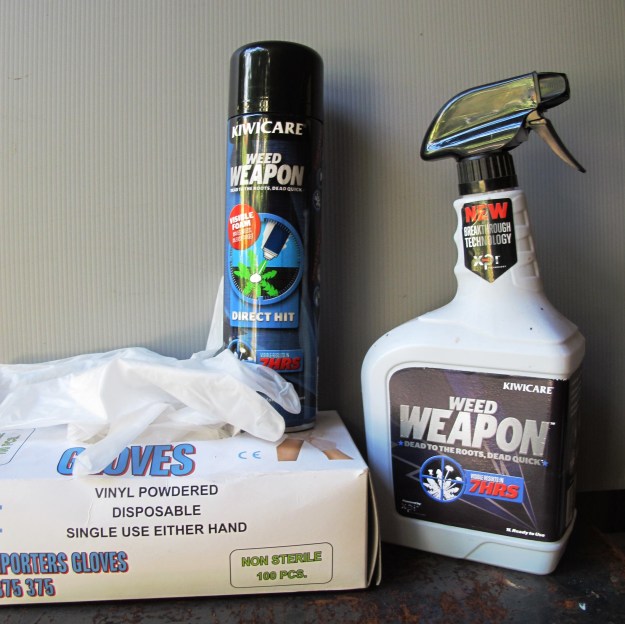
It is so exciting, the rare occasions when I receive a free sample, even if it is weed killer. The garden writer’s lot is not blessed with an abundance of samples. This was Kiwicare’s “Direct Hit” in their Weed Weapon range – aka glyphosate (formerly known by its brand name of Round Up) combined with saflufenacil which gives it a much quicker response in killing vegetation. What makes it different to the earlier “Weed Weapon” (which came in a spray bottle like shower cleaner) is that this is an aerosol foam which means you can see where it has landed.

Does it work? Yes, it will kill most weeds quickly. Is it economical? I doubt it. I didn’t get a price but you will be paying for the convenience of having it packaged in a can like fly spray. Would I recommend it? No. And no again. Being a foam makes it much harder to control the direction of the application than a spray and I suspect the level in the can will drop very quickly. It is also vital to wear protective gloves because I doubt you can use this product without getting foam on your trigger finger. Gardening gloves are not protective gloves. You need disposables or dishwashing gloves.

What was frankly alarming to us (and Mark reeled in horror when I showed him) is that the foam looks like shaving foam or that cream substitute you can squirt from an aerosol. Children would find it simply irresistible. No matter how careful you are, we doubt the wisdom of packaging weed killer that way. If you feel the need of instant weed killer in your life, I would recommend keeping to the earlier “Weed Weapon” in the spray bottle.

First published in the Waikato Times and reprinted here with their permission.

Ideas for very small gardens

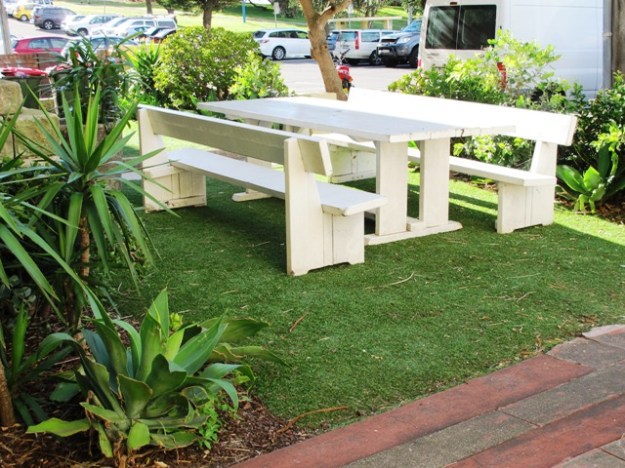
Synthetic grass has come a long way in recent years and can look surprisingly like the real thing. In a few circumstances, it may even be a better option.

Synthetic grass has come a long way in recent years and can look surprisingly like the real thing. In a few circumstances, it may even be a better option.

Camera in hand, I was thinking of you, dear Readers, on my recent trip to Sydney and Canberra and I gathered up three examples of very small, urban garden spaces.

Artificial grass or synthetic turf is often a source of much derision. The common name of Astro Turf is in fact a brand name of one of the early pioneers of this product. Given that I live in a place where we have green grass all year round, I have been guilty of sniffing snootily at the mere thought and indeed the examples I have seen have been such luminous green as to shout, let alone the nasty, rough nylon texture which bears no resemblance to the real thing at all.

The front apartment next door to where I stayed in Coogee on Sydney’s eastern beaches had artificial grass. I knew it had to be artificial because it was a uniform green with no weeds in it and everywhere else was turning brown. But I had to touch it to confirm. And it made me think that this product has come a long way from the early days. I reviewed my blanket dismissal. I won’t be rushing out to buy any, but in this situation, it had a lot going for it. If you have lawn, you have to own machinery to mow it. If you have lawn on sandy soils, you have to water it just to keep it alive. Where space is small and accommodates an outdoor dining setting and barbecue, the furniture has to be moved to mow the grass and the sections subjected to shade or constant scuffing will suffer. If you lay pavers instead, the area will get hotter and that is not always desirable.

A little leaf and soil litter from the surrounding plants gave this synthetic lawn a far more natural look. I could see why the owners had made that choice and I thought it looked fine.

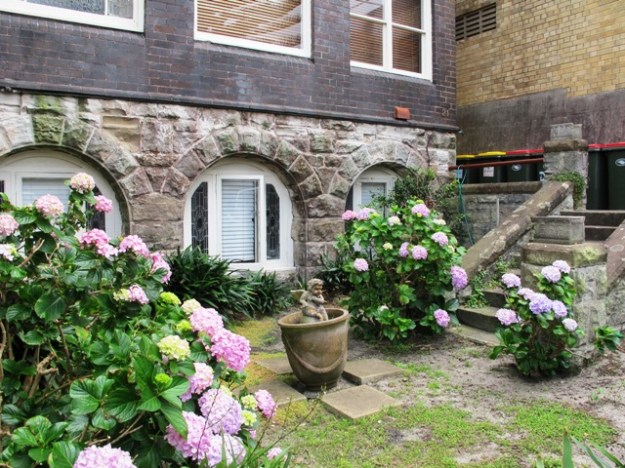
The gothic revival courtyard had a sense of romantic abandon at odds with its Coogee Beach location.

The gothic revival courtyard had a sense of romantic abandon at odds with its Coogee Beach location.

Further up the road was a front courtyard that had me entranced. Gothic revival, I decided. It wasn’t an area to live on. Nor was it tightly manicured for kerb appeal. It was a courtyard that could have come from a story book. Stone steps led down to a simple, geometric space which, despite its austerity and laissez faire maintenance, had an air of romantic abandon. It is hard to beat stone for long term landscaping. It ages so gracefully. Mind you I have a penchant for Gothic lines which I have to keep suppressed here because there is not a Gothic hint to build upon.

Note the very modern row of wheelie bins to the right. It is a bit of a shame about those but rows of wheelie bins are a fact of life in high density urban situations. The shared bins of apartment living may be necessary but they have the interesting side effect of absolving the residents from knowing how much waste they generate individually. We are so close to our household rubbish at home that I know exactly how much we generate when I carry the bag and the recycling out to the roadside each Sunday evening. Not these city dwellers. All they do is separate their recycling and load out to common bins with no investment in reducing their personal waste.

Simplicity, formality and immaculate presentation gave kerb appeal although there is little to appeal to the creative gardener

Simplicity, formality and immaculate presentation gave kerb appeal although there is little to appeal to the creative gardener

Up the road from my Canberra daughter’s home, I had to photograph a new property. It stood out on that street with its immaculate presentation. The roses were at their peak and there was a seductive simplicity to the scene. The standards are good old Iceberg. I don’t know what the shrub roses were – something similar to one I have here that is a low-growing, white single. There were only two rose varieties plus the clichéd standby of buxus hedging. It bore all the hallmarks of being professionally designed, installed (and I use that word deliberately) and maintained. I am pretty sure that road verge is irrigated and sprayed to keep it looking that good. On the day, I would have to give it full marks for kerb appeal though it was totally derivative. The problem is what it would look like when the roses are not in flower – dull as ditchwater, I suspect. This is not gardening for gardeners. It is gardening for property owners who place a high value on external presentation and there is nothing wrong with that.

This particular property confirmed my thinking that if you are not a keen gardener, opting for a formal layout and a very limited plant palette is a safe choice that, when maintained well, can look most effective.

I just preferred the Gothic revival courtyard but that is personal choice. On which note, I wish all readers a safe and happy festive season.

First published in the Waikato Times and reprinted here with their permission.

Plant Collector: Nerium oleander

Oleanders - internationally popular for harsh growing conditions

Oleanders – internationally popular for harsh growing conditions

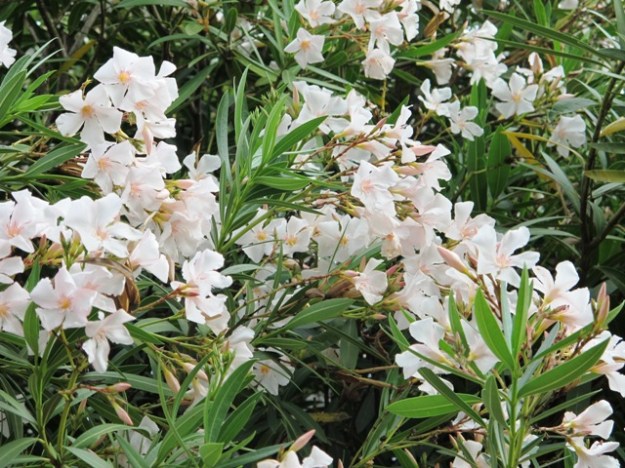
I photographed this oleander in Canberra which rather gives lie to the notion that these are sub tropical plants. Oleanders are so widespread internationally that their original habitat has not been isolated though it falls somewhere in the band stretching from Southern Europe and North Africa through to Central Asia. Some of these areas can get cold winters but what they all share is hot, dry summers. Years ago we saw oleanders used as street trees near the beachside motor camp in Gisborne. Not having been back there for some years, I don’t know if they are still there but similar conditions will apply in the drier, coastal areas of mid to north New Zealand. These plants are tolerant of both drought and salt spray.

Oleanders are evergreen and form large shrubs to small trees, several metres high. They generally grow with multiple stems and can be cut back hard without turning a hair though it may impact flowering the following season. Their tolerance for poor soils, hard conditions and drought means they can be grown in situations where most plants will struggle but it is their ability to flower freely for months on end that makes them a hugely popular plant of choice for many, despite lacking much natural form and elegance. Flowers are whites, pinks and reds, both doubles and singles.

Oleanders are renowned for being poisonous, but so are many plants including daphne. Just don’t ever use it in tisanes, herbal preparations, or anything else that may see you ingesting it. Never use them as kebab sticks. Yes somebody did, with unfortunate results. However, oleander poisoning incidents are generally deliberate rather than accidental. Mind the sap, too when pruning. It can cause skin irritation.

First published in the Waikato Times and reprinted here with their permission.