Author Archives: Abbie Jury

Unknown's avatar

About Abbie Jury

jury.co.nz Tikorangi The Jury Garden Taranaki NZ

Garden lore

“Lady Cantal says that flowers can feel no pain. I asked if hers did, and she said yes, so I pointed to a hideous stone gnome overlooking a bed of very nice Stocks and told her the reason.”

H.L.V. Fletcher Purest Pleasure (1949)

022
Sowing seed

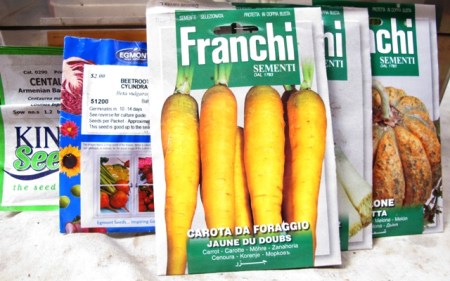
Most beginners think you can just scatter seed around the garden and it will grow but it does not take long to realise that the results can be very disappointing, non-existent even. It is worth learning how to grow seed. Some can be sown direct into the garden. There will be instructions on the back of commercial seed packs telling you how deeply to plant the seed. However, it is often more successful to sow into a seed tray or individual pots, germinating the seed in more controlled conditions.

Generally you need about 10cm of depth so egg cartons are only going to work for quick turnaround crops like peas or lettuces. It is best to buy a bag of seed raising mix which is sterile (so when a green shoot emerges you know it is your seed and not a weed) and also lower in fertiliser than a potting mix. Tamp the mix down to get rid of air bubbles. Individually sow large seeds or sprinkle fine seed carefully and then spread a thin layer of mix on top of the seeds. The smaller the seed, the lighter the covering but almost all seeds need a complete cover. Water carefully. A misting bottle (the well washed window or shower cleaner bottle with a pump spray) is ideal for fine seed. Don’t flood the seeds.

Until seeds germinate, place the pots or tray out of direct sun but in good light. It is usually wise to elevate the seed trays away from slugs and snails or cats who think it is a litter box.

First published in the Waikato Times and reprinted here with their permission.

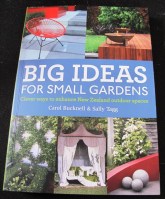
Big Ideas for Small Gardens – Clever ways to enhance New Zealand outdoor spaces

003While I am a big garden specialist, I recognise that the allotted outdoor space for most people is getting ever smaller and tiny urban sections, teensy courtyards or even a balcony is now the lot for many. This is an excellent book of ideas for those who want to make the most of turning small outdoor areas into attractive living spaces.

The photography was always going to be high quality because it is by Sally Tagg, one of our most professional garden photographers and stylists. Unlike their previous joint venture (Contemporary Gardens of New Zealand), all photographs are now fully captioned and the book has the usual good production values one expects from Penguin. There is a bit of contrived urban chic and big budget show-garden stuff going on, but not too much.

What sets this book apart is the sure hand of the author. She is a fund of information for the DIY enthusiast, rendering into simple language the strategies for gaining privacy, blurring the tight boundaries, avoiding an over-stuffed parlour outdoors, how much space you need around your outdoor dining setting, getting shelter, even managing an edible garden in a tight space. It is all about design principles relayed at a thoroughly practical, hands-on level. I was won over as soon as I read: “To create more unity, consider painting …. (pretty much all vertical surfaces) the same colour, or colour tones.” The italics are mine but that was a light bulb moment. Instead of the obvious technique of using one colour everywhere, the subtle change of tone can give complexity without clutter. There is plenty of that type of useful advice along with a wide range of different ideas.

The Plant Directory chapter is the weakest aspect of the book. Essentially, it contains lists of recommended plants which are random, decidedly eclectic and often best suited to gardens in the warmer north – Auckland, really. The author’s skills lie more in the design and planning stages than in the wider world of plants. Those 17 pages might have been more usefully given over to the conundrum of the washing line, the compost bin, hiding the wheelie bin and recycling bins, managing taps and hosepipes and general storage solutions. These mundane matters have to be accommodated in some manner and with good planning there must be ways to minimise the visual impact without sacrificing practicality. I felt it was a wasted opportunity because I suspect the author has more to suggest in this area than in plant lists.

Despite that reservation, this book as a really useful resource for people struggling with ideas on how best to utilise small spaces to create something both practical and aesthetically pleasing, life-enhancing even.

Big Ideas for Small Gardens – Clever ways to enhance New Zealand outdoor spaces by Carol Bucknell, photography by Sally Tagg (Penguin; ISBN: 978 0 143 56884 1).

First published by Waikato Times and reprinted here with their permission.

The Yellow Magnolias and Honey Tulip

Honey Tulip - looking very good this week

Honey Tulip – looking very good this week

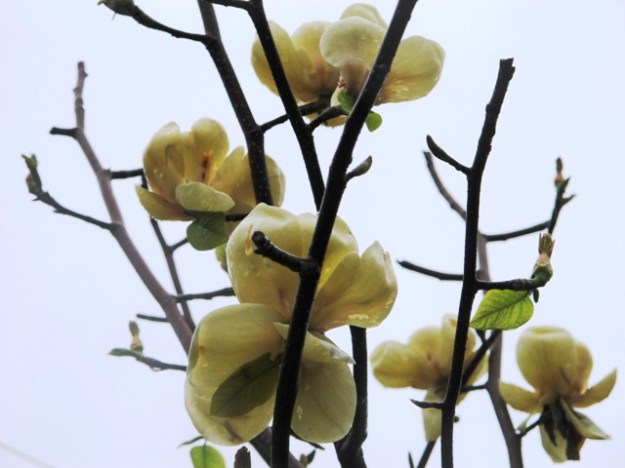
There is some relief here this week as our newest magnolia, Honey Tulip, is looking particularly good. It is always a bit nerve wracking releasing a new cultivar on the market and hoping we have it right.

We are still a little bemused by a communication from some random person when Honey Tulip was first shown in an overseas publication. I will have to paraphrase it because I must have deleted it in irritation at the time, but it said something along the lines of: “It is good that Mark Jury is discerning in the magnolias he names, but the world has enough yellow magnolias already….” It then proceeded to instruct my Mark on what he should be breeding for instead.

The international world of magnolias is pretty small, the number of international magnolia breeders even fewer. We know most of them by repute, if not personally. This email did not come from anyone we had heard of before. What was galling was that in the heady world of new magnolias, Honey Tulip represents a genuine step in flower form for the yellows.
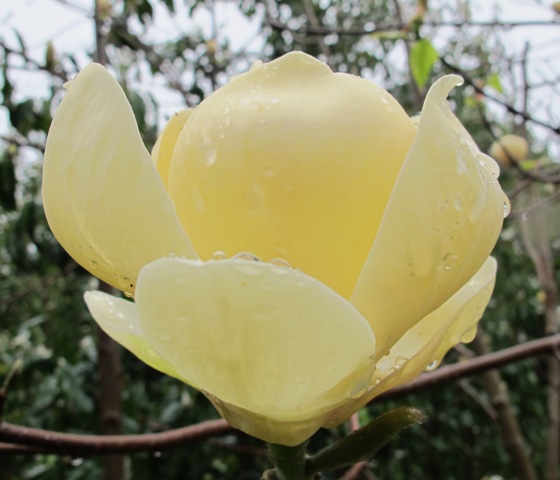
Honey Tulip - a lucky break in flower form and performance

Honey Tulip – a lucky break in flower form and performance

The yellow magnolias descend from a single species and while most magnolias originate from parts of Asia, the yellow deciduous M. acuminata and the evergreen grandiflora magnolias are from USA. M. acuminata is from eastern USA up into southern Ontario in Canada. We can remember when it first came into this country maybe 25 years ago, along with four of the earliest yellow hybrids – Yellow Bird, Yellow Fever, Elizabeth and Koban Dori. They were a collector’s novelty. Who knew that magnolia flowers could be yellow?

It did not take that long to realise that the yellow magnolias were not quite like the big pink, red, purple and white ones. There are a few problems yet to be solved. M. acuminata itself grows very rapidly and very large which takes it beyond the size most gardens can accommodate. The flowers are small, very small by magnolia standards, though they have good fragrance. Mind you, it has to be a very strong scent to mean anything when the blooms are 20 metres up above.

However, the biggest problem with acuminata and most of the hybrids is that the flowers come so late in the season that they coincide with the new foliage which then hides them. We are of the opinion that the whole point of a deciduous magnolia is to have all those fat, furry buds exploding into a mass of blooms on a bare tree in late winter and early spring. So little flowers, no matter what colour, obscured by masses of fresh foliage, are not going to set the world on fire.

Magnolia Yellow Fever planted on our road boundary

Magnolia Yellow Fever planted on our road boundary

We have not kept buying the many new yellow hybrids that have come on the market. There is a limit to how much space we have and too many of them show the same flaws. In a large garden, the best performer we have seen so far remains the early American hybrid with the unfortunate name of Yellow Fever. It is not the strongest yellow but it does flower on bare wood and is a pretty primrose, unlike Elizabeth which is more cream.

There is yellow form of the Asian M. denudata but we have not heard of it being imported to this country yet and have not seen it in person. It is difficult to judge colour from the range of hues shown on the internet. A form called ‘Yellow River’ is being sold overseas but the nature of its breeding and origin is unclear. Certainly it came out of China and it has denudata origins but whether it is a yellow sport of that species, a natural hybrid or a controlled cross seems unclear. Even less clear is when or if it will become available in this country. Only time will tell whether international breeders get the jump on different yellow magnolias using denudata yellow, with or without acuminata.

For all these reasons, our Honey Tulip represented a significant breeding step. It flowers on bare wood, before the foliage. It does not appear that it is going to be of timber tree stature. The colour is a pretty butterscotch but the big breakthrough is the form. While not huge flowers, the tulip shaped blooms are larger than most other yellows – very similar in fact to a soft yellow form of Magnolia Black Tulip. It was also a lucky break because it was the only one of the plants from that particular cross that flowered in that form and colour.

The ultimate challenge is to get a pretty yellow Iolanthe with big cup and saucer flowers. Mark has about 20 years left in him to work towards this goal. I wonder then if the overseas critic who saw himself as an expert on yellow magnolias will concede that there is always room for improvement.

The ultimate breeding challenge - is a yellow Iolanthe even possible?

The ultimate breeding challenge – is a yellow Iolanthe even possible?

First published in the Waikato Times and reprinted here with their permission.

Plant Collector: Camellia minutiflora

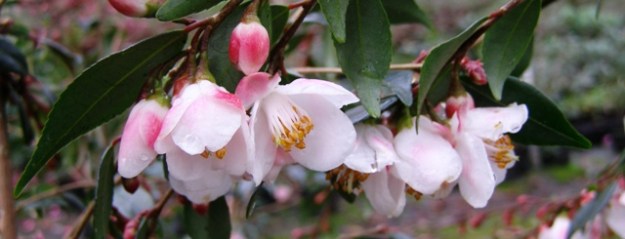
Camellia minutiflora

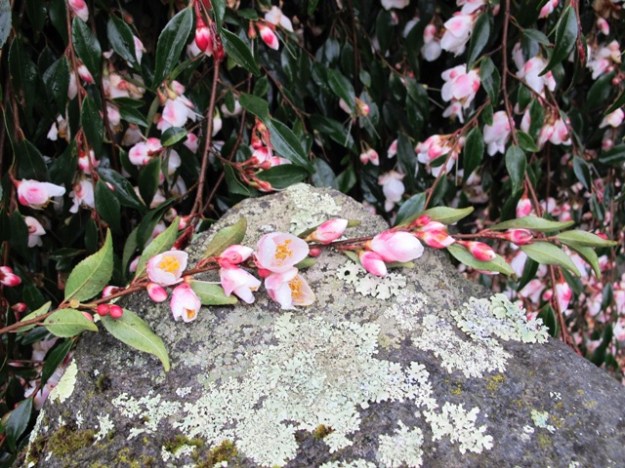
Camellia minutiflora

Before we finish camellia season for the year, I would like to introduce one of my absolute favourites. The foliage is small and dark and the branches are long and pendulous so it has a weeping habit. The tiny red buds open to masses of tiny white flowers with a deep pink flush. It is delicate in appearance and so pretty. The original plant came from Camellia Haven in Papakura (now closed) and has only ever reached a metre in height.

We are so taken by this cultivar that we have trained up about a dozen plants to a taller height, ready to plant out in our new garden. Imagine a miniature, evergreen weeping cherry and you may get a mental picture of the effect we are after with these plants.

It appears that the Chinese have reclassified this plant as a variant of another species so its correct name is Camellia lutchuensis var. minutiflora. As it is their plant and they have professional taxonomists, I am happy to accept their decision. C. lutchuensis has similar tiny foliage though much paler in colour and inclined to yellow in the sun, similar flowers though creamy white without the red and it is the most scented camellia of all. I cannot get any scent from C. minutiflora but it is superior as a garden plant.

This is a species. It can be raised from seed. If you can’t find it for sale but know of a plant somewhere, check around its base for seedlings.

After maybe 15 years, the plant is about a metre tall - C.minutiflora

After maybe 15 years, the plant is about a metre tall – C.minutiflora

First published in the Waikato Times and reprinted here with their permission.

Garden lore

The honeybee kills more people around the world each year than all the poisonous snakes combined, but the creature responsible for the most human deaths worldwide is the mosquito, by a considerable margin.”

Niall Edworthy, “The Curious Gardener’s Almanac” (2006)

003 (5) - Copy Garden Lore: bee food

We were interested to read an article last week reporting that Britons are being urged to plant bee-friendly flowers rather than to try home beekeeping. Amateur beekeeping is not for the ignorant but well-meaning enthusiast. It needs to be done properly or not at all and in London there is simply not enough food to feed the existing bees without adding more.

The plight of bees is a global problem. Without getting too carried away on this matter, the bees need as much help as they can get. What every gardener can do is to plant some food for the bees. Basically, bees need flowering plants with visible stamens. The simplest and one of the most effective ways is simply to sow some seed of flowering annuals along with your vegetables. Let one or two plants go to seed and then weed out those surplus to requirements in future years. Bees are needed in the vegetable garden and orchard in order for some plants to crop so make the environment more inviting for them. Besides, what is not to like about cosmos and poppies between your cabbages? Browse the seed stand or catalogue and pick flowers with plenty of golden stamens visible and a healthy track record. Hollyhocks can be vulnerable to rust and mildew and nobody needs more of these problems in the vegetable patch but most daisies, single poppies and calendula are fine and there are many other options.

First published in the Waikato Times and reprinted here with their permission.