


Anything but organic…..
I see Prince Charles feels vindicated about organic gardening, pointing out that when he first started talking about it, he was the subject of much derision. There is no doubt that the prince is a very keen gardener and he has been a flag bearer for organic techniques in the ornamental garden as well as the kitchen garden. I just recall some discussion about him advocating talking to one’s plants which still seems perilously close to being flaky in my books.
But Prince Charles is absolutely right about home organics. In fact the chemical approach to weed and pest control is comparatively recent, dating back to about the 1950s, as is the routine use of manufactured fertiliser. It was the result of war technology. We’ve been getting steadily better but the intervening decades were not gardening’s finest hours and some pretty dodgy practices and attitudes linger on.
We never describe ourselves as organic gardeners because we are not. We do, however, follow many organic gardening practices because they make good sense in terms of gardening in harmony with nature and enhancing the environment. This is not true of all gardening, much of which has to do with imposing human will upon nature.
As a result of this, we spend a fair amount of time on a quest for reliable information. There is an awful lot of puffery around organics, from flaky thinking to fervent faith, but that does not mean the underpinning principles are wrong. It just means it is a little harder to decode some of it. We’ve still come up short on good information regarding nutritional density, but given time, I am sure we can find that out.
In the meantime, it may help readers to think of organic gardening running a similar line to vegetarian diets – there are a whole lot of points on the continuum where you can find your niche. Starting from one extreme, you have the old fashioned eater whose dinner plate is 50% meat (usually red), 35% spuds and the remainder in consolation green veg. This gardener sees nothing wrong with pouring on insecticides, fungicides and herbicides, along with chemical fertilisers. We won’t dwell too long on this 1960s model.
The realisation of heavy carbon footprints and lack of flavour in food which saw a return to seasonal eating, and then to eating locally produced foods may be analogous to the home gardeners who suddenly decide they must have raised vegetable beds on the quest for self sufficiency. It matters not that they are filling the beds with compost mix sourced from the garden centre, trucked considerable distance and packed in heavy plastic bags. Nor does it matter that any resulting produce will be extremely expensive. They have made a start and they claim it is organic because they are not using sprays. At this point, organics has more to do with what is being left out rather than a change to the way we garden and it tends to be the domain of the enthusiast who is not always particularly well informed or indeed experienced.
Move along to the partial vegetarian movement (which seems sometimes to extend to the genre of foraging and wild foods). We belong around here – two or three meals a week which are vegetarian and always seasonal using our own produce. Gardening organically at this point has much to do with sustainable practice wedded to pragmatism. We factor in issues such as plant and seed selection, plant heath, soil health, maintaining ecosystems, composting, mulching, and lawn management to avoid needing to spray or feed. But we want to be able to get crops of tomatoes through and we are yet to be convinced you can do that organically in our climate. We make relatively well informed choices in food and gardening.
Genuine vegetarians usually underpin their diet choice with philosophical beliefs. Many will eat dairy products and eggs, some even fish. But others will shun any dead animal products including cheeses made with animal rennet, even leather shoes. Being a certified organic gardener tends to come parallel at about this point. It is much more rigorous and prescriptive while offering the security of rules to follow.
At the far end of the spectrum are the vegans, probably matched in gardening by those who operate closed horticultural systems (with no external inputs) and biodynamics. While there is a tendency to accord these extremes the mantle of purity, the higher moral ground, in practice they are usually more faith based than science based. Neither a vegan diet nor a closed growing system is complete in the long term without supplements.
So organics is not a hard and fast set of rules, unless you are after accreditation. What is really interesting to us about Prince Charles is that he is serious about having a beautiful, traditional garden, all the while applying organic principles at every level, not just to his cauliflowers. It is looking increasingly like common sense these days. We just wish we could afford the prince’s eighteen garden staff to help us towards greater purity in gardening practice.
First published in the Waikato Times and reprinted here with their permission.


 3) Strong gloves are recommended, along with sharp secateurs.
 4) This season’s new canes which will bear fruit next summer are red. The old canes, which are dying off, are brown and dry. Remove all old canes from the base of the plant. Thin out any weak new canes.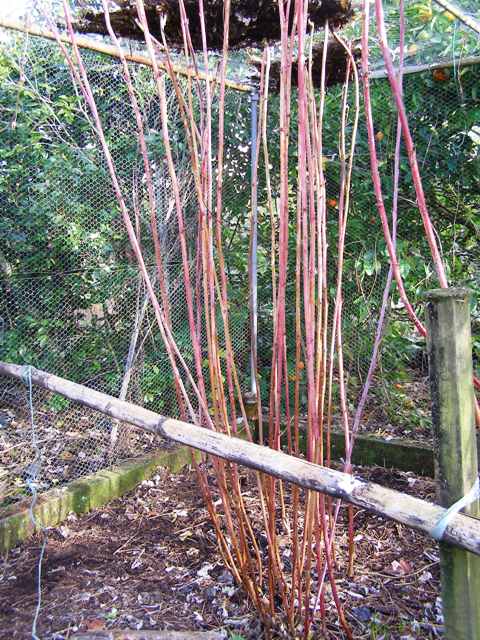
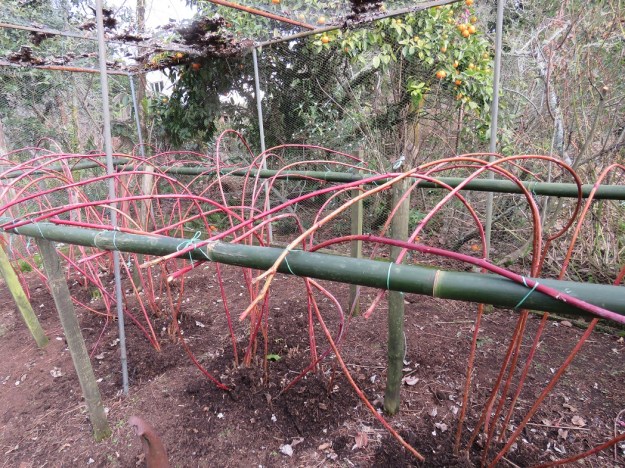 6) Alternatively, hoop the canes over and tie them to a frame as shown here. This is now my preferred approach. While it takes a little more time, it keeps the rampant canes under better control, increases the fruit set down the stem and makes picking very much easier. I then feed each clump with a generous helping of compost.
 6) The prunings need to be burned or disposed of. We clip them to manageable lengths and gather them in a wool bale for convenience. You can’t compost prickly old stems. Town dwellers may like to dry them and then burn them on a woodfire or put them out with the rubbish. Ours will go on the burning heap.
