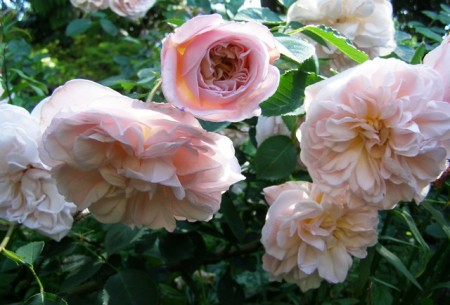
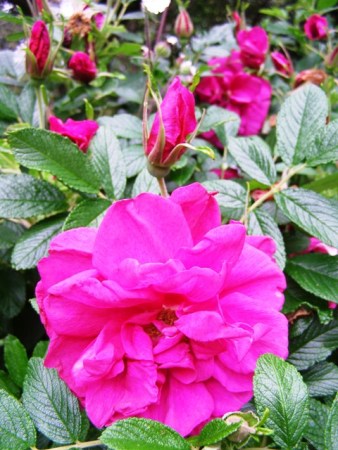
There is something undeniably romantic about Rosa Cymbeline
I have a bit of an ambivalent attitude to roses. On the one hand, there are only two types of flowers I consistently cut and bring indoors – roses and auratum lilies. There is something wonderfully opulent about a vase full of fragrant roses. Most roses rank pretty high up the scale for flower power. In other words, in reasonable conditions, they give a high number of flowers over a good length of time, given the size of the plant. Roses have an air of romance and promise. Well, most roses do. We will ignore the naff patio standards and freaky types. Just as the complete garden has a productive kitchen garden, so should it have at least some roses – in our opinion at least.
On the other hand… well. Roses are grown for the lovely flowers. Very few bushes are things of beauty. They harbour more pests and diseases than any other plant I know. They are probably second only to lawns in being the cause of home gardeners pouring a whole range of nasties into the environment. I hate their thorns and resent splinters and gouges during pruning. I am always nervous of wounds since being told by a nurse how she had to special a patient who caught a thorn in her elbow and it subsequently turned extremely septic. Disposing of prunings is a problem because they have to be burned or go to landfill. They get black spot and have few leaves after about March. They positively lure aphids. Climbing roses are so rampant that it becomes a major battle to contain them. The year I spent an entire afternoon pruning and tying in one plant of Albertine was its last. I decided that the resulting reward was not worth that amount of effort. The list of negatives is extensive.
The bottom line is that, despite all their disadvantages, roses remain a big seller so clearly the general opinion is that they still justify their place in the garden because of their lovely blooms. And I haven’t taken all mine out and put them on the burning heap because I still love them. I have taken some out, though and another is destined to go soon. It has black spot and yellow leaves already.
The issue here is that we don’t spray our roses. Ever. I don’t spray anything and the husband is adamant that he won’t spray roses and I should just pull out the non performers. Despite having grown up as the Chemical Generation (would that be Gen C?), we have made a conscious decision to try and garden with a greatly reduced spraying regime. There are only a few key plants that get sprayed here. Picea albertiana conica is one – the red spiders will take it out otherwise. For the rest, if they can’t survive and thrive in hospitable conditions, planted well and fed regularly with compost, then they aren’t worth keeping.
In times gone by, the classic rose garden tended to be an area of scorched earth with no build up of leaf litter below which stopped diseases from wintering over. Plants were spaced well apart, usually only one of each variety and predominantly hybrid teas, so there was plenty of air movement which reduces problems with mildew. And it was easy to spray. It is a pretty dated look and really only applicable to a picking garden.
The modern rose garden is more likely to go one of two ways. Either the roses get bedded into what is essentially a cottage garden mixed border, filled with a froth of perennials, annuals and small shrubs. That is what I do, in the hope that as the roses defoliate through the season, the other plants will hide the shortcomings.
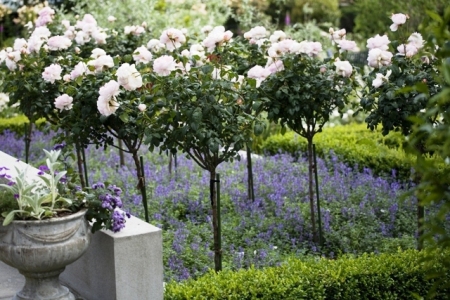
A modern take on the rose garden at La Rosaleda in New Plymouth (photo by Jane Dove Juneau)
Alternatively, one can go the formal path, as at Coleen Peri’s garden, La Rosaleda, where she has planted a grid of matched Sharifa Asma standard roses with a solid groundcover of catmint or nepeta beneath. To carry this look off, you have to maintain your roses in the highest health or they will look unloved, uncared for and considerably more of an eyesore than my defoliated specimens in a mixed border.
What annoys me is that it has taken so long for rose breeders and rose nurseries to heed the call for disease resistant varieties. The Flower Carpets led the way and I have to say that while they are not picking roses and they lack some of the romance of old roses, let alone the fragrance, the white and coral variants of Flower Carpet are two of the very best performers in our garden. I am told the new amber variety is particularly good too. But aside from that series, the trialling and selection of roses based on the criterion of being able to grow them in the home garden without spraying appears to have moved at a snail’s pace. Maybe the clamour from the consumer has simply not been loud enough yet? There is a pretty quick turnaround on rose breeding, certainly compared to the slow process that comes with magnolias, camellias and similar woody trees and shrubs.
Two final comments: firstly, if you are not going to spray, you have to be thorough with pruning and feeding to promote health. We feed through regular applications of compost mulch. I do a textbook hard prune in winter and I constantly summer prune lightly to remove spent stems, weak growth and diseased areas. That repeated pruning encourages the rose to keep pushing out fresh leaf buds.
Secondly, we were told by an international rose breeder in Holland that perfume and longevity as a cut flower are incompatible. That is why many florists’ roses lack scent. They are bred for vase life. Nobody has ever confirmed that for us, but we assume he knew what he was talking about, it being his speciality.
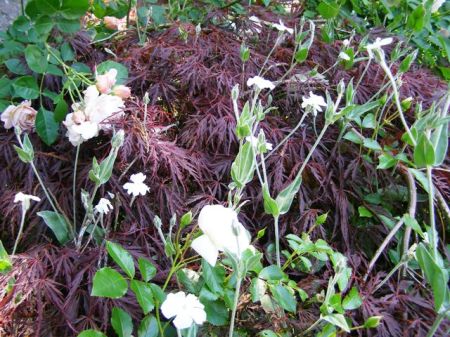
I grow my roses in a mixed border situation - with the hope that the other plants will disguise the defects of the unsprayed rose bushes
First published in the Waikato Times and reproduced here with their permission.
-39.042098
174.300314




 Tikorangi The Jury Garden