Author Archives: Abbie Jury

Unknown's avatar

About Abbie Jury

jury.co.nz Tikorangi The Jury Garden Taranaki NZ

In the Garden: July 30, 2010

The low tech slug bait station

The low tech slug bait station

  • The official start of spring may be another month away but gardeners know that it really starts earlier than that and we can expect significant warming of temperatures in August. This means the pressure is mounting to finish winter pruning. You really do want it done before September and time will run out all too soon. This refers to the usual candidates: grapevines, raspberries, apple and pear trees, hydrangeas, roses, wisteria, hybrid clematis, sasanqua camellias, rhododendrons and most deciduous plants.
  • As you complete the winter clean-up round, it is the optimum time for getting fertiliser and mulch laid. Plants will leap into growth soon and that is the time when you see maximum uptake of fertiliser. Laying a good layer of mulch will greatly reduce the spring weed infestation if you do it properly (covering the whole area to a depth of 4 to 6cm). In areas prone to drying out over summer, the mulch layer will conserve moisture levels.
  • September will signal the start of the busy planting time for summer vegetable crops. If you were good and sowed down bare areas in autumn green crops, you should be starting to think about digging these in. We are still cold and you need to allow six weeks for the crop to break down in the ground before you start planting again. This means you can be using the ground about mid September.
  • If you have already sown early potatoes, keep mounding up the soil around the shoots as they grow (commonly referred to as earthing up). This helps the soil to warm up faster, encouraging more growth, kills the weeds and gives some measure of frost protection to the tender shoots. Early potatoes need every helping hand you can give them and particularly to be given protection from frosts (which means you can’t plant them inland yet).
  • Keep an eye on slug and snail attacks on emerging bulbs. I found a treasured spring crocus which I don’t think was meant to have frilled edges to each bloom. Don’t broadcast slug bait like fertiliser. One bait can kill many. Our practice is to establish little bait stations where necessary – a screw top lid from a milk container with a couple of baits and a large shell semi covering it. The shell looks unobtrusive and keeps the bait dry while allowing the varmints in to feed. Don’t forget that slug bait has an attractant in it so you don’t need to carpet the ground so thickly that they trip over the stuff.
  • Heavy lichen infestations on plants can be unsightly but rarely poses a threat to plant health. Lichen growth is an indication of very pure air (lichens are one of the first organisms to succumb to pollution). If it worries you, you can do a clean-up spray with copper or lime sulphur. If you are using the latter, keep it to deciduous plants in winter and cover any plants below with a tarpaulin so that they do not get damaged or killed.

Countdown to Festival, July 30, 2010

  • Festival gardeners have not been slacking inside during winter. Much of the preparation work is carried out while others huddle by the fire. In Waitara, Alathea Armstrong has finished her structural alterations – widening borders and altering shapes, much aided, she says, by a mild winter. Currently she is keeping track of her emerging delphiniums after the Attack of the Slugs last year. It would be a brave slug that ventured near the plants now. She has been planting a new bed using the two roses Lavender Dream and Mum in a Million and she is most enthusiastic about the Mum rose which she grew last year and describes as being absolutely gorgeous.
  • Down the road, Margaret Goble says she is back on track with garden preparation after a rather bad garden accident in February took her out for some time. Family and friends rallied around, much to Margaret’s gratitude because hers is a large and detailed garden to manage singlehandedly. Rose pruning has been completed (an enormous task with her huge rose collection which is meticulously maintained) and lime and BioBoost have been added to the soil. Her window boxes and handsome hanging baskets are planted and she is eyeing up the concrete which has turned green over winter.
  • Up the hill a little from Stratford, at Mountside Betty Brunton has joined the league of Gardeners on Crutches after recent surgery and is trying to work out how she can get around her garden with the spray unit while only semi mobile so that she can get Vapourguard onto her recently pruned hydrangeas, fuchsias and roses. She wants to protect the fattening buds from getting frosted. Her hellebores are looking fantastic and evoke memories of the late Jill Kuriger who was a fine plantswoman, a Festival stalwart for many years and a wonderful gardening identity. Betty says her trilliums are just pushing through the ground and she is hoping that my Mark will hurry up and have some plants of the related paris ready to share soon.
  • Still in the Stratford area but across the other side, Bruce and Lorri Ellis at Te Popo had their garden routines disrupted when recent high winds swept through taking out two trunks of a triple trunked Montezuma Pine. As the tree was around 100 feet tall (or over 30 metres), this type of damage is not for the faint hearted. One trunk catapulted to earth landing with force in Lorri’s pink garden where it caused huge damage but at least that was better than the second trunk which became wedged half way down in a 50 foot (15 metres) claret ash. The surviving trunk also had to removed because it was now unstable and a threat to nearby buildings so specialist arborist services were required. Something unforeseen like that can really blow the budget and take up time. Here at Tikorangi it was one of our tawa trees we lost about the same time but at least it fell cleanly and didn’t do too much damage to the big leafed rhododendrons below.
  • In New Plymouth, Alan and Cath Morris at Pukemara describe their garden activities as fine-tuning in preparation for their first Festival experience. They have finished the pruning round somewhat earlier than usual because they are having some time out in August. Alan has constructed a park bench out of marcrocarpa and sited it in their Gully Garden so that visitors will be able to have a rest and admire the outlook. They have also relocated a bed of azaleas which had been getting too shaded by adjacent rhododendrons. In fact they are quite pleased with how the garden is looking even though it is wearing its winter cloak and plan to keep it that way up until opening time at the end of October. At this stage, there does not appear to be any garden angst or panic in the Morris household.
  • Also in New Plymouth at Nikau Grove, Elise Lind says her current challenge is learning to garden in shade. As all their plantings have grown, the character of the place has changed and where once there was sun, now there is overhead canopy. This is exactly what they wanted, especially on the waterfall bank but there is an ongoing process of having to find under planting suited to the changing conditions. At least, Elsie notes, there is the indubitable bonus that weeds tend to be sun lovers so they are far less of a problem these days.

Camellia Diary 4, July 27, 2010

Click to see all Camellia diary entries

Click on the Camellia diary logo above to see all diary entries

The ugly devastation of camellia petal blight

I suspect there has been a bit of a conspiracy of silence about the devastating impact of camellia petal blight in this country. Between camellia enthusiasts, growers and retailers, nobody has really wanted to own up publicly to the fact that it must irrevocably change the types of camellias we plant and they way we use them. The sad thing is that when it was first discovered in Wellington over a decade ago, it was only in two or three locations and if there had been a will, it could probably have been eradicated.

Camellia petal blight at the top, showing the distinctive white ring, merely botrytis on the lower flower

Camellias used to be the second biggest plant seller in this country (roses were number one) and it was the wide use of them in relatively large numbers which aided the spread of petal blight. It is a fungal spore which can travel, apparently, up to 5km on the winds as well as being transferred by infected blooms and soils. The overseas advice to rake up and burn all infected blooms to reduce the spread was simply impractical in a country where they are heavily used in informal hedges and windbreaks. Camellias are seen as utility garden plants in New Zealand and not as show blooms so people were never going to get out with the leaf rake to clear up every single affected bloom.

Botrytis shows up as a darker brown on the bush and has been with us for a long time but nowhere near as devastating as the more recently arrived petal blight.

Botrytis shows up as a darker brown on the bush and has been with us for a long time but nowhere near as devastating as the more recently arrived petal blight.

So petal blight has turned the annual flowering into something of a disappointment, particularly on the japonicas where mass display is a thing of the past. We have always had botrytis here, which can turn blooms to sludge on the bush but the combination of botrytis and petal blight has dramatically reduced the display. Botrytis shows up as darker brown markings whereas petal blight is a paler discolouration. When you turn the blooms over and flick off the calyx (the little hat that holds the petals together on the back), petal blight is revealed as a powdery white ring. Botrytis does not show that white ring. As the affected blooms reach the ground, they give rise to the mushrooms which form at the base of affected plants – these release the spore and the petal blight continues its self contained cycle. Alas the self grooming characteristic (where camellias drop spoiled blooms) so determinedly sought by Les Jury in his days of breeding, no longer apply. Blight means the blooms hang on way past spoiling.

Mark put camellia breeding on the backburner and is only now returning to it as the picture becomes clearer on the directions to pursue. They are still a wonderful and versatile plant but we need to explore different ways to use them in the garden.

Tikorangi Notes

Latest Posts:

1) July 23, 2010: The yellow Lachenalia reflexa midst English snowdrops – the delight of the early bulbs.

2) July 23, 2010: Recommended tasks for this week in the garden – our winters do not last long here.

3) July 23, 2010: Heucheras are a tried and true plant, readily available from every garden centre in an ever increasing colour range but they do need a little attention if the clumps are to grow larger, rather than smaller.

4) July 23, 2010: Outdoor Classroom – the hows and wherefores of long overdue pruning of elderly apple trees. Our step by step guide.

Naturalising the snowdrops takes some special efforts here. The rhododendron leaf belongs to a sino nuttallii

Tikorangi Notes: July 23, 2010

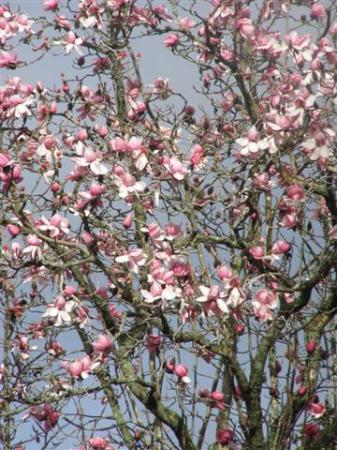
While there is considerable anticipation looking at the early magnolias laden with big, fat furry buds (sleeping bags for mice, our children used to describe the furry casings in years gone by), it is the tiny vision of the English snowdrops with which we are currently delighted. We can understand why these pretty, dainty little flowers give rise to such passion in dedicated collectors (are they called galanthophiles?) We are hardly good snowdrop territory here so we confine ourselves to the few varieties which will keep performing happily in our mild conditions. Managing to get some drifts established in a meadow situation is no mean feat. Meadows are not easy here. Our grass growth is so rampant we mow the lawns all year – weekly for most of it and fortnightly in the depths of winter when the growth slows. It is a bit much to expect bulbs or wildflowers to compete with such vigorous growth. In order to get this bank of bulbs started, Mark has had to discourage the stronger grasses and encourage a much slower growing, less competitive native microlina grass which won’t swamp the little treasures.

The galanthus only flower for a few weeks, but for that short time they are one of the most charming of all seasonal bulbs.

The Plant Collector: Lachenalia reflexa

The earliest bulbs are in flower - Lachenalia reflexa midst the snowdrops

The earliest bulbs are in flower - Lachenalia reflexa midst the snowdrops

I have this little self-imposed rule which is that I can’t repeat a plant (at least, not yet) so the plant this week is not the delightful English snowdrops (this form is Galanthus S. Arnott which is the most reliable performer in our conditions), even though the clumps and drifts we have in full flower throughout the garden are an absolute delight. No, we are looking at the yellow flowers coming through with the snowdrops. This is Lachenalia reflexa. It is the yellowest of the lachenalias we grow here, all of which are native to South Africa. There are well over 100 different species, often taken for granted in their homeland where they are just wild flowers. Not all are easy to grow. Reflexa isn’t too difficult though it is not particularly vigorous, which is why it is not common. The yellow is a pure bright lemon shade, sometimes with green markings which fade out as the flower matures. Like most lachenalias, it doesn’t hang onto its foliage for particularly long after flowering. These plants are growing on the edge of our gravel driveway beside a low stone wall. Many of the species bulbs (which is as they occur in the wild) are used to surviving in quite harsh conditions with little soil and low fertility. If you try and treat them like choice garden plants, they don’t always cope. The critical issue, as always with bulbs, is to ensure excellent drainage, even more so when they are dormant (in summer for reflexa), to avoid them rotting out.