Category Archives: Abbie’s column

Abbie’s newspaper columns

Our worst weeds

After advocating for wildflowers on our road verges in January, it is perhaps ironic that I follow up with the worst weeds in our garden. All are ornamental garden escapes and none should be liberated to roadsides.
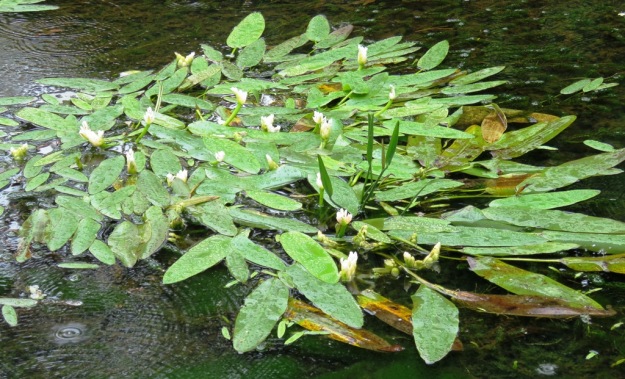
Cape Pond Weed

Cape Pond Weed

There are times Mark has wanted to line up and shoot the former neighbour upstream from us who deliberately planted Cape Pond Weed – also known as water hawthorn, botanically Aponogetum distachyum. Pretty it may be in bloom, but we have been waging war on it for well over a decade. Floods scoured it out upstream but it has made itself right at home in our slow moving sections. We spend countless hours raking it out each summer because it we don’t, it will only take one full season before it covers the entire water surface. Miss one piece and it grows away again at an alarming speed.
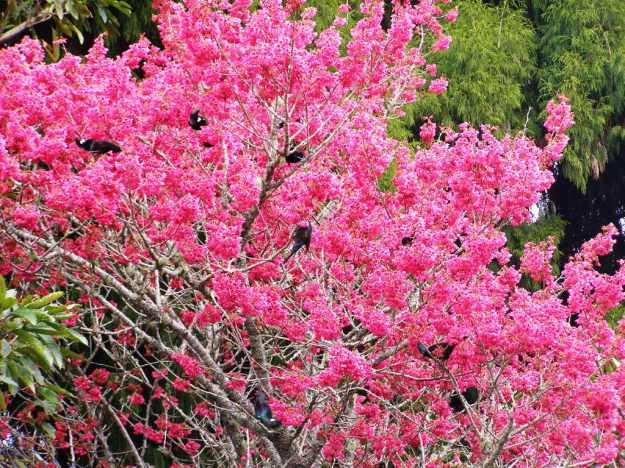
Prunus campanulata filled with tui

Prunus campanulata filled with tui

Prunus campanulata ranks amongst our two worst weeds. We are constantly pulling seedlings out, or digging if they have snuck through to a second season. Any older than that, and they require poisoning. Yes I know some folk think we should get rid of all of these but the tui! The tui! And please do not tell me to plant kowhai for the tui instead because they don’t flower at the same time and even our largest kowhai trees cannot sustain the scores of tui that frequent our early blooming Taiwanese cherries. So we continue to deal to the unwanted seedlings on an ongoing basis.

There is hope. Mark has been turning his attention to the sterile campanulatas we have here, because it is the seed that is the problem. His father bred sterile campanulata hybrids – ‘Pink Clouds’, ‘Mimosa’ and ‘Petite Pink’. The last variety is probably not commercially available now which is a pity because it is a true dwarf tree. The problem with all three varieties is that they are candy pink, not the sought after carmine red. But we have a few sterile reds with some possible options which give flower power and nectar for the tui without the curse of seed.
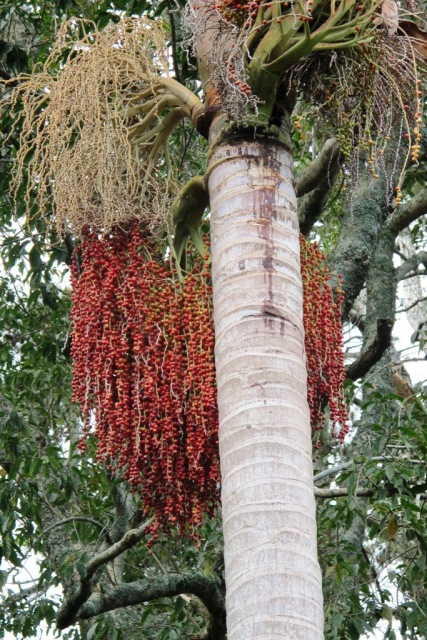
About the bangalow palm's seeding ways...

About the bangalow palm’s seeding ways…

The other shocker – maybe I had better whisper this, given its popularity – is the bangalow palm (Archontophoenix cunninghamiana). Yes it is handsome and reliable but this Aussie import is far too keen to make itself at home. It took a long time for our specimens to start flowering but boy, are they a problem now. Mark tries to cut the seed off as soon as it is visible, but this requires the extension ladder and a pole saw. There is probably not a square metre left in our garden where we have yet to find a germinating bangalow. What is particularly concerning is that in the early stages, they are very difficult to pick apart from seedling nikaus. If you are anywhere near native bush or reserve, this is one plant that you should question having in your garden. Based on our personal experience, we recommend the Queen Palm (Syagrus romanzoffiana) as an alternative.

Mark adds in Cornus capitata, the weedy dogwood. It was favoured by his father who planted it all along one of the road frontages and Mark has been battling it ever since. At least it makes good fire wood.
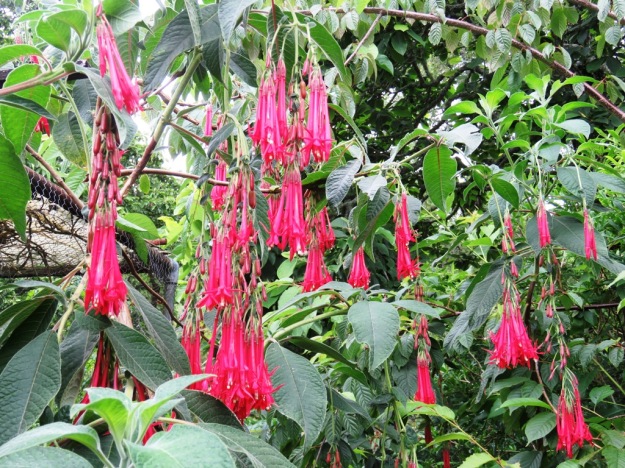
Fuchsia boliviana performs TOO enthusiastically in our climate

Fuchsia boliviana performs TOO enthusiastically in our climate

We have reviewed pretty Fuchsia boliviana. We acquired it before it appeared on the National Plant Pest Accord but never moved it into the garden. Thank goodness. In the wilds of the “plant out” area, where some specimens can languish for years while waiting for the right spot to be found, it grew far too vigorously and the carpet of seedlings rang loud alarm bells. It is another of those plants where a sterile form would be advantageous because it flowers for months on end, is showy and has attractive foliage.

Dare I mention the wonderfully fragrant Himalayan Daphne bholua? It is not in the same league as the previous plants but it has certainly seeded down all round the place here. Not all the seedlings flower, either, which is not to their credit. It is another example of a plant which is highly prized internationally but can become a significant weed in our benign climate.

It can be a mighty fine line between a desirable self-seeder and a weed. Most of the plants mentioned produce berry-like seeds which are then distributed by the birds, particularly the kereru. Plants which only seed down close to the parent are manageable but once our feathered friends are on the loose, it becomes a different matter altogether.

First published in the March issue of NZ Gardener and reprinted here with their permission. 
A trip to Baotai Mount

Baotai (16)
We returned from China last week, but alas brought with us a bad dose of Chinese flu which has kept us laid low ever since. Very low, in fact, but we are inching our way back to the Land of the Living.

Baotai (14)The International Camellia Congress in China was certainly an extraordinary experience.

We travelled around in matched purple coaches – seven or eight of them in total – headed by a police car, with another police vehicle and ambulance bringing up the rear. And as we made sedate progress (often travelling at about 40k/hour) with police on hand at every intersection to stop traffic that we might have unimpeded progress, all I could think was that we resembled the stately galleon from the old Joyce Grenfell song (“Stately as a galleon, I sail across the floor…”). Either that, or a ponderous, purple mechanical dragon.
Baotai (4)
On the day we headed off to Baotai Mount, in Yongping County, we transferred to small coaches for the mountain roads – a fleet of somewhere near 20 of them sailing through the countryside under police escort and all with hazard lights flashing. You know you are part of something unusual when villagers come out in numbers to line the roads to see what is happening!

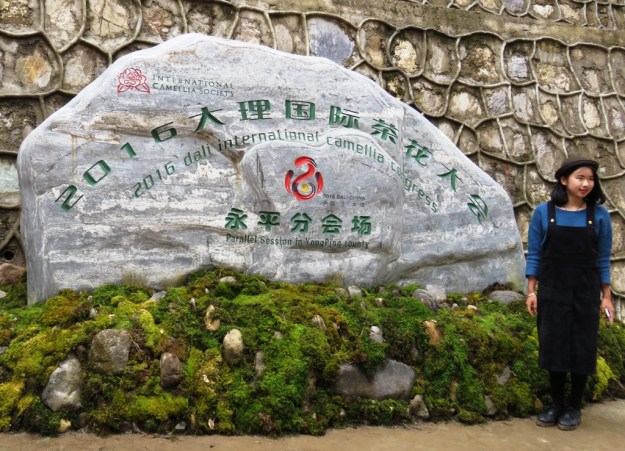
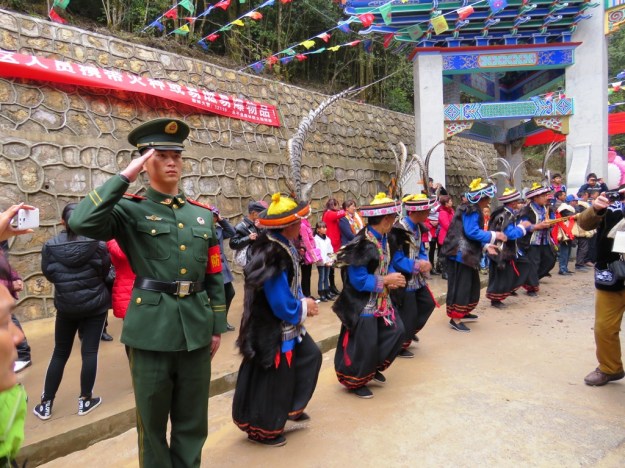
Baotai (3)The day promised a four hour journey to Baotai Mount, the unveiling of The Stone Monument, tour of primitive camellia forests, mountain azalea, red lotus flowers and more in the natural landscape. The unveiling happened at lightning quick speed as most of us strolled up to the vibrant welcome. With a huge turnout of locals, it began to dawn on some of us that maybe WE were the exhibits, the sight to see on this occasion. China is a country driven by huge domestic tourism where foreigners still have novelty value.
Baotai (43)
Do not smile at the sight of the medical support team. While it is true that such events as the International Camellia Congress attract an older demographic who may well be prone to the occasional heart attack, there were also altitude issues on Baotai Mount. There seemed to be some debate as to whether we were at 4000 or 6000 metres, but given that NZ’s tallest mountain, Aoraki Mount Cook, is less than 4000 metres, we were a fair way up and some folk were certainly suffering, needing oxygen.

Baotai (34)Baotai (36)After lunch, we wandered in the woods of ancient reticulata camellias – primarily Lindl. Most of the wander was on a four metre wide paved walkway, but it is different in a country with a massive population. There wouldn’t be much nature reserve left if thousands, hundreds of thousands or more feet were able to trample root systems in the wild.

Baotai (19)
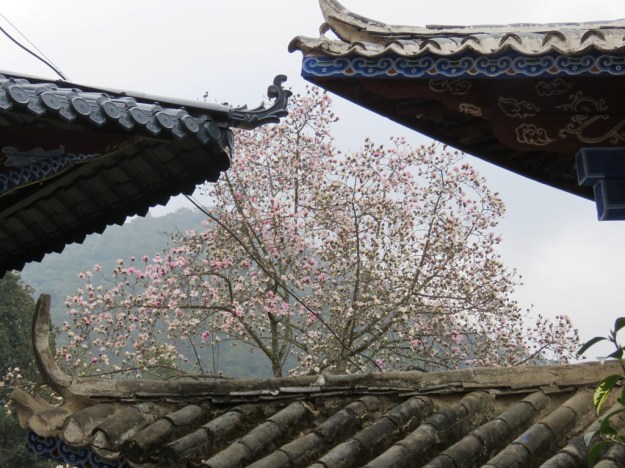
There was a Magnolia campbellii in full bloom at the visitor’s centre which was such a delight that we will only whisper that it wasn’t a particularly good form of that species.

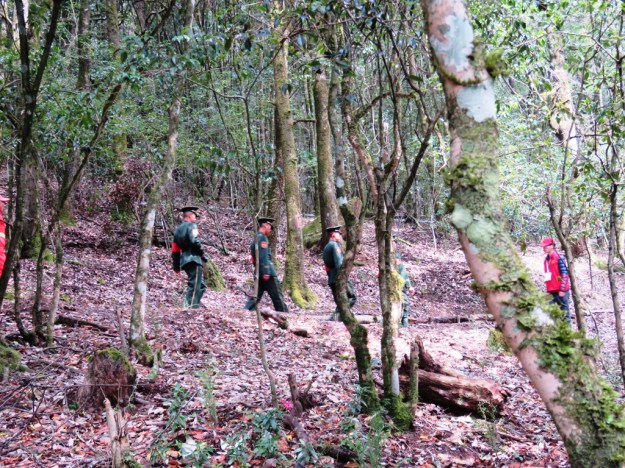
Baotai (47)We never did see mountain azalea and red lotus flowers though Mark was pleased to see a little Daphne bholua growing in the wild. Sometimes you just have to go with the flow and embrace the unexpected. Botanical variety may have bypassed us on this occasion, but I will never forget the unexpected sight of four soldiers (Red Army?) marching through the ancient camellia woods on Baotai Mount. You don’t see that sort of thing back home in Tikorangi.
Baotai (49)
And then we drove the four hours back to Dali for dinner.

Simple pleasures – hydrangeas in summer

One of the You-Me series of hydrangeas

One of the You-Me series of hydrangeas

What would a Tikorangi summer be without hydrangeas? They are one of the easiest and showiest of summer flowering plants here. Much of that is due to summer rain. We are blessed with both high sunshine hours (higher than Auckland, I like to point out) but also regular rainfall and hydrangeas do best in moist conditions.

We have the usual macrophylla mop tops which often feature in older gardens, with their big heads of blue or white. These we use more as background plants but hydrangeas are a large family and there are many more interesting variations than often realized.

Hydrangea quercifolia ‘Snowflake’

Hydrangea quercifolia ‘Snowflake’

Most hydrangeas hail from Asia, particularly Japan, Korea and China but the oak leaf species, H. quercifolia, is a toughie from USA. The double form of this plant, ‘Snowflake’, is particularly showy. The abundant flower heads hang like cones, with each bloom forming multiple layers of petals down the stem. While it opens white, over time it ages through shades of soft green and antique pink before drying on the bush to a buff colour. It can look as if they are made from paper or silk and the flowers last right through the summer season into winter.

Hydrangea serrata ‘Preziosa’  changes flower colour through the season

Hydrangea serrata ‘Preziosa’  changes flower colour through the season

We looked at a vast collection of H. serrata in an English garden and were very taken with the more refined appearance of this branch of the family. We have had the serrata hybrid “Preziosa” in our garden for many years. It starts flowering in November, coming out lime green, ageing through cream to white before turning pink and then red by the end of the season, often showing a range of colours on the same bush at any one time. The serratas are generally colour stable, unlike many macrophyllas. I want more serratas when I find the right spaces, particularly the daintier lace-caps.

We prefer Schizophragma hydrangeoides to the climbing Hydrangea petiolaris

We prefer Schizophragma hydrangeoides to the climbing Hydrangea petiolaris

When it comes to climbers, we favour the close hydrangea relative, Schizophragma hydrangeoides, over the more common climbing Hydrangea petiolaris. We have them in pink and white and they dance in the breeze with a lightness that petiolaris lacks, as well as flowering more profusely in warmer climates. Give them something to climb up and they will stick themselves to it.

Hydrangea ‘Immaculata’ – a top performing compact, white macrophylla

Hydrangea ‘Immaculata’ – a top performing compact, white macrophylla

If you are a fan of macrophyllas, I can vouch for the top performance of “Immaculata” which is a compact growing bush with beautiful white mop top blooms. I am also extremely impressed by the new You-Me series that has come from a Japanese breeder. We have four different ones and they have names like “Forever” and “Eternity” and I lost the names so I don’t know which is which. But they are all very good with compact habit and such lovely flowers – semi-double lace-caps in the prettiest shades.

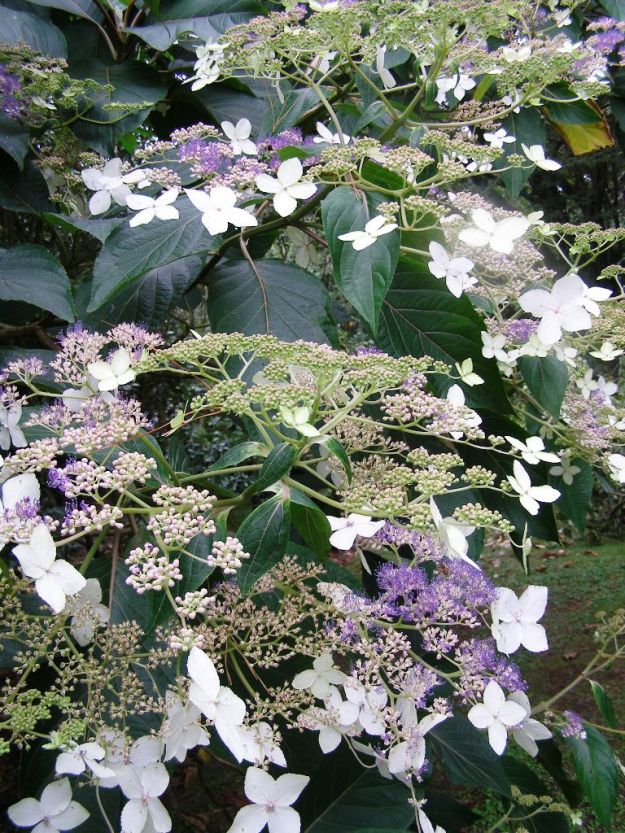
The magnificent tree hydrangea, probably a form of H. aspera

The magnificent tree hydrangea, probably a form of H. aspera

The season will close out for us with the huge, unusual, evergreen tree hydrangea that I see is now classified as belonging to the H. aspera (syn. villosa) group and sometimes given the cultivar name “Monkey Bridge”. At over five metres tall, it is large. It is also brittle so needs protection from wind. And somewhat frost tender. This is not a plant for everybody. But those huge lace-cap flower heads in early autumn are showstoppers and the flowering season lasts for a long time. Each flower head can measure up to half a metre across with colouring in subtle antique shades. I love it.

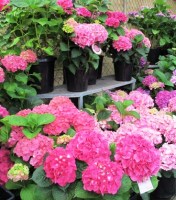
003 - CopyA word on the thorny matter of turning hydrangeas blue or pink… why bother? Gardening should be about working with nature, not trying to outwit it. In Taranaki, our hydrangeas are largely blue, very blue – the sort of blue that folk with pink hydrangeas envy. Yet I found myself charmed by the pink hydrangea display in a Canberra garden centre.

It is many of the macrophyllas that have colour determined by soil conditions. In acid soils (where rhododendrons thrive) they are blue, in alkaline soils they are more likely to be pink. It is actually to do with the available aluminium, an element that is usually strong in acid soils and absent from alkaline ones. Surely it is better to live with what we have and just admire the alternatives elsewhere?

The good news is that in a time of declining specialist, mail order nurseries, you can still source many of the less common hydrangea varieties as well as good selections of more usual types. Woodleigh Nursery was originally set up by Taranaki plantsman, hydrangea expert and personal friend, Glyn Church but is now in the capable hands of Janica and Quin Amoor. Their website is good and easy to use.

Hydrangeas are invaluable plants for easy-care summer gardens where there is enough moisture in the soils and, ideally, semi-shade. An annual winter prune tidies them up and gives larger blooms but you don’t even have to do that if you don’t want to.

057 - Copy

First published in the February issue of New Zealand Gardener and reprinted here with their permission. 


Plants for dry shade – for Radio Live listeners and others

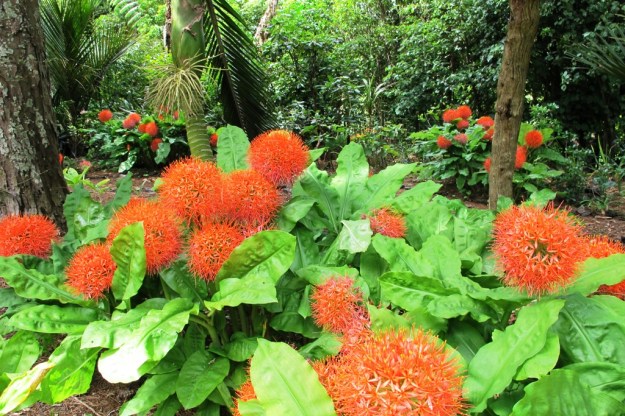
Scadoxus multiflorus ssp katherinae, beneath a canopy of rimu, pine and nikau

Scadoxus multiflorus ssp katherinae, beneath a canopy of rimu, pine and nikau

After talking to Tony Murrell on Radio Live this morning, here is the quick list of some of the plants we have found we can grow in our dry shade areas.

Bulk cheapie fillers (and many gardeners need these to get some quick coverage)
ajuga
phlomis
francoa (the bridal veil plant) – both ramosa and sonchifolia
impatiens
pulmonaria
mondo grass and lirope
scuttellaria

Triffids (for those who have B I G space to fill
Fruit salad plant (monstera delicosa)
various plectranthus but they need to be kept under control
philodendron
(short list – we are not too keen on many triffids here)

Shrubs
evergreen azaleas
vireya rhododendrons
cordylines – both natives and some of the more tropical varieties
hydrangeas – on the outer margins
some of the small palms – Lytocaryum weddellianum (the wedding palm or feather palm) is one that is performing well in our shade in several places.

Building up the planting areas beneath huge rimu trees

Building up the planting areas beneath huge rimu trees

Natives
renga renga lilies (arthropodium)
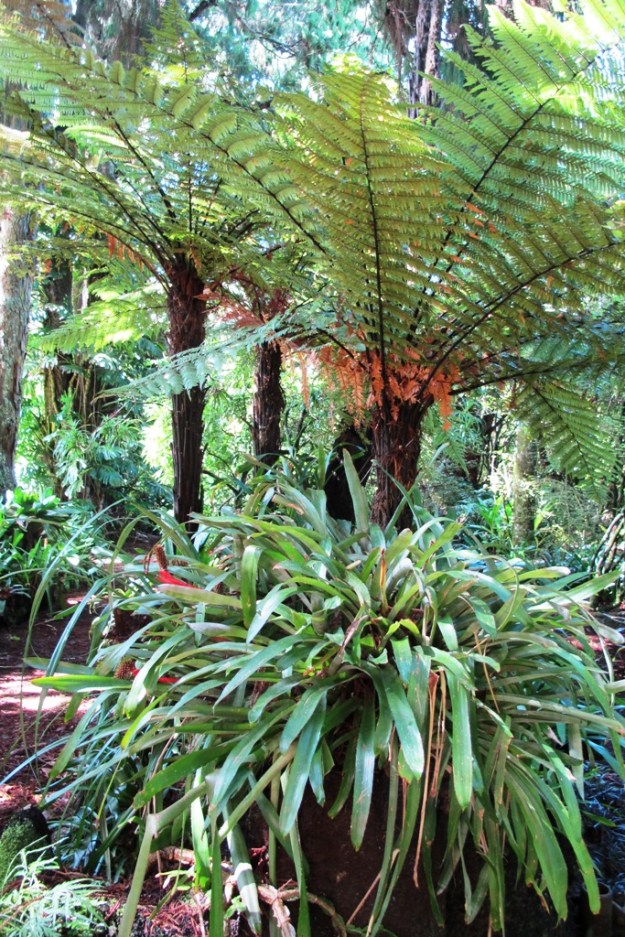
ferns – many and varied
dracophyllum latifolia
parsonsia (native jasmine)
tree ferns or pongas which just arrive these days
nikau palms (we planted the first ones, now they just seed down and we keep those which are not in the wrong places)
astelias – bush species including A. fragrans
widow-makers – collospermum which also just arrive of their own accord
cordyline – particularly banksii

“Backbone” plants
ferns
clivias
farfugium and ligularia of various species
ferns
hostas
helleborus – particularly x sternii and also foetidus (better than the more common orientalis in full shade)
dicentra (can’t keep D.spectabilis going here but D.eximia does very well
zygocactus
and did I mention ferns? Lots of different ferns, both native and exotic.

Choice treasures and bulbs and high interest plants
scadoxus – puniceus and multiflorus ssp katherinae
cyclamen on the margins but not into the deeper shade
Soloman Seal – Polygonatum multiflorum
arisaemas
veltheimias
hippeastrum – particularly aulicum but papilio is also looking promising
trilliums
haemanthus albifloss
Crinum moorei – even better is the variegated form of C. moorei
bromeliads
orchids – cymbidiums, dendrobiums, calanthes
Paris polyphylla
streptocarpus

Other points from my conversation with Tony Murrell (love that man – he is so easy to talk with and so enthusiastic about plants):

  1. If you want bluebell or snowdrop woods in the English style, remember they are mostly beneath deciduous trees. In New Zealand, evergreens dominate and our shady areas remain shaded all year round.
  2. Lift and limb the canopy trees. There is not a lot that grows in deepest shade so you need to keep the canopy higher to allow light.
  3. We are completely frost free in our shade areas but even gardeners in colder parts of the country may be surprised what they can get away with in terms of more tender material beneath evergreen trees.
  4. While many of the plants we grow are epiphytic or have epiphytic origins (in other words, they don’t have big root systems below ground but will often be happy settling in forks in the trees), it is still necessary to build up soil at ground level to allow many plants to get established. The big trees suck up all the moisture and goodness from the ground and small plants find it very hard to compete. If you find it hard to dig into the ground because of the existing roots, plants will find it equally hard to get their roots in.
  5. We raise beds by using mostly found items like old tree trunks, ponga logs, rounds of sawn timber – anything that looks natural (NEVER tanalised timber!) In dry shade conditions, they last a long time.

Our shade areas are low maintenance and generally self sustaining, We don’t water, we don’t spray, we don’t add fertiliser. Very few weeds grow in the shade, especially with the thick mulch that builds up over time. All we have to do is tidy up bigger bits of falling debris and carry out a bit of general maintenance.

I have written about many of these plants in earlier posts – use the search engine box on the right hand side if you want to check them out in more detail.

Again, building up beds beneath the rimu trees, using ponga logs in this case that have already lasted decades

Again, building up beds beneath the rimu trees, using ponga logs in this case that have already lasted decades

‘Editing’ the plants for a lower maintenance garden

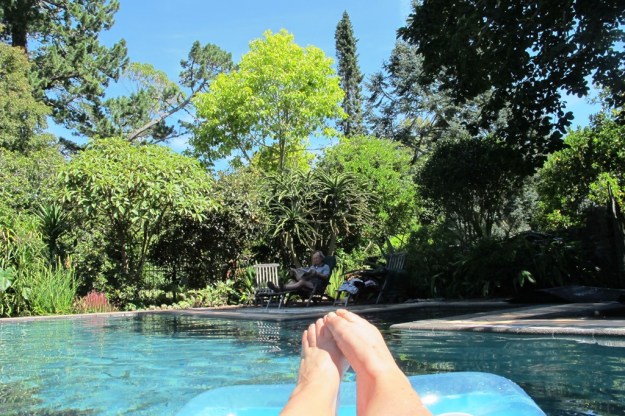
A few years ago. It is amazing how much the skyline of trees has changed since. My feet.

A few years ago. It is amazing how much the skyline of trees has changed since. My feet.

Editing, dear New Zealand readers. Cleaning up the borders and beds is often about editing the plantings.  I know this because I read a certain amount of British garden media.

I have certainly been editing the plantings in the gardens around our swimming pool. It seemed a good summer occupation and on a few hot days this week, the flow between gardening and cooling off in the pool has been excellent.

The gardens were put in when we built the pool in the late 1990s and, in that clichéd way, we naturally opted for a sort of tropical feel. It was never thought out very well at the time. In the years since, I recall doing one relatively major rejig of the gardens but beyond that, they have only had the most perfunctory of care and minimal maintenance. This often included plugging gaps with whatever I had to hand.  And it was showing that lack of attention.

I am a more thoughtful gardener than I used to be. I think that comes with experience. Knowing that we were unlikely maintain a pristine swimming pool, we had chosen from the start not to make it a key landscape feature but rather to site it discreetly where it is largely out of view. I am not keen on garish blue pools taking centre stage so ours is also a modest dark grey and we went with a black pool cover.

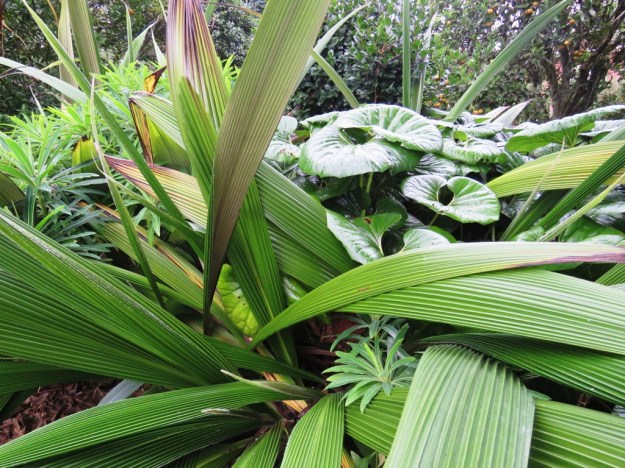
Curculigo, euphorbia and Ligularia reniformis, lush enough to pretend to be tropical and low maintenance

Curculigo, euphorbia and Ligularia reniformis, lush enough to pretend to be tropical and low maintenance

The upshot of this is that I figured we want a really low maintenance approach to the gardens around the pool and that it should be specifically targeted to the swimming season – which for us is mid to late December through to mid February. There is no point in putting in plants that flower outside that time because we won’t see them. Extreme editing was called for to eliminate my previous efforts to plug gaps and add seasonal interest with assorted perennials and bulbs.

I am quite happy with the earlier effort blocking up the Ligularia reniformis with Curculigo recurvata (nice foliage contrast and happily co-existing). We removed all but one of the damn dangerous euphorbia (E. mellifera, I think) which seeds far too freely and has disappointingly insignificant flowers but compensates with good form and foliage. Ligularia reniformis is getting to be a cliché in New Zealand gardens and I will restrict how widely we use it elsewhere in the garden, but it is very handsome and lush here, reaching well over a metre in height. However, the compact red dahlia hybrid will have to go. Not our style. Too suburban in our context.

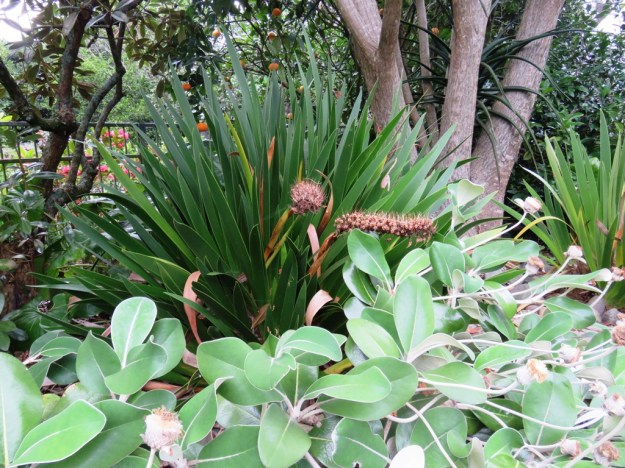
Pachystegia insignis in the foreground, Xeronema callistemon behind and overhead a large Aloe bainseii

Pachystegia insignis in the foreground, Xeronema callistemon behind and overhead a large Aloe bainseii

The Pachystegia insignis (Marlborough rock daisy)  and Xeronema callistemon (Poor Knights lily)  flower outside the summer season entirely but these native plants are not the easiest to grow in our environment and the plants are handsome and well established with good foliage contrast. Besides, it is not in our nature to edit our plantings down to a simplistic mass.

IMG_6956It is the next ten square metres or so where I have gone for a block planting. It was a mish-mash. No longer. I chose to use two common plants – the pretty but tough Dietes grandiflora and black taro. At least we know it as black taro but I am not sure if it is a colocasia (in which case it may be ‘Black Magic’) or an alocasia.  It looks very new and raw at this stage, but I expect it to be a pleasing combination with plenty of pretty flowers next summer and good foliage interest. And low maintenance, without looking like a supermarket carpark.

Patience is a virtue. The freshly planted dietes and black taro.

Patience is a virtue. The freshly planted dietes and black taro.

I see some debate in garden media about whether digging and dividing perennials is necessary. Many folk seem to dread and shun digging – hence the no-dig craze for vegetable gardens. All I can say is that since I started doing a lot more digging and dividing, the garden looks hugely better for these efforts and the perennial plants thrive in more friable conditions with less soil compaction. It is also a learning experience as I experiment with plant combinations and think through the seasonal effects. It is a whole lot more interesting than mere garden maintenance and gives an opportunity to review and edit the plant selections. And it doesn’t even cost any money because I am working with plants already in the garden. There is nothing to fear from increasing the dig and divide regime.

IMG_6892And for those of you who don’t follow the garden Facebook page, I offer you my little study in dietes blooms. It makes no logical sense to float them in water, because they are not damp-loving plants at all. I just thought they would look charming, and they did – first in the swimming pool and then I gathered them all (slightly battered) to float them in the stream. Because I could.

IMG_6896

IMG_6907