 Back in the early 1980s, Mark’s late mother Mimosa was an active supporter of the groups lobbying for clean water in this area of ours. At the time, there were extended hearings into the establishment of the gas to gasoline plant at Motonui – with plans to pipe waste out to sea – and a claim under the Waitangi Treaty regarding discharging of waste to water. In good country-woman style, she would bake food to share at these hearings and on many days she would pack her lunch to head down and sit in support of those speaking out to protect our water.
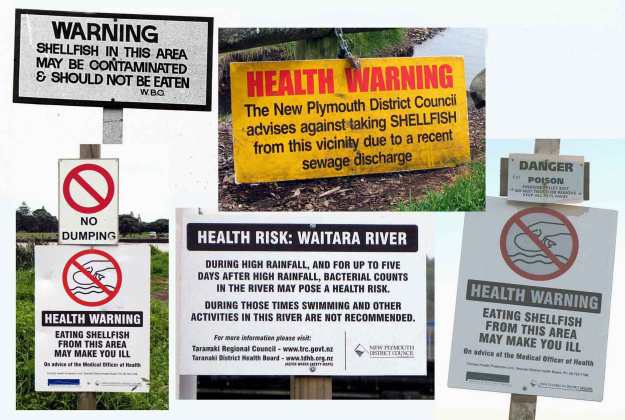
As can be seen from the photo of all the signage we have now, the need to protect our water has never been greater in this time when “clean and green” is looking increasingly like The Great New Zealand Myth.
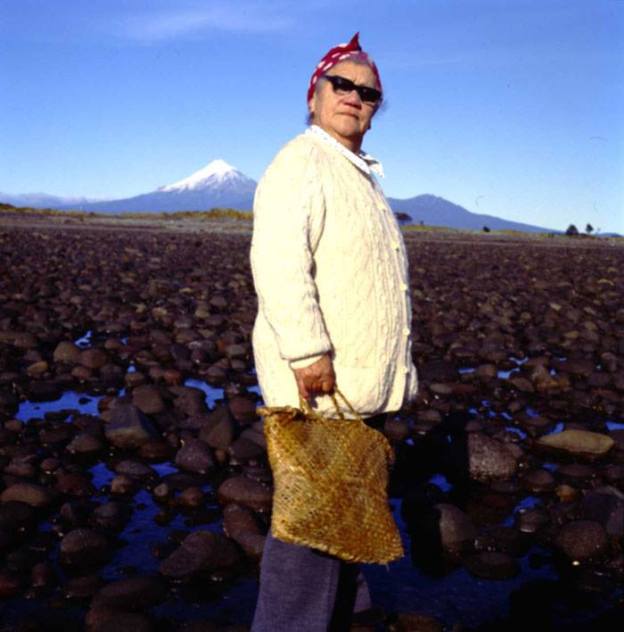
Auntie Ivy – Werenia Papakura Kipa. 1982. Photo credit Fiona Clark
I have huge respect for those who continue to battle these issues. Back in the 1980s, visual activist Fiona Clark, did a haunting series of portraits of local kuia (senior Maori women, informally referred to as aunties) in their traditional coastal kaimoana locations (kaimoana – food of the sea). Thirty five years on, she remains resolutely committed to the cause.
To see Fiona and two others being pursued relentlessly by our Taranaki Regional Council for costs related to a consent hearing on discharge of waste to waters around Waitara makes me rage at the injustice. Fiona, Robbie Taylor (son of the hugely respected, late kaumatua, Aila Taylor who led the Waitangi claim back in 1982) and Pikikore Moore are being held personally liable for costs, rather than the group for whom they signed. Friends of Waitara River traces its origins back to those activists of the early 1980s but lacked legal status. By the time the hearing was held, the group was an incorporated society, but when the submission was lodged, they were not. Because of those intervening weeks, the Taranaki Regional Council decided to hold them personally responsible and the law upheld this technicality.
Being right in law does not mean that such action is fair, just or ethical. Nor did that legal process take into account any of the other failures of process on the part of the Council. In fact even the amount demanded remains a mystery but is likely to be in the mid twenty thousand dollars range.

Fishing at the Waitara river mouth
I am departing from my usual gardening posts to ask New Zealand readers to consider donating a few dollars to the Give A Little page raising money to pay the Council. You just need your credit card to hand.
While the very thought of paying money to an organisation I regard as vindictive (and many other words I cannot use publicly) sticks in my craw, that doesn’t help the three people in the firing line. They need help.
Taranaki Regional Council must be really proud of leading the charge – ensuring that environmental groups or individuals can not afford to become involved in democratic processes under the Resource Management Act. Or indeed the Official Information Act. They have set an important precedent for this area and others and the best way to challenge this precedent is to show them clearly that there is great disquiet at what they have done.
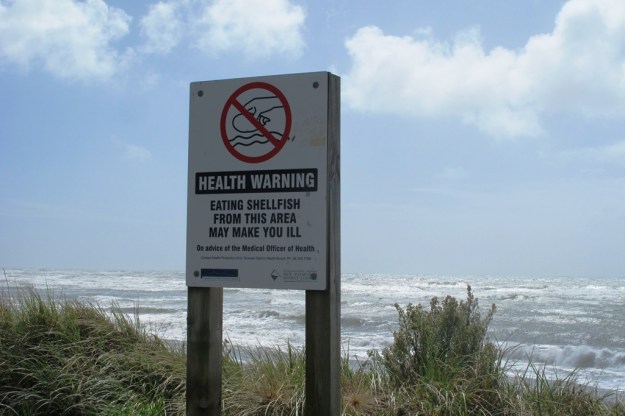
…but take no shellfish from the same area
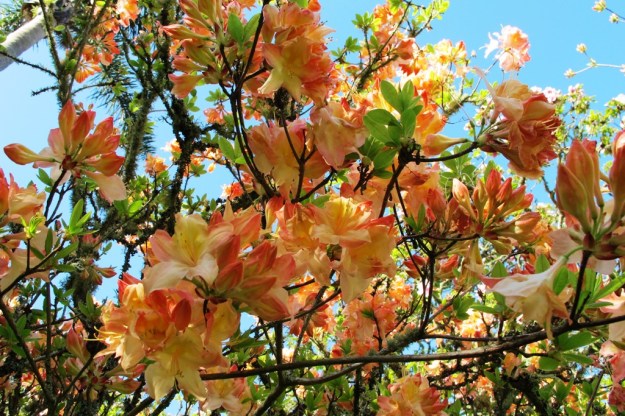 The deciduous azaleas certainly add vibrancy to the late spring garden as we enter November. They are not all so breathtakingly unsubtle. But I guess, were a plant to think like a human, if you are going to spend 11 months of the year being pretty insignificant, you might as well make a loud statement when it is your time to star.
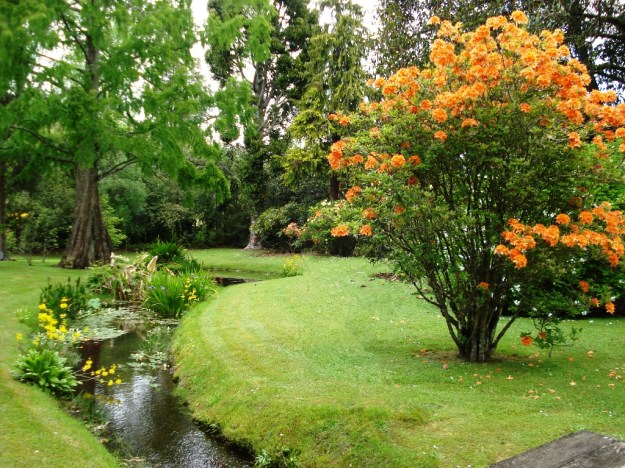 The area of our garden that we refer to as ‘the park’ was first planted in the early 1950s, in the style then promoted by the New Zealand Rhododendron Association. Plants stand in solitary splendour which gives them their own space, plenty of air movement and the ability to be viewed from all aspects. While it has changed and matured over the intervening six decades, the deciduous azaleas still thrive in this environment with minimal attention.
 Azaleas are all part of the wider rhododendron family. Evergreen ones originate from Japan while the deciduous azaleas are much more widespread in the temperate world, being found in China, Japan, Korea, southern Russia and North America. Most of what are grown now are hybrids with very mixed genetics.They are often inaccurately referred to as Ilam azaleas or azalea mollis in this country. “Mollis” refers to a particular cross deriving from A. molle and A. japonicum, originating from early plant breeders in Holland and Belgium. The Ilam azaleas came from the breeding done in Christchurch but have strong links to the Exbury azaleas, also referred to as the Knap Hill hybrids. Then there are the Ghent azaleas, which originated from that area in Belgium. Confused? It is really difficult to disentangle when in fact the most accurate description is simply to refer to them as “deciduous azaleas”.
 First published in the November issue of New Zealand Gardener and reprinted here with their permission.
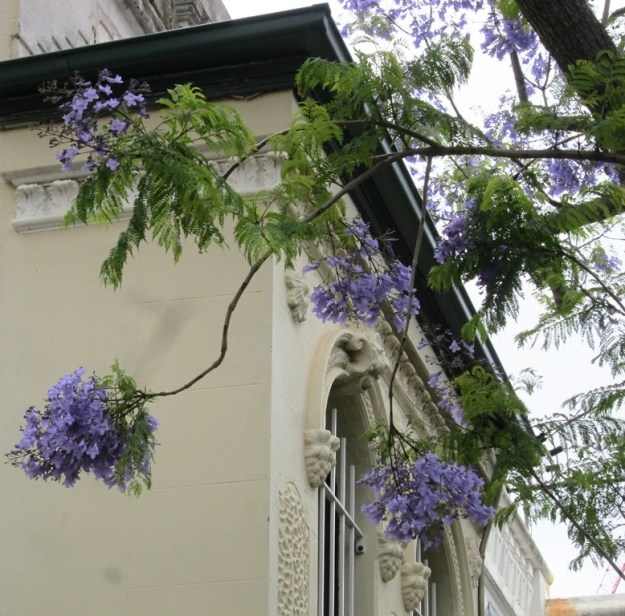 I spent the past week in Sydney, helping our second daughter move into her new apartment. This was a larger task than either she or I had anticipated so left little time for things horticultural. But oh the jacarandas were lovely, used widely as street trees and in front gardens in the eastern suburbs. Sydney is a great deal warmer than Tikorangi –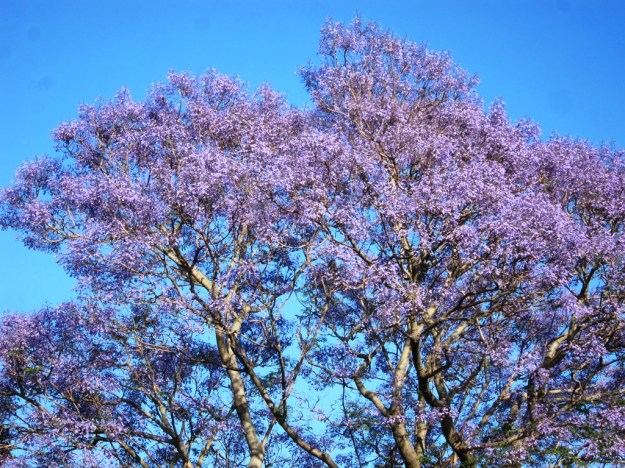
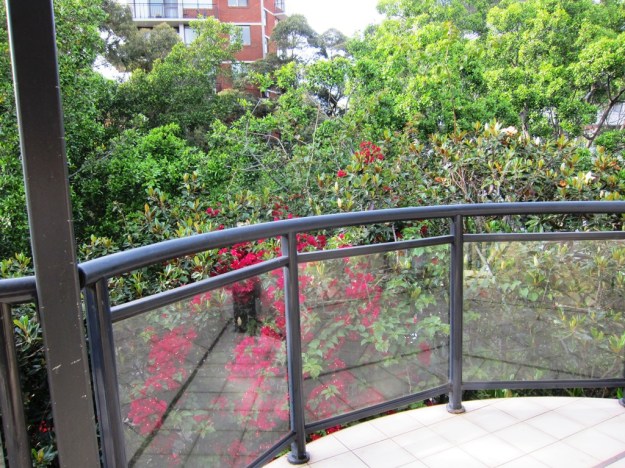 Daughter’s apartment is on the third floor. No lift. It’s not too bad – the stairs are well designed to make it easy. But I mention the third floor because that is several Magnolia Little Gems and a handsome red bougainvillea growing level with her apartment balcony. I have written about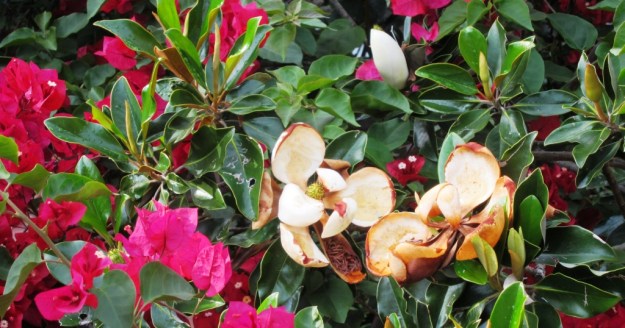
 Over the years I have seen a number of small English backyards where the only access way is via the house and thought that would be tricky. I can now say that these are eclipsed by apartments with no lift. ‘I will repot her container plants while I am here,’ I thought. Or at least the kentia palm and the tired peace lily which looked as if it was on the point of surrendering. I briefly toyed with carrying the plants down to the potting mix where there was a bit of communal garden so the mess wouldn’t matter, but decided it would be easier to carry the potting mix up and do it on the balcony. I wasn’t sure there was an outdoor tap and the rootballs needed a good soak. Logistically, it is harder than you think. Believe me. I was trying to contain the mess but even so some of the debris and the water went over the edge and I worried about alienating the lower apartment residents. The spent potting mix then had to be carried downstairs to spread. These were new challenges for me and I will look upon apartment gardeners with even greater respect. Undeterred, Daughter reclaimed her closed unit worm farm from a previous dwelling and located it discreetly at the back of the ‘landscaped’ communal area. Her kitchen scraps need to be carried downstairs anyway, so she figured she might as well keep them separate, feed the worms and use the liquid fertiliser they generate. It makes you proud to be the parent.
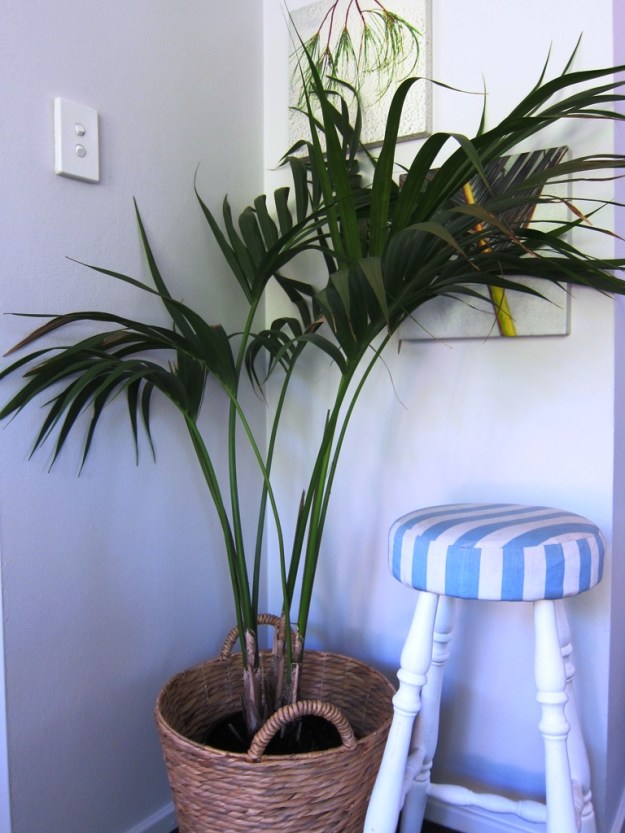 The kentia palm, I noted, is in fact three kentias (Howea forsteriana from Lord Howe Island) and there were at least five seeds sown in the original pot. That is a nursery technique to get a larger plant in a shorter space of time. Naturally I wondered about separating them but daughter needed one attractive kentia, not three smaller ones going into shock from such brutal treatment.
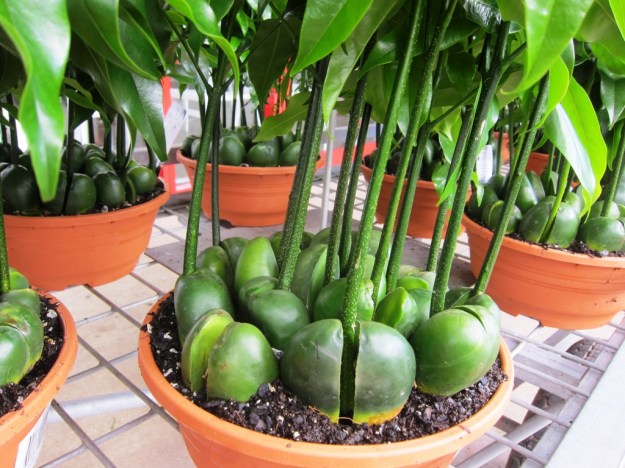 Greater love hath no mother than shopping for plastic items in Kmart but I did also get to wander through the plant section of a Bunnings store while we were doing a mission in search of home handyperson supplies. For $A26.90, you can buy a novelty houseplant of germinated “Black Bean” seeds. These are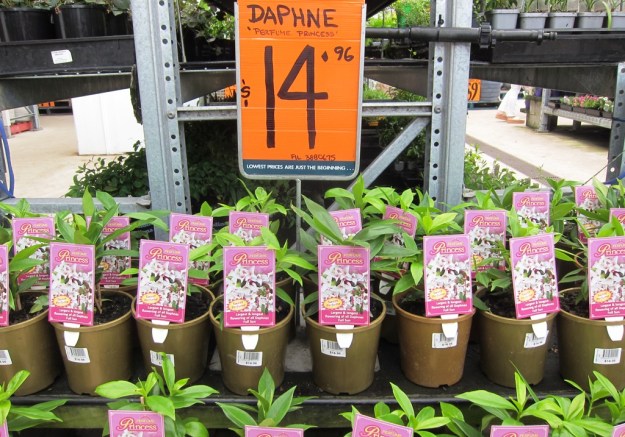
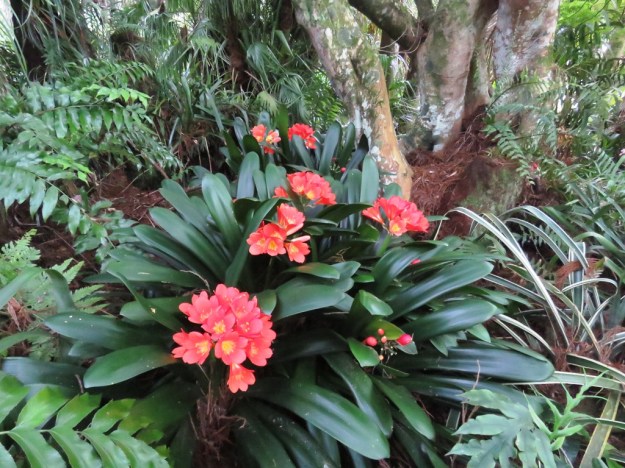 Clivias sure do light up a dark spot at this time of the year, for those of us who live in climates where they grow. This is not a family that will take much at all in the way of frost, though their preference for shaded, woodland conditions gives some protection against cold.
 I headed out with my flower basket to gather a single flower from a range of plants around the garden, feeling a little as if I was doing a geriatric Milly-Molly-Mandy impersonation. Given that ours are almost all seedlings, I was a little surprised at how consistent the flowers are when I started sorting them by colour. The variations are… subtle, shall we say?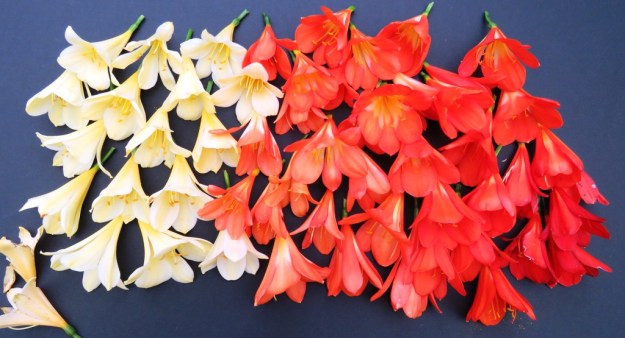
 To the right, we have the ones that age to red. Do not be like the novice gardener I heard of who ordered a swag of expensive red clivia for a mass planting in her ‘designed’ garden. They opened orange, so she dug them all back up again, complained and wanted them replaced. We have not seen clivia that actually open to pure red – some age to red.
 On the left, very battered by bad weather, are a couple of examples of blooms heading to what are called the peach tones. Like many other clivia enthusiasts, Mark has been playing around crossing different plants to try and extend the colour range and the peachy ones are certainly different to the yellows which are the comparator. We have yet to acquire any of the green throated clivia which would add a worthwhile variant.
 Earlier articles include a step by step guide to
 Tikorangi The Jury Garden