
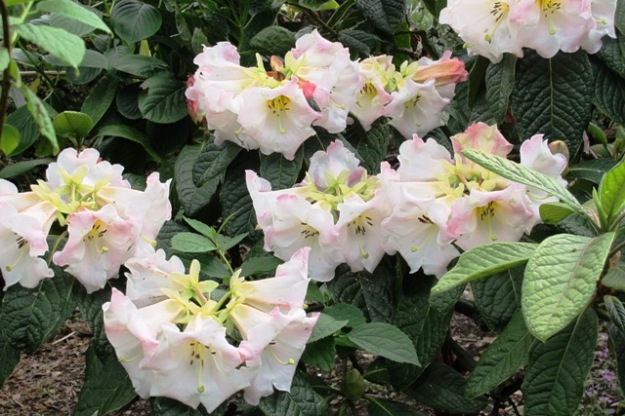
The glory of the sino nuttallii rhododendrons
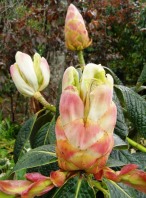
Floral Legacy in bud
Rhododendons may no longer be the elite fashion item they were for so many decades, but we still love them.
When we started in the plant business back in the early 80s, rhododendrons were a hot ticket item. We were but one of several rhododendron nurseries in Taranaki and to survive, we needed to find our own niche. To this end, we grew a different range, specialising in varieties that would perform well in warmer climates – like Auckland. After all, even back then, one in four New Zealanders lived in greater Auckland and we figured that if we were going to sell them rhododendrons, we might as well sell them ones that would do better for them. Mark’s father just happened to have done some breeding to find varieties that were more resistant to thrips, didn’t get that burned and crispy edging to their foliage and were predominantly fragrant as well as floriferous. It gave us a good place to start.
Nowadays there are no specialist rhododendron growers in Taranaki at all and the demand has melted away. I no longer have to try and convince people that not all rhododendrons have a big full truss in the shape of a ball but many have loose trumpets in curtains of bloom instead.
Rhododendrons are one of the backbones of our garden and we wouldn’t have it any other way. While they have a relatively short season in full bloom, the anticipation of fattening buds stretches out the weeks with the promise of delights to come. They are as fine a shrub as any we grow here and a great deal more spectacular than most.
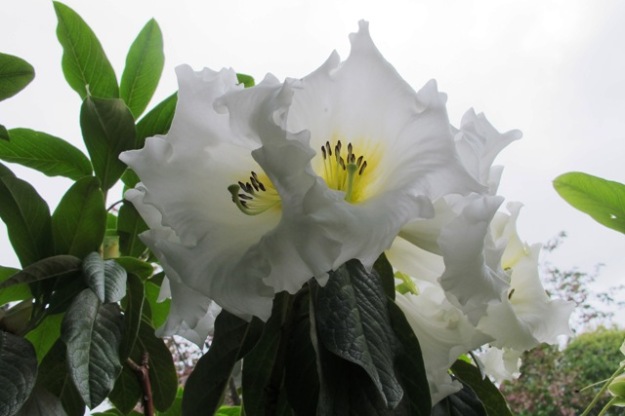
The nuttalliis! Oh the nuttalliis!
The nuttalliis. Oh the nuttalliis. Peak nuttallii season doesn’t start until closer to the end of the month, taking us into November but some varieties have already done their dash for this year. If we could grow only one type of rhododendron, we’d choose a nuttallii and even more specifically, the sino nuttallii from China. You can keep your big red rhodos (most people’s favourite pick). We love the fragrant, long, white trumpets which look as if they are made from waxed fabric, the lovely peeling bark and the heavy textured foliage. These are rarely offered commercially now so grab one if you ever find it for sale.
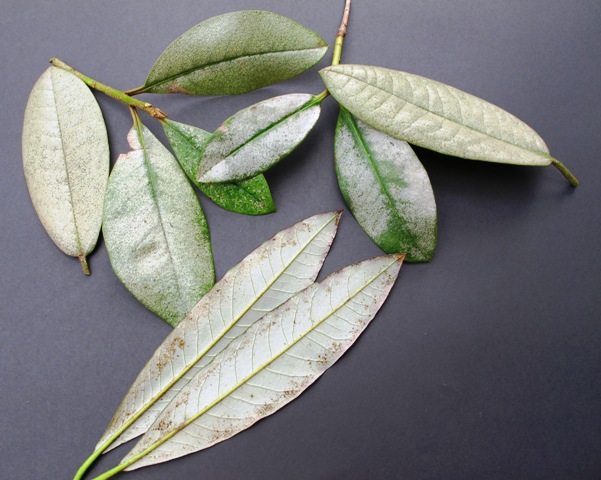
Thrips!
It is, by the way, nasty little leaf-sucking thrips that turn foliage silver and no, you can never turn those silver leaves green again. If you look at the underside of the leaf, you can see dark thread-like marks – these are the critters that do the damage. All you can do is to try and prevent the new season’s growth from getting similarly infested. We are not at all keen on spraying insecticide these days and you need a systemic insecticide that the plant absorbs into its system to get a thorough kill. If you must go down this path, spray in mid November, early January and late February for maximum effect. Others praise Neem oil instead but we haven’t tried it.
We favour choosing more thrip-resistant varieties, keeping them growing strongly and opening up around them to let more air and light in. Thrips prefer shade and shelter. Unless it is really
special, if it is badly thrip-prone, we replace it with a better variety. Not every plant is precious.
In the longer term, plants come and go in the fashion stakes. Goodness, even red hot pokers are having a resurgence of popularity. We don’t worry about the fashion status of the rhododendron and Mark continues hybridising for better performing cultivars. If there is no commercial market for the results, it doesn’t matter. We will continue to enjoy them in our own garden.
First published in the New Zealand Gardener and reprinted here with their permission.
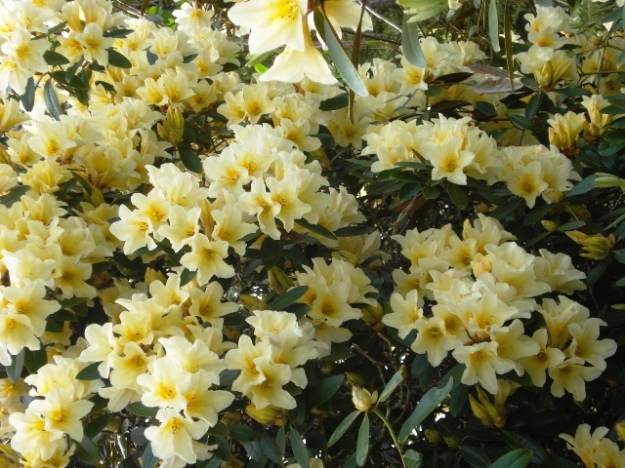
Rhododendron Barbara Jury – one of Felix’s hybrids
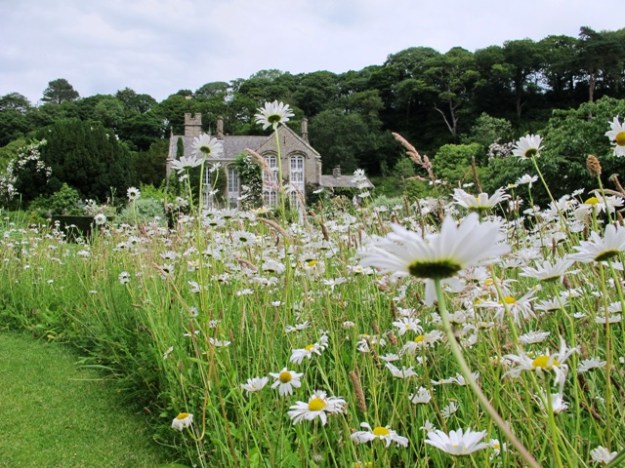


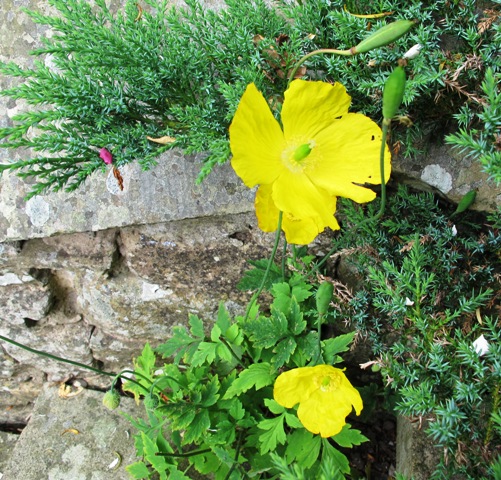
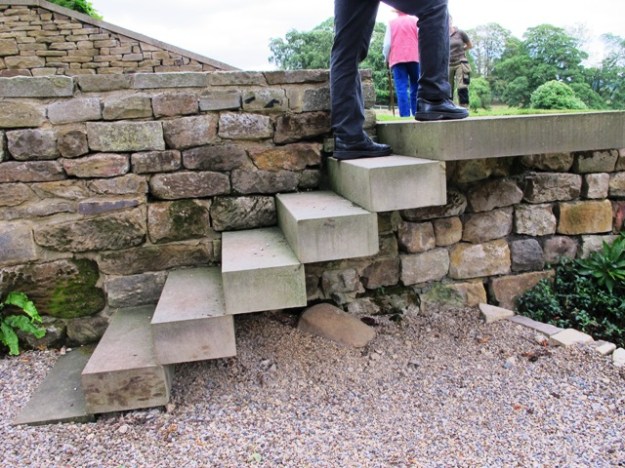 The floating or suspended steps with no visible support structure are a common feature in modern interior architecture where a lighter look is desirable. I can’t recall seeing them used in a garden before and, to be honest, I am not sure they add a great deal to this particular scene. But I did photograph it in a place with a large budget where the owners and designer could clearly afford such attention to detail.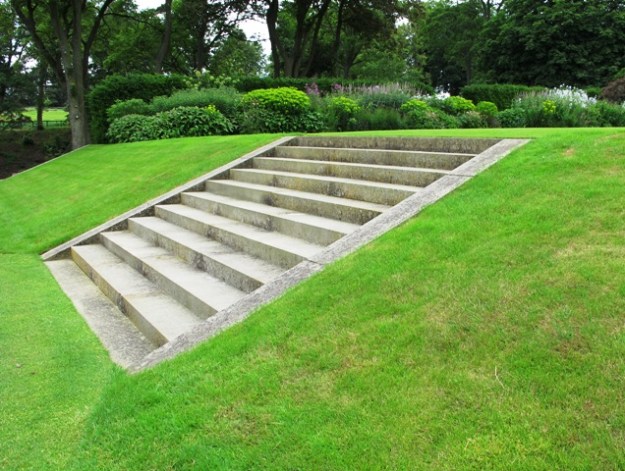
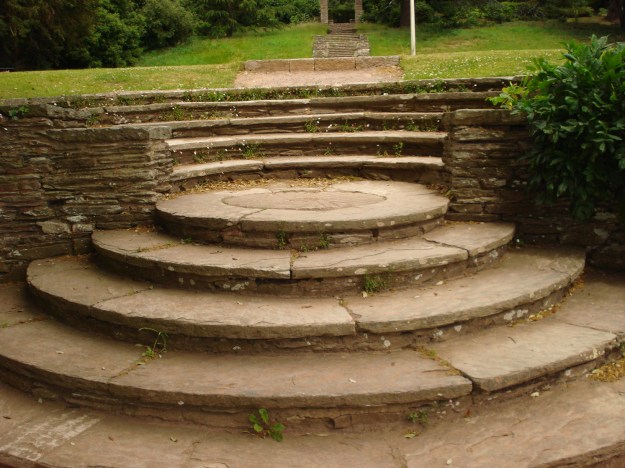 These are the classic steps which are attributed to the great architect Edwin Lutyens during the time of the Arts and Crafts movement at the turn of last century. A central circle has inwardly curved steps on the upper side and outwardly curved steps leading downwards. Good design does not date. Good construction also lasts the distance.
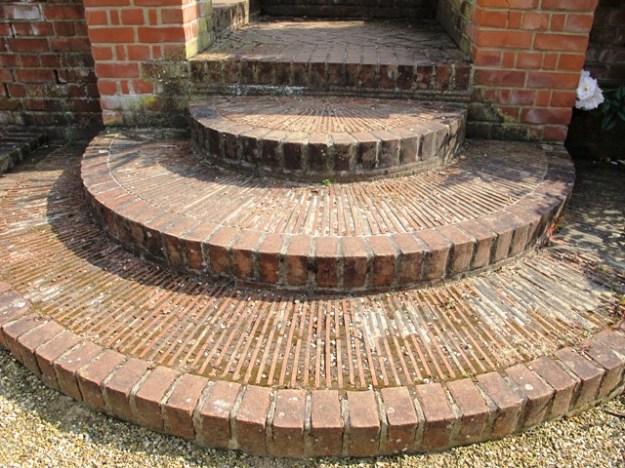 These steps have the outward curve only, but I chose them because they are an example of dry climate steps. The narrow strips on the treads are actually terracotta tiles placed on their sides. The look is detailed and attractive although I imagine it would be expensive to do here Both clay brick and terracotta will become moss-covered and very slippery in damper climates like ours. Note the care and precision in construction.
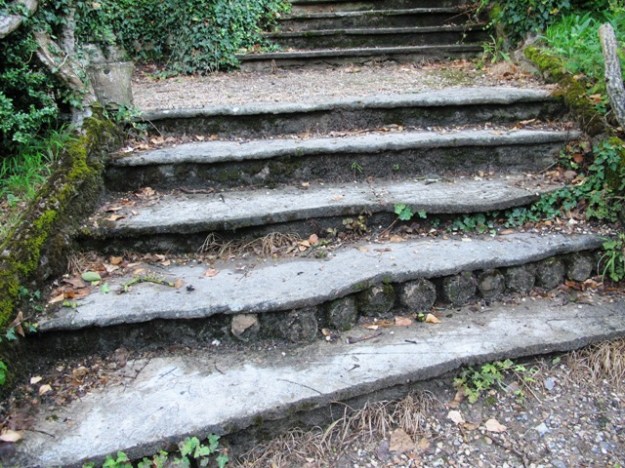 Not every set of steps is going to be a precisely engineered work. These were clearly DIY, although access to flat slabs of stone for the treads gives the impression of permanent quality. Look at the risers – some are local round stones held together with cement. In the absence of suitable stone slabs, check out the modern concrete pavers on offer. These can be cut to size and the finish can be good enough to deceive most eyes.
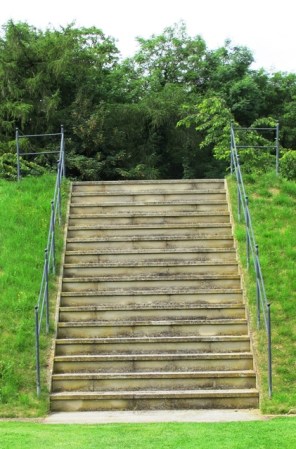
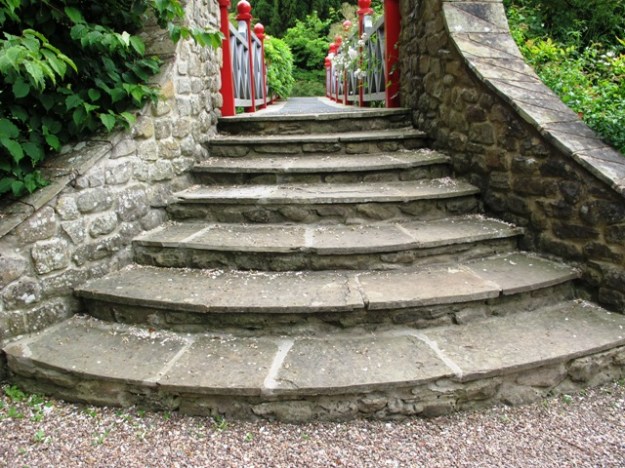 No matter what material you choose to construct your steps, there are well established guidelines for measurements. For comfort, the gradient is less than internal house stairs. Step risers should not be more than 15cm high and the corresponding step tread around 30cm from front to back. There is plenty of information on proportions that work best. Generously wide steps usually look more gracious than tight, narrow steps where space allows.


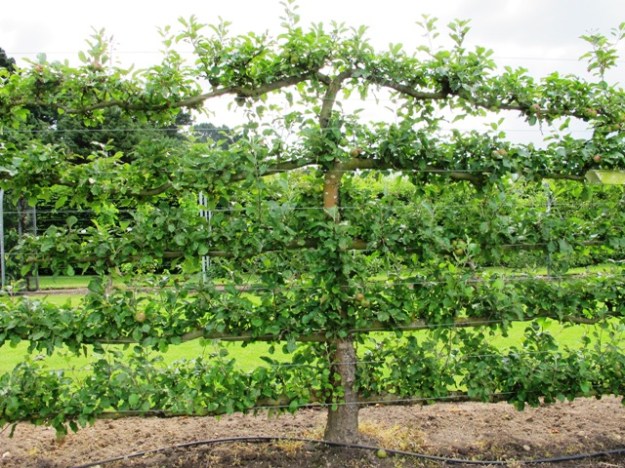 1. The freestanding horizontal espalier. You can see clearly the advantages of a two dimensional plant. Good air movement will reduce disease. It is easy to tend the plant and the fruit all receives equal sunlight. You can also see that the supports are heavy duty. This is not an exercise to be done with a few bamboo stakes and stockinette ties.
 2. The cube requires some heavy duty framing but is quite stylish, even if I was worried by the top branch that was trained back on itself. Using a frame which gently rusts as it ages will make it less visually intrusive than the tanalised pine we often favour in this country. It is the plant shape you want to emphasise, not the support structure. This design allows good air movement through the centre of the tree.
 3.The diamond row was visually the strongest in terms of pattern. I raised my eyebrows at the potential rubbing of bark where branches cross. Stem damage can let disease into the plant and a rule of thumb in all gardening is to avoid crossed branches. Presumably in an intensively maintained espalier, you are replacing the branches regularly with fresh growth so there is a bit of leeway if this is the look you want.
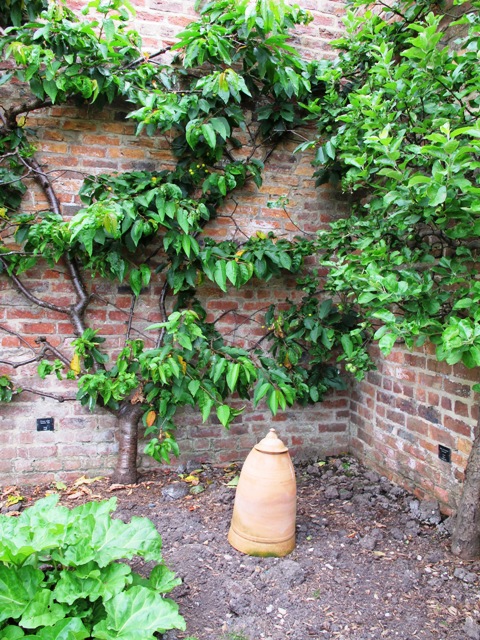 4. There is little doubt that your fan-shaped espalier will look better if you clad the fibrolite garage in old brick veneer and casually pose a stylish, vintage, terracotta forcing pot in front. The advantage of espaliering against a wall is the increase in heat for marginal crops. We don’t need to do it for apples and pears in this climate but I can see that it could work well for figs and some of the stone fruit.
 5. I have mentioned trendy stepovers before – the training of an espaliered fruit at knee level. This is a dry climate technique and where rains are light and misty. Our torrential downpours will cause rain splash and spread disease faster than you can blink. We need maximum air movement and to be above the splash line in our humid climate. That said, you can see disease in this example. I have yet to see one which remains at step-over height all growing season.
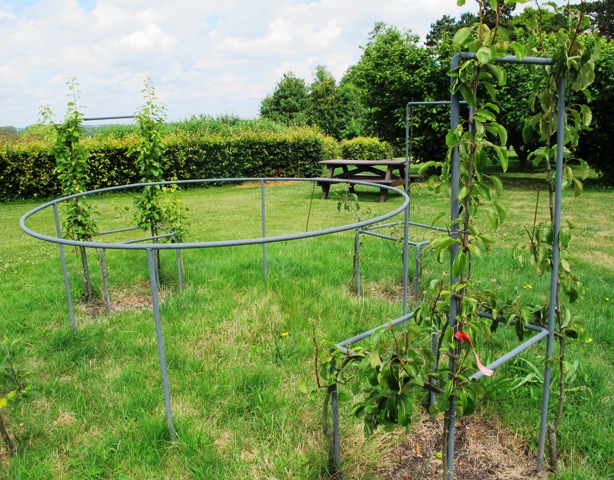 6. These table and chairs are obviously not yet established. I offer them as an idea without comment, secure in the knowledge that regular readers will know exactly what my personal opinion is likely to be. However, for those who like a little novelty in their garden, here be they. I even recorded some instructions for you.

