Category Archives: Abbie’s column

Abbie’s newspaper columns

Bulb meadows

Colchicums in the park

Colchicums in the park

The demise of two of our grand old pine trees a few weeks ago has necessitated a fairly large clean up. They were about 140 years old and had been on a major lean for much of that time. Clearly they passed the point of balance. But, as happens in gardens, their collapse also opened up an opportunity. Suddenly there was a nice little area which had been dense shade and more or less left to its own devices but was now light, open and clearly of potential.

“Bulbs,” I thought, “I shall plant it in a succession of bulbs to take it through the seasons.” I started with what was already there – a congested but large clump of snowdrops, a few cyclamen and some valiant pleione orchids which were battling on despite choking ground cover plants. Then I raided the nursery where we still had quite a few pots and trays of suitable bulbs, particularly dwarf narcissi of various types. By this point, I was already committed to using minis and dwarf growers which would co-exist and not choke out their growing companions.

So how many bulbs are needed to fill an area?

So how many bulbs are needed to fill an area?

    As I continue to raid suitable bulbs from wherever I could find them, I started to do the maths. We are not talking a large area here. It is maybe 10 square metres (5x 2) at the most. Do you have any idea of how many dwarf and mini bulbs are needed to fill that space? Allowing maybe 5 bulbs per 10cm square, that adds up to a massive …. 5000! Okay, so the cyclamen are not planted at that density, but many of the others are.

Had I chosen to start with larger bulbs of stronger growing varieties – full sized daffodils, bluebells, tulips, colchicums and the like – I could have planted them at maybe 10 cm spacings so would have only needed about 1000 bulbs. It is still a lot.

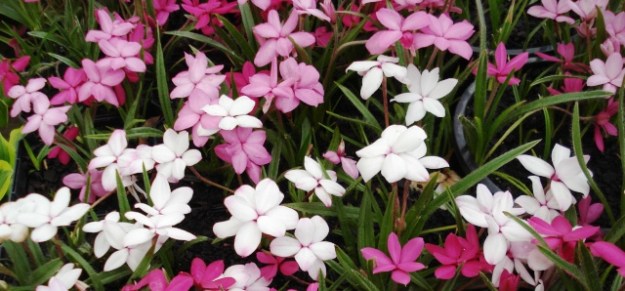
The lesson is that if you are besotted by bulbs, as we are, it helps to learn how to look after them so that you can increase the supply for other plantings. Having depleted the nursery of spare bulbs that are suitable for this situation, I am now taking apart beds in the rockery to thin the bulbs there and get the surplus for my new area. So far, as well as the types already mentioned, I have added rhodohypoxis, blue brodiaeas, various different lachenalias and crocus. I am aiming for mix and match in the hope that there will be something seasonal and dainty flowering in that particular section at all times of the year. It will take some tweaking over time to get it right.

Belladonnas beneath the gum tree at our entrance

Belladonnas beneath the gum tree at our entrance

    I have a mix and match of large and some invasive bulbs beneath a huge old gum tree at our entrance. Invasive bulbs are easily contained there and there is room for sometimes scruffy performers like the belladonnas to put on a good show.
Bluebells to the left and common old Lachenalia aloides in front

Bluebells to the left and common old Lachenalia aloides in front

    Elsewhere, we have tended to keep our bulb plantings separated by variety. This may be our nursery background – keeping the option open to start selling bulbs again if need be. But a big show of a single variety can be striking. We sometimes use the root zone at the base of large, specimen trees, usually on the sunny side because most bulbs enjoy light but are adapted to surviving quite harsh conditions. This gets them out of the way of the lawnmower.
Drifts of bulbs are harder to manage here

Drifts of bulbs are harder to manage here

    But really what we covet most are drifts of bulbs – informal, randomly organised rivers of seasonal colour flowing through. In harsher climates where the grass stops growing in winter (too cold) and summer (too dry), it is possible to do it in grass. But not here. Without significant management, the strong growing grasses overwhelm the bulbs and need mowing before the foliage has had a chance to carry out its function of replenishing the bulb.

It is easier to work with bulbs which shed their foliage quickly. There are big differences in how long different types keep their leaves – anything from 4 to 6 weeks up to 11 months. Fortunately the pretty snowdrops (galanthus) are light on foliage, because what we really want over the next decade is to develop proper drifts of snowdrops. Not a few hundred. Thousands. They will be a fleeting wonder lasting a mere week or two each year. But it is the sheer frivolity of self indulgence that will spur on the snowdrop dream. At least we know which ones perform well in our climate – without snow or much winter chill – and we will just gently work on it by continually dividing and spreading the existing clumps. I am guessing the one clump of Galanthus viridapicis in my new little bulb garden yielded upwards of 300 bulbs. That is a good return.

First published in the Waikato Times and reprinted here with their permission.

Maples in the garden

???????????????????????????????Maples. They are acers, botanically speaking and there are plenty of them. They are often seen in gardens too, though the majority are probably what is commonly referred to as the Japanese maple – A. palmatum usually dissectum. There are multitudes of selected forms of this around, many of them carrying Japanese names. One of the reasons I have not written much about Japanese maples is because we don’t have names on many of the ones in our garden here and I have not gone to the trouble of working out which varieties they are. This failure is irrelevant when it comes to their role in the garden but it matters rather more when I write about them.

A random collection of maple leaves from around the garden

A random collection of maple leaves from around the garden

The world of maples goes well beyond those feathery Japanese ones. Maple syrup, dear readers does indeed come from maple trees, unless it is a synthetic version. Acer saccharum – the sugar maple – and that is the inspiration for the Canadian maple leaf emblem. It is also a major contributor to the autumn colours we associate with North America, along with Acer negundo. These are large landscape trees, not dainty little garden specimens though Acer negundo ‘Flamingo’, a pretty variegated form, is widely sold here and stays small enough to be a good option.

Autumn colour supreme

Autumn colour supreme

Maples are classified botanically and share certain characteristics including curious winged seeds which are designed to be dispersed by wind. In a gardening or landscape context, they have some common ground too. The foliage is soft so almost all of them are unsuitable for windy locations. They need adequate moisture levels in summer so are never going to like baking in hot, dry conditions. Many of them are happy in semi shade though some will lose their colour and become dull green in low light levels. Many colour up beautifully in autumn, even in milder climates.

Beyond that, rather than looking at pictures and deciding that you want a particular variety, this is one plant family where I suggest you go to your garden centre and read the plant labels. If you are really lucky, you may even strike someone there who knows about maples. You need to make decisions about whether you want a tree (and if so, what sized tree) or a little dwarf – often called patio maples. Also whether you want weeping or arching growth, or a more upright habit. Then there is the colour and whether you want one that keeps the same colour through spring and summer because some of them change colour as the leaves age.

I would counsel caution against buying too many red or burgundy foliaged maples. These are very dominant colours in the garden landscape and best used sparingly as feature plants. And if you feel compelled to plant a collection of maples, bear in mind that there may not be a huge difference in style between the dreaded conifer garden of the 1970s and the maple garden of more modern times. Enough said on that issue.
???????????????????????????????Besides feature trees which add to the skyline, we find the smaller growing maples combine well in a variety of situations. I really like the little weeping one we have planted with roses growing through it. It is a very pretty combination, especially with perennials also in flower. Pretty too are the ones in a semi- shaded bed with clematis scrambling around them and seasonal bulbs at their base. We have more upright forms in the rockery where we can keep their bases clear and they give good year-round form.
???????????????????????????????But one of the unsung delights of the smaller growing maples is that as they grow older, they can be gently encouraged into natural bonsai forms which give shape and interest in winter when they are fully naked. We do a bit of thinning and shaping but not much is required to make a feature of a maple with a good skeleton.

Plants which delight with distinctive, fresh spring foliage, last all summer, colour up in autumn and then have a really interesting shape in winter justify their garden position all year round. Add in their adaptability to a range of situations and their happy characteristic of combining with all sorts of other plants. It all comes down to making the right decisions on the variety and the garden position from the start. These are good staple plants to incorporate into any sheltered garden.

First published in the Waikato Times and reprinted here with their permission.

Stripes, splashes and edges – variegated plants

Yellow variegated conifers are redolent of the 1960s and 70s but we have retained those that add a statement to the garden landscape

Yellow variegated conifers are redolent of the 1960s and 70s but we have retained those that add a statement to the garden landscape

New Zealand gardeners are not, in the main, huge fans of variegated foliage. There are exceptions – hostas being one – but as a general rule, we tend to avoid bi-coloured variations. This often surprises overseas gardeners, particularly British ones who are far more enamoured of such things.

I am sure it is related to the differing quality of light in this country. New Zealand is remarkable for its clear, bright light. In recent times, that light has been even less filtered due to the hole in the ozone layer. Those prized white, cream, yellow or pale variegations burn badly in the sunlight. If the sun doesn’t get them, then the winds often do and burned brown edges take the charm away.

It is different in countries with softer, more diffused light. Often such conditions go with lower sunshine hours and in a climate which is generally greyer, yellow plants and variegations can add a bright touch in the garden and landscape which is valued.

Variegations are usually sports – mutations, genetic aberrations, if you like. Sometimes it is the result of a virus. Most plants grow with one solid colour on the foliage. All sorts of plants can throw up a branch or stem with a variegation but most of these will be unstable and revert back to the original single block colour. Where a variegation can be isolated and increased by propagation, the resulting plants often the lack the vigour of the original plant.

Hideous variegated plants I have seen include a nasty variegated oleander in Spain. The mottled and margined leaf added nothing to what is a lovely flowering street tree in the right climate, in my opinion at least. There was a ghastly variegated spirea (a yellow and green leaf with murky pink flower) that we saw being sold widely in the UK. In this country, the top selling rhododendron for a number of years in the 80s was a mutant named President Roosevelt. Some of you may still have it in your gardens so stop reading now if you are going to take offence. It was the first plant I cut out when we bought the property across the road from where we now live. I do not think the yellow mid-rib to the leaf added anything but when you add a red and white variegated flower to green and gold foliage, it was all too much for me. But distinctive, so it sold.

We have retained the odd variegated yellow conifer here but only because they are handsome, established trees which make a contribution to the landscape. I can’t think that we would choose to plant them from scratch.

The variegated disporum lit up a dark area but proved altogether too invasive

The variegated disporum lit up a dark area but proved altogether too invasive

That said, in darker areas of the garden, the odd bit of variegated foliage can light up an area. It was for this reason that Mark planted the ground cover that I think is Disporum sessile variegatum. It’s pretty green and white foliage gave a lift in the shade. I have spent the better part of this week weeding it out because, unlike other disporums we grow (‘diaspora’, I keep calling them), this one was scarily invasive. It spread alarmingly, rampantly and through everything. We have retained only one small patch in a confined area. The rest is now in the compost heap. Plant this one at your peril. This variegated form is an exception to the rule in that, for us, it is much strong growing than the others we grow.

Farfugium tussilagineum argenteum looks good in shaded areas

Farfugium tussilagineum argenteum looks good in shaded areas

Other variegated shade plants we use – but in moderation – is a white edged form of Soloman Seal, a yellow striped renga renga lily (arthropodium), a handsome variegated crinum, farfugiums (which most readers will still know as ligularias) and, of course, hostas. But not all together. The secret to using plants with variegated foliage is to set them off with plenty of block-coloured foliage.

Offset variegated hostas with other plain coloured varieties for best effect

Offset variegated hostas with other plain coloured varieties for best effect

Nowhere is this more apparent than with hostas. Too often, people will only buy the fancy, variegated ones and I have never seen a good planting of a variegated hosta beside other variegated hostas, all different. But take the same hosta and put it beside some plain coloured foliages and it can add zing and star in its own right.

Most variegated plants lean to the “Look at me! Look at me!” sort of statement. If you are going to grow variegated plants, make sure that you use them so that they are the feature they want to be and don’t sit them alongside a medley of other plants also demanding to be the star. That becomes a jumble.

First published in the Waikato Times and reprinted here with their permission.

Irises – named for the Greek goddess of rainbows

Louisiana iris are flowering by our stream

Louisiana iris are flowering by our stream

I am enjoying the irises enormously this season. This week we have three main types in flower – the Sibericans, bearded irises and the Louisanas.

Botanically Iridaceae, they are more romantically named for Iris, the Greek goddess of the rainbow. It is a big family – there are maybe 300 different species and they are grouped in different botanical sections. Then there are thousands upon thousands of different hybrids, for irises have been bred extensively for hundreds of years. Some of those hybrids are what I would describe – politely, if disparagingly – as ‘novelties’. This is more evident in the bearded iris class than anywhere else but I will draw veil of silence beyond saying that not all hybrids are improvements.

'Crowned Heads'

‘Crowned Heads’

We are not the best bearded iris territory here. These ones grow from rhizomes that sit on top of the soil and they tend to prefer free draining, sandy soils (great if you live on the coast though you may have to stake the flower spikes). They like their rhizomes baked in the sun and they are fine with winter frosts but are not so at home in high rainfall, high humidity climates. They are also better without a whole lot of other foliage flopping over their rhizomes, which tends to happen in perennial beds.

Yes that is a black iris, called 'Anvil of Darkness' no less, and an old yellow variety to the right

Yes that is a black iris, called ‘Anvil of Darkness’, and an old yellow variety to the right

The modern hybrids are often touchier than the old toughies. I was delighted by the iris fields of nursery plantings I saw last spring (www.theirisboutique.co.nz) and tramped up and down looking at them all. The owner, Coleen Peri, has given me a few new ones to try here. Bless her, she avoided the weird colour mixes, splashes and splotches that I personally dislike. The very dark ones are interesting but are not going to be easy to place in the garden so that they stand out. There are some exquisite blues available but my most reliable standby is still an old pure yellow one which dates back to Mark’s mother. It is very forgiving and tolerant.

One of the easiest of all iris to grow, as long as you have heavy or damp soil - Iris sibirica

One of the easiest of all iris to grow, as long as you have heavy or damp soil – Iris sibirica

The easiest of all irises to grow must be the Siberian iris or I. sibirica. As its name suggests, it is fully hardy but it does want to grow in a heavier soil which doesn’t dry out during the growing season. It is dormant in winter, so winter dry won’t matter – though few of us have dry winters in this neck of the woods. It has the classic form with three upright and three falling petals and comes mostly in gorgeous shades of blue. Because it is clump forming (it has a fibrous root system as opposed to many irises which are either bulbs or rhizomes), it can be planted and left for many years. I get a lot of pleasure from the border where I have combined it with the big hairy-leafed Bergenia ciliata. I like the contrast between the foliages and they co-exist happily together.

The Louisiana irises are in flower down by our stream. These ones hail from the bogs and swamps of Louisiana and are easy to grow in clumps on the margins of water, although they can also be grown in heavy soils. These are plant and leave types, too. The lovely Japanese Higo irises will not come into flower for another few weeks yet. We are still working on establishing these here and they appear to be at their best immediately by water. We want lots of them blooming into December because we love their colours and ethereal form.

Moraea villosa or the peacock iris

Moraea villosa or the peacock iris

Then there are the Dutch iris (often sold widely and cheaply as corms in autumn). They looked out of place in the rockery, vulgar even, so I moved them into a perennial border where they flowered away in early spring and looked much better. Dutch iris are not native to Holland. It is just the Dutch who did the breeding to get these popular forms for the floristry and garden markets. The dwarf (ground-hugging) Iris cristata from USA look much more appropriate in the rockery and have that classic three up, three down petal formation so often associated with the iris family. The peacock iris (moraea) species which grow from corms, also fit in well with the rockery and different species flower through autumn, winter and spring though many people would not even pick some as irises.

It seems a general rule that if the iris grows from rhizomes or bulbs, it needs excellent drainage and will do better in lighter soils and full sun. If it has a clumping, fibrous root system, it leans more to heavy soils and damper conditions. One size does not fit all when it comes to the large iris family.

A field of irises being grown commercially

A field of irises being grown commercially

First published in the Waikato Times and reprinted here with their permission.
Where to start? Childhood success in gardening

Lobelia and pansies - two choices among many quick maturing annuals

Lobelia and pansies – two choices among many quick maturing annuals

I was chatting to a Waikato reader this week and we got on to the subject of encouraging children to garden. It’s not rocket science. Setting up your child for success will breed enthusiasm and confidence.

Our three progeny are well and truly adult now (and gardening adults at that) but they were whizzes at school garden competitions, sand saucers, miniature gardens and floral art. In self defence, I have to say they never won any of the calf rearing cups and ribbons (their experience was at rural schools) and success in the lamb-related sections was rare. But at anything to do with gardening and flowers, they were winners. We set them up for success.

Back in the days when rural schools here promoted competitive school gardens, I was once asked to judge the winners. These were little plots at home where the children grew flowers, herbs or vegetables. Goodness me, they were all raised from seed in those days, organised at a subsidised rate by the schools.

I still remember that judging round as I visited maybe 20 different garden plots. The saddest sight was that of a sole child of older parents. They had a lovely house and garden and poor daughter had been banished to a hidden, shaded spot out the back so as not to spoil the overall appearance of the property. She was doomed to failure.

Children’s gardens need to be in the best possible position where they are in full view and walked past all the time, not hidden away. Think of it like the wretched trampoline that dogs so many parents. If that is hidden away from view, it is not used anywhere near as much as if it is in prime position. As every parent knows, the years of childhood seem long at the time but in retrospect they have flashed past. Tramps, sandpits, paddling pools, plastic toys and their ilk don’t combine with the beautiful house and garden but they are transient. Children’s gardens are in the same class. Celebrate them. Don’t hide them away. Put them in a prominent spot by a main access path in full sun.

Rural families may have a damaged farm trough to recycle as a child's garden but move it to a sunny, prominent spot

Rural families may have a damaged farm trough to recycle as a child’s garden but move it to a sunny, prominent spot

Children like a defined space that is their own. A raised garden bed may be just the ticket but is not necessary. Defining an area with stones or bricks may suffice. Our youngest had a successful garden in a cracked farm trough which had been recycled as a sandpit and then had a third life as his vege garden. I mention this for rural readers who may have suitable farm trough lying around which they can move to the right position.

Keep the size manageable. Generally a metre square is all a small child needs, maybe two square metres for one who is a little older. Getting too large can become daunting, especially when it comes to weeding.

Guarantee success by preparing the soil. Digging it over, making sure it is friable without huge clods and adding compost or sheep pellets means that most plants will grow as required. It is too much to expect young children to be able to dig a garden. That ability comes with experience. If time allows, letting the first flush or two of weeds germinate and push hoeing them off saves an awful lot of weeding later on. Odds on, however, most children will be too keen to get planting and not want to wait for that process but at least rake the surface level for them.

If you are starting on a patch of lawn, make sure you remove all the turf first rather then digging it in.

The purist in me says that children should be encouraged to learn how to grow plants from seed. The realist says that times have changed and for a first experience, it gives a quicker result to start with punnets of small plants. The middle ground is to do a mix of purchased seedlings and seed that can be direct sown into the ground. Just avoid seeds that need to be started in individual pots or seed trays.

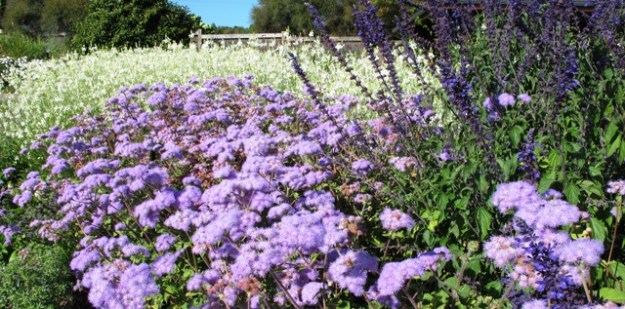
Let your child choose what they want to grow. Herbs often appeal to older children. Oreganum, marjoram, thyme, chives and parsley are good options. Coriander can be direct sown. If flowers are the choice, guide them to quick maturing annuals. Pansies, lobelia, nigella, petunias, alyssum, ageratum – the list is long. Let your child choose maybe five different ones. Most children I have seen like to plant in patterns.

Quick maturing vegetables are the way to go with children

Quick maturing vegetables are the way to go with children

When it comes to vegetables, quick maturing is the way to go. Lettuces or Asian greens are good options. Radishes are the classic choice but few children like eating them. Peas and dwarf beans can be direct sown from seed. A Sweet 100 tomato is a good choice, but keep it to just one strong plant. By mid to late summer, it will probably take up the entire patch but by then, many of the other crops will have finished and interest may have waned.

Success breeds enthusiasm. Set your child up for success from the start even if it involves some work behind the scenes.

First published by Waikato Times and reprinted here with their permission.