Category Archives: Abbie’s column

Abbie’s newspaper columns

Know thine species

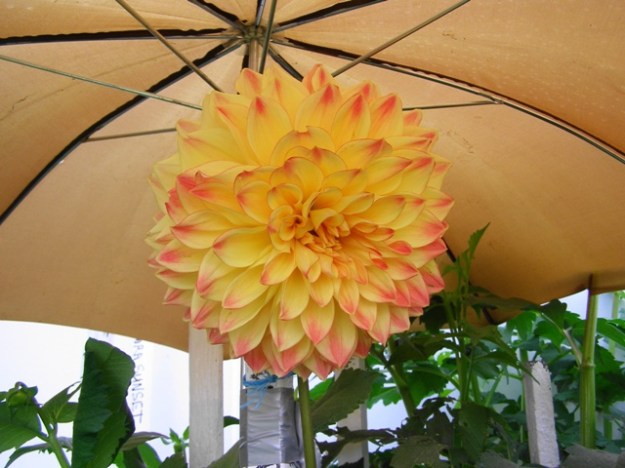
The show dahlia

The show dahlia

You can quite easily live out your gardening days without ever worrying about species and hybrids. Indeed you can, but as with most activities, many people will find that the more they know, the more they enjoy what they are doing.

At its simplest level, species are the natural form of a plant in the wild. And all plants originated somewhere in the wild.

Hybrids are mix of two different species in the first instance and after that they can quickly become a mix of many different species and resulting hybrids getting ever more complex genetic makeup. There is no value judgement in the rights and wrongs of that. Sometimes these hybrids occur in the wild without any human intervention (usually referred to as “natural hybrids”). Often it is done deliberately to try and improve plants.

A variation on controlled hybridising is line breeding – raising many seed from a plant and selecting only the very best with which to continue. Then seed from those best plants is raised time after time until it shows stability. Seed can be extremely variable and this form of line breeding is trying to edit out the less desirable aspects over several generations.

It happens all the time with edible crops. Think how much sweet corn and kiwifruit have changed over the years. The original, wild collected species of edible crops are often poor shadows of what we have now in terms of yield, reliable production, ease of handling and palatability.

It is not always true, of course. Sometimes commercial imperatives have seen us saddled with inferior tasting product – tomatoes are a prime example. And there are concerns about the loss of the wild species which are important to maintain the gene pool for food crops.

As far as ornamental plants are concerned, most of us will have gardens which are a mix of species and hybrids. There are no hard and fast rules although I have met a fair number of gardeners in my time who parade a collection of species only as a badge of status.

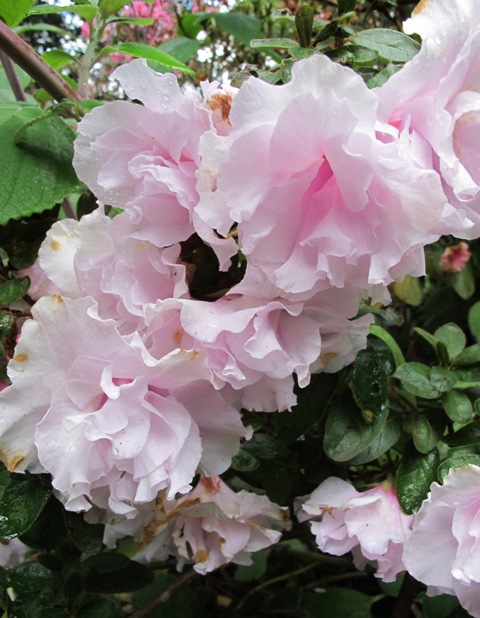
Species Camellia gauchowensis

Species Camellia gauchowensis

Some species have a simple charm which is lost in their showier hybrids. Others are nondescript in the extreme. Some highly desirable species are simply damn difficult to grow whereas the hybrids bring new vigour which makes them much more rewarding garden plants. Sometimes there are species which make splendid garden plants but they can be overlooked because their names are not appealing. Camellia gauchowensis has been the standout star of that family here recently and why anybody would grow the likes of Mine No Yuki instead of C. gauchowensis, I don’t know.

We have been revisiting the camellia species as we pick over the best options in the face of the devastating camellia petal blight which has so affected many of the hybrids we grow. It is not that the species don’t get it. It is just that some of them have less susceptibility and have other good characteristics which are worth looking at. More on this in the future.

Show blooms, no matter which plant family, often tend to be over-bred hybrids which are but distantly related to original species. Dahlias which are too heavy to hold their heads up without staking, bizarre daffodil forms, overblown cyclamen or chrysanthemums, enormous begonia flowers – anything that is bigger, allegedly better or a novelty genetic freak.
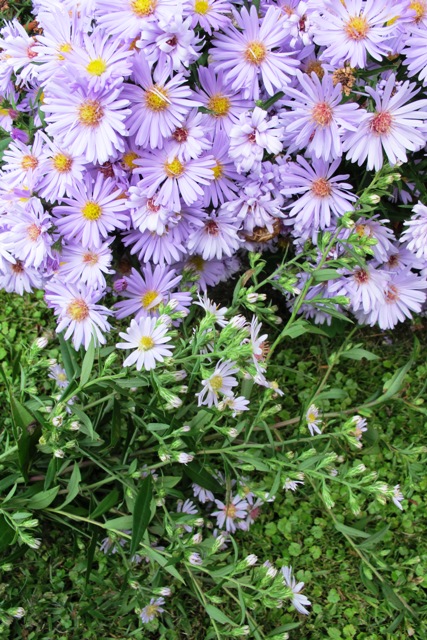
Named hybrid aster at top, self sown seedling at bottom

Named hybrid aster at top, self sown seedling at bottom

But controlled hybridising can also give us garden plants which are hugely better performers. You can see in the photograph of asters that the abundance of blooms at the top are from a named hybrid whereas the few poor specimens at the bottom are from a self sown seedling which has probably reverted closer to how the original species looks.

Hybrid arisaemas for our own garden

Hybrid arisaemas for our own garden

I am of course married to a plant breeder who is driven by the desire to create better performing garden plants. Sometimes it is just to get plants which will grow better in our garden here. His work with arisaemas is of this ilk. Many of the desirable arisaemas are a battle to grow in our conditions with insufficient chill and they simply don’t come back a second year. By hybridising two different species, he can get hybrid vigour which means they are much more reliable and stronger growing.

Other plants may be hybridised to look for new or improved characteristics – extending the colour range, reducing the impact of disease, getting more compact growth, better floral display, a longer season, sterility (to avoid unwanted seeding) or bringing the best features of different hybrids together in one plant. There are many reasons to hybridise and one of the final tests before selecting a new cultivar for release is to measure it against both the originating species and the actual parent plants. If it is not a significant improvement, then it won’t get released on the market.

Hybrids have their place in the ornamental garden and in the edible garden. But in a world which is squeezing the natural environment in every way possible, we need to retain the original species for reasons of ecology and bio-diversity. The more people who understand the difference the better – even more so if they can move away from the modern “green” cliché that says the original species are, by definition, better. They are not, but they are important.

First published in the Waikato Times and reprinted here with their permission.
Managing garden maintenance

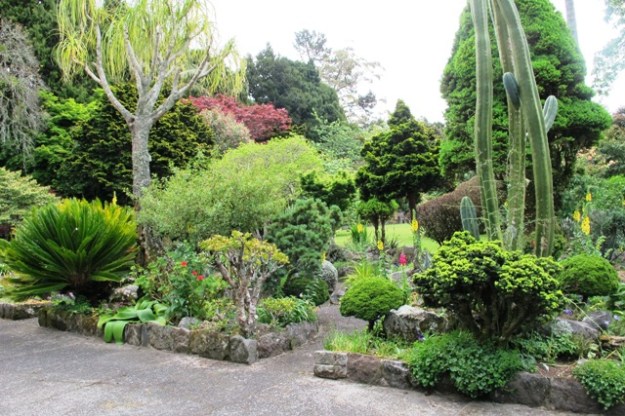
Close in by the house is under constant maintenance

Close in by the house is under constant maintenance

Garden maintenance. Oh yes, it is often like housework outdoors. No matter how much you do, it always needs to be done again. Vaccuming, tidying, dusting, spring cleaning – there are garden equivalents for the lot.

I admit I am not the world’s most dedicated housekeeper. I do it because I have to. If I found a gem of a reliable cleaner, I would find the money to pay this person to do it for me. But the times of my life when I have paid regular cleaners have also been somewhat irritating because they do not do it to my standards. Gems are hard to find.

Good garden help is equally difficult to find, I believe. Fortunately, because I don’t mind the garden maintenance side, I don’t feel the need to pay someone to do it for me. I have a wonderful book from 1984, vintage Alan Titchmarsh who is now a doyen of English garden television but who was a lesser known, bright young wit 30 years ago. It is called “Avant-Gardening, A Guide to One-Upmanship in the Garden.” In it he has a chapter entitled: “Having a Man In” and his opening line is: “Or a woman; but most likely a man.” He divides gardening help into Treasures and Tolerables. The Treasures, he declares, are rarer than blue roses.

I would love to quote the lot about The Tolerables, but it is too long. Edited highlights include: “They resent change. Their favourite flowers are …scarlet salvias, orange French marigolds, standard fuchsias and lobelia and alyssum. They love ‘dot’ plants. They have difficulty in recognising your treasures and pull them up as weeds…. The vegetables they grow will be their favourites, not yours. ….They dig beds where you don’t want them and act on ‘initiative’ without asking if you actually wanted the orchard felling…. They don’t let you know when they are not coming in (it pays to keep you guessing).” There is more in that vein.

Judging by the number of enquiries I have had over the years, good garden help is just as scarce nowadays as it has ever been. But, as with anything else, if you are only willing to pay the equivalent of minimum wages, you are unlikely to find a Treasure who knows what he or she is doing in your garden. A Treasure whom you can trust is even rarer and will need to be cherished.

The bottom line is that most of us end up doing it ourselves and gardening as a DIY ethos is deeply ingrained in this country to the point that it is often worn as a badge of pride.

The outer areas are on a once a year maintenance cycle

The outer areas are on a once a year maintenance cycle

I credit the potted wisdom on garden maintenance I received years ago to senior NZ gardener, Gordon Collier. Think of the garden as radiating circles, he told me. The circle closest in to the house is where you carry out the most garden maintenance to keep it well presented. Essentially, you stay on top of it by keeping at it all the time. The next circle out should be on a seasonal cycle so you get around it four times a year. Then there is the outer circle which you do once a year.

This of course is big garden advice. A smaller urban garden probably does not take you beyond the second circle. I have always remembered his words because it gave a sensible and manageable framework for a large garden, and we are large gardeners here. It is worth thinking about if you are extending your garden. The further out you go, the less you will do in terms of regular maintenance. Plan from the start to keep it on an infrequent cycle and you won’t be making a yet bigger rod for your own back.

He Who Does the Majority of the Weed Control here (aka my Mark) would like it pointed out that this does not apply to weeding. Depending on the time of the year, he will start a weeding circuit as often as every three weeks. If you leave the weeding circuit to three monthly, or annually, you will never keep invasive weeds under control. The convolvulus will have smothered its host, the seedling cherries grown too large to hand pull and there will be a permanent carpet of bitter cress. Most weeds will have viable seed on them by six weeks – hence the three weekly cycle to catch the weeds missed on the last round.

That outer round of maintenance is the pruning, cutting out dead wood from shrubs, the removal of large debris, seasonal dead heading where necessary, cutting bank rank grass and a general tidy up. It is what I am doing right now.

The middle circle is hedge trimming, digging and dividing perennials, cutting back, staking, pruning, shaping, clipping and mulching.

The close in circle is… well… like vaccuming the living areas and washing the kitchen floor really. Frequent and ongoing. I just prefer to work outdoors and, in my case, without power tools.

First published in the Waikato Times and reprinted here with their permission.
Stripes, hedges and gardening on the flat

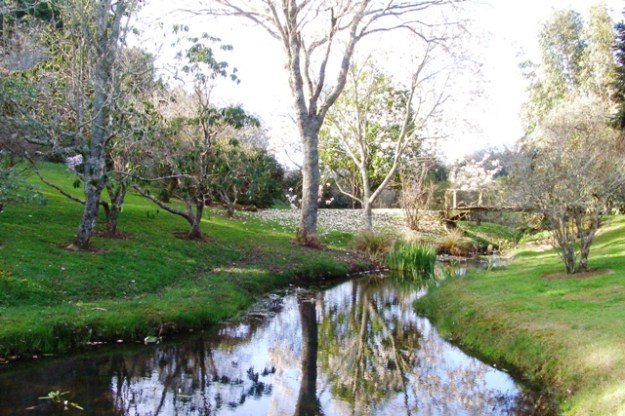
Striped gardening a la Monet (photo: Michal Osmenda via Wiki Commons)

Striped gardening a la Monet (photo: Michal Osmenda via Wiki Commons)

There I was last week, railing against the fad for edging plants everywhere and referencing planting in stripes. We watched a programme which we had recorded on Monet’s famous garden at Giverny. There was his striking central allée and it was planted in long stripes! But beautiful, complex stripes created with painterly style and panache.

I have yet to visit Giverny and I may have trouble motivating Mark to accompany me. Being a New Zealander, he has an abhorrence of crowds and that particular garden is renowned for packing ‘em in. That said, good friends of ours went last year, not expecting to be overly impressed, but they were blown away by it so if we are in that part of the world (an hour or so north of Paris), we will probably go. And admire planting in stripes.

It is probably no surprise that a Frenchman would go with formalised planting. The genre of parterres (regimented planting of colour on formal terraces) is closely identified with the French nobility of old. It was primarily designed to be viewed from upper windows and is essentially using flowering plants as a tool to paint patterns in stylised form, such as we see on fabrics.

Monet used more of a mix and match of colours to get the beguiling complexity we associate with Impressionist art, but if you look at the composition around that central allée, it is still geometric.

The danger is that if you over simplify it, you are more likely to end up with bedding plants arrayed in the style of the old fashioned traffic island or floral clock.

Next up came a programme we had of BBC Gardener’s World where lead presenter, Monty Don, was walking down one of the paths in his garden and lo! There was another garden in distinctive stripes. It was all dead straight. Very tall hedges either side, a middle layer of matched small bushes planted in long stripes inside, edged by buxus with a narrow path between the matched borders. There is something engaging in the simplicity of such a scene, but it is still really like a house hallway outdoors – an access way which you want to lead to somewhere more open and spacious at either end.

David Hobb's garden in Canterbury

David Hobb’s garden in Canterbury

It started a conversation here about creating a garden on a dead flat site with no established trees or structure. That is apparently what Monty Don did and he went with masses of clipped hedges to give form. I saw the same strategy in large Christchurch gardens on the flat. These hedges gave both structure and protection from Canterbury’s winds which can howl across the plains.

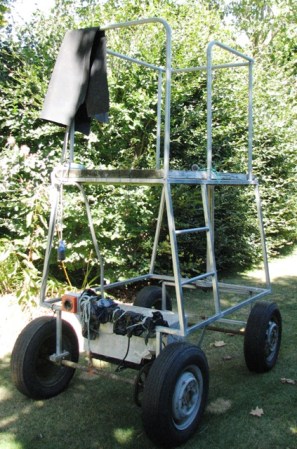
Mobile hedge-trimming platform from Trotts Garden in Canterbury

Mobile hedge-trimming platform from Trotts Garden in Canterbury

Ever practical gardeners, we could see difficulties in the longer term. In order to get good structure, you need to let the hedges grow tall – around the 4 metre mark in large spaces. Formal hedges need trimming at least once a year, more often if you want clean crisp lines. If you get the mechanical hedge trimming contractors in, you have to keep a vehicle path width down either side of the hedge. If you do it yourself, you need mobile scaffolding, a good eye and the determination to get it right. It is not a path we would choose to go down ourselves. There are more fun things to do in the garden than endless hedge trimming. These may not be gardens to grow old in, unless you can afford the labour to carry out the trimming.

The alternative in large flat gardens is to plant good long term trees with sufficient space to grow to reach their potential. They can give the structure and form in the long term and as long as you choose well, they are not going to need anywhere near the regular maintenance of the formal hedge.

Next, on the long, wet weekend, we reviewed yet another of the gardening programmes we had saved. This time it was the UK’s longstanding and vastly experienced garden presenter, Alan Titchmarsh (a refreshingly unpretentious Yorkshireman) with his Love Your Garden series. One episode showed a simply astounding, verdant, lush forest on a very traditional, flat, rear section.

If you have ever seen British suburbia, the British equivalent of our traditional quarter acre section is a narrow plot which is the width of the semi detached or terraced house (in other words, two rooms wide if you are lucky) with a small front area and a longer rear area. This was one of those. I think Alan Titchmarsh said it was 30 metres long but it can’t have been more than 8 metres wide, if that.

The gardening owner had taken this long, thin rectangle and entirely disguised it. The main device was a zigzag wall structure running diagonally across the yard which had then been planted heavily. The foliage hid the wall but that structure turned a blank, open canvas into a much more complex design with different conditions in which to grow plants. Against the odds, there were hidden areas to be discovered and the garden was not visible at any point in its entirety (except, presumably from an upstairs window).

You can take a dead flat, unprepossessing piece of ground and turn it into something surprising and deceptive if you have flair. But then you can take planting in stripes and turn it into something special as well, if you are another Claude Monet.

First published in the Waikato Times and reprinted here with their permission.
Begone edging plants!

Shocked to realise I had planted the Tiger’s Jaw (Faucaria tigrinia) in a row...

Shocked to realise I had planted the Tiger’s Jaw (Faucaria tigrinia) in a row…

Ahem. I risk annoying many readers this morning. I know this because odds on, many follow trend and do not think gardens are complete without tidy rows of edging plants. Noooo, I say.

There is a difference between hedges and edgers. Hedges are living walls, usually green, giving structure to a garden. Edgers are edging plants. The baby Buxus suffruticosa is commonly an edging plant. Edgers are designed to make a garden look tidy.

There is a school of thought that if you have tidy rows of edging plants, the garden will always look neat. I beg to differ. If you have a messy garden, you have a messy garden. If you have a messy garden with a tidy row of edging plants, said edging does not make the rest of your garden look neat. It will look precisely what it is.

When you have a garden bed already defined by sharp edging – whether a path, pavers, or a mowing strip – you don’t actually need edging plants to add further definition. That is unless you like gardening in stripes.

I looked at a photo in another publication last week. There was a border beside a driveway. The drive was paved and then edged in a concrete nib wall. But that double definition was apparently insufficient for the owner. The line was further defined by an unbroken row of variegated Agapanthus Tinkerbelle, with another row of matched low shrubs behind, punctuated by dot plants at regular intervals, used as vertical accents.

If you asked ten year olds to design a garden, what would most of them come up with? A bed in long stripes, I would guess. A row of one colour, backed by another row of a different colour and broken up by regular placement of upright lollipops or pillars. Just as the adult owner of the aforementioned garden did. Tidy. Tidy and suburban. It is so ubiquitous these days that it has become the norm.

Mondo grass – black or green, liriope, blue carex, fescue, dwarf agapanthus, dietes, lavender, rosemary, renga renga lilies, even hostas in shady conditions – what is with this need to plant them all in edging rows, I ask. It is all a bit too reminiscent of traffic island planting, in my opinion.

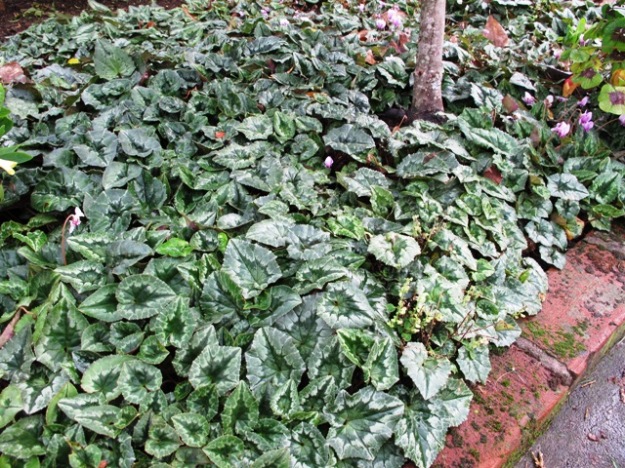
Would an edging of mondo grass really improve this bed of cyclamen which is already defined by brick edging and mowing strip?

Would an edging of mondo grass really improve this bed of cyclamen which is already defined by brick edging and mowing strip?

Yes, defining lines and shapes in the garden by ribbon planting the same plant is a tool, but only one tool and not a compulsory one at that. I had hoped that the advent of buxus blight with the unfortunate result of a whole lot of dying edging plants might encourage a rethink on their role by many gardeners. Alas that does not appear to be the situation, judging by the frequent searches I see for alternatives to buxus. Many people are simply looking for a suitable plant to use instead rather than reviewing the role of the little garden hedge.

Formal gardens are planted in stripes and blocks, everything measured so that the spaces are even. It is all about control and maintenance. That is the style. Informal or naturalistic gardens are at the other end of the scale. There is nothing so contrived or tightly managed as a row or an edging stripe. This style is more about emulating Nature, recreating but improving on what occurs naturally. Most of us choose to garden somewhere in the middle between those two ends of the spectrum. As such, we are in good company. That mix is the hallmark of some great gardeners like Vita Sackville West and Gertrude Jekyll.

I just can’t imagine that Vita or Gertrude would have forseen the translation into edgings of mondo grass or bedding begonias. They didn’t ever straitjacket every garden bed and every garden border in behind tidy edges of border plants. Woodland and cottage gardens were spared. Herbaceous borders were allowed to festoon outwards over the wide mowing strips, softening the hard lines. One of the lovely distinctive styles of many English gardens is their use of wide gravel paths (usually a honey coloured gravel rather than sombre grey) with voluptuous plantings allowed to overflow to the path and often gently seeding down.

I admit that I gave myself a shock when I headed out to photograph the Tiger’s Jaw (Faucaria tigrinia) plants which were opening their faces to the sun. It wasn’t until I lined up the photo that I realised I had planted them in a row at the front of that particular garden border. There was a good reason. They are very low growing and will rot out if larger plants flop over them. But a row! I shocked myself. It may just be the only edging row you will find our garden outside of the vegetable patch (excluding proper hedges) but we are in a minority among New Zealand gardens. Pretty much every one I go into these days is defined by the use of edging plants.

Consider grouping the plants, darlings, rather than planting them in single file. You may even like the different effect.

First published in the Waikato Times and reprinted here with their permission.

Our world of azaleas here

Our sky carpet of Kurume azaleas in September

Our sky carpet of Kurume azaleas in September

I have never tracked the flowering season of our evergreen azaleas. Generally we would say they are spring flowering and the peak is in September. But this year, I have become aware of them coming into flower already and I have been snapping a few photos for several weeks. When I looked around, plenty have blooms out.

I googled and found references to them having a flowering season of a week or two in spring. Not here, is all I can say. For us, they are unsung heroes in the background of our garden. We have lots of evergreen azaleas and they are rarely foreground stars. But they are such an obliging plant because they grow in semi shade to shaded areas (of which we have plenty), they never get too large, they are wonderfully unfussy, don’t need deadheading and they gently flower on… and on… and on.

The evergreen azaleas are gently flowering already and will continue through til spring

The evergreen azaleas are gently flowering already and will continue through til spring

You can make them stars. You can turn them into bright, colourful clipped mounds of bloom if that is what you want in your garden. You can tastefully plant the same cultivar (to keep uniformity) as an edger alongside a driveway or path. You can colour tone for variation and mass plant out a gentle incline. Or you can ignore fashion and plant a mismatched collection as a vibrant statement of mushroom shaped mounds out in the open. With any of those options, you will probably get peak flowering for a couple of weeks and have relatively anonymous, small leafed green shrubs for the other 50 weeks of the year.

We have plenty of star plants in our garden, so we lean more to using the evergreen azaleas as understated support plants throughout. They are so obliging by nature. Even if you cut them back very hard, most will just come again. You can raise your own plants from seed if you are a patient gardener. They are widely available for sale and generally you decide what you want by leaf and flower size – some are much smaller in both than others – and by colour rather than searching out particular named cultivars.
???????????????????????????????Colours are from white through the whole gamut of pinks to pure reds. The closest to blue is lilac and the closest to orange is more coral in tone. Nor are there pure yellows. Just white with a green or yellow toned throat.
We have plantings of the fine leafed Kurume azaleas from Japan which are now over 60 years old. At about 45 years of age, Mark decided they needed some attention and rather than cutting them back hard to rejuvenate them, he set upon a course of limbing them up. It is a constant task but we take out all the lower growth and have them as an undulating carpet of blooms just above head height.

A garden visitor from Kurume came a few years ago. He spoke no English and we speak no Japanese but he managed to convey the information to us that our Kurumes were simply astounding for their age. But, and there is always a but, we should be taking better care of them. I have spent a prodigious amount of time grooming out dead twiggy bits and an excess of lichen ever since. Some gardeners choose to use copper sprays or lime sulphur to combat lichen build up on older plants.

All azaleas are rhododendrons but not all rhododendrons are azaleas. In other words, azaleas are a separate section of the rhododendron family. They then divide further into the deciduous azaleas (botanically Pentanthera) and the evergreen azaleas (at least mostly evergreen, the Tsutsuji or Tsustusti azaleas originating from Japan).

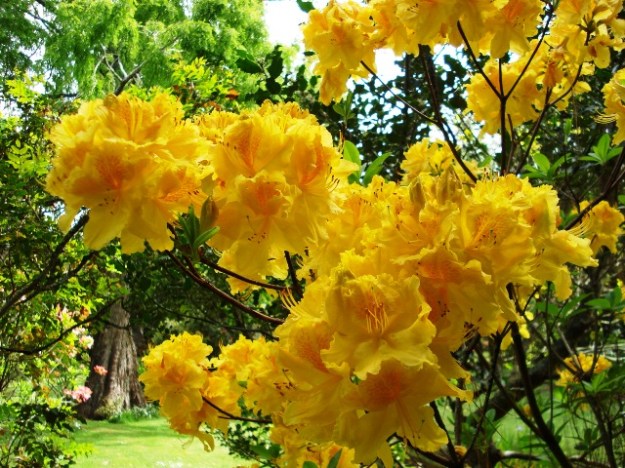
Vibrant colour in late October from deciduous azaleas

Vibrant colour in late October from deciduous azaleas

Deciduous azaleas are a different branch of the family altogether and many look more like rhododendrons with their full trusses. They are often referred to as Azalea mollis or Ilam azaleas in this country. Some bring the most wonderfully vibrant colour into the spring garden, bordering on vulgar if not placed well. You don’t get the same bright oranges in any rhododendron that I know of and the intense yellows, tangerines and reds make a big statement. For those of more refined sensibility, there are also pastels and whites. Many are strongly scented.

Deciduous azaleas are more tolerant of heavy, wet soils – even occasional flooding – and of full sun than their rhododendron cousins. Surround them with lots of green is my advice, and let them have their time to star in all their glory.

The problem with deciduous azaleas is that when they are not in flower in mid spring, they tend to be pretty anonymous plants. And in humid climates, they are inclined to get mildewed foliage by the end of summer so are not plants of great beauty in small gardens.

Nor are they always easy to source. Garden centres really only have a three week selling time on them when they are in flower because few will impulse buy outside that show time. So buy plants when you see them on offer, is my advice, rather than waiting until the precise moment you are ready to plant them.

Our garden might look a bit sad and empty without the strong showing from the azaleas.

First published in the Waikato Times and reprinted here with their permission.