Category Archives: Abbie’s column

Abbie’s newspaper columns

Stripes, hedges and gardening on the flat

Striped gardening a la Monet (photo: Michal Osmenda via Wiki Commons)

Striped gardening a la Monet (photo: Michal Osmenda via Wiki Commons)

There I was last week, railing against the fad for edging plants everywhere and referencing planting in stripes. We watched a programme which we had recorded on Monet’s famous garden at Giverny. There was his striking central allée and it was planted in long stripes! But beautiful, complex stripes created with painterly style and panache.

I have yet to visit Giverny and I may have trouble motivating Mark to accompany me. Being a New Zealander, he has an abhorrence of crowds and that particular garden is renowned for packing ‘em in. That said, good friends of ours went last year, not expecting to be overly impressed, but they were blown away by it so if we are in that part of the world (an hour or so north of Paris), we will probably go. And admire planting in stripes.

It is probably no surprise that a Frenchman would go with formalised planting. The genre of parterres (regimented planting of colour on formal terraces) is closely identified with the French nobility of old. It was primarily designed to be viewed from upper windows and is essentially using flowering plants as a tool to paint patterns in stylised form, such as we see on fabrics.

Monet used more of a mix and match of colours to get the beguiling complexity we associate with Impressionist art, but if you look at the composition around that central allée, it is still geometric.

The danger is that if you over simplify it, you are more likely to end up with bedding plants arrayed in the style of the old fashioned traffic island or floral clock.

Next up came a programme we had of BBC Gardener’s World where lead presenter, Monty Don, was walking down one of the paths in his garden and lo! There was another garden in distinctive stripes. It was all dead straight. Very tall hedges either side, a middle layer of matched small bushes planted in long stripes inside, edged by buxus with a narrow path between the matched borders. There is something engaging in the simplicity of such a scene, but it is still really like a house hallway outdoors – an access way which you want to lead to somewhere more open and spacious at either end.

David Hobb's garden in Canterbury

David Hobb’s garden in Canterbury

It started a conversation here about creating a garden on a dead flat site with no established trees or structure. That is apparently what Monty Don did and he went with masses of clipped hedges to give form. I saw the same strategy in large Christchurch gardens on the flat. These hedges gave both structure and protection from Canterbury’s winds which can howl across the plains.

Mobile hedge-trimming platform from Trotts Garden in Canterbury

Mobile hedge-trimming platform from Trotts Garden in Canterbury

Ever practical gardeners, we could see difficulties in the longer term. In order to get good structure, you need to let the hedges grow tall – around the 4 metre mark in large spaces. Formal hedges need trimming at least once a year, more often if you want clean crisp lines. If you get the mechanical hedge trimming contractors in, you have to keep a vehicle path width down either side of the hedge. If you do it yourself, you need mobile scaffolding, a good eye and the determination to get it right. It is not a path we would choose to go down ourselves. There are more fun things to do in the garden than endless hedge trimming. These may not be gardens to grow old in, unless you can afford the labour to carry out the trimming.

The alternative in large flat gardens is to plant good long term trees with sufficient space to grow to reach their potential. They can give the structure and form in the long term and as long as you choose well, they are not going to need anywhere near the regular maintenance of the formal hedge.

Next, on the long, wet weekend, we reviewed yet another of the gardening programmes we had saved. This time it was the UK’s longstanding and vastly experienced garden presenter, Alan Titchmarsh (a refreshingly unpretentious Yorkshireman) with his Love Your Garden series. One episode showed a simply astounding, verdant, lush forest on a very traditional, flat, rear section.

If you have ever seen British suburbia, the British equivalent of our traditional quarter acre section is a narrow plot which is the width of the semi detached or terraced house (in other words, two rooms wide if you are lucky) with a small front area and a longer rear area. This was one of those. I think Alan Titchmarsh said it was 30 metres long but it can’t have been more than 8 metres wide, if that.

The gardening owner had taken this long, thin rectangle and entirely disguised it. The main device was a zigzag wall structure running diagonally across the yard which had then been planted heavily. The foliage hid the wall but that structure turned a blank, open canvas into a much more complex design with different conditions in which to grow plants. Against the odds, there were hidden areas to be discovered and the garden was not visible at any point in its entirety (except, presumably from an upstairs window).

You can take a dead flat, unprepossessing piece of ground and turn it into something surprising and deceptive if you have flair. But then you can take planting in stripes and turn it into something special as well, if you are another Claude Monet.

First published in the Waikato Times and reprinted here with their permission.

Begone edging plants!

Shocked to realise I had planted the Tiger’s Jaw (Faucaria tigrinia) in a row...

Shocked to realise I had planted the Tiger’s Jaw (Faucaria tigrinia) in a row…

Ahem. I risk annoying many readers this morning. I know this because odds on, many follow trend and do not think gardens are complete without tidy rows of edging plants. Noooo, I say.

There is a difference between hedges and edgers. Hedges are living walls, usually green, giving structure to a garden. Edgers are edging plants. The baby Buxus suffruticosa is commonly an edging plant. Edgers are designed to make a garden look tidy.

There is a school of thought that if you have tidy rows of edging plants, the garden will always look neat. I beg to differ. If you have a messy garden, you have a messy garden. If you have a messy garden with a tidy row of edging plants, said edging does not make the rest of your garden look neat. It will look precisely what it is.

When you have a garden bed already defined by sharp edging – whether a path, pavers, or a mowing strip – you don’t actually need edging plants to add further definition. That is unless you like gardening in stripes.

I looked at a photo in another publication last week. There was a border beside a driveway. The drive was paved and then edged in a concrete nib wall. But that double definition was apparently insufficient for the owner. The line was further defined by an unbroken row of variegated Agapanthus Tinkerbelle, with another row of matched low shrubs behind, punctuated by dot plants at regular intervals, used as vertical accents.

If you asked ten year olds to design a garden, what would most of them come up with? A bed in long stripes, I would guess. A row of one colour, backed by another row of a different colour and broken up by regular placement of upright lollipops or pillars. Just as the adult owner of the aforementioned garden did. Tidy. Tidy and suburban. It is so ubiquitous these days that it has become the norm.

Mondo grass – black or green, liriope, blue carex, fescue, dwarf agapanthus, dietes, lavender, rosemary, renga renga lilies, even hostas in shady conditions – what is with this need to plant them all in edging rows, I ask. It is all a bit too reminiscent of traffic island planting, in my opinion.

Would an edging of mondo grass really improve this bed of cyclamen which is already defined by brick edging and mowing strip?

Would an edging of mondo grass really improve this bed of cyclamen which is already defined by brick edging and mowing strip?

Yes, defining lines and shapes in the garden by ribbon planting the same plant is a tool, but only one tool and not a compulsory one at that. I had hoped that the advent of buxus blight with the unfortunate result of a whole lot of dying edging plants might encourage a rethink on their role by many gardeners. Alas that does not appear to be the situation, judging by the frequent searches I see for alternatives to buxus. Many people are simply looking for a suitable plant to use instead rather than reviewing the role of the little garden hedge.

Formal gardens are planted in stripes and blocks, everything measured so that the spaces are even. It is all about control and maintenance. That is the style. Informal or naturalistic gardens are at the other end of the scale. There is nothing so contrived or tightly managed as a row or an edging stripe. This style is more about emulating Nature, recreating but improving on what occurs naturally. Most of us choose to garden somewhere in the middle between those two ends of the spectrum. As such, we are in good company. That mix is the hallmark of some great gardeners like Vita Sackville West and Gertrude Jekyll.

I just can’t imagine that Vita or Gertrude would have forseen the translation into edgings of mondo grass or bedding begonias. They didn’t ever straitjacket every garden bed and every garden border in behind tidy edges of border plants. Woodland and cottage gardens were spared. Herbaceous borders were allowed to festoon outwards over the wide mowing strips, softening the hard lines. One of the lovely distinctive styles of many English gardens is their use of wide gravel paths (usually a honey coloured gravel rather than sombre grey) with voluptuous plantings allowed to overflow to the path and often gently seeding down.

I admit that I gave myself a shock when I headed out to photograph the Tiger’s Jaw (Faucaria tigrinia) plants which were opening their faces to the sun. It wasn’t until I lined up the photo that I realised I had planted them in a row at the front of that particular garden border. There was a good reason. They are very low growing and will rot out if larger plants flop over them. But a row! I shocked myself. It may just be the only edging row you will find our garden outside of the vegetable patch (excluding proper hedges) but we are in a minority among New Zealand gardens. Pretty much every one I go into these days is defined by the use of edging plants.

Consider grouping the plants, darlings, rather than planting them in single file. You may even like the different effect.

First published in the Waikato Times and reprinted here with their permission.

Our world of azaleas here

Our sky carpet of Kurume azaleas in September

Our sky carpet of Kurume azaleas in September

I have never tracked the flowering season of our evergreen azaleas. Generally we would say they are spring flowering and the peak is in September. But this year, I have become aware of them coming into flower already and I have been snapping a few photos for several weeks. When I looked around, plenty have blooms out.

I googled and found references to them having a flowering season of a week or two in spring. Not here, is all I can say. For us, they are unsung heroes in the background of our garden. We have lots of evergreen azaleas and they are rarely foreground stars. But they are such an obliging plant because they grow in semi shade to shaded areas (of which we have plenty), they never get too large, they are wonderfully unfussy, don’t need deadheading and they gently flower on… and on… and on.

The evergreen azaleas are gently flowering already and will continue through til spring

The evergreen azaleas are gently flowering already and will continue through til spring

You can make them stars. You can turn them into bright, colourful clipped mounds of bloom if that is what you want in your garden. You can tastefully plant the same cultivar (to keep uniformity) as an edger alongside a driveway or path. You can colour tone for variation and mass plant out a gentle incline. Or you can ignore fashion and plant a mismatched collection as a vibrant statement of mushroom shaped mounds out in the open. With any of those options, you will probably get peak flowering for a couple of weeks and have relatively anonymous, small leafed green shrubs for the other 50 weeks of the year.

We have plenty of star plants in our garden, so we lean more to using the evergreen azaleas as understated support plants throughout. They are so obliging by nature. Even if you cut them back very hard, most will just come again. You can raise your own plants from seed if you are a patient gardener. They are widely available for sale and generally you decide what you want by leaf and flower size – some are much smaller in both than others – and by colour rather than searching out particular named cultivars.
???????????????????????????????Colours are from white through the whole gamut of pinks to pure reds. The closest to blue is lilac and the closest to orange is more coral in tone. Nor are there pure yellows. Just white with a green or yellow toned throat.

We have plantings of the fine leafed Kurume azaleas from Japan which are now over 60 years old. At about 45 years of age, Mark decided they needed some attention and rather than cutting them back hard to rejuvenate them, he set upon a course of limbing them up. It is a constant task but we take out all the lower growth and have them as an undulating carpet of blooms just above head height.

A garden visitor from Kurume came a few years ago. He spoke no English and we speak no Japanese but he managed to convey the information to us that our Kurumes were simply astounding for their age. But, and there is always a but, we should be taking better care of them. I have spent a prodigious amount of time grooming out dead twiggy bits and an excess of lichen ever since. Some gardeners choose to use copper sprays or lime sulphur to combat lichen build up on older plants.

All azaleas are rhododendrons but not all rhododendrons are azaleas. In other words, azaleas are a separate section of the rhododendron family. They then divide further into the deciduous azaleas (botanically Pentanthera) and the evergreen azaleas (at least mostly evergreen, the Tsutsuji or Tsustusti azaleas originating from Japan).

Vibrant colour in late October from deciduous azaleas

Vibrant colour in late October from deciduous azaleas

Deciduous azaleas are a different branch of the family altogether and many look more like rhododendrons with their full trusses. They are often referred to as Azalea mollis or Ilam azaleas in this country. Some bring the most wonderfully vibrant colour into the spring garden, bordering on vulgar if not placed well. You don’t get the same bright oranges in any rhododendron that I know of and the intense yellows, tangerines and reds make a big statement. For those of more refined sensibility, there are also pastels and whites. Many are strongly scented.

Deciduous azaleas are more tolerant of heavy, wet soils – even occasional flooding – and of full sun than their rhododendron cousins. Surround them with lots of green is my advice, and let them have their time to star in all their glory.

The problem with deciduous azaleas is that when they are not in flower in mid spring, they tend to be pretty anonymous plants. And in humid climates, they are inclined to get mildewed foliage by the end of summer so are not plants of great beauty in small gardens.

Nor are they always easy to source. Garden centres really only have a three week selling time on them when they are in flower because few will impulse buy outside that show time. So buy plants when you see them on offer, is my advice, rather than waiting until the precise moment you are ready to plant them.

Our garden might look a bit sad and empty without the strong showing from the azaleas.

First published in the Waikato Times and reprinted here with their permission.

Gardening crimes against nature

The banks of waterways should not be sprayed

The banks of waterways should not be sprayed

There is a wonderfully self-satisfied confidence in many gardeners that their hobby is good for the environment and that they are working with nature. On the contrary, too often gardening is in direct opposition to nature and many gardeners are guilty of environmental crimes. This has probably escalated considerably since the 1960s when all manner of nasties became available to the home gardener in order to control the excesses of nature.

Lawns are arguably the greatest gardening crime against the environment. Edwin Budding would have had no idea of what he was unleashing on the world in 1827 when he invented the lawnmower. It took until much later in the century before a motor mower appeared. Until then, all grass was cut by scythe and would have been grass, not lawn as we know it. Now we prize lawns that resemble lush bowling greens, but at what cost?

Take a demerit point if you remove all clippings from your lawn but then turn around and fertilise it regularly to compensate. At least buy a mulcher mower next time you replace your machine. If you mulch your clippings back into the lawn, you don’t need to buy fertiliser to give it a boost.

Take three demerit points if you put your lawn clippings out with the green waste or in your wheelie bin. There can be no justification for the public sector having to dispose of domestic lawn clippings.

More demerit points can be added if you insist on spraying your lawn with hormone sprays (which of course means you cannot remove the clippings to the compost heap but must find some other way of getting rid of them for the next six months). The most common spring time enquiry we receive about distorted leaf growth on deciduous trees, particular magnolias, is directly attributable to the use of hormone sprays on lawns. Quadruple your demerit points if you are one of the environmental vandals who insists on spraying your lawn to kill the earthworms beneath so they cannot spoil the effect with their worm casts. Shame.

Not taking responsibility for plants you may be growing which have the capacity to escape beyond your patch is a crime against nature. Too many of our weeds in this country are garden escapes – erigeron daisies, self seeding campanulata cherries, old man’s beard (Clematis vitalba), wild gingers, to name a few. Without ripping out every seeding or suckering exotic plant, gardeners have a moral responsibility to make sure they keep such things under control. Potting them up to sell at your local school gala or a car boot sale is not acceptable. Not at all. You are merely dispersing plants with weed potential.

Using plastic coated bubble slow release fertilisers in the garden warrants demerit points, no matter what your garden retailer may tell you. These were developed for container plant growing, not for general garden usage and, believe me, those plastic bubble coatings last for many years in the environment. If you are going to use bought fertilisers, then make sure you are using ones which are fully biodegradable. Better still, make your own compost.

Growing plants that you have to drench regularly with fungicide, insecticide or even simple copper sprays in order to keep them alive and healthy needs review. Get the message – these plants are not happy in your conditions. It is only a triumph to grow something difficult or different if you can give it conditions that make it relatively happy and healthy. Regular human intervention with a chemical arsenal is not good gardening practice. Once a year is neither here nor there but more often than that, and you should be asking yourself questions. I include copper in that list. While relatively benign, there is evidence that repeated applications over time kill earthworms, bacteria and other soil organisms which are part of the natural environment.

An array of edging tools - preferable to spraying garden edges

An array of edging tools – preferable to spraying garden edges

While on chemical sprays, I acknowledge we are growing increasingly conservative about their usage. In our gardening opinion, they are best as a last resort rather than a routine management tool. As such, I rail against the sight of sprayed edges. Invest in a repertoire of edging tools and get rid of the nasty brown sprayed look which is a crime against both nature and aesthetics. And when you routinely apply herbicide, you create a vacuum which nature will invade. In sunny areas, this will be with weeds and in shady areas, it is likely to be liverwort.

The same goes for banks on waterways. We should be avoiding all man-made chemical usage near waterways so err on the conservative side. A line trimmer or a scythe can be used to cut back and will leave cover rather than dead brown vegetation and then bare soil to erode. Pioneer farmers knew to plant trees along waterways to shade out weed growth.

Fortunately the horror that was the minimalist garden died out quickly after its heyday in the 1990s. That was the three large rocks, white pebble mulch with one sanseveria (unkindly known as mother-in-law’s tongue) and three green mounds of hummocky scleranthus. Contribution to nature? Less than zero. Demerit points? Top of the scale.

First published in the Waikato Times and reprinted here with their permission.
Magnolia – Michelia: the evergreens

Just another Magnolia laevifolia (syn Michelia yunnanensis) selection but in this case it is our selection which we called Honey Velvet

Just another Magnolia laevifolia (syn Michelia yunnanensis) selection but in this case it is our selection which we called Honey Velvet

I was surprised this week to have someone ask me what michelias are. I realised I have never written about them in a general sense. That is because I try and separate my published garden writing from our commercial interests and michelias are inextricably bound up with the latter.

Michelias are in fact a type of magnolia. They used to be seen as close relatives to magnolias, now they have been reclassified botanically as magnolias and this has involved a complete name change for some species.

Mention evergreen magnolias and most people think of the grandifloras from the southern states of USA. All readers will know these by sight, if not by name. They have big, tough, leathery leaves and they flower in summer with large creamy white blooms.

Personally, I am not a big fan of the grandifloras. They make big, chunky trees which are remarkably tolerant of harsh weather conditions. As such they have their place but I think that place is on golf courses and cemeteries. There is a row of them as you exit Huntly to the south and I am pretty sure they are on the edge of a cemetery.

Why am I not keen on them? They don’t mass flower, for one thing. In fact the flowering is generally random and intermittent. I find them a bit chunky in the landscape and if one is going to go chunky, I would rather have our native puka. The leaves are really tough and take forever to decompose.

That said, the varieties with deep velvety brown indumentums (the furry coating on the underneath of the leaf) can look attractive in the wind. Magnolia grandiflora “Little Gem” is a tough plant with exceptionally dark forest green leaves contrasting with cinnamon indumentum and is much favoured in modern gardens. Just be aware that it is only a little gem as opposed to an extremely giant gem. It will still get quite large over time and you will never get many flowers on it.

Fairy Magnolia Blush - bringing pink into the range

Fairy Magnolia Blush – bringing pink into the range

Michelias are very different. Their foliage is smaller and much lighter in substance so they are not an oppressive plant. And they can flower and flower because they set flower buds down the stem at nearly every leaf axel, not just on the tips. Most of them peak in spring but some keep on flowering for months on end and some will have a second blooming in summer.

There are a few michelias that are widely available here. M. figo has long been referred to as the port wine magnolia and many gardeners will know it. It has small leaves and is inclined to go a bit yellow in full sun. When it starts pushing out its scent in late afternoon, it smells remarkably like Juicy Fruit chewing gum.

There are various forms of doltsopa, the most common in this country being “Silver Cloud”. It has wonderfully large, pure cream blooms which are very fragrant. But, there are always buts, the flowers are floppy and often get frosted in colder areas, the tree tends to drop most of its leaves after flowering and it gets rather larger than most people expect. M. maudiae is a better bet as a garden tree but difficult to propagate so not generally available.

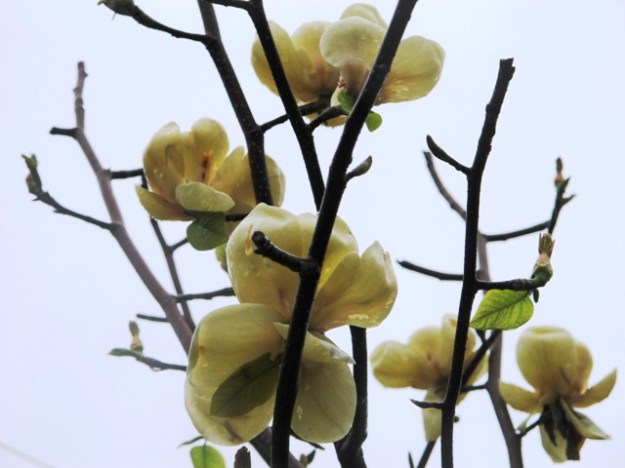
What we used to know as Michelia yunnanensis is certainly a popular addition to the garden plants of this country. It had a brief flirtation with being called Magnolia dianica before its current name was settled upon. It is now correctly known as Magnolia laevifolia but you are still more likely to find it sold as M. yunnanensis. It sets seed really freely so just about every nursery around the country has made a selection and named it (including us!). You can recognise it by its small leaves and creamy cup shaped blooms. You can hedge it and clip it but it is easier to start with a variety which is more generous in the leafage department.

Several decades ago, the late Northland plant breeder Os Blumhardt released Bubbles and Mixed Up Miss onto the market and these hybrids had many advantages over the species as garden plants. They are still tidy plants when juvenile, but nothing remarkable as they mature.

Now there is an explosion of new michelias on the market. Many are just the aforementioned M.laevifolia selections. Some are hybrids. I must declare an interest here. The ones you see being marketed as “Fairy Magnolias” are ours. For we are in the midst of a longstanding love affair with the michelias.

When camellia petal blight first showed up, my plant breeding husband immediately abandoned camellias and started on michelias. After about 17 years we have many, probably into the 1000s by now but we have never counted, as he has pursued breeding goals. They are in shelter belts, hedges, around the garden, through the nursery areas – anywhere there is space. Fairy Magnolia Blush was the first release a few years ago, bringing pink into the colour range. Cream and White are being released this year.

What we love about michelias is their versatility. They can be clipped tightly, even in topiaries. They make good hedges, even pleached into hedges on stilts. Some can become specimen trees without being forest giants. They give us masses of flowers, many are scented and they are pretty much free of all pests and diseases. They are an all round useful plant family.

We would not be without them.

Our new star - Fairy Magnolia White to be released this year

Our new star – Fairy Magnolia White to be released this year

First published in the Waikato Times and reprinted here with their permission.