Category Archives: Abbie’s column

Abbie’s newspaper columns

About the butterflies and the bees

Single flowers like the white cosmos and semi doubles like the aster provide pollen and nectar

Single flowers like the white cosmos and semi doubles like the aster provide pollen and nectar

Were my Mark to have his life over again, he might equally choose to be a meteorologist or a lepidopterist instead of a plant breeder. But as he only has the one life, he is destined to remain merely a weather-watching butterfly enthusiast. It is butterflies this week.

As a country, we are a bit deficient in the butterfly stakes. Moths we have a-plenty and very beautiful many are but the jewel colours of butterflies are in short supply. I have even seen Mark, in a fan club of one, admire the fluttering of cabbage whites around the summer garden.

When he found a beautiful Blue Moon years ago, he became very excited and tried to make a home for it. I have only just looked it up and informed him that his Blue Moon was a male and could never have laid the eggs he hoped for. The females are modest brown but the male was gorgeous. We figured at the time that the Blue Moon had been blown over from Australia but I see they are now to be found in parts of this country so maybe they will turn up here to enrich our lives at some stage. Plant portulaca, though it needs to be the right one.

A stinging nettle turned up in a prominent spot of the veg garden this summer and we are pleased. It can stay and we may encourage a bigger patch of them to form because that is what is needed to bring in the admiral butterflies. We know next door but two had red admirals and was working on yellow admirals last year so we are optimistic. It is just a shame their host plant is so off-putting.

Monarchs, the most rewarding common butterfly on offer in this country

Monarchs, the most rewarding common butterfly on offer in this country

Essentially it is the monarchs which are the most rewarding of all and which have become part of our way of life here. The earlier obsession that saw Mark successionally sow swan plants by the kilometre (I am not exaggerating – I paced out his rows one summer) have passed. These days we have plants seeding down and naturalising with just a bit of topping up from fresh seed as required.

Nasty yellow aphids

Nasty yellow aphids

Nasty yellow aphids are an ongoing issue. They suck the sap from plants and can weaken them to the point of death. After trying various ways to control these critters, Mark is pleased to report that there is a spray that works. It kills the aphids without harming the caterpillars. Nature’s Way, a product from Yates. It is not organic, despite its reassuring name, but it is targeted and appears to be safe to use. Nature’s Way is a fatty based spray. In his capacity as my in-house technical advisor, he thinks that the organic canola oil-based Eco Spray from Tui should also work in a similar manner. Both sprays will need repeat applications every few weeks to achieve control. If you only have one plant and are vigilant, you can probably squash the aphids (digital control) but that is not practical on larger plantings or out of control infestations.

It is not the caterpillars that have exerted the greatest influence over our gardening here. Leaving swan plants to seed down in corners around the garden is the easy part. It is the next step – food for the butterflies.

The fashion for minimalist gardens (so last century now) which has morphed into the clean lines of prestigious modern landscaping using large swathes of the same plant in monochromatic monocultures, is one of the unfriendliest types of gardening as far as butterflies, bees and insects are concerned. Most insects need nectar and pollen and that means flowers with visible stamens. Green, sculpted gardens don’t do it.

If you follow the British garden media, you will have noticed a very strong drive to promote gardening which supports eco systems rather than imposing unfriendly garden styles on nature.

Single and semi double blooms offer the most to both bees and butterflies

Single and semi double blooms offer the most to both bees and butterflies

All this means flowers, particularly single and semi double flowers. A single flower form has one row of petals arrayed around a sunny centre of stamens which usually means pollen and nectar. A semi double has two rows of petals so looks to be a fuller flower but still has that life supporting centre. Full double flowers only have petals visible and are of very limited or no value at all to insects, including our butterflies and bees. This is not to say you should shun double flowers. You just need to make sure that you have a good representation of singles and semi doubles as well.

Generally, there is plenty in bloom during spring and early summer. We target flowers for summer, autumn and winter to keep the butterflies around. If you lack the food for them, they will just fly away. These days our vegetable patches are a major mix of flowers and produce. This tumble of plants may not appeal to ultra tidy gardeners, but our patch is full of bees and butterflies and many lesser appreciated but valuable insects. We are also factoring in the need for food for butterflies and bees in the ornamental gardens.

You know you are succeeding when you get monarch butterflies wintering over in your garden and when you have plenty of bees buzzing busily. Not only is it better for the balance within nature, it adds vitality to the garden.

First published in the Waikato Times and reprinted here with their permission.

Tikorangi News

Tikorangi-Butter-paper

Welcome to the first edition of Tikorangi News which your council has undertaken to write in response to complaints from a few local residents that they don’t know what is happening in their district. At New Lympouth District Council, we take our duty to consult local residents very seriously and we hope this newsletter will fill the gap. We would like to thank the guardians of the old Tikorangi Dairy Factory for making their butter wrapper available to use as letterhead, reminding us of the semi rural nature of the area. regular_smile

036• We at Council are deeply aware that traffic is a major issue for many Tikorangi residents but we have AWESOME news. We have brokered an arrangement between companies, their subcontractors and Tikorangi School. Starting next week, the trucks will be calling in to the school where the students will be painting happy faces on all the vehicles. We are confident that smiley faces will bring a smile to all Tikorangi residents as the trucks pass by. Drivers have also been instructed to give a cheery wave as they pass. regular_smile regular_smile regular_smile

• Graymooth Petroleum have told us that they are very, very sorry that their drilling rig on Kowhai B allegedly broke their consented noise levels on one occasion and they promise they are doing all they can to remedy this situation. We are confident that this is the case because they even returned our wet bus ticket to us. The good news is that they have nearly finished this well and may shortly be moving their rig to the Stratford area which means it will no longer be our concern. sad_smile

???????????????????????????????• Tikorangi residents will be as thrilled as Council is that the Len Lye Centre has been given the green light. It is only because of Toad Energy’s wonderful generosity that this project is going ahead. In recognition of the special relationship between Toad and Tikorangi, residents will be guaranteed free entry to the new centre when it opens for a period of five years. regular_smile
???????????????????????????????• A few residents have suggested that Greymooth are not abiding by their declared number of light vehicles on their Kowhai B site. We are pleased to report that Greymooth have assured us that they are abiding by all conditions of their consent. We suggest that busybody residents who have counted up to 17 light vehicles parked in the two carparks at the same time should perhaps find something better to do with their time and get a real job. There are only six light vehicles a day travelling to the Kowhai B site. Similarly, Toad have assured us that they too are keeping strictly to the terms of their consent and there are only 8 light vehicles and 3 heavy vehicles driving on to their Mangahewa C site in any 24 hour period during drilling activities.

???????????????????????????????regular_smileThe next edition of the Tikorangi News will be called the Todger News after your council successfully negotiated a sponsorship deal with both Toad Energy and Greymooth Petroleum. This is good news because it means the special needs of Tikorangi will no longer be a drain on the other ratepayers of the district.

• Residents are reminded that they are best to contact the company concerned in the first instance when they have worries. This cuts out the middle man and companies can let us know what queries they have logged. We recently requested the logs from both Toad and Greymooth and were thrilled at the positive entries.
“Thanks so much for our awesome new road. Now we can speed down it at 120km an hour” said one Tikorangi East Road resident (Good news, Otaraoa Rd people. Roadworks will be starting in your area soon!)
“ Thanks guys for the generous gift of a hamper. My wife and I loved it. Now we no longer notice the sound of your generators and drilling rig at night.”
“Don’t take any notice of the carpers and moaners, guys. These few greenies are probably the same types who spend their time buggerising around on Facebook and besmirching the reputation of NLDC. We think you’re great. I will be back at work next week, by the way.”
It was wonderful to read so many positive comments and to know that the companies are taking such good care of you all. ???????????????????????????????

• On a more serious note, Council is reducing the affected party zone for new sites to those people whose residences are 20 metres or less from the site. This brings it in line with the notional boundary ruling in the District Scheme where noise levels are monitored at a distance of 20 metres from the nearest neighbouring houses. Effects from this change should be less than minor and no parties will be adversely affected. The rural character of the area will not be changed by this minor amendment.

• Big thanks go to both companies and their active programme of retro fitting double glazing in houses where the owners do not even have affected party status. This is a wonderfully generous move on their part and one which they are under no obligation to make. regular_smile

???????????????????????????????cry_smile We are acting on concerns raised by an elected councillor at a recent Council meeting regarding malcontents in Tikorangi “besmirching the reputation of the Council”. He suggested a public education programme might be required. Council categorically rejects any insinuation that this may be a case of shooting the messenger and is investigating models of re-education programmes pioneered in the Soviet gulags, the Chinese re-education through labour programmes and the Vietnamese voluntary relocation strategies of the 1970s. We are confident that any troublemaking dissidents in Tikorangi can and will be dealt with promptly and efficiently and will no longer be able to embarrass your council and to sully the reputation of Taranaki.

• Finally, in response to community concerns, we at New Lympouth District Council can assure Tikorangi residents that as far as disruption as a result of the petrochemical industry is concerned, we will leave no stone unturned in our quest to find where the buck stops. We think it may be with central government but we are mindful it may even be international – maybe WTO or OPEC.

• Kia kaha Tikorangi! And remember, you drive a car so you can’t complain. regular_smile

Tikorangi-Butter-footer

Allotments and community gardens

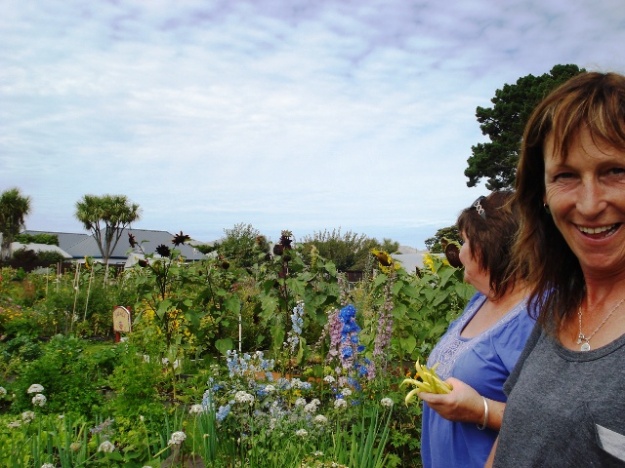
The New Brighton community gardens

The New Brighton community gardens

I concluded last week’s column on the lost gardens of Christchurch with the vibrant New Brighton Community Gardens.

I always follow allotments with interest when I visit the UK and I believe they are found in some Northern European countries too. They have been around for a long time. Apparently when people live in densely populated areas with little personal space, there are some for whom the urge to grow plants, usually vegetables, remains so strong that they will walk or drive to another space to satisfy that need.

Allotments with a million pound view at Gerrans in Cornwall

Allotments with a million pound view at Gerrans in Cornwall

Traditionally our sections or plots of land in this country have been so generous that there was no need for allotments on public land. The quarter acre per family is quite sufficient for most. But of course the quarter acre section is on the way out, in our major cities at least. These days people are more likely to find themselves on an area half that size or less and much of the land will be taken up by the larger footprint of many modern houses.

Community gardens appear to find more favour with local authorities. The word “community” has a better ring to it than the individualism which is a part of the allotment, although in the UK many allotment areas operate somewhere in between. While they retain individual plots, a high level of interaction, cooperation and community can evolve – and with that, peer pressure to keep your allotment up to scratch.

No one system fits all. Community gardens fill a different niche. Everything is shared and participants or volunteers are required to work within that cooperative ethos. I don’t think it is a coincidence that community gardens are springing up through Christchurch – over 30 of them, I was told. In the aftermath of the quake, there is comfort in community at a very local level.

004The New Brighton Community Gardens were created before the earthquakes but the coordinator, Catherine O’Neill, told me that interest had grown exponentially since those events and she now has around 100 volunteers registered. For two hours work a week in the gardens, they can take home free vegetables. This project goes way beyond just the gardens, though they are at the heart of it.

It is the site of a former sports club (croquet, then bowls if my memory serves me correctly), so it did come with a very handy building incorporating toilets, kitchen and a good sized meeting room. The building is used by other community groups as well as being a base for the gardening volunteers and related workshops.

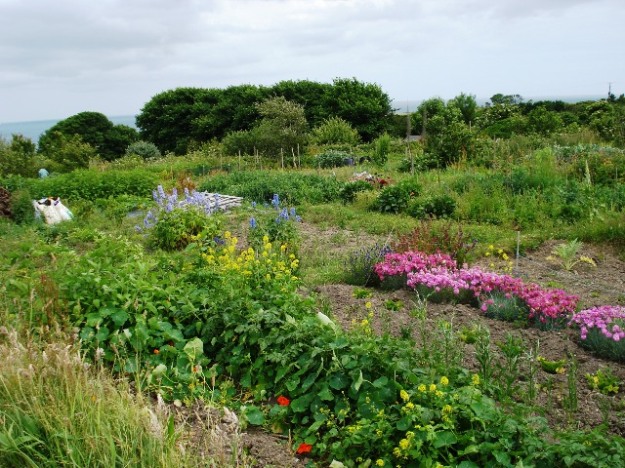
On a sunny summer’s day, the gardens were a riot of colourful flowers and vegetables. There is so much more to it than mass producing utility cabbages and Catherine observed that they wanted them to be a place of beauty and colour as well. There is a growing recognition now that it makes good sense to inter-plant vegetables with flowers which can attract and feed beneficial insects but flowers also lift the spirits with a joy that it is hard for a carrot to manage.

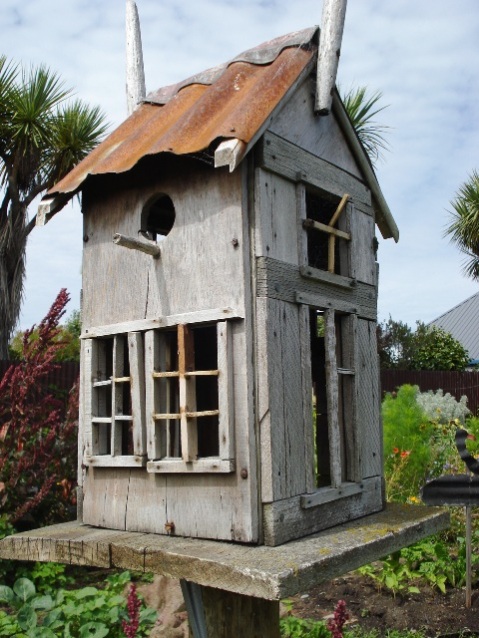
A quaint bird house built by a volunteer at the New Brighton Community Gardens

A quaint bird house built by a volunteer at the New Brighton Community Gardens

This particular community garden has developed in infrastructure which includes a paid coordinator. Its success must lie in part with having found coordinators who have gardening skills, interpersonal skills and a strong sense of community. There must also be people in the background with good administrative and fund raising skills because there is a need for some outside funding. These things do not run themselves.

It will be interesting to see how the community gardens and allotments develop in the next decade or two in Christchurch. One aspect of the quake damage is the large number of plots of land which are likely to remain vacant for some time to come. While there is a certain amount of guerrilla gardening going on and some less guerrilla-like and more community-based (you can check out Greening the Rubble on line), will it be just a matter of time before residents spread their wings – or their patch of dirt in this case? There is a limit to how many green parks, gardens and street plantings rate-payers will want to pay for Council to maintain and it certainly won’t be taking in all the open space that is being created. In the new normality that Christchurch has forged, it is likely that some local residents will start expanding their gardening space.

The indefatigable gardener and garden writer, Di Madgin, told me that she would be needing an allotment when they move to their new house shortly because it is in an area of high density housing. She offered up what must surely be one of the most practical suggestions to combat the destructive nature of vandals where gardened areas are not attached to a house. Beehives. “A larrikin would never try to graffiti a beehive more than once,” she said.

First published in the Waikato Times and reprinted here with their permission.

The Lost Gardens of Christchurch

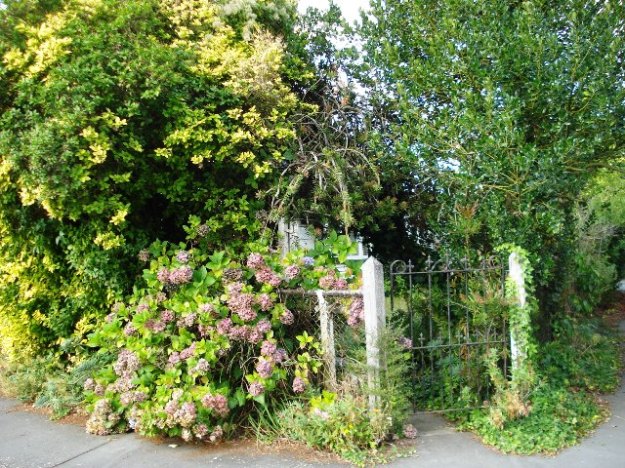
Behind every overgrown gateway, there is a personal story

Behind every overgrown gateway, there is a personal story

I went to Christchurch last weekend.

It is very hard to grasp the sheer scale of what has happened in Christchurch when you don’t know the city well to start with and you are gaining most of your information from the mainstream media. That is not a criticism of the media. It is just that the biggest and most spectacular will get covered (such as the demolition of the CBD) or the most extreme (families still living in caravans or garages). In between lie tens of thousands of individual domestic stories of lives changed forever.

I stayed in an old part of the city, immediately beside a red zoned area alongside the Avon River and my evening strolls took me down streets which are to be cleared by July. The water level in the river has risen and these residential areas are deemed too high a risk to repair. It was poignant in the extreme.

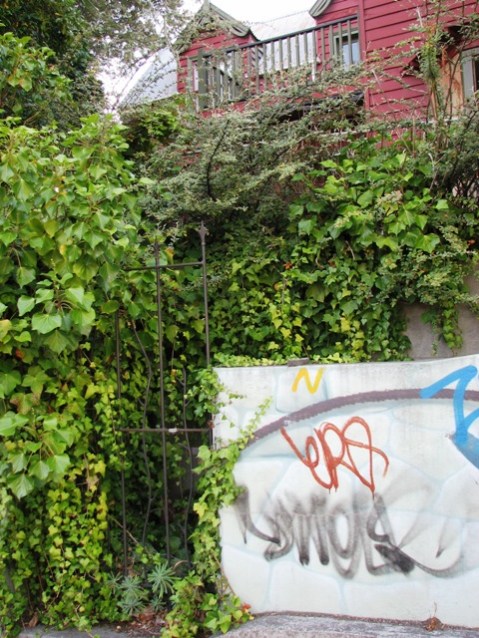
Graffiti and vandalism abound

Graffiti and vandalism abound

Initially there was a slight thrill of mystery and the classic children’s novel “The Secret Garden” by Frances Hodgson Burnett kept coming to mind as I peered at overgrown gateways and glimpses of houses behind rampant foliage. These had been gardens tended down the years until the earthquakes. With no humans in residence any longer, the plants were taking over and there was a sense of wild abandon.

I quelled those sentimental thoughts very quickly. Behind every one of these gates, often hanging crookedly, behind every garden wall or fence – usually broken – lay a personal story of distress, probably of hardship and extreme dislocation. I just didn’t know the individual stories but I was embarrassed by my trite romanticism.

It was unbelievably haunting. Along River Road, maybe one house in ten was still occupied (though not for much longer now). A second house in every ten had already been demolished. The remaining eight were empty. Some were clearly damaged badly, others less so. But as the people move out, the vandals move in. There was graffiti everywhere on top of damage that was not always earthquake related. That edge of lawlessness and sense of only just holding the ugly side of humankind at bay adds to the feelings of tension and dislocation.

I imagine it is like London after the Blitz. There is no quick fix here. It will take 20 years before the new face of Christchurch takes over and entire generations will have been changed forever by the experience of living through the new normality that is life in that city.

So what happens to formerly loved suburban gardens that are abandoned?

Grass grows but rather than long, rank, greenish mix of grasses that we get in wetter climates, this is tinder dry and uniformly brown. The fire hazard is such that some properties with larger lawns have clearly had the grass cut, presumably with line trimmers, as a safety precaution.

Trees and shrubs survive and keep growing and flowering. But without a garden owner trimming them back, they encroach ever further, making passage difficult.

Wisterias were obviously much favoured and will survive no matter what. Unpruned, they are stretching out their tentacles in every direction, taking control. The same is true of ivy.

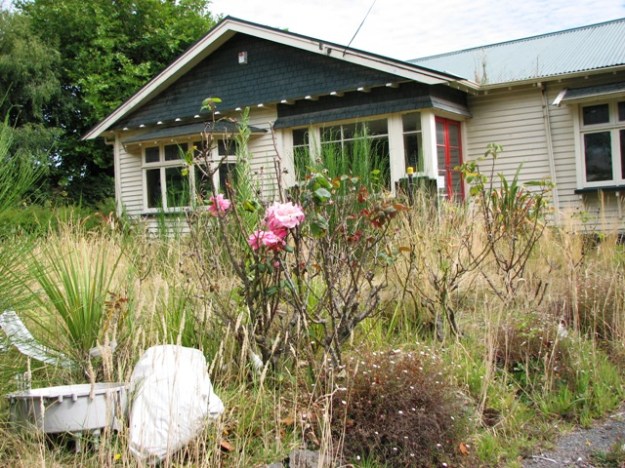
Hydrangeas and roses, growing ever larger, flower on.

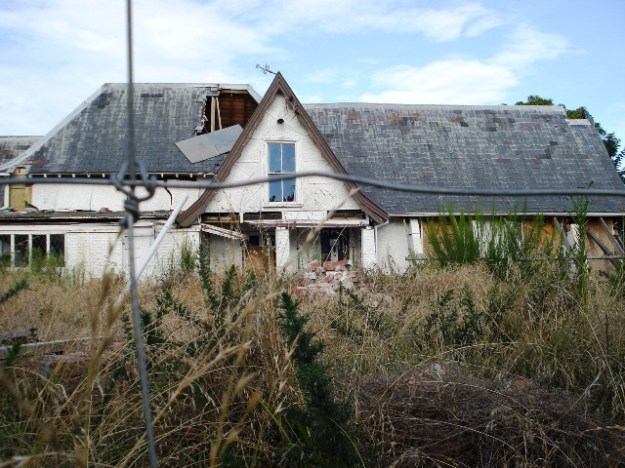
Historic house sitting in limbo but the gorse and broom are staging a comeback in the central city

Historic house sitting in limbo but the gorse and broom are staging a comeback in the central city

Only the toughest of perennials survive and probably sooner rather than later, the convolvulus will smother everything. That is if the perennial pink climbing pea doesn’t get there first. It was interesting to see gorse and broom moving back in to inner city locations. It is likely that this was the effect of liquefaction bringing long dormant seed to the surface because it must be many decades since these plants were grown in inner city Christchurch.

Formality and garden design disappears very quickly. It made me reflect that the whole notion of formal design is an imposition by humans on the natural landscape. Left to its own devices, nature moves straight back in and blurs all the hard edges before swamping them out altogether. In fact there are few right angles left anywhere in that area. Everything is dislocated and angled off the true and formerly straight lines waver, even on the roads.

The contrived water features just looked sad, tacky and derelict. They were bereft of any water. I guess the watertight seal on most had been broken when the ground heaved so violently and the long dry summers mean there is no accumulation of rain water.

It wasn’t actually depressing, more disconcerting to find a formerly pleasant and staid leafy suburb turned upside down.

To then visit the nearby New Brighton community gardens was like a breath of life with a vibrant community response to a shared crisis. Community gardens are sprouting like Topsy. I was told there are over 30 of them now throughout Christchurch but their story will have to wait for another day.

Roses flower on in formerly loved gardens, now abandoned

Roses flower on in formerly loved gardens, now abandoned

First published in the Waikato Times and reprinted here with their permission.

Gardening on a steep slope

Terracing allows for easier gardening after the initial cost and effort (but I think the steps are too steep to be comfortable)

Terracing allows for easier gardening after the initial cost and effort (but I think the steps are too steep to be comfortable)

I had a few days in Tauranga last week. It is always interesting for me, a country dweller, to stay in city suburbia. It reminds me that others garden in very different situations. In this case, I was staying with my sister who lives on a relatively steep hill and that certainly brings a whole new set of challenges for gardening.

If I was starting from scratch on a steep section, I would get wide steps in first and then start working around them in terms of the garden on the sides. Where space allows, wide steps look far more generous and remove much of the off-putting aspect of a steep slope.

Where space allows, wide steps look more generous and less onerous to climb

Where space allows, wide steps look more generous and less onerous to climb

There are rules for garden steps. The DIY home owner often makes the mistake of getting the tread width and riser depths wrong. The riser is the vertical piece and the general advice is that in a garden situation, it should not be more than about 15cm. To balance that, the tread (or flat part of the step) should be about 30cm. That is a gentler gradient than indoor house stairs. There is plenty of information around on this topic and it pays to take notice. The hand hewn steps in my sister’s garden were probably the other way around and very difficult they were to negotiate as a result.

If you decide to do a zigzag path crossing your section rather than steps, take the time to get the path almost level crossways. Most of us have two legs the same length. It is not at all comfortable to limp along a path that slopes sideways as well as wending its way up or down a bank. I say almost level. You want your path to shed water sideways rather than channelling it down the length so you need just a slight gradient across. Get the spirit level out.

Once the steps or paths are in, you can then decide what you are going to do with the sides. It is difficult on a steep slope. If you are a serious gardener, you will probably want to put in terraces. If you don’t, you are going to destabilise the slope every time you dig into it and the rain will wash the soil downhill. It is also physically uncomfortable to work perched on a steep angle.

Just remember that if you terrace and sow lawns, you need to make it easy to get the lawnmower down. If it is too difficult, you will keep putting off mowing the grass.

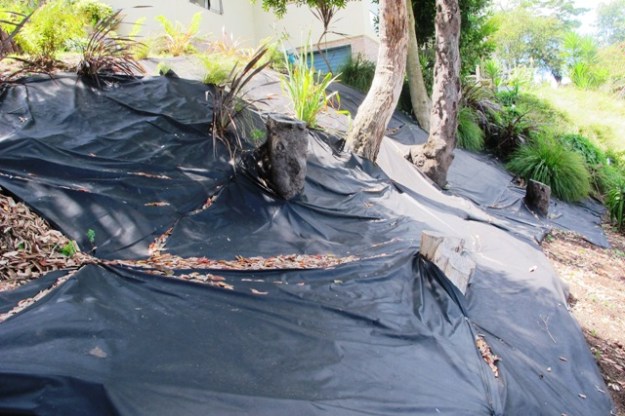
Weed mat is never a good look

Weed mat is never a good look

If you don’t want to tackle the effort and expense of terracing – the hard landscaping, retaining walls, finding topsoil to fill your terraced areas and the rest – you may choose to let nature take over your slope. One hopes not many of you will think it appropriate to clad your slope in ugly weedmat. That is a truly awful finish. In shaded areas, allowing ferns and mosses to colonise gives an attractive, natural look over time.

In sunny areas, you will need to give a helping hand. Whatever your opinion of agapanthus, it does a great job of retaining clay banks with the bonus of summer flowers. Alternatively, there are a range of sedums and sempervivens that you can plant and leave to smother a dry, sunny bank. Or you can establish our native iceplant (horokaka or Disphyma australe) which evolved to cope with these types of conditions. Renga renga lilies (arthropdium) prefer a little shade but will tolerate full sun and will grow in inhospitable soils.

A bare bank will erode so you need to stabilise it with something.

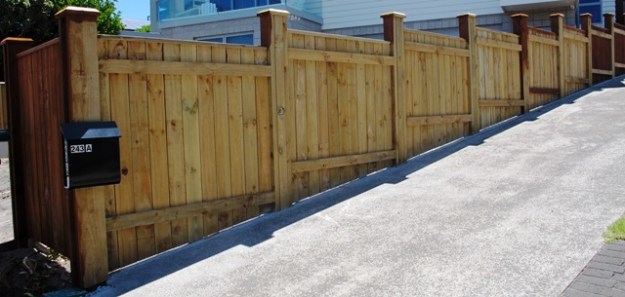
Professionals step fences to get them down slopes

Professionals step fences to get them down slopes

I would also observe that fences can define your station in life. A DIY fence often follows the lie of the land, undulating its way down the hill. A professional fence steps its way down. That is all on that matter.

The DIY fence is often obvious by its undulating line, following the contours

The DIY fence is often obvious by its undulating line, following the contours

I admit that I leaned on the decking railing at my sister’s house and looked at her steep section which runs down to a native bush reserve and then an estuary. I looked at my sister. Confine her gardening to the flatter, more accessible areas immediately by the house, I suggested, and let the lower slopes revert to bush. She will keep her lovely outlook without having to do major construction and continual garden maintenance on a difficult site. I think it likely she will heed my advice.

First published in the Waikato Times and reprinted here with their permission.