Category Archives: Abbie’s column

Abbie’s newspaper columns

Our towering pines

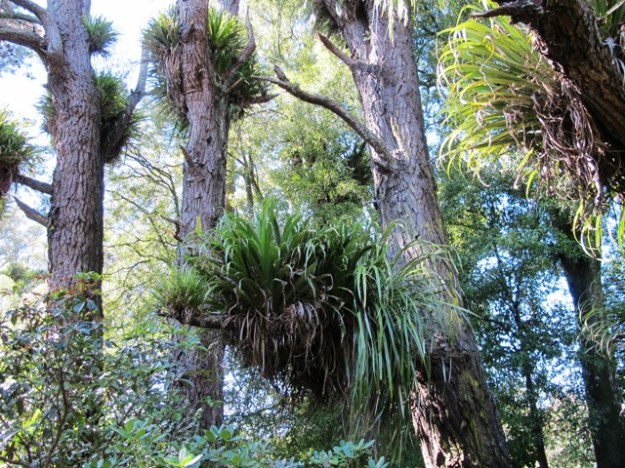
The rich tapestry epiphytes that has developed over many decades

The rich tapestry epiphytes that has developed over many decades

If asked to name the tree least likely to be planted in a garden today, I bet most New Zealanders would say Pinus radiata. Is it our most despised plant? Maybe it is just that familiarity breeds contempt since we have made this tree our own utility, forestry tree. Believe it or not, back in 1838 you would have had to pay between 21 shillings (an old fashioned guinea, no less) and 100 shillings (or 5 pounds sterling) to buy one in England.

I have a personal interest in the humble pine tree because we have an avenue of them which are now somewhere over 140 years old. I looked at them with new respect when colleague, Glyn Church pointed out to me that all the really old Pinus radiata and the old man macrocarpas in this country would have protection orders slapped on them in their native territory. For these two species, so strongly represented here, are native to a small part of the Monterey Peninsula in California where they are referred to respectively as the Monterey Pine and the Monterey Cypress. They grow somewhat larger in our conditions.
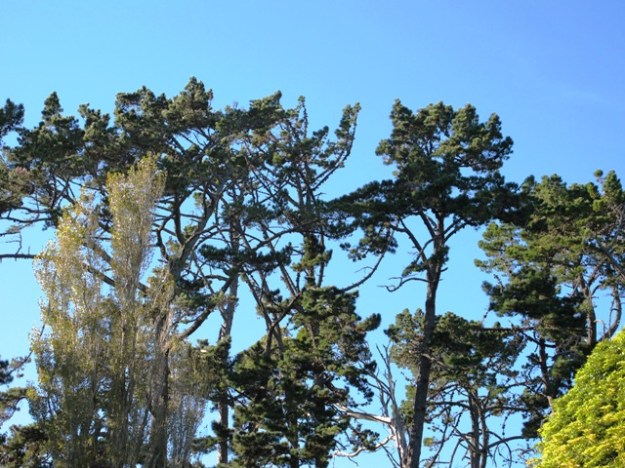
The tops are not things of great splendour, but these Pinus radiata are now over 140 years old

The tops are not things of great splendour, but these Pinus radiata are now over 140 years old

The tallest of our pines must be around 50 metres now. They’re a motley bunch of trees. One or two are handsome from top to bottom. A couple are dead and have become skeletons. Some have much better crowns than others and many of them lean out at odd angles. There are masses of interesting epiphytes which have taken up home on the branches and forks in the trees, mostly collospermum and astelias spread by the birds and ferns dispersed by the wind. We have nigh on 40 of them in one area of the garden, planted originally as wind-break in double rows at about 3 metres spacings.

There is nothing at all unique about our pine trees here beyond the fact they are still standing and we have turned the area beneath into long avenue gardens. Ours are by no means the oldest in the country. That honour goes to a single pine tree at Mount Peel Station in Canterbury. It was apparently planted as a three year old seedling in 1859 so is at least 15 years older than our ones.

It did not take long for the earliest trees of Pinus radiata in this country to start showing their potential as a timber source, especially as our new colony had been ripping out the native forests at a rate that was alarming even back then. In the 1870s, large quantities of pine seed, mostly P. radiata but also other species, were imported and distributed widely. It is likely that our pines date back to these seed importations. If so, they were merely a few dozen among anything up to 500 000 seed distributed.
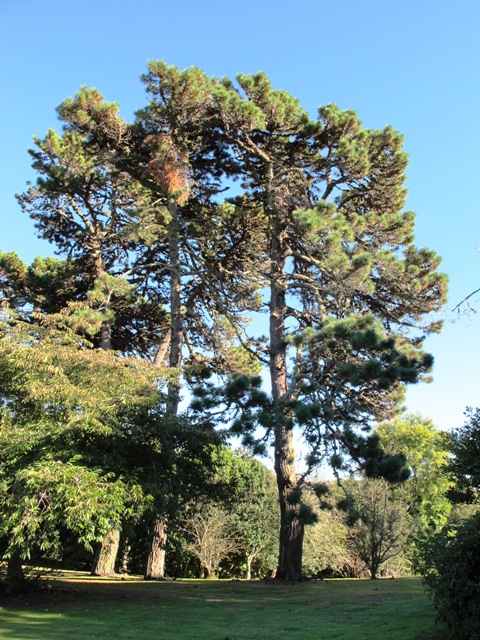
Pinus muricata, lesser known here and probably the same age as the radiata pines

Pinus muricata, lesser known here and probably the same age as the radiata pines

There were actually about 48 different species of tree introduced at that time through official channels. One of them was the lesser known Pinus muricata, or the Bishop Pine, also from California. We happen to have a little row of four P. muricata. To the untrained eye, they look like slightly more compact, smaller growing radiata pines. We don’t know anything about the history of our muricata but it would seem likely that they, too, date back to those 1870 seed importations.

Would I ever recommend anybody these days to plant Pinus radiata as an avenue? Well, no. Our avenue of rimu trees dating from the same time are much more impressive, rock solid and long-lived. But we see some merit in our crusty old pines which have wonderful fissured bark and add a solid presence to the landscape of our property. Fortunately, Pinus radiata tends to break up and drop in pieces over time, rather than keeling over in its entirety. We get a fair amount of firewood on an ongoing basis and the pine cone production is prodigious.
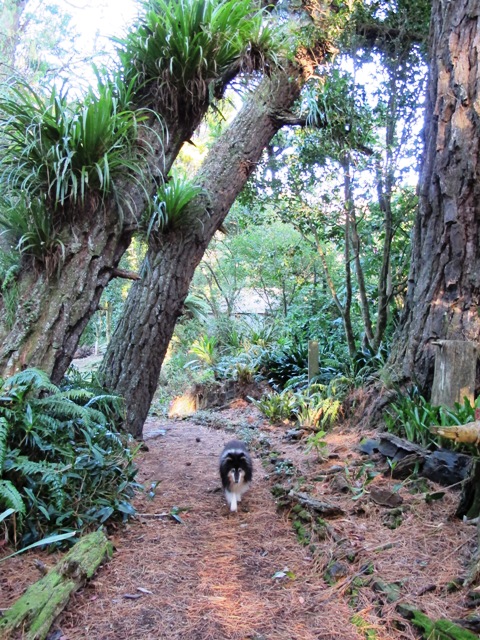
Zephyr the dog photobombs yet another garden shot - the leaning trunks of the old pines

Zephyr the dog photobombs yet another garden shot – the leaning trunks of the old pines

In the past four decades, three have fallen. The only really alarming one was the latest a few years ago which snapped off at about 5 metres up. Turns out the trees have all been topped at that height – maybe a century ago.

We have lost count of the number of garden visitors (all older men) who have surveyed our pines and said: “Oh, they’re a problem. They’re at the end of their life. How are you going to get those out?” Of course the general view in this country is that any Pinus radiata over the age of about 40 is past its life span.

We can’t take them out even if we wanted to. We can’t get heavy machinery in. They would have to be done by huge Russian logging helicopters and we aren’t millionaires. We plan to just leave them to their own devices and to continue cleaning up the fallen branches. Common old pines they may be, but they are part of the history of our place and part of the history of this country, too.

We have, however, had a discussion on what to do should one of us be standing in the wrong place if one falls. Run towards the trunk, is my theory, because that is the thinnest section, and then decide at the last second whether to throw oneself to the right or to the left.

References:
http://friendswbg.org.nz/PINUSRADIATA.html (Friends of the Wellington Botanic Gardens).
Horticulture in NZ 1990 Vol 1, No 1 republished on http://friendswbg.org.nz/PinusRadiatatoNewZealand.pdf

First published in the Waikato Times and reprinted here with their permission.
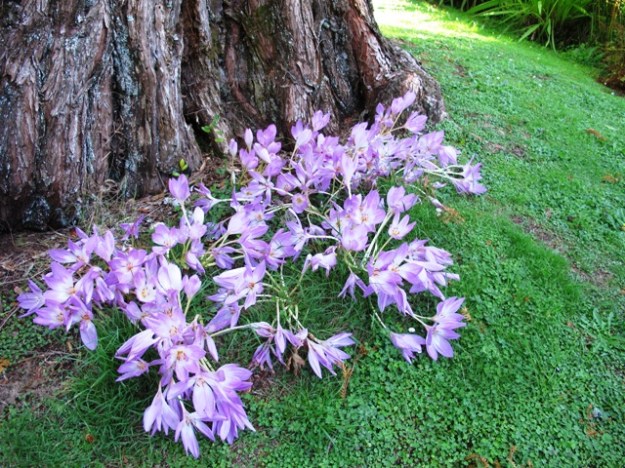
At the end of a golden summer come the autumn bulbs

Colchicums, not autumn crocus

Colchicums, not autumn crocus

Autumn. It is indubitably autumn. I can no longer pretend it is just the summer slowly waning and that winter is still a long way off. For most people, autumn is synonymous with leaves colouring to fiery hues.

However those of us in coastal areas may carry that mental image but the reality can fall well short. Inland areas get much better autumn colour because the nights cool down more rapidly and it is the sharp drop in temperatures which triggers the colouring response in most deciduous plants as much as the declining day length. The moderating effect of the sea means we drift far more slowly between seasons and the leaves are inclined to turn brown and fall, skipping much of the colouring process.

Our extensive use of evergreen plants in this country also mitigates against fantastic mass displays of autumn colour. Our native plants are all evergreen and in a generally benign gardening climate, we tend to favour evergreen exotics as well. I have met many gardeners who shun deciduous plants because they are allegedly messy and lack winter interest, which has always seemed a bit myopic to me. We are never going to rival countries like Canada with its native maples when it comes to a mass blaze of autumn tones.

It is the autumn bulbs that signal the change in season for me. There are so many pretty seasonal flowers coming through now. These are triggered into bloom by a drop in temperature, declining day length and some by late summer rain – don’t laugh at that last one.

The charm of carpets of Cyclamen hederfolium

The charm of carpets of Cyclamen hederfolium

Gardeners in this country tend to focus on the spring bulbs – from the early snowdrops through the snowflakes, bluebells, tulips, daffodils, anemones and ranunculus. These are readily available and marketed widely. They also flower at a time when the majority of trees and shrubs are blossoming forth.

The autumn bulbs have never captured the market in the same manner yet they bring freshness to the garden at a time when many plants are looking tired or passing over. I find them a wonderful antidote to the autumnal despondency of declining day length. There they are, all pretty and perky, just coming into their prime.

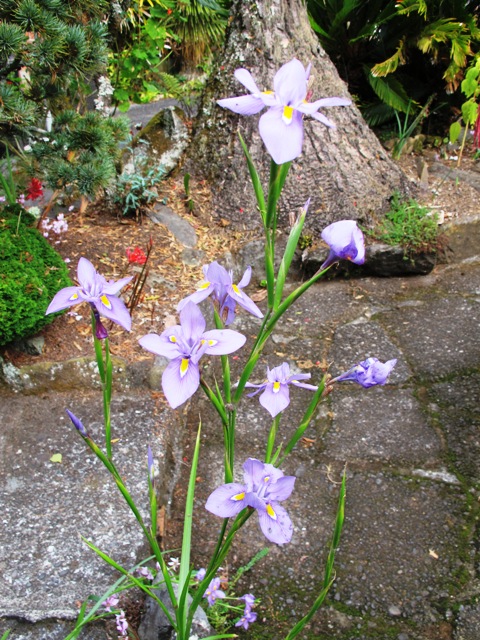
I often feature selected autumn bulbs in Plant Collector because this is their time to shine. As I wander around the garden, I see carpets of Cyclamen hederafolium (flowers only so far – the leaves have yet to appear) and taller spires of the autumn peacock iris, Moraea polystachya, which is inclined to seed itself around a little. This lovely lilac moraea has one of the longest flowering seasons of any bulb I know. The common old belladonnas are already passing over but I enjoy their blowsy display while it lasts. We use them in less tamed areas on the road verge.

Moraea polystachya - the autumn flowering peacock iris

Moraea polystachya – the autumn flowering peacock iris

Over the years, I have waged a campaign to convince people of the merits of the ornamental oxalis, many of which are autumn stars. Call them by their common overseas name of wood sorrel, if the mere mention of oxalis makes you shudder. The range of different species is huge. By no means are all of them nasty weeds and many are not the slightest bit invasive. We have them flowering in white, yellow, apricot bicolour, a whole range of pinks, lilac, lavender and even crimson. Some are perfectly garden-safe. I can vouch for their good behaviour after decades in the garden here. Others I keep in pots – preferably wide, shallow pots for best display.

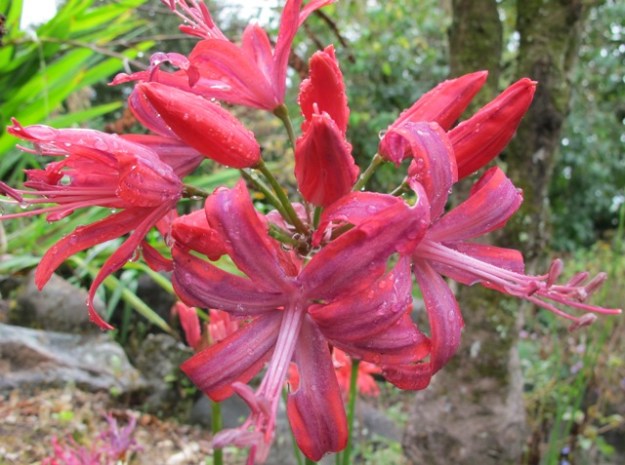
We are big fans of the Nerine sarniensis hybrids

We are big fans of the Nerine sarniensis hybrids

And nerines are the major feature of our autumn rockery. The majority of these are sarniensis hybrids with big heads of flowers. By no means are all of them the common red of Nerine fothergillii or the strong growing pink Nerine bowdenii which comes later in the season. We have some lovely smoky tones, reds deepening to violet hues, a remarkable lolly pink – the colour of a highlighter felt pen, two tone sugar candy and even heading to apricot. Nerines are renowned as a good cut flower but I never cut them. There is only one stem per bulb and I would rather admire them in the garden than indoors.

Then there are the bold colchicums which, contrary to popular belief, are not autumn crocus but certainly put on a splendid show with a succession of flowers from each corm. You have to go a long way back in the botanical family tree to get any relationship between colchicums and the proper autumn crocus. The latter is a much more delicate and transient performer whose flowers appear at the same time as its foliage. Currently, we are enjoying both in bloom.

Some bulbs are quite transient in flower but no less delightful for all that. If I am ever forced by declining health and aged frailty to trade down from a large garden, I can see that it would bulbs that I would chose to grow. I love the way they mark the seasons and how there can always be a different one coming into its time to star.

First published in the Waikato Times and reprinted here with their permission.

A gem of a garden

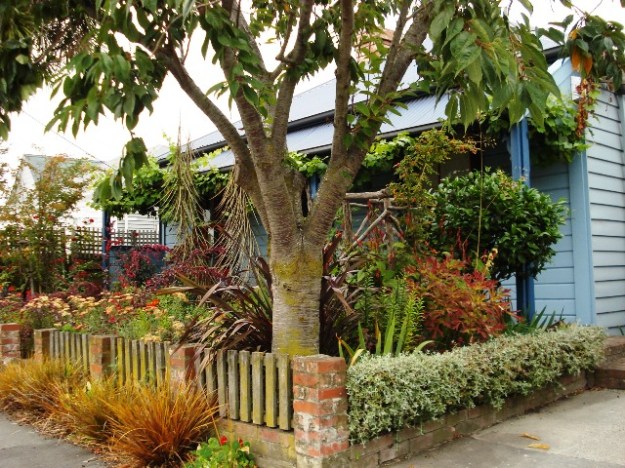
The front garden of Number 11 in tawny and red tones

The front garden of Number 11 in tawny and red tones

Tiny gardens have not featured large on my radar. They are just not part of my life experience so far but they are a reality for many people, whether by choice or circumstance.

When your allotted physical space in life is to have only one of those smaller garden spaces, it is undeniably different. I stayed with garden writer and gardener, Robyn Kilty, in Christchurch. Her own garden which has been acclaimed as one of the best examples of its type, is huge in charm but very small in size.

If you are working in a small space, you can go the Ellerslie show garden way and produce a static scene which is primped and starched to perfection as if frozen in time. Show gardens leave me cold, personally, and the idea of creating and maintaining that in my own environment around my home is even less appealing. So you will need to look elsewhere for ideas on that approach. Try magazines because that is what you will be creating – the glossy feature look. It will probably be unchanging through the seasons and it will not usually have a specific sense of place but be more universal in style. To me, that is like making more housework outdoors because it will need tidying, dusting and vacuuming twice a week to keep it pristine.

I was far more interested in what Robyn was achieving – seasonal change, interesting plants with plenty of colour, texture and detail and a garden which invited you take a little time to enjoy it. But in small spaces, everything has to be thought out, carefully controlled and restrained. “If you get something wrong in a small garden,” Robyn said to me, “it is in your face all the time. You can’t ignore it or get away from it.”

It is a mistake to think that all plants have to be tiny to be in proportion. Sure, if your garden bed is only 3 metres long and 1 metre wide, you don’t want a plant that is going to spread to a couple of metres across. But if you keep everything itsy bitsy, you will end up looking as if you have planted a traffic island. You still need height and some plants with stature in their foliage to give grace and proportion. But you need height without width. You can still be bold in a tiny space.

You will probably end up having to prune and clip regularly to keep plants to their allotted space. Bold foliage may be fine but triffids you can do without.

It is not compulsory to have lawn. If you have grass, you need a lawnmower which will also mean a shed to contain it. Sometimes it is better to manage a little open space by paving and do away with lawn altogether.

Achieving some level of continuity is pleasing in any garden, no matter the scale. In a tiny garden, it might be by a little formality in design, by small groupings of the same plant, mirroring a planting on one side of the path to the other, or by very careful colour management. In late summer, Robyn’s front garden was in tawny autumn shades and red whereas her even smaller back area was featuring deep burgundy with just touches of pure blue and yellow to give it zing.

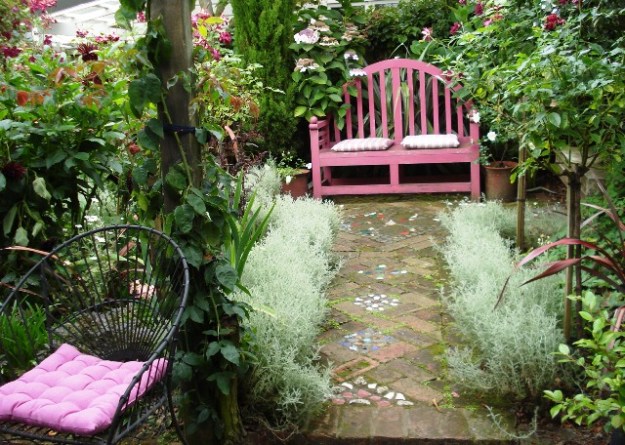
A touch of formality, careful colour choices and paving instead of lawn in a tiny back garden area

A touch of formality, careful colour choices and paving instead of lawn in a tiny back garden area

You have to be more restrained in a small space, even if you are creating a colourful or maybe flamboyant display. Every plant has to justify its place. The real gardening skills come in managing changes through the seasons, which make it all a great deal more interesting. Bulbs need to be used so they can star when in flower, but not look awful and scruffy when they are passing over. As one dominant plant passes over for the season (maybe a hydrangea that has finished flowering or a hosta that is going dormant), another nearby plant needs to be coming into its own. The challenge in a small garden is to make the whole area work for you all year, giving you lovely views out your windows, from the road frontage and from all your viewing points within the space.

Ever the practical type, I would find it hugely challenging to manage without the hidden areas “out the back” as we call them. If you have plants in containers, you need somewhere to repot them. You still need a shed or cupboard for tools and packets, even if your space is too small to warrant a wheelbarrow. Dealing with green waste would be a challenge without a compost heap. Yet if you have a small one of those, there will be trimmings and prunings that are too large for it. You probably can’t run a closed system in a tiny garden, recycling your own waste.

I am not ready to trade down on space, but when I thought about tiny gardens, I developed a new respect for the few I have seen where the owners have made them into something special. It is harder than it looks to do it well.

First published in the Waikato Times and reprinted here with their permission.
Banned plants in New Zealand

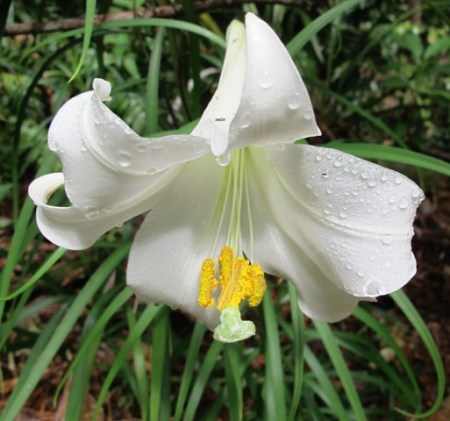
The offending Lilium formasanum

The offending Lilium formasanum

I have to start with a mea culpa today. Last Friday I featured Lilium formasanum on Plant Collector. I wouldn’t have done so had I known it was on the Pest Plant Accord list. In other words, it is banned from propagation and sale in this country.

To be honest, we are a bit surprised it is on the banned list. While it seeds down, in our experience it does so gently and has never shown invasive tendencies here and it is not strong enough to out-compete native plants that we can see. However, we respect the spirit of the Pest Plant Accord and I would not have praised the merits of this lily had I known.

Being on that list, does not mean it has to be eradicated – just that it can’t be produced for sale and that gardeners should be cautious with it. My general advice is that if you live near native bush or a reserve and certainly near a national park, the responsible action to take is to get rid of these plants from your garden altogether. In more suburban areas, it is not likely to be a problem but keep an eye on what they are doing and don’t let them escape. You also need to be careful what you do with garden waste because too many of our weeds are garden escapes.

So embarrassed was I at having been caught out making a public slip-up that I started to browse the National Pest Plant Accord booklet, the website of the Ministry for Primary Industries and some of the regional council websites. After encountering some of the most confused and badly designed websites I have seen in a while, I rang our local pest plant person to confirm my interpretations. There are no simple answers and there is a wonderful level of inconsistency in language, classifications and recommendations. It is all as clear as mud really. So here is my attempt to translate it to home gardener level.
???????????????????????????????
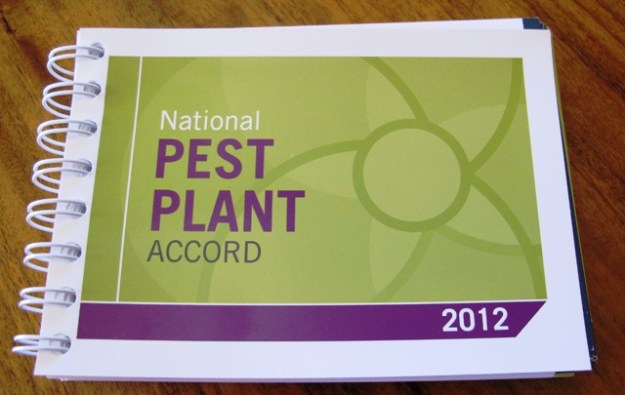
The handy little spiral-bound book entitled the National Pest Plant Accord is a listing agreed to by various bodies including the Nursery and Garden Industry Association of NZ. You can request a copy of this booklet from the Ministry or your regional council. It has photos and descriptions (one plant per page) but no advice on dealing to individual plants – every page tells you to contact your regional council for this advice. The plants included are a little… random, shall I say. Lilium formasanum is there but I don’t know where it is a particularly problematic weed.

Curiously, Rhododendron ponticum is also included. Now, R. ponticum is a blue rhododendron species that has been used extensively to breed many of the big blue hybrid rhododendrons favoured by gardeners. It is a real problem in the UK where it has established itself in the wild by layering and seeding but I am not aware of it ever being produced much, if at all, in the nursery trade in this country because the hybrids are so superior. The hybrids are not a problem. In other words, ponticum is not a problem in this country but it could be if we let it get established. Well, if this Pest Plant Accord were to include every potential weed in the world that could establish here, it would be a massive tome.

We have not cut our bangalows out at this stage, but we are alarmed at their weed potential

We have not cut our bangalows out at this stage, but we are alarmed at their weed potential

But the Accord misses out on some significant plants because the nursery industry has dug its toes in and refused to play ball. I have written before about the bangalow palm (Archontophoenix cunninghamiana) which we regard as having significant pest potential, and we are not alone in that opinion. Similarly the Chinese Windmill Palm (Trachycarpus fortunei) is pretty questionable but so strong in the trade that it may never make the Accord. We’d say the same about the Himalayan Daphne bholua too.

The problem with the Accord is that it is national and what is a significant or major weed in one area, may not be at all problematic in another. That is where the regional councils come in. As far as I know, their pest plant lists are not dependent on cooperation from the nursery industry and being based on local experience, they are more relevant to local gardeners.

In Northland there are huge issues with seedling campanulata cherries and I have been told that only sterile varieties can be sold there now. Similarly Buddleia davidii and agapanthus, but they are not on the national Accord. Taranaki completely bans both species of the giant Chilean rhubarb (Gunnera tinctoria and manicata) and insists on total removal.

Waikato Regional Council has lists on its website though you do have to know the common name (often confusing) because apparently it is too complicated to list under both botanical and common names on the directory page. Plants are classified as eradication (Council will deal to it for you), containment (landowner’s responsibility), potential pest and merely nuisance status (presumably waiting to move up the ranks). There is information on how to deal to these plant pests. A quick look suggests that not many of them are common garden plants (though we will be getting rid of our yellow flag irises here), but it is worth having a look.

I just can’t help but think that some analytical thinking, better writing, consistency of information and good website design would make this stuff a whole lot more useful for responsible gardeners. These are important issues but the powers-that-be haven’t made it easy to use the information.

The days are numbered here for the yellow flag iris

The days are numbered here for the yellow flag iris

First published in the Waikato Times and reprinted here with their permission.
Reviewing summer garden choices, as the drought worsens

Plant options for dry conditions- at Beth Chatto's Garden.

Plant options for dry conditions- at Beth Chatto’s Garden.

Have we reached a point where the emerald green sward of lawn in the midst of drought is a badge of shame, rather than a symbol of pride and good management?

The current extended dry spell has focussed my train of thought on inappropriate gardening styles. As I walked around Christchurch a few weeks ago, I marvelled at just how many sprinklers were running and how many property owners were out holding hoses and watering their ornamental gardens of an evening. At the time, I wondered why this city of keen gardeners were so determined to ignore their Mediterranean-style summers and slavishly pursue an English style of gardening which, in their conditions, relies entirely on irrigation.

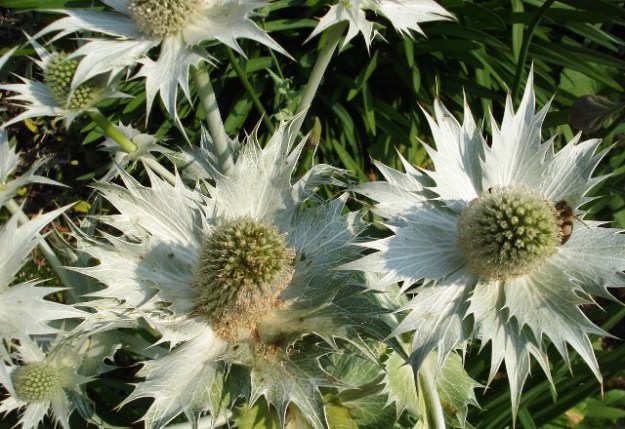
Eryngiums - another plant option for dry conditions

Eryngiums – another plant option for dry conditions

The deepening drought conditions here in the north should be raising red flags for gardeners who rely on summer watering. Where I live, drought is pretty much unheard of – until this summer at least. But much of the Waikato was in severe drought a few years ago and there are warnings coming from meteorologists that these are likely to become more common. Maybe it is time for thinking gardeners to lighten their heavy hoof prints on the planet and actively explore other ways of creating beautiful and pleasing gardens without following what are, at times, downright bad environmental practices. A clarion call, no less.

Lawns are a major offender. Frankly, I regard watering your lawn as an indefensible waste of a scarce commodity. Perfect green lawns are a value we have adopted, almost without question, from American suburbia. We have elevated the lawn to a pedestal way beyond its actual position in life which is to offer a useful area upon which to play and entertain and to provide a negative space (an empty space) to act as a foil which highlights ornamental plantings. A lawn should be a functional tool, not an end in itself.

Watering hedges is similarly dubious in my books. If you have to water your hedge to survive, you have chosen the wrong plant in the first place.

I also put permanent irrigation systems throughout gardens in the same category. If you are having to water your garden all summer to achieve the effect you want, then I think you should be going back to the drawing board and looking at different gardening styles.

We watched a BBC Gardeners’ World programme recently on the Royal Horticultural Society gardens which includes Hyde Hall in Essex. The head gardener there commented that their annual rainfall was less than Jerusalem. We have been to Hyde Hall and while they certainly irrigate many of the ornamental gardens (and probably the lawns, too), the dry garden was a revelation to us.

Not far from Hyde Hall are the famed Beth Chatto Gardens and it was Mrs Chatto’s dry garden which astounded us with its magic when we visited. She is gardening in similarly dry conditions and her dry garden is on an old river bed so with even less moisture retention.

We wanted to come home and try a dry garden but alas, in a climate where we regard three weeks without rain as a drought and where we have an annual rainfall level about eight times higher than those areas of Essex, it is never going to work here. We failed on the photography stakes in those two gardens. I took plenty of photos of wonderful colour combinations in perennial plantings at Hyde Hall (gifted colour combos, even, though my photos are average) but it is the special magic of the dry gardens at both locations which has stayed in our memories.

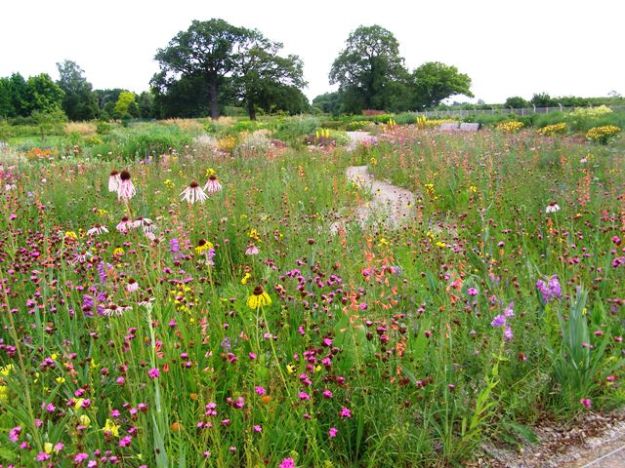
Missouri meadow garden at Wisley - simple but magic in 2009

Missouri meadow garden at Wisley – simple magic in 2009

Wisley Gardens in Surrey to the south are also very dry and they were showcasing a different style of dry gardening in their Missouri Meadow.

Helichrysum Silver Cushion - happy in dry conditions, attractive, tidy and it's even a native

Helichrysum Silver Cushion – happy in dry conditions, attractive, tidy and it’s even a native

If you pause to think, much of the world is dry and of course there is not only dry gardening with Mediterranean style plants – shrubs, trees and perennials which will take poor, dry conditions. These are often dominated by grey foliage, not necessarily small leaves but frequently so, often furry or prickly – all ways for the plant to conserve water. Some of our native plants fit into this type of garden. Pachystegias, our native helichrysum, some of the olearias, Astelia chathamica – all will take dry conditions.

The American prairies are a rich source of inspiration for seasonal gardens and home to a host of wild flowers that we now incorporate in our gardens such as echinaceas and black-eyed Susans. The work over recent decades by prominent Dutch gardener and designer, Piet Oudolf, appears to draw more from the American prairies as it does from the Med. The Oudolf School has been one of the most influential garden styles in Europe for the past decade but has pretty much bypassed us in this country so far. Yet it is one which lends itself to dry gardens.

Look across the Tasman. Our nearest neighbours have a wealth of plant material which has evolved to thrive in dry conditions. Some of it is very beautiful.

As the drought deepens here, maybe it is time to seriously question why so many of us are hanging on for grim death to an arguably outdated genre of lush, green gardening, mixing formality with informality, inspired by the English gardens of early last century.

If you are having to water anything other than your vegetable garden every summer, have a rethink. There are other ways to garden.

First published in the Waikato Times and reprinted here with their permission.