Category Archives: Abbie’s column

Abbie’s newspaper columns

But where are the hollyhocks?

Bragging rights on the home grown pineapple

Bragging rights on the home grown pineapple

“But where are the hollyhocks? I can’t find any hollyhocks,” the garden visitor said last weekend. I can honestly say that that is a first here. Nobody has ever commented on the absence of hollyhocks before. But it is true. We have none. I haven’t tried growing hollyhocks since the children were young and school gardens were still a part of the gardening calendar. The problem with hollyhocks is that they are very prone to rust in our climate which spoils the look.

There are, of course, many other plants we don’t grow. I can’t think that we have any petunias and gerberas are notable for their absence. Sweet peas we lack. Ditto tuberous begonias and we are distinctly light on fuchsias. Some plants we do not grow because we don’t like them, others because they don’t like us. Some are not worth the effort and presumably at least some are because we have never even thought of growing them.

The cold border in the park with meconopsis and Inshriach primulas

The cold border in the park with meconopsis and Inshriach primulas

The challenge for many a keen gardener is to grow plants which are either very difficult or are well out of their natural zone. We certainly identify with this group. It is enormously satisfying to grow something which is not known in your local area. To this end, we are always trying to stretch the climatic boundaries and we do have options in a big garden. Mark put his cold border onto a south facing slope where temperatures are noticeably cooler and he has managed to get some of the plants which want a colder winter settled in. The blue poppies (meconopsis) from the Himalayas, less common but colourful Inshriach primulas from Scotland, the Chatham Island forget-me-nots and the deep coloured burgundy hellebores are all much happier in cooler conditions.

On the ridge above, the Marlborough rock daisy (Pachystegia insignis) and trickier forms of astelias perch in exposed conditions  compensating for our high humidity and mild temperatures. A different north facing slope gives us hotter conditions for the aloes and yucca plants that will rot out elsewhere.

Some highly desirable plants defeat us entirely. We’d certainly grow herbaceous paeonies if we could but they want low humidity, hot, dry summers and dry, cold winters to do well. There is no way we can simulate those conditions. Having had a Dunedin childhood, I loved the Bleeding Heart plant (now named Lamprocapnos spectabilis but formerly and widely known as Dicentra spectabilis). I bought several over a few years to try in different parts of the garden but they never returned for a second season. There was a little lesson there for me – just because garden centres sell a lovely looking plant in full flower does not mean that it is suitable for the local area. Oftimes they are shipped in from places where they do grow well. That is a lesson many others have learned, I am sure.

Where we draw the line is when it comes to having to spray in order to grow plants out of their normal climatic zone. We are not prepared to festoon sensitive plants in frost cloth either but that is because we can’t be bothered and we don’t want that ghostly presence of draped shapes in the garden. Chemical intervention is a step too far altogether.

I have never gotten over my shock when a very experienced gardener told me she kept her alpines alive in our conditions by drenching them in fungicide once a week. I can no longer look at her alpine area as an example of good gardening. Fungicides are not that good for the environment and in my opinion, good practice dictates they should only be used when absolutely necessary and not as a routine application. So no hollyhocks here – we are not going to spray to keep them healthy and we don’t want diseased plants sitting around festering.

If you are not a gardener who relishes the challenge of pushing climatic boundaries, then keeping to plants which are happy in your conditions is going to make life a whole lot easier. This does tend to mean you can’t have a sub tropical garden in Hamilton because winters get cold and frosty. Second daughter attended Waikato University a decade ago and she commented on the gardens she walked past which had clearly been “landscaped” in summer on a tropical theme. Come winter, the plants were blackened, looking very sad and often dead. If you are a novice gardener, take up walking. You can see much more on foot than you will ever see from a car window and noting what is growing well and is being repeated in gardens around your area is a good guide. It may also be an indication of what plants are available for sale.

For those of us who like a challenge, there is nothing quite like the bragging rights that come with… a pineapple! Yes, this was grown and harvested from our very own pineapple patch set against a warm brick wall. Not as sweet as a Dole one but not exactly a run of the mill crop for our area.

First published in the Waikato Times and reprinted here with their permission.
The generosity of some gardeners and the vandalism by non gardeners

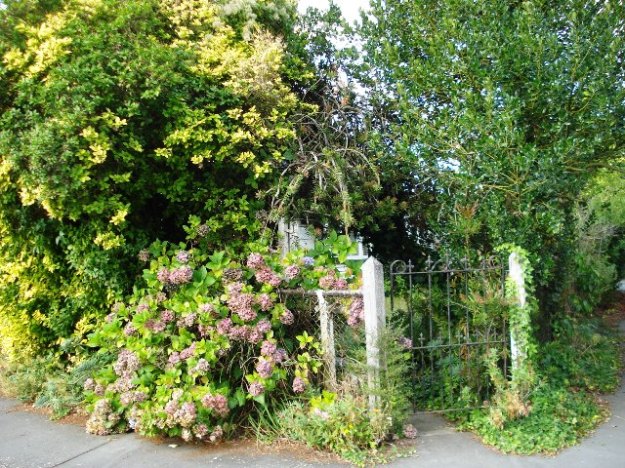
I smile each time I pass a property down our road. The frontage is a froth of flowers for much of the year. There is nothing choice. Most of them are common enough daisy bushes and pelargoniums which balloon out onto the road verge. It is just a delightful picture for the passing motorist – it being in a position where there is no foot traffic. What makes it a little bit special, to my mind, is that the sole reason for this planting is to bring pleasure to passersby. From my vantage point on the road verge, it looks as if the property owner would not really see this particular planting from their house windows or indeed from inside their garden. That shows a generous gardening spirit, in my opinion.

The contrast to the bleak hillside on the edge of my local town could not be more extreme. Until about two years ago, this hillside was fully planted in mixed trees and shrubs, many of which were flowering varieties. I am guessing the property was sold and that it was the previous owners who had planted it up two decades ago. We always enjoyed the roadside view, particularly because at the bottom, it had a well established specimen of our Magnolia Vulcan which the owners must have planted in a prominent position not long after we released it on the market. Being in town, the air temperature tends to be a degree or two warmer so this Vulcan would come into bloom every spring just ahead of the time it opens in our own garden. It was such a feature and was on the way to becoming a mature specimen.

Cleared entirely and left to weeds and erosion

Cleared entirely and left to weeds and erosion

The hillside is too steep to garden intensively or indeed to mow or graze, and it lacks sufficient space to be terraced so there is very little that can be done with it beyond establishing permanent plantings. It took a lot of plants to cover the area but over twenty years, they had grown to give an attractive cover which had knitted together in a patchwork of colour, foliage and flowers. It would have stopped most of the weed growth below, prevented the risk of slipping in rain and given an attractive drive in to reach the house at the top. It would also have required very little maintenance yet it brought a great deal of pleasure to passersby who stood to benefit the most. The house, perched on the top, looked over the plantings.

It must be two years ago now that I drove past as the hillside was being stripped. By stripped, I mean every tree and shrub was removed, even the Magnolia Vulcan at the base of the hill. My heart sank but I thought they must have plans to develop the property differently. Not so. After two years, all that remains are weeds, rank grass growth and clay. But wait – a billboard has appeared, advertising loans at 11.9% to people who cannot afford them to buy new cars. It’s a destructive travesty.

My guess is that new owners moved in and found the shrubs at the top of the slope were starting to block their soaring views across the town and maybe distant views of the river and sea. You have to understand that these are soaring views of a former freezing works town which is not noted for the beauty of its architecture. Rather than seeking advice as to how to frame views, to establish view shafts and to thin or selectively remove problem plants near the top of the slope, they went in and cleared the lot from top to bottom. Believe me, the house will have unimpeded views (and wind) at the top and the owners may never realise how much pleasure people used to receive because of the generous gardening spirit of the previous owners.

Fortunately, this planting facing State Highway 3 still grows and blooms

Fortunately, this planting facing State Highway 3 still grows and blooms

Fortunately a similar planting alongside the state highway survives. A different owner with another difficult slope of some area, she planted it around the same time. Many rhododendrons, camellias and flowering cherries grace this hillside along with a large specimen of Magnolia grandiflora at the base of the slope. Very little of it will be visible from the house and again it is relatively steep. It too has billboards but in this case they are faded old ones promoting the activity of golf, rather than the town’s newest finance company. Every day thousands of motorists pass the boundary and for three months in spring, many of them will notice seasonal blooms and maybe it will bring a smile to their day.

To me, that sets a standard for generous gardening, way beyond the sharing of cuttings and divisions. With no expectation of admiration or appreciation, these good folk create beautiful plantings in areas where they can see little from their own homes or outdoor living spaces. They are there to be enjoyed by passing strangers.

The late spring bulbs


Left to right: Gladious carneus, a dainty allium, Romulea rosea, camassia, Phaedranassa cinerea, Stenomesson miniatum, Gesneria cardinalis, calanthe orchid, Albuca candadensis and spiloxene.

When spring bulbs are mentioned, most people think of daffodils, bluebells and tulips. But when they have been and gone and all that is left is the scruffy foliage, there are the late spring bulbs coming into flower. Most of these are less well known and certainly less celebrated in literature and art. For all that, they are often more interesting, maybe because they are unexpected.

We love bulbs here and with bulbs I include corms, rhizomes and tubers. More than any other type of plant, they seem to mark the passage of the seasons and to create the smaller, detailed pictures that add layers of interest to the garden. Maybe because the perennials and annuals are coming into their own at this time, the late spring bulbs are often ignored and therefore harder to source.

I headed out to the garden to see what was coming into flower. Discounting the earlier bulbs which are still flowering but well past their peak (veltheimias, the late lachenalias, Hippeastrum aulicum and the like), I found about 20 different types of bulbs coming into their own and that is by no means complete. There is little which is duller than endless lists and plant descriptions so I lined a number up for photographs.


Clockwise from top – Soloman Seal (Polygonatum multiflorum), tritonia, babiana, Satyrium odorum (orchid), rhodohypoxis, Watsonia brevifolia, tulbaghias – probably comminsii and possibly simmleri

I featured the rhodohypoxis in Plant Collector a fortnight ago. These are relatively common and form attractive carpets in pinks, whites and carmine red with their mass of star flowers. There is nothing rare or exclusive about Soloman Seal (Polygonatum multiflorum) either. It was common in the gardens of grandparents and is perhaps undergoing a surge of discovery amongst newer generations of gardeners. It is particularly handy for semi shade positions and, after battling a near impenetrable mass of entangled rhizomes, I decided it may well have some merit as a natural stabiliser for an eroding bank. I will report back in three years about the success or otherwise of this venture but as it will grow pretty much on top of the ground and grip hard, I am optimistic. As a bonus, the foliage turns golden in autumn – an unexpected source of autumn colour for us.

Hippeastrum papilio

Hippeastrum papilio

For sheer exotica, it is hard to beat Hippeastrum papilio which is just opening. Papilio means butterfly though I think it is more orchid-like really. This is a spectacular bulb from Brazil which is offered for sale from time to time. It is more expensive than rare. We had to try a couple of different places in the garden before we found a spot where it was happy but we now have it thriving in open woodland conditions.

Scadoxus puniceus

Scadoxus puniceus

While on the big bulbs, Scadoxus puniceusis one of our showiest but I won’t dwell too long on it because it is rather too frost tender for inland areas and rare in this country. Its cousin, Scadoxus katherinae, is a better bet for frosty areas because it is dormant in winter and doesn’t start moving until spring, flowering in summer. Similarly, our love affair with the arisaema family (sometimes called snake’s head lilies though they aren’t lilies) is of limited value because our showiest ones are Mark’s hybrids which we have never sold so they can’t be seen anywhere but in our garden. Given time, we may put them on the market but that is a way off. Most of the arisaema family hide their flowers below the foliage but Mark has managed to breed with varieties to bring out the desirable trait of holding their flowers above the leaves, making them much showier as well as being easy garden plants. You may, however, find Arisaema speciosum which is easy to grow and Arisaema ringens is relatively common. If you have a bank that you look up to, the flowers are little more obvious without having to part the leaves to see them. We describe A. speciosum as the closest thing to a cobra you would want in the garden.

If you are getting frustrated trying to find more unusual plants, there are good reasons why. Many if not most of the specialist nurseries throughout the country have closed down over the last decade as have most mail order nurseries. Treasure the ones that are left because there are few new plant businesses opening. However, bulbs are perhaps a little easier than trees and shrubs and I occasionally look at the bulbs section of Trade Me and see some interesting and less common material offered for sale there. Beyond that, you may have to start haunting your local horticultural society or keen gardening groups where there are likely to be one or two people who know their bulbs from their onions.

First published in the Waikato Times and reprinted here with their permission.
Meet the maddenii rhododendrons

The Rolls Royce of rhododendrons - sino nuttallii

The Rolls Royce of rhododendrons – sino nuttallii

Allow me to introduce you to maddenii rhododendrons. We are pretty keen on them here, although you may not share our enthusiasm if you think all rhododendrons should have the tight ball truss of blooms which is usually regarded as typical of the family. Maddenias don’t hold their flowers in that style.

But the family does include the spectacular nuttalliis with their huge trumpets. I rate these as the most stunning rhododendrons of all with their flowers which look as if they have been cast out of wax and their wonderful, big leaves which are heavily veined – described as bullate foliage. There is nothing quite like them but they are not generally available on the market. They don’t produce much cutting material and they are not easy to propagate but many will set seed so, if you are really keen, you could try raising seed. Some of the hybrids can be found from time to time – Mi Amor and Floral Sun in particular.

There are two huge pluses for the maddeniis. Most are scented, some strongly so. R. polyandrum can waft out for a metre or two which is an indication of a strong scent. Many will pass the 30cm sniff test which is good. And if you are willing to risk the pollen on the nose, most have a sweet scent when you bury your face in the flower.

The second big bonus is that the maddeniis show much better resistance to thrips than most other rhododendrons. Thrips are nasty sucking insects that hide away beneath the leaves, sucking out the chlorophyll. This turns the leaves silver and once that has happened, they can never be turned green again though the new season’s growth will be green, at least until the thrips get hold. Over time, serious infestations can weaken a plant past the point of return. Very cold winters will kill the bugs off, but we don’t get cold enough here so there is not a whole lot one can do beyond spraying with insecticide or neem oil, or trying a cloth collar soaked in systemic insecticide wrapped around the main trunk. Or you can choose varieties which are more resistant.

Bernice, as red as the maddeniis get

Bernice, as red as the maddeniis get

There is a preponderance of whites and pastels in the maddeniis and where there are coloured ones, they lean to the subtler, softer shades. In other words, there are no pure reds, purples, blues or oranges. We don’t mind because we can get the stronger colours in azaleas and other types of rhododendrons. Some of the hybrids flower so heavily that it can be like viewing a wall of bloom with barely any foliage visible at all.

Wonderful peeling bark and bullate foliage

Wonderful peeling bark and bullate foliage

I should perhaps mention also that most of Maddenia types don’t make tidy compact little buns of bushes either. They are inclined to be more open in their growth – though by no means are all of them giants. Some can only be described as leggy, but all is forgiven when they flower. Besides, another attractive feature of these rhododendrons is the lovely peeling cinnamon bark many have. If they were bushy, dense plants, you would never see it.

Google tells me that this group were first introduced to the West in 1849 by famous plant collector Joseph Hooker – he who also visited New Zealand. For reasons which are not entirely clear, he named them after Lieutenant Colonel E Madden of the Bengal Civil Service. How random is that? Given that these rhododendrons are found in northern India, Burma, southern China and the milder areas of Tibet, maybe Lt.-Col. Madden was particularly helpful to Hooker’s expeditions.

Internationally the maddeniis are rated as subtropical and somewhat tender so they are the envy of gardeners from cold climates. Our climate in New Zealand is so temperate that you are able to grow most of the maddeniis in all but the coldest, inland conditions. They form the backbone of the rhododendron collection in our garden and, being later flowering than many others, are coming into bloom right now.

There is no simple way to determine which rhododendrons fall into the maddenii group. That is what books and Google are for. But ones you may find, or know of, include Fragrantissima, Elsie Frye, Princess Alice, Bernice, Moon Orchid, the aforementioned Mi Amor and the plant confusingly known simply as Rhododendron maddenii.

The problem is sourcing these rhododendrons. In fact the problem is sourcing any interesting rhododendrons at all in these days when specialist nurseries have fallen like flies. The best option for Waikato readers may be Rhodohill or Tikitere Nurseries in Rotorua. Failing that, try Trade Me where there is a South Island grower, RhodoDirect, producing and selling by mail order. I have seen them listing the lovely Floral Sun and there are other maddeniis in their range.

Our very own Floral Sun

Our very own Floral Sun

First published in the Waikato Times and reprinted here with their permission.

For the love of wisteria

Blue Sapphire - a classic blue sinenis wisteria

Blue Sapphire – a classic blue sinenis wisteria

I am feeling the love for wisterias. This love does not last 52 weeks of the year, but when they are in flower, you would have to be lacking in all romance not to admire them. This week it is Blue Sapphire that is looking its very best. White Silk and Amethyst are just opening, to be followed by Snow Showers and Pink Ice. Even the very names are romantic and evocative.

If you have your wisteria beautifully trained and tied in across your verandah (best with an equally romantic looking old villa or cottage) where its long racemes of fragrant flowers festoon down, so much the better. All you need is the rocking chair with calico cushions to complete the picture. I don’t go there, because I know that in the 49 weeks of the year when it is not flowering, that plant is going to take on triffid-like characteristics and try to split the spouting and drive a wedge between the roof and the ceiling. The oh-so-lovely blue wisteria on the side of our house was eradicated years ago. I was too much of a novice to understand why Mark’s father took it out when it looked so beautiful in flower, but now I understand just how quickly a wayward tendril can leap into a gap in the roof tiles, thicken, harden and bingo, you have a broken tile before you’ve even noticed it got away on you.

One growing season is all it takes. Believe me. I have had the lovely Snow Showers split the plastic spouting immediately outside my office window and I prune thoroughly every year. By autumn, one stem had driven such a wedge between the spouting and the building that something had to give.

Snow Showers - a floribunda selection on our bridge

Snow Showers – a floribunda selection on our bridge

Growing wisteria takes a bit of work. You need to prune them and to train them and picking a suitable location is important. Currently we grow a couple over a wooden bridge (and they have made an attempt to split the bridge timbers), three up strings on a brick wall where they can do no harm beyond leaping into nearby trees if not supervised closely and the aforementioned one up a wooden wall out my office window. I have two waiting to be planted out and they will be going on freestanding metal frames which will support a canopy over time. A bit of forethought can save a lot of trouble later. Wisterias are not something you can plant and leave. I was once told that the largest plant in the world is a wisteria which has layered and leapt its way along 5km somewhere in China. I have no idea if it deserves the title of the largest plant, but I have little doubt that such a one exists.

There are two main groups of wisterias, the Chinese ones (“sinensis” which just means from China) and the Japanese ones (floribunda). The Chinese ones usually have finer leaves and they flower on bare wood before the spring foliage appears. As a relatively random piece of information, the Chinese ones twine anti clockwise whereas the Japanese ones twine clockwise.

Wisteria White Silk

Wisteria White Silk

The floribunda wisterias flower as the new foliage appears but to compensate, they tend to have much longer racemes of flowers. Some can be 50cm or more and, as the plant gains maturity, the flowers just get better. White Silk (or Shiro Kapitan) is an exception with its short, fat racemes but it makes up in flower size and heavy fragrance what it lacks in festooning capacity. There are also North American species and I have yet to discover whether they twine clockwise or anti clockwise. The ones most commonly available on the market here originate from China and Japan. The flowers resemble pea and bean flowers and indeed wisterias are members of the legume family.

The trunks of these vines are borer fodder supreme. If you look at an old wisteria, you are almost certain to find extensive borer damage. They battle on remarkably well for quite a long time, but left untreated, sooner or later sections will die and snap out. It pays not to put all your trust in one central leader or even a central plait of three leaders. Sooner or later, the borer are likely to take them out so you want to be training the occasional replacement through as well.

Whenever you spot a borer hole or borer sawdust, treat it. Either cut it out or pump the hole full of insecticide (fly spray seems to work) or light oil such as a cooking oil. I favour CRC because the spray cans come with those handy little tubes for poking down the hole.

If you are willing to put the work into managing your wisteria, they will reward you in a most gratifying manner.

Wisteria Amethyst

Wisteria Amethyst

Help! My wisteria won’t flower.
1) Check for borer infestation and make sure the plant is still alive.
2) The sparrows may have disbudded it. Sometimes they develop a taste for the buds but you should see freshly damaged debris lying below.
3) The plant has been pruned incorrectly in winter. If you cut it back to a stump every year, you are cutting off all the flowering spurs. Sort out the main stems and then prune back all the side canes to three or four buds out from the main framework. That is where the flowers develop from.
4) You have bought a seedling instead of a named variety. Replace it.
5) You have a grafted plant and the root stock has taken over. We much prefer cutting grown wisteria so this problem does not arise. If you can identify what is root stock, remove it to allow the grafted variety to grow without competition. These days, most plants are cutting grown.

First published in the Waikato Times and reprinted here with their permission.