Category Archives: Abbie’s column

Abbie’s newspaper columns

The high cost of “regional gardens”

The Taranaki Regional Council’s summary of their annual report arrived as an inclusion in our free community newspaper. “Duty of Leadership”, it heads itself with a wonderful air of importance. The section that interested us was the one on the regional gardens which had around $2,100,000 spent on them in the last financial year.

Just to clarify, the regional gardens do not include the likes of Pukekura Park and King Edward Park which remain with District Councils. The regional gardens are a different kettle of fish entirely to the highly valued urban spaces that city parks and gardens provide. They are comprised of Tupare and Hollards (both former private gardens of a similar size and age to our own garden) and Pukeiti (formerly a private trust garden).

When Regional Council took over these gardens, in their wisdom they decided to give free entry. Except nothing is free. It just means the entry charges have been replaced by ratepayer funding despite the fact that many of the bona fide garden visitors are tourists. So ratepayers are paying for the free entry of people from beyond the region.

The same report this week claims close to 20,000 visitors to Pukeiti last year. We wonder how entries are counted for all the gardens, given that people just walk in. Without electronic counters, there is no way of knowing how many people actually visit and I can’t say I have noticed electronic counters on Tupare’s entrances. As far as we know, Council are claiming combined visitor numbers in the vicinity of 50,000 people. That sounds great – until you divide the $2mill and find it is costing ratepayers around $40 per head for every person that sets foot in those gardens.

We question how many of those 50,000 claimed attendances are actually to see the gardens. A fair proportion are there simply because the gardens are being used as a ratepayer subsidised venue. People who go to Farmers Markets, Fun Runs (there’s an oxymoron for you), an Antiques Fair and weddings are NOT garden visitors. The gardens are merely an incidental backdrop.

Our educated guess is that the number of bona fide garden visitors who go specifically to look at lovely gardens would be less than half that figure. There just aren’t that many garden visitors around. So even if they attract 25 000 genuine garden visitors, that ratepayer subsidy leaps to $80 for every man, woman and child who sets foot in the gate.

The decision to waive all entry fees and place the full costs of these gardens on the ratepayer is one which immediately put Regional Council in direct competition with the private sector. I am still stunned at the naivety of one councillor who said to me recently, “Have you had no positive spin-off?” Well no, because Council set the value of a garden visit at a big fat zero. We see garden tours come in to the province whose itineraries include all or most of the free Council gardens and one or two small town gardens. The much vaunted cruise ship last summer is only one case in point. Of course tour participants pay an all-inclusive price so any extra profit from concentrating on the free gardens goes straight into the pockets of the tour operators.

I quote an email received by friends with a large private garden: “We plan to bring a group down to New Plymouth for 4days early Nov.& have had your gardens recommended to visit. Even though we have brought other groups to New Plymouth we have not come out to Oakura. We are looking at coming to your place either the 5th or 6th Nov. depending on the weather. Are your gardens open all year?, & is it a free council one?

In fact Council have made it much harder for the private gardens which suddenly look very expensive at a $10 per adult gate charge. But to say so publicly (as I am here), is to open oneself to accusations of self interest and sour grapes. Of course we are more interested in our own garden. What couldn’t we do with half a million dollars of public money a year? In fact the annual garden festival (the Powerco Taranaki Garden Spectacular) is the event that makes opening a private garden viable here, not the provision of very expensive regional gardens with free entry.

The Taranaki Regional Gardens have a whiff of empire building about them. Add in the rugby stadium in New Plymouth, as the Taranaki Regional Council has, and the empire expands. Bring on local body reform.

Today’s column is but the latest in a series over recent years. Earlier columns on this topic include:
1) Taranaki Regional Gardens Part 1 – first published late 2004
2) Taranaki Regional Gardens Part 2 – first published, apparently January 2005. A satirical take on the situation.
3) And Taranaki Regional Gardens Part 3 – which tells about the treatment of an unsolicited submission. When in doubt, levy accusations of self interest. This may explain why we no longer bother trying to follow the “official” channels (read: hoops to jump through) set up by Council.
4) A tale of Pukeiti Rhododendron Trust and ratepayer funding Published March 2010.
5) A letter from a ratepayer My satirical letter to the chair of the Taranaki Regional Council from July, 2010. (He never replied, of course.)

The potential folly of the phalanx planting

The seductively quick result of grid planting

The seductively quick result of grid planting

As I drive into town, I pass a grid planting of trees in a garden. I understand these formal grid plantings are called a phalanx these days, which is probably an indication of their growing popularity in modern design. A chic interpretation of the commercial plantation, perhaps?

If you have a big garden with a large flat area, there is a seductive appeal to grid planting the same tree. It has an immediate impact and as such is a weapon in the landscaper’s armoury. A 4 x 4 grid is a small one, but it is still 16 matched trees all flowering at the same time (assuming you have chosen a flowering one). A 6 x 5 grid is 30 trees which is potentially impressive. It is using soft landscaping (plants) to achieve the impression of hard landscape structure. It should look like a deliberate statement of style.

That is about all I can think of in favour of the phalanx.

If you are going to try one, get out the tape measure. Don’t even think of doing the spacings by eye. You need accurate measurements all the way so the trunks line up. You also need closely matched trees. One or two with poor root systems may struggle for years and spoil the uniformity. While minor variations in height will even out over a year or two, variations in shape or vigour may never do so.

I don’t like them because I think it is a very short term trick for effect and if you are going to go to the trouble of planting trees, I think they should include good quality specimens planted in situations where they have at least some chance of reaching maturity. I see too little consideration going into the selection of the cultivar. If you are going to plant somewhere up to 36 or even more identical trees, it matters a great deal which one you choose. Alas, the selection is more likely to be governed by price and availability than anything else. Too often these grids are done in short term cheapies.

Next there is the problem of working with living plants and not all may oblige equally. If one or two trees die in the phalanx, it destroys the uniformity on which the formality depends. The same is true of formal avenues, of course and it is one of my enduring memories of an otherwise splendid Italian villa garden – random and obvious gaps in a line of mature lindens.

Pearly Shadows - but allow 15m spacings long term

Pearly Shadows – but allow 15m spacings long term

Spacing is an issue. I looked at our Prunus Pearly Shadows which would make a handsome phalanx specimen with its upright Y-shaped growth. A phalanx relies on each tree standing in its own space. As soon as they mesh together, you have something more akin to a forest. While not a particularly large tree, the extent of the canopy on a free standing, mature Pearly Shadows is in fact 15 metres. I paced it out. Yet planting out at final spacings would simply look mingy and dwarfed in the early years. Sure you can plant closer and plan to go through in due course removing every second tree to give the remaining ones a chance but that is not without risk and considerable expense. You would have to fell very carefully so the falling branches and trunks do not cause damage. If you don’t take out the stump, roots and all, you run the real risk of opening up the remaining trees to armillaria – honey fungus, which will take hold in the rotting stump and move on to healthy neighbouring root systems, usually killing the host.

Then there is the problem of maintaining the grass below. If you like the formality of the phalanx, then odds on you won’t want rank, long grass beneath. But mowing around all the trunks is fiddly and you certainly couldn’t manage the formal striped effect. Using a weed eater is risky in the wrong hands because of the likelihood of damaging the bark on the trunk and maybe ringbarking the tree. Spraying will leave ugly, rank brown grass.

When I thought about phalanxes, I came to the conclusion that they are a lot harder to do well than initially appears to be the case and are decidedly impractical in the mid to long term. If you go for a more random planting, it won’t spoil the effect if some specimens fail to thrive. In the short term, you could achieve a copse, in the long term a woodland. You could manage some level of uniformity by keeping to one plant genus – say, all maples or all magnolias, without keeping to the same plant variety. But then I would say that. I am happy to sacrifice the instant appeal of a formal planting in order to achieve a higher level of plant interest. I would much prefer to look at a collection of different maples, rather than serried rows of the same one.

Each to their own, but I would only plant a phalanx if I was tarting up a property to sell.

The humble origins of the ornamental phalanx may lie in commercial plantations

First published in the Waikato Times and reprinted here with their permission.
Of slugs and snails but no puppy dogs’ tails

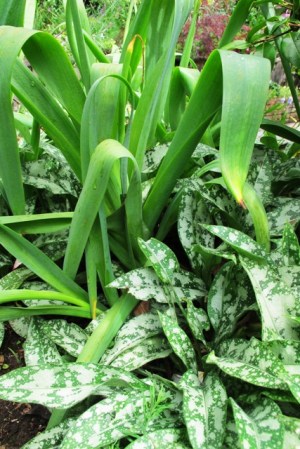
The hostas are all romping into growth. There is nothing quite like this for focussing the mind on slugs and snails.

We don’t have a big slug and snail problem here and we rarely resort to using bait. We can only conclude that we must have a struck a reasonable balance with the main natural predators – birds. We have a rich birdlife in our garden and think that eating slugs and snails which have been poisoned is not a good call for our feathered friends.

Where we see the slimy critters making inroads to something precious, we resort to discreet little bait stations – a bottle cap with two or three pellets beneath a paua shell. The roof keeps the bait dry so it lasts a lot longer. A small packet of bait lasts us for ages.

Mark has been railing for years against gardeners who broadcast slug bait as thickly as fertiliser. Baits have an attractant so you don’t need to layer them on so densely that you trip up passing targets. One bait placed at the base of a lettuce seedling is all that is required to kill the marauders.

The bait trap

The bait trap

If, like us, you are reluctant to reach for the poisons as a routine solution, there are alternatives. The night time prowl with the torch can be effective though it may take a few forays to get the timing right. The snails don’t usually come out until a good hour or more after dark. The richest hunting nights are when there has been rain after a dry period. I squash all but the giant tiger slugs underfoot, which is a quick end for them. Others of more delicate dispositions drop them into a bucket of salted water where I imagine they die a slow and lingering death. Sentimentalists and, presumably, Buddhists release them in farther reaches or drop them over the fence to the neighbours so they live on causing damage. I am afraid that I think the only good garden slug or snail is a dead one (our native powelliphanta excluded).

As much of our problem slimy population was imported, it has always seemed a great pity to me that the early settlers who were so determined to bring food crops and plants to remind them of home, did not while away the hours of the long sea voyage ensuring that this vegetative material was free of the pests. It seems a missed opportunity and would have saved a lot of bother later. While we have a remarkable number of native slugs and snails, most of these feed on decaying material whereas the imported ones generally feed on fresh, green growth and do the damage.

I have not tried the beer can approach (I just don’t want cans of flat beer lying around my garden) but, as with the hollowed out orange half, these traps require you to do a morning round to dispose of any lurkers. There is nothing in the beer and the orange to kill them.

It is a myth that slimy critters will not crawl over rough and gritty surfaces. Insect expert Ruud Kleinpaste once showed a photo of a snail crawling over the sharp end of a razor blade. But they will take the line of least resistance so surrounding vulnerable plants in a thick enough ring of something less appealing can deflect them in another direction. However, you need a small mound rather than just a scattering of crushed egg shells, sawdust, rimu needles, sand, gravel or similar and you need it round each plant individually. It can certainly help with new plantings. Copper rings are reputed to work but it seems an awful lot of effort to go to, fashioning a copper bangle for each plant.

One eco friendly solution I have tried with success is generous amounts of cheap baker’s bran. Apparently slugs and snails find it irresistible. I don’t think the bran actually kills them, unless they gorge so much that it swells up inside and dehydrates them. I think it more likely they eat too much and then lie around in a comatose state making easy pickings for the early bird in the morn. All I can say is that it did work when I tried it on a patch of hostas that was getting slaughtered.

I have not tried the temptation approach suggested by BBC Gardeners’ World presenter, Monty Don. According to him, there is nothing slugs and snails like more than comfrey so he lays fresh comfrey leaves beside vulnerable plants. What he didn’t say is that you would have to replace the comfrey leaves every two days and you would need to follow up in the evening and deal to the revellers. I don’t think there is anything in the comfrey that kills them. It is merely an attractant (like the beer). I thought it seemed to be a case for not planting comfrey near vulnerable plants to reduce temptation.

In the end, we will never win the war on slugs and snails. It can only be managed and if you can get your garden to a balanced state of co-existence, you can target your efforts to areas of particular damage. If you are the type who carpets an area in slug bait (which then breaks down with moisture), just remember you are in fact carpeting your garden with a poison. It is better to try other ways of management if you can and save the slug bait as a last resort.

First published in the Waikato Times and reprinted here with their permission.

Weeding – just like outdoor vaccum cleaning, really

Edging tools, push hoes and our well-used petrol powered line trimmer

Edging tools, push hoes and our well-used petrol powered line trimmer

Weeding. It’s the garden equivalent of vacuuming really. Tedious, repetitive and while the place looks great when you have finished, all too soon you need to start again. I guess you could ignore the weeding part (if not the vacuuming) but most of us prefer a garden that is pretty much free of weeds. In fact most of us place a high priority on this state.

There is a much higher tolerance for weeds in some other gardening countries, particularly in Britain. This may well have something to do with the fact that the vast majority of our weeds in this country are imports and a fair number are in fact native to Britain and Europe – plants like dandelion and blackberry, for example. We are probably more tolerant of our self seeding native plants too. I don’t refer to the scores of nikau palms we pull out and dig out as weeds. They are merely self seeded plants in the wrong place whereas the buttercup and campanulata cherry seedlings are indubitably weeds.

I have to admit we weed spray here though Mark is trying to reduce the amount he does. Glyphosate is pretty much all that stands between us and claiming organic status, but in a large garden, glyphosate is oft described as the equivalent of a labour unit. It is much faster to whip around with the knapsack sprayer than to hand weed. Mark has spent the last decade gently worrying that research will come up with definitive arguments against the use of glyphosate. It hasn’t happened yet, to his relief. But in this day of heightened sensibilities, he is rarely to be spotted by any garden visitor with the knapsack on his back. He hides, dear Reader. True.

The rusted Niwashi, implement for flat weeds and aptly branded Wonder Weeder

The rusted Niwashi, implement for flat weeds and aptly branded Wonder Weeder

We have a repertoire of weeding implements here and do a fair amount of hand weeding too. Others swear by the Niwashi weeder, to the extent that Mark bought one and it was relatively expensive as I recall. I asked him this week if he had ever used it because I never have. Neither has he, apparently, but somebody here must have because it made the trip right through the compost heaps emerging after about a year at the other end. Mark is a push hoe man and keeps his favourite two well sharpened. However push hoes come with a warning – refer to the quote of the day below! I have heard of one public garden which banned push hoes in the hands of volunteers because they caused so much damage. I favour the precision of close up work with the cheap and cheerful Wonder Weeder – so cheap that I have several and so sturdy that they can emerge from the compost heap pretty much unscathed. These implements work best in loose, friable soil. It is much harder work in compacted earth but a breeze where it is easy to scuff up the surface and hook out or sever weeds.

We also have edging tools – ones designed for both hard edges (where grass meets a solid surface like a path) and soft edges. And let’s not forget the petrol powered line trimmer but that is excessive unless you have a large section. These are because of a strongly held opinion on Mark’s part that little looks worse than sprayed edges. You know that dead brown line others have? Not here. The lawn weeder is also well used since we made the decision not to spray the lawns. Nothing works as well on flat weeds as this handy implement.

The bottom line of weeding is that vigilance and early intervention lessens the task. There is an old saying: “one year’s seeding, seven year’s weeding”. You can never completely eliminate weeding but if you can stop seeding, you certainly lessen the load considerably. We are lucky in that we took over this garden from Mark’s father who was a vigilant weeder. True, he leaned towards the chemical arsenal to carry this out as so many of that generation did. But at least we don’t have soils jampacked with weed seeds waiting to germinate. Where a patch may have got away from us and set seed heads, we usually have a bucket on hand to receive them. If you cut them off and leave them lying on the ground, the seeds can still ripen and live to germinate another day. For the same reason, gardening clothes with pockets can be handy.

Spitting cress

Spitting cress

Get ‘em when they are small and much easier to deal with. Soon after germinating is the best time, before they have well established root systems. They are far easier to hoick out of the ground and far more likely to die instantly at that tender stage. While the saying that a weed is merely a plant in the wrong place is repeated so often it has become a cliché, I can not think that the nasty spitting cress fits this kind interpretation. Every gardener knows it – the little flat weed which can go from first appearance to setting seed in a matter of days in full summer. As soon as you touch it, it jet propels its seeds around to ensure immortality. Vigilance – that is the single most important mantra. Target the worst offenders and maybe be a bit more relaxed about some of the others.

First published in the Waikato Times and reprinted here with their permission.
Orchids as garden plants

Referred to here as the Aussie dendrobes - dendrobiums

Referred to here as the Aussie dendrobes – dendrobiums

We are at the peak of orchid season in the garden. There can be few plants which carry the aura of luxury and exotica accorded to orchids. They belong to a huge and complex family, second only to the daisy family in number and go well beyond the common cymbidium. Yet they are not a plant that is common in New Zealand gardens.

Besotted by calanthes

Besotted by calanthes

The calanthe orchids are particularly rewarding as garden plants but you need to take the long view. We use them mainly as woodland plants. The blooms are a bit frost tender. Some we had on the margins were once hit by a memorable late frost but that was a one-off event. After about five decades of building them up, we have large swathes or drifts. In fact we have so many that a gardening ingénue who saw them recently drew the conclusion that they must be an unusual but easy bedding plant. Ah, no. But for those who have the time and inclination, they are a very rewarding branch of the family. Over time, they form a string of back bulbs below ground and can be increased from these.

For orchid enthusiasts who want the technical data, we understand that it is mostly forms of striata that are showiest for us. We have a pale lemon one which flowers in early spring and a much brighter yellow form that comes later. We used to have them under different species names but have come to the conclusion that they are more likely just different striata forms. Note: I have now been informed that the pale yellow calanthe shown is in fact Calanthe ‘Higo’ (C. sieboldii x C. aristulifera) which makes sense to us. We also use the white C. arisanensis but alas we failed with a lovely lilac species and appear to have lost it. All of these are evergreen varieties, though I understand there are deciduous species as well. The fresh spring leaves are large and could, at a pinch, be thought of as looking like pleated hosta leaves. A fair number of garden visitors over the years have asked us about the yellow flowered hostas. (Hint: hostas only flower in white or shades of lilac to purple.)

The Australian dendrobiums make compact, clumping plants with many smaller flowers and are pretty as a picture in the subtropical woodland areas. They combine very well with bromeliads and ferns and are an easy care garden plant. We have them in pinks, lilacs, white and yellow. We don’t know much about the hardiness of these. Ours are in positions where they never get frosted but they will get cold and they never turn a hair. They are probably similar to cymbidiums in hardiness.

Cymbidiums give long lived blooms, even outdoors

Cymbidiums give long lived blooms, even outdoors

DIY bamboo stake

DIY bamboo stake

Cymbidiums are the usual florist’s choice and are surprisingly easy as garden plants, given the right conditions. All of ours are grown in the ground, not containers. We don’t get florist quality blooms but they last an amazingly long time in flower and put on a splendid show as long as I remember to stake the flower spikes at the right time. I see I started photographing the flower spikes a full two months ago and those same flowers are now a little weather beaten but still showy. These days I harvest stems of green bamboo which still have convenient leaf axils because I can gently engage the flower spikes in the leaf axils and don’t have to tie each one which makes staking much faster and more discreet. I admit this only works if you have a convenient stand of bamboo to harvest.

The jury is still out on whether we can get the disa orchids naturalised by the stream. They were fine for the first two seasons but the proof of the pudding is in the five to ten year cycle – whether they are still strong and flowering after that time. At this point it is not looking good. The native English field orchid, Dactylorhiza maculata, has gently ticked on here for decades but is romping away more enthusiastically now we are trying cooler, damper positions. We didn’t succeed with the masdevallias (though we probably didn’t try very hard) and the tropical orchids like phalaenopsis (moth orchids) won’t do as garden plants for us.

One of the easiest orchids to grow - pleiones

One of the easiest orchids to grow – pleiones

This week it is the pleiones which are the stars. Their flowering season is nowhere near as extended as some of the other orchids, but they form pretty carpets, are not at all tender and are dead easy to increase. Most bulbs will make one or two offsets a year. Along with the dactylorhiza, they are deciduous, becoming dormant in autumn. The yellow pleiones want more of a winter chill and have gradually died out for us but we have an abundance of purest white ones and an array of lilacs and purples.

These are not generally plants that you will find offered for sale at garden centres (which may be why they are not often seen in gardens). You probably need to find your nearest Orchid Society and enquire about sales tables. Orchid enthusiasts tend to be a different breed. At the risk of making sweeping generalisations, Orchid Society people are more often collectors than gardeners. More than any other horticultural group we have come across, orchid people have well above average technical knowledge and like to show off their treasures in bloom. They are also generous and encouraging to any novice who shows an interest. Much of our collection has come from Orchid Society people over the years. We cannot speak highly enough of them as a repository of knowledge about a very complex plant genus.

For details on how to multiply calanthe orchids, check out our earlier Outdoor Classroom on the topic.

First published by the Waikato Times and reprinted here with their permission.