Category Archives: Abbie’s column

Abbie’s newspaper columns

Dealing with maturity (in garden terms)

First published in the spring issue of “Our Gardens”, the quarterly magazine of the Garden Clubs of Australia
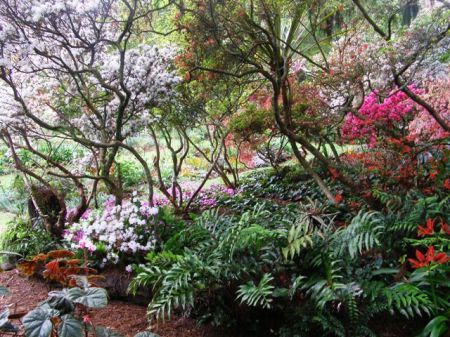
Sculpted kurume azaleas

Sculpted kurume azaleas

In gardening terms, I guess most people would agree we are blessed. Our climate is mild, never very hot and never very cold. We have regular rain all year round, good sunshine hours and the soils are friable and volcanic. Added to that, we are fortunate to be on a family property where the oldest trees were planted by Mark’s great grandfather in 1880. These give a wonderful mature backbone to the garden and how obliging of him to have planted an entire avenue of our majestic native rimu trees.

Notwithstanding the big trees, the majority of our plantings date back to the 1950s and having a mature garden offers its own challenges. Finding space for new plants can be problematic, even though we have reasonable acreage (we open about seven acres to the public). But the biggest challenge of having a mature garden is to stop it all melding together and becoming walls of foliage which choke out the less vigorous plants. Increasingly we find ourselves doing more lifting and limbing, shaping and clipping.

We like to use plants as focal points and features. Our garden is light on ornamentation. You won’t find anything armless, legless or white lighting up a dark corner. We prefer to place garden seats where we will sit on them, rather than using them as focal points. When sculpture is used in gardens, we think it becomes the dominant feature, forcing the garden setting and the plants into the background. We want the plants to be the stars.

There is no shortage of candidates for clipping or shaping but we do not want the Italian formality where almost every plant is manipulated. This is not about topiary so much as it is about finding the natural shapes within the plants and featuring them.
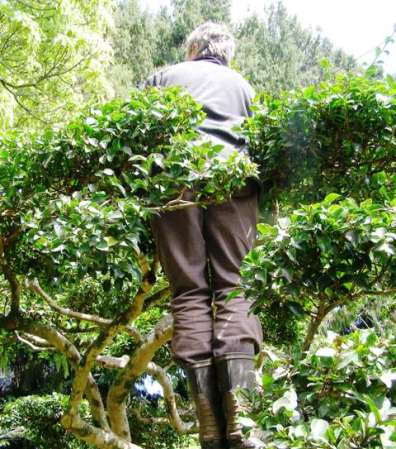
Clipping Mine No Yuki

Clipping Mine No Yuki

Maples can develop a wonderful form over time which just needs cleaning up. Loropetalums also clip and shape well. We keep our small flowered Kurume azaleas limbed up so that it is possible to look through them. The trunks naturally grow white lichen and, in season, the undulating tops of the azaleas form a carpet of colour, while we have species cyclamen planted beneath around the white trunks.

Camellias are wonderful for clipping because their growth rates are not too fast and, if you make a mistake, they will sprout again from bare wood. We have a massive plant of the white sasanqua, “Mine No Yuki”, which looks wonderful with its pristine white blooms until we have a heavy downpour to turn them to brown sludge. These days we regard any flowers as a bonus and the plant justifies its garden space because of its shape. We keep it tightly clipped into layered mounds – generally referred to as cloud pruning in a technique associated with Oriental gardens.
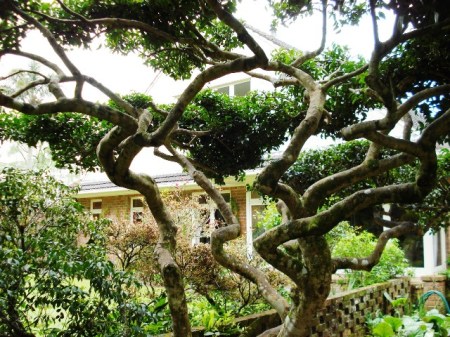
The finished product
The finished product

Fairy Magnolia Blush

Fairy Magnolia Blush

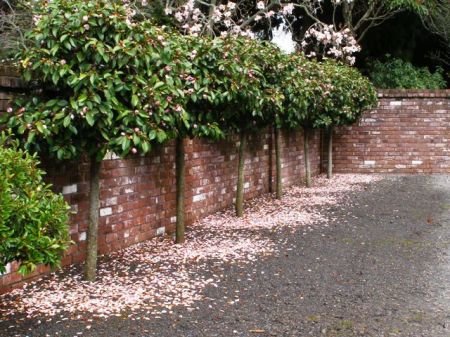
Michelias also lend themselves to shaping and the lollipop Fairy Magnolia Blushes at our entranceway are a more recent addition. A light pruning twice a year with secateurs keeps them to a tidy shape and we have been able to stop them getting too large.

It is all much more fun than weeding and gives us the detail and focal points we want.

Mark and Abbie Jury garden at Tikorangi, The Jury Garden in Taranaki on the west coast of the North Island of New Zealand. Like his father before him, Mark is a plant breeder, probably best known in Australia for his Fairy Magnolia Blush, Camellia Volunteer, Magnolias Black Tulip and Felix Jury and his joint venture plant with his father, Cordyline Red Fountain. Abbie is a garden writer for national and regional publications. Their garden opens for the magnolia display at the start of August and remains open until the end of March.
Website: http://www.jury.co.nz
Facebook: facebook.com/thejurygarden
Twitter: @Tikorangi

New post on Magnolia Diary.

Magnolia Mark Jury - what else could it be?

Magnolia Mark Jury – what else could it be?

Three years ago, I charted the magnolia flowering season here in a Magnolia Diary. Just posted is an update explaining why, despite raising hundreds of different magnolias over a period of 60 years here, we have only ever named eleven – eight of Felix Jury’s breeding and three of Mark’s (with a fourth in the pipeline). In the meantime, our magnolia display here goees from strength to strength, with both named varieties (our own, and others) and also-rans from the breeding programme.

Sweetheart is not one of ours, though we would be happy if it was

Sweetheart is not one of ours, though we would be happy if it was

Biodynamics – the homeopathy of the gardening world

A mutinous threat from Zephyr and Spike

A mutinous threat from Zephyr and Spike

Being a SNAW (that is a Sensitive New Age Woman, but of course you knew that), I am all for religious tolerance. That is, as long as nobody comes knocking on my door thinking I may need to be converted of a Saturday morning. I could perhaps do with being renovated, but not converted.

Similarly, when the personal faiths of others start to intrude on me, especially by claiming to occupy the higher moral ground, I get a little twitchy and few are worse at this than homeopaths, lunar planters and biodynamics converts.

Adding to my twitchiness, Spike and Zephyr, our surviving pets, are seeking legal advice. They are threatening to take out an injunction to prevent us exhuming their former colleagues for preparation 505. That is the one where a skull of a domesticated animal is stuffed with oak chips and immersed in fresh water for three months. Spike and Zephs are appalled at the thought that we may be wanting to stuff skulls with oak chips. Not only do they want to protect their former colleagues, but they are not offering to make the ultimate sacrifice, proffering up their own skulls to test the efficacy of this soil conditioner. They have been known to harumph and suggest that in this country, we should surely be stuffing bird skulls with totara chips seeing as we lack both native mammals and oak trees. And don’t be thinking any old oak tree will do. It has to be Quercus robur which is of course native to Rudolf Steiner’s homeland of Austria.

Preparation 502 is giving me much anxiety. That is the one where you stuff the bladder of a red deer with achillea flowers and bury it for months on end. There is a definite shortage of fresh deer bladders (or even frozen ones) here and local supermarkets don’t seem to stock them. I notice there is a stag where I buy my free range eggs and I pondered asking the owner how she would feel about donating its internal organ to improve our soils. But I am not sure that it is a red deer (it appears to make a difference to compound 502) and as she was hand feeding the stag when I called in one day, I feared she may not react well to my request. I think we may do better with preparation 503 (that is chamomile blossoms stuffed into the small intestines of cattle and overwintered in the ground – must remember to mark where I bury it). And preparation 506 looks manageable – dandelions stuffed in the peritoneum (sounds nasty) of cattle and similarly overwintered.

Prep 501 has powdered quartz stored in the horn of a cow (minus the cow) and buried over summer (note: summer burial, not winter, for this one). In autumn you dig it up and mix it with water at a dilution rate of one tablespoon of quartz powder to 250 litres of water (starting to sound dangerously homeopathic…). But before you spray it, you have to stir the solution for an hour and the method and direction of stirring is prescribed. You can not stint on the stirring because some see the vortex created by methodical stirring as acting like a funnel to imbue the solution with cosmic energy, making it more efficacious. Quartz is largely insoluble in water and spraying a chemically inert substance in microscopic traces over a wide area is of no discernible value whatever but let not these facts get in the way of passionate belief.

The best known prep 500 (a cow horn stuffed with the excrement of a lactating cow and buried over winter in the ground) receives similar treatment to 501 and is diluted to the same extent. Preps 502 to 508 are added to the compost heap at a rate, give or take, of around a teaspoon per cubic metre. Faith goes a long way. Apparently.

Rudolf Steiner was a philosopher and it is most unlikely that he ever got his hands in the soil. Put succinctly, Steiner came from a strong background of esoteric theosophy and when he split from the European theosophical mainstream at the turn of last century, he evolved his own world view which he styled anthroposophy. And that might be described simplistically as an attempt to synthesize mysticism and science. Lost? Don’t worry. I don’t think it matters. I would guess that Steiner, a man who spent his life thinking and in philosophical discourse, likely saw his theories on agriculture and care for the soils as merely part of a much larger universal whole. He might be slightly stunned were he around today to see how this particular side shoot to his core philosophies has taken on a life of its own as biodynamics.

Biodynamics seems to have taken a greatly simplified interpretation of Steiner’s elaborate world view and repackaged it as pseudo science to give it a credibility which it lacks. You really are back in the realms of mysticism without the science once you are into focusing cosmic rays to harness the spiritual energy of the universe. Cows’ horns and deer antlers are apparently particularly good receptors acting as a cross between a satellite dish and a storage battery for cosmic energy and cosmic wisdom. Yet, if you set aside the biodynamic preparations, the other underpinning principles of modern biodynamics are sound organics. You can not fault practices such as:
* Stocking with several different animal species to vary grazing patterns and reduce pasture borne parasites.
* Widening the range of pasture species.
* Planting trees for multiple purposes.
* Crop rotation designs to enhance soil fertility and control weeds and plant pests which include the use of green manures.
* Recycling of organic wastes, where possible, by large scale composting.
* Changing from chemical pest control to prevention strategies based on good plant and animal nutrition and careful cultivar selection.

There is nothing flaky in any of that. There is nothing spiritual either. It is just good, sustainable practice applicable to all aspects of gardening and agriculture.

I respect the right of bioydynamic converts to believe in cosmic energies and a holistic interpretation of their position in the universe. But I do wish they wouldn’t try and package it as science and, like lunar planting and homeopathy, such practices have gained a level of mainstream acceptance which is not founded on any scientific credibility at all. It can make it hard to disentangle what is sound environmental practice from what is religion.

Be bold with colour. White is not always right.

My first ever video upload (two minutes of a mass of tui in a campanulata cherry tree) and notes on the magnolias in flower have just been posted on www.jury.co.nz (our garden website).

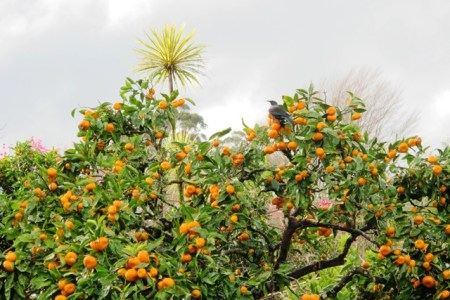
Winter colour on the mandarin tree - and food for tui

Winter colour on the mandarin tree – and food for tui

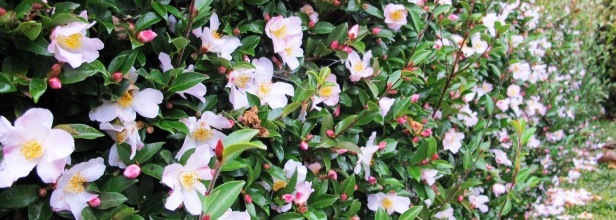
It was most refreshing this week to receive an email from a reader seeking recommendations on a suitable sasanqua camellia for a hedge. “Anything but white,” was her request. I liked her instantly. White flowered camellia hedges can indeed look pretty and fresh but have become such a cliché in this country (especially as nine out of ten white sasanqua hedges are Setsugekka). It is most unusual for someone to specify colour.

We have a curious obsession with white flowers in this country. Why is Iceberg still the biggest selling rose here? Probably followed by the white Margaret Merrill or Rose Flower Carpet White. They are good plants but are they much better than other coloured options? No, they are just white. According to the Rose Flower Carpet agents, the coloured ones are much more popular overseas and it is mostly NZ that prizes the white. My informant put this down to our mild climate here and the fact that we are never snowbound. “If you spend months of the year looking at a white landscape,” he said, “the last thing you want is a garden of white flowers.”

I think it is conservatism. For the same reason, the trend is to have a near absence of colour on interior walls of the house (usually off white because pure white can be too stark and clinical to live with). Too often we play it safe in the garden. The garden backdrop of green is, for some curious reason, perceived as colour neutral and into that we drop another neutral in the form of white flowers. Call it serene, restful, stylish and sophisticated if you wish. In the right hands and at its best, it is. In lesser hands, it can be bland and dull. But safe. You can always be confident that your garden will be perceived by some as being in good taste if you keep to white, maybe with just the occasional colour thrown in as a feature (but just one colour, mind).

Fewer try the monochromatic scheme in other colours – though it is of course bichromatic (is there such a word?) because they are all plus green. Sissinghurst has its purple border, Hidcote its red border and both are beautiful in full summer bloom, but in NZ we tend to keep to white.

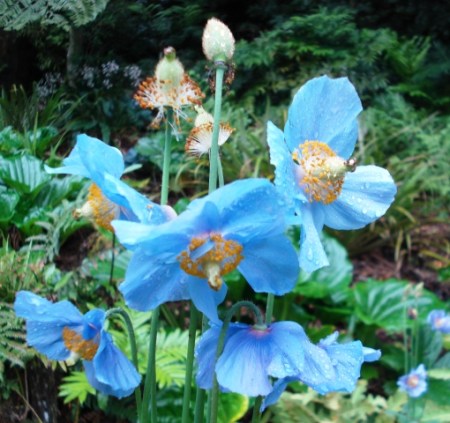
You can never have too much blue in the garden - especially if it is meconopsis

You can never have too much blue in the garden – especially if it is meconopsis

My first ever colour managed garden was to be all pinks, blues and whites. It looked pretty, but flat. Mark stood looking and said, “You need a touch of yellow.” He was so right. These days that garden remains predominantly pink, blue and white but it is the lemon and cerise (the latter, a surprisingly common colour in flowers) that give it some zing. Hence my choice of the Gertrude Jekyll quote below. Pastel gardens tend to be very feminine but they can be a little too “pastelle”, bordering on bland unless you get it absolutely right.

If you are unsure, go back to the colour wheel. It is touches of the opposite colour that will provide contrast. So yellow will be highlighted by purple, red by green and blue by orange. It does work. That said, I think blue flowers and foliage fit in with everything and you can never have too much blue in a garden. There is no theory to back that one up so it is entirely my personal opinion.

Colour to brighten a gloomy day - Magnolia Vulcan

Colour to brighten a gloomy day – Magnolia Vulcan

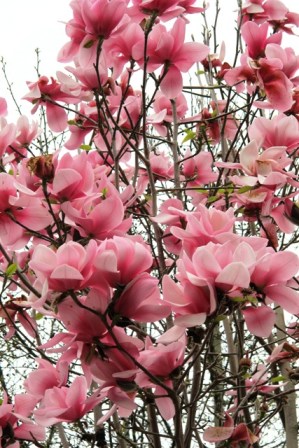
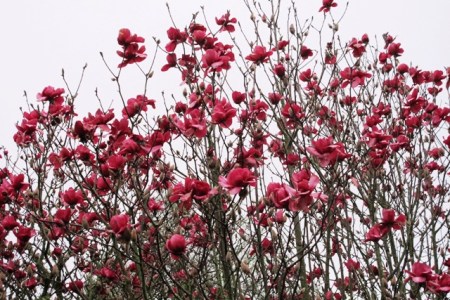
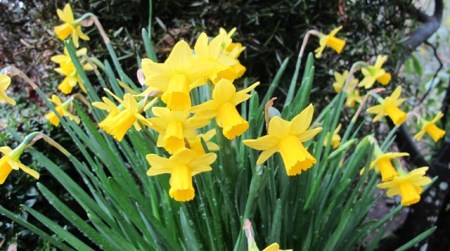
On a wintery day, however, I don’t want pastels or unrelieved green. Give me colour. The mandarin trees are a bright spot on a gloomy day, especially when populated by tui sucking the juice from damaged fruit. Most of our early flowering magnolias are in strong colours and can lift the spirits wonderfully with their over the top displays. The early flowering campanulata cherries lean to bright candy pink and cerise colours which are certainly a startling colour combination with the bright gold narcissi in bloom. There is no subtlety in any of those but I am not going to trade them for refined white flowers instead.

There is nothing subtle about the bright yellow of early narcissus

There is nothing subtle about the bright yellow of early narcissus

First published in the Waikato Times and reproduced here with their permission.

A blight upon your camellias

I married in to a camellia family. Long before the Jury name ever became associated with magnolias, it was known both in New Zealand and overseas for camellias. That is because there were two brothers working independently on camellias in the previous generation.

Les Jury (known here as Uncle Les, for obvious reasons) was the better known and some of his cultivars are classics in the camellia world – Anticipation, Debbie and Jury’s Yellow to name just three. Not far behind was Felix Jury who created Water Lily, Dream Boat, Rose Bouquet and many others.

Encouraged by his father and his uncle, my Mark was following suit. They were heady days and camellias ranked second only to roses in volume of plant sales in New Zealand. Both Mark and I remember the Day of Doom. Mark received an unannounced visit from senior members of the local Camellia Society bringing him the bad news that camellia petal blight had been found in Wellington. It took quite a while for the implications to sink in for me but Mark knew instantly what it meant and that was the day he stopped camellia breeding. Only now, more than twenty years down the track, is he starting to return to it as the picture has become clearer.

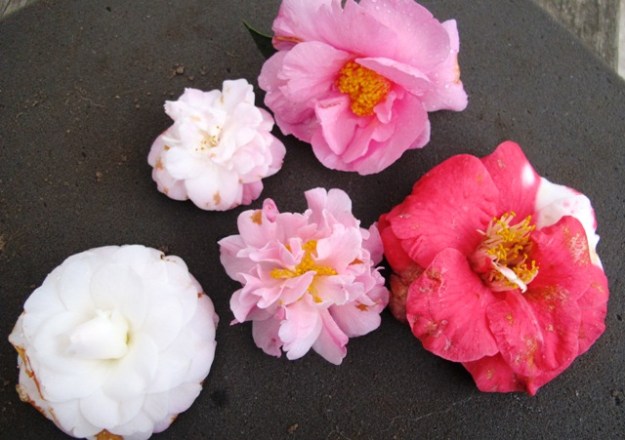
From these slightly blemished blooms...

From these slightly blemished blooms…

Camellia petal blight is endemic to China and Japan and has long been a problem on the west coast of the USA. More recently, it has struck the UK and Europe though apparently Australia is still free from it. A plant can’t carry it. It is transmitted on the flower or in the soil. Even back when it was first found in this country, standard practice was to ensure that all plants being shipped in or out of New Zealand were stripped of all flower buds and had their roots washed clean. It is quite possible that it entered this country inadvertently in a corsage somebody failed to discard safely or some similar incident. The discovery of infected blooms in Wellington Botanic Gardens and in two locations in the Hutt (if my memory serves me right) was hardly painted apple moth or Queensland fruit fly territory but its impact has certainly been very disappointing.

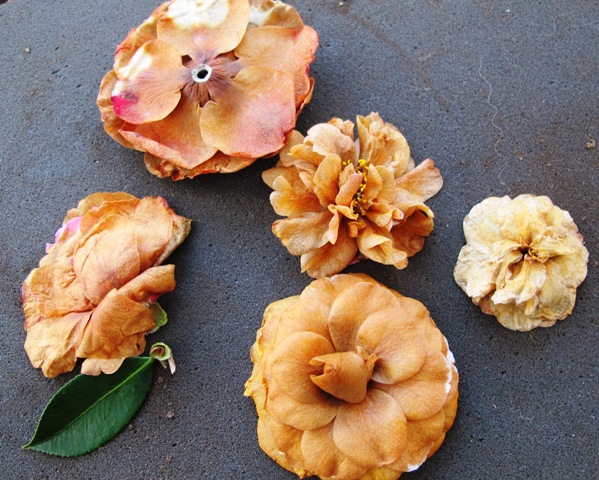
... to this in two short days

… to this in two short days

It is a fungus – Ciborinia camelliae, to be precise and the spore are dispersed through the air. The problem in this country is that the camellia is so ubiquitous and the distances from host plant to next potential host so short that the disease spread rapidly. For the same reason, you can’t eradicate it because you will just get reinfected. So we have learned to live with it.

We have always had botrytis which turns blooms dark brown but petal blight is much more rampant. What may be light brown speck on a bloom one day can show as riddled as the pox the following day and pale mush the day after. And it usually hangs on the plant, which is the worst aspect of all because blighted blooms look awful. A lot of modern breeding has been to get camellias that are self grooming – in other words they fall when finished. But not the blighted blooms.

If you want to check that you have it, flip a bloom over and peel off the calyx which holds the petals together in the centre. If it has a telltale white powdery ring inside the calyx, that is petal blight. If it is greyish black, it is botrytis.

The white ring of death - camellia petal blight

The white ring of death – camellia petal blight

Petal blight does not weaken the plant. It merely cuts the floral display. You won’t get as many blooms, though given camellias’ propensity for massive bud set, they will still out flower most other shrubs. You will probably have to do more of a clean up, maybe shake the bush as you pass and rake up the debris to keep them looking attractive. It is still a lot less than many other plants require.

Reticulata camellias (the ones with the huge blooms the size of lunch plates) tend to drop their blighted blooms because they are so heavy. And many are red which doesn’t show the brown blemishes as badly. But reticulatas are very hard to find for sale these days. Despite what some information on the internet says, we have never found petal blight on our sasanqua camelliaseither, and that is not for want of looking. As far as we are concerned they are clean.

The smaller flowered camellias with masses of shortlived blooms in succession are just as good as ever. We had a rush of blood to the head when Mark thought last week that petal blight was entirely absent from his Camellia Fairy Blush (the first camellia he ever named – a C. lutchuensis hybrid, not a sasanqua). He examined many spent blooms and finally found one with the telltale white ring. So not blight free, but unaffected in its display.

It is the bigger flowered, paler varieties that look the worst along with the ones bred for show blooms – fewer flowers but with perfect form. It has pretty well wrecked the traditions of camellia shows. Whether time and renewed efforts by plant breeders can replace these types with blight resistant options is still unknown.

Camellia Fairy Blush - not immune but the display is unaffected

Camellia Fairy Blush – not immune but the display is unaffected

First published in the Waikato Times and reprinted here with their permission.