Category Archives: Abbie’s column

Abbie’s newspaper columns

The garden identity crisis

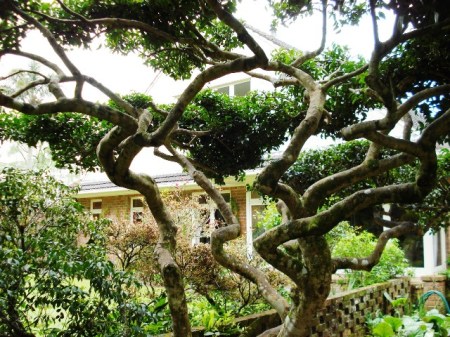
Finding the shapes within the plants, in this case a maple

Finding the shapes within the plants, in this case a maple

“People don’t know what to do with the garden when they get to year fifteen,” commented the retired gardener who was visiting us last week. “You need to do quite big things.” I grabbed a pen and paper to record his words because he is so right. We know exactly what to do with young gardens in this country, but too few know what to do as they mature and change.

The general age of crisis was set at fifteen years but that is a reflection of the rapid growth rates we have. It could be twice that in colder climates. The point is that at some stage, you wake up to the realisation that your garden is not how it used to be. The trees that you planted too closely in order to get a quick effect have now grown too large for their allotted space. Similarly, shrubs have outgrown their area and you are either madly hacking them back every year or you have stopped walking round the house on the path and have been forced sideways to avoid the dripping foliage. Your hedges seem to have grown wider than you intended and nearby plants appear to be suffering. The bulbs aren’t flowering as well as they used to. In fact a fair number seem to have disappeared altogether, as have the choicest perennials. It is the thugs that are left and even they are struggling in some areas which are now heavily shaded. The clumping perennials have become enmeshed together with bald areas showing and weeds popping up throughout which you can’t spray or pull out because they are so intertwined. The garden looks tired, lacking the freshness you remember from earlier days.

You are not alone. It is a natural part of the ageing process of the garden. In this country, most people leave the problem behind by selling up and moving on and the new owner is likely to cut it down and start again. The problem comes if you don’t want to move. That is when you need to do some quite big things.

Most people try and regain the earlier freshness and juvenility in the garden because they can’t see beyond that option. It used to be so pretty, you know. So poor plants are either slaughtered and removed, to be replaced by younger, smaller models. Or they are brutally cut off in their prime and reduced to ground level in order to “come again”. I have seen it done repeatedly.

The alternative is to learn a whole new set of skills. These are not skills that you often see demonstrated in this country because we still lack a heritage of long term gardens. First off, do not make the mistake of thinking that your garden is mature at 15 years. It isn’t. It is really just a gangly adolescent relying on your guidance to take it through to adulthood. On more than one occasion, we have had garden owners gushing that it is just wonderful having mature trees when there is not one single specimen that is older than 20 years. Fast growth we may have, but maturity in trees takes somewhat longer than that.

Leaving tree stumps to rot out in their own time is not without risk though many of us do it.

Leaving tree stumps to rot out in their own time is not without risk though many of us do it.

But it is a common fault to overplant gardens, both large and small, in the early days. At some point, you need to reassess and work out which are the key long term plants worth saving and which are expendable. You may need advice. The ones that are staying are the foundations to take the garden through to maturity. Be ruthless about the expendable plants in between. If you just cut woody plants off at ground level and leave them to rot out over time, you run the risk of opening up the whole area to armillaria (honey fungus) which starts in decaying wood but can then romp through killing healthy plants as well. Best practice is to get rid of the stump and many of the roots, especially willows, but that does not come without money or effort. Convenience and economy means that we often just take our chances.

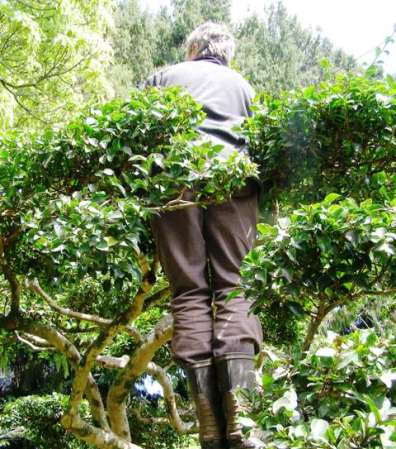
An example of lifting and limbing over many years.

An example of lifting and limbing over many years.

Then lift and limb and let light back in. Plants need light to grow, even in shade gardens or woodland. Make tree loppers and a pruning saw your friend. But you don’t have to have the light beaming straight down from above. If you lift the lower branches and thin the plants, you allow light in sideways. It also creates views through and brings welcome changes of light and shade.

Now is the time to develop skills in shaping plants. This is not beating them into submission. It is negotiating to make the most of the plant’s best features by highlighting its good form and shape. By now you are working in an environment which has height as well as width and depth. It is a lot more fun than weeding – and on the bright side, weeds are fewer in shaded gardens.

It is just a different way of gardening and these are but the first steps. If you are floundering a little, take heart. It takes time to learn new skills (and some never do). But if you have a garden which is now in that mid adolescent phase, take a hard look because you will need to do something quite major with it sooner or later.

First published in the Waikato Times and reproduced here with their permission.

The sweet smell of daphne in winter

Daphne odora - happy around the back by the rubbish tin.

Daphne odora – happy around the back by the rubbish tin.

We have never forgotten the nursery colleagues who told us that their range included lemon trees and daphnes “because you can sell a lemon tree to pretty much every household and everybody has to replace their daphne every five years or so”. I had never thought about it before, but they were right. Most New Zealand gardens have at least one of each and daphnes do not rank up there as long lived plants. But we wouldn’t be without them in the winter garden.

While there are upwards of 60 different species in the wild, in terms of garden plants in this country, generally you have a choice of odora, odora or odora with occasional breaks for D. bholua and if you are really lucky, you might spot the little ground hugging D. cneorum (with its silent c), the dainty D. x burkwoodii, or the remarkable blue D. genkwa. You may buy your odora by many other names, but if it has typical daphne foliage and flowers, it is just an odora selection. The flowers are generally small and a mix of lilac pink and white with a range of subtle variations. Some are darker, pinker or even pure white. I bought one that was reputedly apricot but that was wishful thinking with the description.

The good and the bad of the Himalayan Daphne bholua

The good and the bad of the Himalayan Daphne bholua

We have a bit of a love-hate relationship with the Himalayan Daphne bholua. In our opinion it has the best and strongest fragrance of all and it has a long flowering season. Its upright habit of growth means it fits into borders and beside paths well. That is the good side. On the down side it suckers (spreads underground), seeds much too freely and is dispersed by birds so has weed potential. It also becomes very scruffy with time. It is semi deciduous which means it is neither one thing nor the other – it drops some leaves and those that hang on often look messy. The form is ugly and it can get quite large after a few years if you don’t stay on top of the pruning. So it is not a plant of great beauty at all, but its scent is superb. Hide it at the back of the border in behind more attractive plants so that it can wow you with its fragrance.

The blue flowered Daphne genkwa from China is remarkable. For most of the year it is just an anonymous willowy shrub. It is fully deciduous, so drops all its leaves in autumn. Then in late August, all those whippy growths burst into lilac blue flowers down their length. It is a wondrous sight. Some claim a light perfume, but I think that is imagination. It is just one of the loveliest shrubs you will ever see in flower. Alas, it is difficult to propagate (it is generally done from root cuttings) and can be difficult to get established so it is not common. However, it is still produced commercially and a good garden centre may be able to order it in for you. Plant it where it has good light, good drainage and plenty of space so it won’t need trimming. I killed a well established plant by cutting it back and I wasn’t that brutal. I loved it so much I bought three replacements and these will be planted with plenty of space so they should never need pruning.

Deciduous, lacking scent and blue lilac but it is probably the most spectacular - Daphne genkwa

Deciduous, lacking scent and blue lilac but it is probably the most spectacular – Daphne genkwa

Growing tips: daphnes are not suitable plants to grow in containers. Mostly they look unhealthy and straggly because it is hard to get the potting mix right. It is much easier to keep them lush and healthy planted in the garden, even more so if you pick a position out of full sun. The odoras and bholua are often a good choice for the more shaded house borders. While they need good light levels, they are quite happy with little or no direct sun.

Daphnes prefer rich loamy conditions, neither acid nor alkaline. They won’t love you if you put them in waterlogged conditions either so look for spots with good drainage which never get bone dry either. Keep them mulched with compost or leaf litter.

While Daphne bholua will accept hard pruning, most other types won’t. You are better to take a bit more care and think more about pinching out new growth to encourage bushiness and shaping with secateurs, rather than hacking bark hard all over.

Because they are winter flowering, finding locations near to where you walk in winter means you will get more benefit. This is one of the few plants with such strong scent that you will pause and look for the source so plant it where that can happen. Only D. genkwa is spectacular in flower, so they are wasted in more removed locations. Round the back of house near the rubbish bin is a handy location for us though we have quite a few other plants all over the place.

First published in the Waikato Times and reprinted here with their permission.

In praise of ornamental oxalis (or wood sorrel, if you prefer)

Oxalis show considerable variation in leaf form (and in flower colour)

Oxalis show considerable variation in leaf form (and in flower colour)

Most people shudder at the mere mention of oxalis. The bad reputation of a few has tarnished the entire population. We would not be without the cheerful sight of them blooming from early autumn through winter, but the most common reaction from others is complete dismissal. I have even resorted to their colloquial name overseas – wood sorrel. It sounds so much prettier and more acceptable than oxalis.

Over the years, we have gathered up around 30 different ornamental varieties but these are a mere drop in the bucket. The oxalis family is huge. In the wild, the number of different species is into the late hundreds. That is not to say that they are all of great merit. Nor are they all bulbs. Equally, not all are invasive.

O. deppei "Iron Cross" grows and flowers in the opposite seasons to most ornamental varieties

O. deppei "Iron Cross" grows and flowers in the opposite seasons to most ornamental varieties

Most oxalis are native to either South Africa or South America, though it is the former that gives us the majority of varieties which have garden merit. Most are triggered into growth by late summer rain, so they come into flower around this time of year. The two notable exceptions we have in our collection are both from South America. Oxalis deppei “Iron Cross” (named for the markings on its leaves) is from Mexico and going dormant now, to return to growth at the start of November. O. triangularis, with its triangle shaped leaves in deep burgundy, is Brazilian and also flowers in summer. I bought this one at a car boot sale where I commented that it was an oxalis that I did not have. “No,” protested the vendors. “It is not an oxalis. It is a triangularus.” I didn’t argue.

Some of these oxalis are perfectly safe in the garden. I can vouch for this after decades of growing them in the rockery where they have never threatened to become a weed. Others are downright dangerous. Turn your back and they will invade at alarming speed. Such wayward habits don’t mean you have to shun them. Keep them in pots. You can either plunge the pot into the garden (which reduces the need to water it), or have a collection on a sunny doorstep. Oxalis only open their flowers in the sunshine. When they have ceased being attractive, you can move the pots out of sight for the rest of the year. We have not had problems with them setting seed so as long as the bulbs are confined, they rarely escape.

My all time favourite - O. purpurea alba

My all time favourite - O. purpurea alba

Same species but different form and very different behaviour. Keep O. purpurea "Nigrescens" confined to a pot

Same species but different form and very different behaviour. Keep O. purpurea "Nigrescens" confined to a pot

My all time favourite is the pristine white O. purpurea alba. It has an exceptionally long flowering season and is extremely well behaved in the garden. A mat of this plant opening up its large blooms to the sunshine is a delightful sight. Each flower has a golden eye. Purpurea is a variable species. The green form (same clover-like leaves but with large pink flowers) also has an excellent length of flowering but I haven’t had it long enough to know whether it is garden safe or not so I still keep it in pots. The reason for my caution is that O. purpurea ‘Nigrescens’, highly desirable for its deep burgundy foliage and big pink flowers, is dangerous. I have seen it invade an Auckland garden on heavy clay. It was as bad as the weedy varieties, just more ornamental. Keep it confined at all times.

My second place favourite is the lavender O. hirta. We also have a bright pink form of it, but the pastel lavender is prettier. This has very different foliage – trailing clusters of leaves. The range in leaf form is surprising. O. fabaefolia is often called the rabbits’ ear oxalis because its leaves look like pointed rabbits’ ears. It has a big yellow flower but a very short season.

O. luteola - an excellent garden variety

O. luteola - an excellent garden variety

Oxalis luteola, with its neat mat of clover-like leaves and masses of sunshine yellow blooms over many weeks, is another tried and true garden plant here. It has never been a problem in the rockery and gently grows amid other plants without ranging far afield. O. lobata is like a miniature form of O. luteola and equally garden safe.

Oxalis flower in colours from white, through the full gamut of pinks and lavenders to the crimson red of O. braziliensis, yellow, and apricot-orange tones. The well known O. versicolour has a pointed bud which is candy striped pink and white, like a traditional barber’s pole, though in the sun the flowers open to white. It is the only one I know which is showier when it is not open.
Oxalis (or wood sorrel, if that sounds better) are easy and fun to grow for a bit of cheer as the autumn draws in.

We keep O. eckloniana in a pot plunged into the garden

We keep O. eckloniana in a pot plunged into the garden

Growing oxalis in containers:

If in doubt, keep oxalis confined to pots in sunny positions.
• Pots can be plunged in the garden to reduce watering.
• Repot every year or two.
• Empty the pot onto newspaper and choose only the best looking bulbs. You will see which varieties have dangerous tendencies – either masses of tiny bulbs or long runners with too many bulbils attached. Throw the rest out with household rubbish to prevent any escaping.
• Free draining potting mix is recommended.
• If you have used a commercial potting mix, it will have fertiliser already added. If you are not repotting every year, the time to feed is as the bulbs are coming in to growth.
• Wide, shallow pots give the best display.
• Keep pots dry when bulbs are dormant to stop them from rotting out.

Perfect for sunny doorsteps

Perfect for sunny doorsteps

Dealing to the weedy ones:

There are no easy answers when it comes to getting rid of the weedy oxalis in gardens and lawns. O. corniculata is a creeping plant which doesn’t have a bulb so it can be weeded out. It spreads rapidly from seed and matures quickly so it pays to be vigilant and to dispose of plants in the household rubbish to avoid dispersing the seed. It can be green or red-brown in leaf and has tiny yellow flowers.
The pink or yellow flowered weedy bulb forms are more problematic, especially if they are growing through other plants. Glyphosate will kill them eventually, if you keep applying it every time you see leaves reappearing. I have never tried Death to Oxalis but it appears to need frequent reapplications as well. If you can lift all the other plants out of the garden border, you can sieve the soil or even replace it all. If you cover the area in black plastic and let it bake throughout a hot summer, it will sterilise the soil to some extent. Failing that, you just have to be persistent and vigilant, getting rid of every little bit you see.
First published in the Weekend Gardener and reproduced here with their permission.

O.hirta lavender - second place favourite

O.hirta lavender - second place favourite


O.massoniana - massed in a wide, shallow container in full sun

O.massoniana - massed in a wide, shallow container in full sun


O. polyphylla shows very different foliage

O. polyphylla shows very different foliage


O. bowiei - bold and showy very early in the season

O. bowiei - bold and showy very early in the season

The Bad Tempered Gardener from the Welsh borderlands

Veddw, the garden of Anne Wareham and Charles Hawes (photo copyright Charles Hawes)

Veddw, the garden of Anne Wareham and Charles Hawes (photo copyright Charles Hawes)

Anne Wareham (photo credit Charles Hawes)

Anne Wareham (photo credit Charles Hawes)

Anne Wareham had my attention from the first page of her book, bravely titled “The Bad Tempered Gardener”. Her second sentence opens:

I have to make my way in a world which is totally alien to me. A world where people are inevitably passionate, always ‘green’ and always terribly concerned about the little furry things….

She continues:

I began to get tired of hearing every garden described as ‘lovely’. I visited many of them and often found them to be banal and uninspired. I began to wish for writers who would tell the truth about the gardens and gardening and found only ‘garden stories’ and discussions of gardening techniques…. The problem is the fond idea that gardening is inevitably nice but dull…. ”

What is interesting about Anne Wareham’s work is that this is contemporary thinking about gardening from a hands-on perspective. I have also been reading Vita Sackville West’s collated newspaper columns from the early 1950s. She is renowned for creating the garden at Sissinghurst. There has been a proud tradition of garden writing by gardeners – Russell Page, Beth Chatto, Penelope Hobhouse and other great names, particularly in the world of English gardening. Not to put too fine a point on it, they are all either elderly or dead. Where is the current thinking?

Garden writing at this time seems to fall into three categories. There are academic treatises out of institutions where gardening has been hijacked by higher status landscape design. Then there are all the novice wannabe books which are of no interest at all to the serious gardener. All that breathless naivety and ingenuous enthusiasm wears very thin if you are not in the target demographic. The rest tends to be either prosaic description or praise in purple prose. There is no attempt at critique and very little in the way of ideas.

Apparently it is the same in the UK though I did think that the writer of the BBC Gardening Blog was guilty of gross hyperbole when he or she babbled of this book that: “Everyone, but everyone has been talking about possibly the most controversial book ever written about gardening.” It is not that radical and actually slots quite nicely into the tradition of garden writing. It is thought provoking and a breath of fresh air.

That said, it is not highly polished and the forty five chapters stand independently, almost as if they are a collation of pieces published previously, though there is no reference to this being the case. So there is not a cohesive argument but more a case of recurring themes. What I can tell about this book is that there is a great deal of thinking time that has gone into formulating the ideas and opinions. The author has two acres of intensive garden which she started from scratch and two acres of woodland which she maintains with her husband. Much of gardening is repetitive and takes little concentration so there is a lot of solitary thinking time. It takes one to know one. It is how I operate so I recognise it in someone else. And I have never before read a book where I have so often felt as if I was in conversation with the author. I kept wanting to say: “Exactly. I wrote about this very thing here.” Whether it is water maintenance, show gardens, rose gardens, scented plants, the impact of devaluing the garden visit experience by bringing it under the amateur and charitable banner, the hyperbole of garden descriptions – this is all familiar territory.

The Bad Tempered Gardener by Anne Wareham

The Bad Tempered Gardener by Anne Wareham

Thought provoking chapters are interspersed with short pieces on plants. These have little relevance in New Zealand. Erigeron is that highly invasive daisy that is actually on the banned list here. Tulip mania has never struck this country in the European manner (to buy fresh bulbs every season seems profligate). Alchemilla mollis is not the easy, frothy plant here that it is in the UK. These are just little interludes, breathing spaces, between the more opinionated pieces. Of interest are the chapters on the creation of her own garden, Veddw, on the Welsh border and the principles which drove her in design and plant selection. We are not in agreement on plants, but that is fine. To disagree with a well thought out and strongly held position challenges one’s own thinking.

Best guess is that the author has cultivated a certain prickly persona. I doubt very much that she is inherently any more bad tempered than the rest of us. The title of her book is probably as much a nod to the late Christoper Lloyd (he of Great Dixter fame) with his book titled “The Well-Tempered Garden” and maybe to Germaine Greer. Readers here may not be aware of the latter’s enthusiasm for gardening. She wrote a newspaper column under the pseudonym of Rose Blight and a collation of these were released in book form under the title of “The Revolting Gardener”.
Indeed, I am wondering about extending the theme with my own book – “The Opinionated Gardener”. Don’t hold your breath, however. I am unlikely to find a publisher any time soon.

I sourced my copy through Amazon though Touchwood Books or good bookshops will be able to order it in. As far as I know it is not on the shelves in this country.

The Bad Tempered Gardener by Anne Wareham. Photographs by Charles Hawes. (Frances Lincoln Ltd; ISBN: 978 0 7112 3150 4).

The reflecting pool at Veddw (instructions are in the book). Photo credit: copyright Charles Hawes

The reflecting pool at Veddw (instructions are in the book). Photo credit: copyright Charles Hawes

First published in the Waikato Times and reproduced here with their permission.

A blue as blue verbascum. Apparently.

Oh wow. That is a true blue verbascum. (Photo: Thompson and Morgan)

Oh wow. That is a true blue verbascum. (Photo: Thompson and Morgan)

It is rare for us to get excited about plants we see overseas which are not available here. In fact, between us we can only recall three. There were the double hellebores in the mid nineties which Mark saw when he was taken to meet the English breeder. Similar ones are now readily available here but they represented a major breakthrough at the time in the heady world of hellebores.

Then there was the red Edgeworthia papyrifera we saw in northern Italy. We have the yellow form in this country (often called the yellow daphne though it is a different genus) but as far as we know, the red form has still not been imported.

Now there is the blue verbascum which was featured at Chelsea Flower Show last week. Not that we were there. I merely found the write-up on line and saw it – a knock-out blue verbascum. Well, verbascums plural, on the Hilliers’ Nursery stand.

Not all verbascums are equal. The family is large and some can be a bit weedy, let alone insignificant and untidy. Some can be downright difficult. We have never succeeded growing the popular English hybrid ‘Helen Johnson’, with its dusky, apricot pink colouring. We were disappointed to lose a big white flowered verbascum we bought from Peter Cave before he closed down his Cambridge nursery. It had large, felted grey leaves and would have been a lovely addition to our garden. (Has anybody got seed of it? Do tell.)

Take one good, large flowered verbascum (this one is V. creticum though Blue Lagoon is a different species))...

Take one good, large flowered verbascum (this one is V. creticum though Blue Lagoon is a different species))…

In fact our dedication to the family has much to do with the splendid Verbascum creticum. It hails from the areas of Crete and Malta and is biennial in our conditions. This means it germinates and forms a rosette of leaves in its first year and flowers, seeds and usually dies in its second year. We leave one or two strong plants in situ to go to seed and just weed out the surplus seedlings or those growing where we don’t want them. It is wonderfully easy care and in springtime we get handsome flowering spires up to a metre high which then open large, clear yellow individual blooms all the way down the stem. In the rockery, it gives us vertical accents (like exclamation marks) and the flowering lasts for many weeks.

What wouldn’t we give for blue vertical accents? Not just any old blue or lilac purple tones pretending to be blue. No, this new Verbascum Blue Lagoon is described as being the pure electric blue seen in meconopsis (Himalayan poppies). It is a rare and distinctive shade and meconopsis are notoriously difficult to keep going in our climate. In the photos, one could be forgiven for thinking one is looking at delphiniums – another plant that is not so easy to keep going without constant care and intervention.

We, of course, are visualising Blue Lagoon as a pure blue equivalent of our tried and true yellow Verbascum creticum. If it is that good, it should be a sensational addition to a garden. And the initial information says it is perennial (though possibly a shortlived perennial), not just biennial.

... but in the pure biue of the meconopsis....

… but in the pure biue of the meconopsis….

But don’t hold your breath. It won’t be here yet and it is a moot point as to whether it ever will be. We have one of the tightest border controls in the world – and rightly so. I do not dispute for one moment that we need to be very careful to mimimise the risks of introducing some of the dreadful pests and diseases which afflict other parts of the world. It is just that some of the policy got lost in translation by the bureaucratic administration process. In this day and age, you would never be able to import kiwifruit (actinidia) and it would cost a swag of money and take a long time to get approval for an apple tree if we had none here. In fact, for a country which has built its agricultural and horticultural industries on imported species, nothing new of note has come across our borders for over a decade. You can only bring in plants if the species is known to be here already. I don’t know whether the species that has thrown up the blue verbascum (from Armenia and Turkey, originally) is on the magic list. It may take a very determined individual to import it.

Nor is it as simple as importing the seed. This blue colour came as a one-off result and the plants for sale have been built up by tissue culture from that one blue seedling. Let them go to seed and they will probably revert to the common colours with only occasional exceptions. You need to raise a lot of seed to find the occasional blue ones and it will take years of selection and subsequent generations to stabilise the blue colouring – if it is possible at all. However, the original work has been done by a well established British seed company, Thompson and Morgan, so odds on they are working to stabilise the colour in a seed strain.

In the meantime, we just cast covetous eyes at the photographs.

First published in the Waikato Times and reproduced here with their permission.