Category Archives: Abbie’s column

Abbie’s newspaper columns

Prole drift in New Zealand gardening

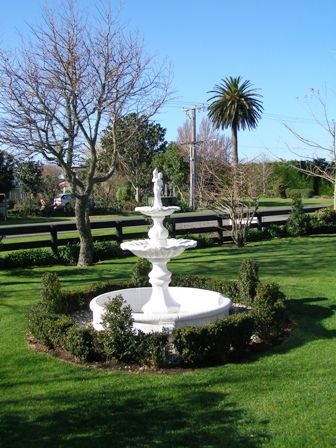
The rococo styled fountain has drifted down the road from us

The rococo styled fountain has drifted down the road from us

Prole drift. I had never heard of it until last week but I was greatly amused by it. The usual example of prole drift is the devaluing of status suffered by the Burberry plaid when it was embraced with gusto by the chavs of the UK (referred to, apparently, as a downmarket demographic). The SUV is undergoing a similar slide in status. The classic Range Rover slipped a little when Japanese manufacturers started making more reasonably priced models. But those new generation sports utility vehicles still came with a reasonably hefty price tag and appealed to the wealthy middle classes who wanted to look as if they were forever whipping up to the ski fields, whether or not it was true. “The four wheel drive is so handy – eliminates the need for chains, don’t you know.” In those early days, such vehicles were often referred to as urban tractors or Remuera shopping baskets. These days they are just as likely to be Manukau or Pakuranga Tractors. There is a certain inevitability that the status symbols of the privileged will be coveted just as much by those a little lower, or indeed much lower, on the socio economic ladder.

But as I pondered prole drift, it occurred to me that it is a remarkably good description of much of New Zealand gardening. In an earlier column, I asked whether there was such a thing as the New Zealand garden. I came to the conclusion that there are certainly some defining characteristics. At that time, I wrote:

It must be something in our egalitarian heritage which has many New Zealanders taking the ideas of the large, historic gardens – especially in Britain though sometimes from wider Europe – and attempting to re-create something similar here. We seem to be oblivious to the fact that the vast majority of the great gardens of Europe and Britain were established and maintained by the wealthy and the powerful who could afford to pay gardeners to actually do the work. So we go for high maintenance gardening styles (clipped hedges, a touch of topiary, sweeping lawns, mixed borders, buxus enclosures around statuary) – all the trappings of the gentry and the nobility which our forbears were so keen to leave behind.

Prole drift! That is what it is: prole drift. We are still at the stage of wanting the status and class (prounounced something akin to claarss) and thinking that if we embrace the status symbols of those further up the social scale, somehow the mystique of privilege will envelop us as well. It is not our egalitarian heritage after all. It is covetous envy and has resulted in scores of mini-Sissinghursts and even mini-Villandrys with barely a smidgeon of originality. Buxus hedges in abundance, tightly clipped, filled with either neat and decorative vegetables (which makes it a potager), citrus trees (which makes it Italianate), colour toned perennials or annuals in formal style (French parterres) or a froth of artfully casual blooms lifted by the mandatory white cosmos or foxgloves (which passes for English cottage style but tightly corseted by encircling low hedges) , with accents of clipped topiary balls or pyramids, even the occasional knot garden, all ornamented with obelisks, Lutyens styled garden seats, pergolas, formal avenues, laburnum arches, and… marble garden features. Diana, perhaps, something armless or a small fountain.

The funny thing is that so far so good – this heavily derivative style of prole drift gardening has indeed been accorded status and recognition in this country and, scarily, is often equated with style, superior taste and class. It remains to be seen what happens as it continues its drift sideways and downwards.

The evolution of a New Zealand style of gardening better suited to our conditions (geographic, climatic, botanic, cultural and financial) will continue. Genuinely original gardens shine and in time, we may see a decline in popularity of the current prole drift styles.

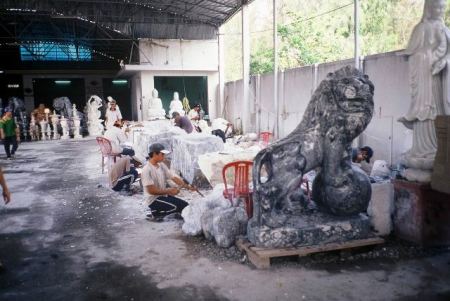
Random piece of information: just beyond Hoi An in Vietnam, on the road to Danang are the Marble Mountains. These are mined and the local craftsman can create whatever you desire and to whatever scale you wish. What is more, they will then pack it and ship it to your home. On the day we visited, the striking memory was of the carved American eagle, but the factory was full of repro classical statuary. You too can order your greatest desire – and at third world prices. They were doing a roaring trade in the classical figures. I am afraid I still subscribe to the view that if you can’t have an original (and the British museums got first dibs on a large quantity of them), then you are better off to have nothing.

Repro classical statuary to your heart's desire from the Marble Mountains near Hoi An in Vietnam

Repro classical statuary to your heart's desire from the Marble Mountains near Hoi An in Vietnam

A final few words about the rococo fountain: it belongs to Pat. I do not for one minute think that Pat believed that this recent installation in her front garden would elevate her social status. It is equally unlikely that she has looked into the rococo forbears of her fountain. No, she bought it because
a) she really liked it
b) it was cheap
and c) she has a very obliging husband who was willing to install it for her. I just think that the fountain may have drifted as far as it can – it may have reached its ultimate destination.

Growing garlic

Sown in late autumn, the garlic is well into growth here - seen with an unusually heavy frost which had me out with the camera this morning

Sown in late autumn, the garlic is well into growth here - seen with an unusually heavy frost which had me out with the camera this morning

We have been talking about garlic.This is because of the repeated advice from a local garden centre that it is not too late to plant garlic but you must start it off in trays and transplant in several weeks time when the bulbs have made good growth. It is an approach that will work (though individual pots cause less root disturbance at the time of transplant rather than trays) but it is a lot of work that we are not convinced is necessary.

Garlic can be planted directly into the ground. It is not difficult to get it growing. Within a few days of planting, it should be showing fresh root. But it is getting late in the planting season and should be done immediately. Increasingly, we are of the opinion that it is an unhelpful old wives’ tale that it should be planted on the shortest day and harvested on the longest day. These days, Mark plants it in autumn, a practice which is becoming increasingly common in this country. Autumn planting means the cloves are already growing well before the ground becomes cold and sodden.

The single biggest issue with garlic is that you need to know where they come from because you want NZ garlic. Cheap imported garlic may look fine and clean but it is usually from China, so from the wrong hemisphere and therefore on an opposite seasonal sequence. Added to that, imported garlic is reputed to be troubled by garlic virus which you do not need to unleash.

Other growing tips:

• Break the garlic bulb into single cloves and only plant the big ones. It is a waste of time planting small cloves.

• Plant at about 10cm spacings into ground which has been dug over well and is friable and fluffy.

• Put the cloves in so they are about 2cm deep to the top of the clove. Press them down firmly because they can push themselves out of the ground as they start to grow.

• Pile on the compost on top of the soil. Garlic is a hungry plant. Real enthusiasts will liquid feed regularly and keep the fertiliser up to them and it is likely to result in a bigger and better harvest. We are busy here with a big garden so Mark just plants well, keeps the area weedfree and that is pretty much it until harvest time.

• If we get a very dry spell in spring, that can be a problem. Check the crop. You may have to water them if we get several weeks without rain.

• Harvest around mid summer when the bulbs have reached maturity. You do not have to wait for the tops to die off. Dry the garlic before storing (plaited is the traditional approach) – hanging in an airy situation helps it to last longer.

And, basically, that is about it. Keep the vampires at bay.

Growing Citrus in the Home Orchard – our Taranaki Experience

Lemon and mandarin trees beside the driveway

Lemon and mandarin trees beside the driveway

We are never going to suffer from scurvy here. We have fresh citrus fruit in the garden twelve months of the year and our lunches are accompanied these days by a glass of fresh squeezed orange juice. It takes an average of six oranges each to get a full glass of pure juice.

Of all the fruit trees we grow, the citrus is probably the crop we take most for granted but would miss the most if we were to be deprived. Were it not for Mark’s parents, we would not be so blessed. As far as we can make out, they must have started planting grafted citrus back in the 1940s and 50s – a time when few people realised we could successfully grow any citrus other than lemons in our climate. Mark can remember some of them being mature when he was a young child. We did a quick count – we think we have about 20 productive trees dotted around the garden, mostly oranges, and that does not include the new plants we have waiting to be planted out.

The earliest trees planted here, a generation or maybe two earlier than Felix and Mimosa, were seedlings which grew too large and were erratic at best with fruiting. The breakthrough came with trifoliata root stock which is much more adaptable to our climate and is also a dwarfing stock. Most of our mature citrus trees are now in the 3 to 4 metre height range.

Oranges: When it comes to oranges, one variety stands head and shoulders above all others for us. The Lue Gim Gong on trifoliata stock is the breakthrough variety in this climate. When all the other oranges have finished fruiting, we can continue picking the Lue Gim Gong and it keeps us going twelve months of the year. When the fruits hang on to their second season, the skins turn a deeper orange and the fruit gets even sweeter and juicier. It is a form of the Valencia orange and dates back to Florida in 1876 where it was recognised as a breakthrough because it is sweet and more frost tolerant than other Valencias. If you can only grow one orange, our pick is definitely the Lue Gim Gong and it is still available for sale (try Google).

The distinctive navel orange - good eating

The distinctive navel orange - good eating

Because we can grow more than just one variety, we also have the Jaffa (excellent crop and flavour and most attractive on the tree as well as a long season) and a range of navel oranges. It appears that all navel oranges descend from the one specimen but some have sported over the years to give variations. Of them all (and I think we have tried most of them) the Leng Navel has the best flavour. It is hard to beat a good, tree-ripened navel orange for eating but the downside is that their season is comparatively short and they don’t hold on the tree. If you are not around to pick them, they fall off and rot. We have a blood orange waiting to be planted out. The flavour is good but the red colouring seems to be dependent on a hotter summer than we can give.

Lemons: Most New Zealanders grow a lemon tree except for people who live in the coldest areas. The Meyer is the most common because it is most tolerant of a range of conditions but it is not a true lemon, being thought to be a natural cross between an orange and a lemon. We planted a new lemon tree several years ago but we have lost the label. It is certainly not Meyer – it may be a Lisbon. We were very disappointed in it for the first couple of years because the fruit was thick skinned and unappealing but it has settled in well and gives us plenty of fresh lemons throughout much of the year. This specimen does require regular copper spraying to prevent leaf blights.
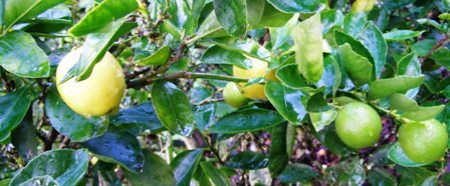
The Tahitian lime - a favoured crop for kitchen use

The Tahitian lime - a favoured crop for kitchen use

Limes: I prefer the old Tahitian lime we have which is under two metres high and a little wider. We tend to leave the fruit to turn yellow and use them like juicy little lemons. The fruiting season is not as long but the volume of fruit is excellent. The younger leaves are also aromatic for flavouring Asian dishes. I use the ripe yellow limes to salt for use in Middle Eastern dishes. They are a more convenient size to put in jars and have a thinner skin. If you are warm enough to grow a Tahitian lime, it is well worth its place in the garden. Preserved Lemons recipe.

Grapefruit: We have a couple of trees which fruit well but they are not in a convenient location so we tend to ignore them and the crop goes to waste. Proper grapefruit do not do well in New Zealand, apparently. It appears that they need a hotter climate than most citrus. What does grow here is the New Zealand grapefruit or Poorman Orange which was apparently introduced by Sir George Grey to Kawau Island. It came from Australia and is thought to be a natural hybrid, probably between a pomelo and a mandarin. Alternatively the Wheeny grapefruit is grown here (we have one) and it has a thin skin and a good flavour though it is not as hardy as the Poorman. My late mother in law was a splendid jam and marmalade maker and her advice was that neither the Wheeny nor the Poorman has sufficient pectin to set marmalade easily so it is necessary to add lemon juice.

Mandarins: These are particularly decorative and ideal for families with children, especially when they are the easy peel varieties. Besides plucking fruit as we pass, much of the crop sits on the trees looking attractive here because in the end we would rather eat oranges. Silverhill, a named form of Satsuma, is the best producer for us. Our Clementine died which was a pity. It had a better flavour but because it is not as easy to peel, it is never going to be as attractive to children. Added to that, it has many seeds and seedless citrus is preferable for eating.

Tangelos fruit well and are easy to peel, though messy, and delicious when you get good ones. It is thought that the tangelo is a hybrid between a mandarin and a pomelo (also known as a shaddock). They are not a replacement for oranges but they are a good addition where space allows. They have an unfortunate tendency to produce some dry fruit for us but we have never worked out why – we suspect it is varietal rather than conditions.

A mature Jaffa orange grown as a lawn specimen

A mature Jaffa orange grown as a lawn specimen

Growing conditions and general maintenance:
When choosing a site for citrus trees, give them as much sun, warmth and air movement as you can, along with good drainage. We have some as lawn specimens and they appreciate the open conditions. However, they are now so old that there is a clear space under the canopy which stops grass competition. On young specimens, it would pay to keep the trunk clear and not to mow within half a metre or so. We do not go in for the urban fashion of growing citrus in containers so can not give specific advice on that practice beyond the generic techniques for growing plants in containers.

In the world of fruit trees, our citrus are remarkably easy care. Common advice is that they need plenty of feeding but we rarely bother. Years go by between feeds. That said, yellow foliage is usually a sign of nitrogen deficiency so if you have a sickly yellow citrus, give it some fertiliser or compost and make sure that whatever you use is rich in nitrogen. With regular rains twelve months of the year, we never water. It is often said that citrus need plenty of water to keep the fruit juicy but I have seen them growing extensively in Spain and Italy where conditions are bone dry and hard and I can’t imagine that watering was particularly consistent or thorough.

Control against the borer larvae

Control against the borer larvae

We do not regularly prune the trees. All we do is take out the dead wood or any wayward branches as required. Borer is one of the biggest problems but not so big that it threatens the entire tree. If you are more thorough, you can inspect the trunks and branches and kill out the borer larvae by injecting holes with oil, insecticide, kerosene or other variants. Look for the tell tale signs of holes with a ring of sawdust beneath. Spraying CRC down the hole using the fine nozzle works a treat, suffocating the grub, though Mark is of the view that flyspray with the same fine tube would be better. The borer can kill a whole branch which is why we need to prune out dead wood from time to time.

Neither do we worry too much about spraying the trees (except for the above mentioned lemon). They certainly do not undergo any regular spray programme. What little is done here is strictly on an as-required basis. Leaf roller caterpillars can be a problem because if they damage the skin of the fruit, it is enough to make the fruit drop off.

Sometimes we get an attack of brown rot which gives, surprise surprise, brown rotten patches on the fruit and causes extensive defoliation. Mark is out with the copper spray on the very next fine day when we notice this. In theory he does an autumn copper spraying round of all the citrus trees but in practice this can be hit and miss. We have enough trees here to ensure that if one or two have a bad year, we don’t run short of fruit. The use of trifoliata root stock is a major factor in enabling us to continue with such a laissez faire approach because it shows excellent resistance to many common problems.

All of which brings us to the thorny issue of climatic range. We can’t say, is the answer. We garden on volcanic loam about five kilometres from the coast. The disturbed westerly air patterns mean that such frosts as we get are only mild (a degree or two) and we never get very cold. On the other hand, we never get particularly hot either and we have high sunshine hours, high humidity and high rainfall twelve months of the year. The Meyer Lemon is the hardiest of these citrus. If you are in doubt, check whether it is growing nearby. If it is, then you could start experimenting with other options but don’t get too carried away until you can see some success. Coastal areas are always milder. While citrus are happy in places with hot summers, if the corollary is a very cold winter with heavy frosts and maybe snow (a continental climate), it will generally be too cold for them in winter.

Trifoliata coming away below the graft - our preferred root stock

Trifoliata coming away below the graft - our preferred root stock

In summary:

• Source trees budded on to dwarfing root stock or learn how to bud your own plants. Our experience is that trifoliata stock is successful. This root stock keeps the trees smaller and gives greater hardiness and disease resistance in less than perfect conditions. You can grow your own rootstock from cutting if you find a tree which is sending shoots from below the graft as shown in the photograph. You then need to bud or graft onto the rootstock. For general instructions on budding, check out our Outdoor Classrooms:
Autumn chip budding
T budding

• Citrus can be a decorative addition to the garden as well as being productive (and the scent at flowering time is divine). If you have space for several trees, you don’t have to be so particular on spray and maintenance programmes.

• Healthy, established trees in good conditions do not succumb as readily to pests and diseases.

• Lue Gim Gong on trifoliata stock is our single best orange variety here and guarantees fresh fruit twelve months of the year.

• In our conditions, the citrus range are probably the most rewarding and easy care tree crop we grow. You can go to a great deal more trouble and effort if you want, but you can get away with very little.

Lue Gim Gong as a lawn specimen - our top performing orange

Lue Gim Gong as a lawn specimen - our top performing orange


(Reference, in addition to decades of hands on experience here: Citrus in the Home Garden, Ministry of Agriculture and Fisheries NZ, Bulletin 393 [1972 edition].)

What does your lawn say about you?

The front lawn - a support player, not the star

The front lawn - a support player, not the star

A gardening newsletter arrived this morning and it contained a quote: “Lawns, hedges and edges… these are what make a good garden.” No. I do not agree. Lawns, hedges and edges are what make a tidy garden and that is something entirely different.

The person being quoted was Sue Macfarlane of Winterhome Garden near Kaikoura. I have been to Winterhome and I really liked it. This was surprising because it is a garden which makes heavy use of low buxus hedges and I am not the world’s greatest fan of the use of this device to define spaces. But what I remember of Winterhome is the use of long vistas and enticing avenues which draw you down to explore with a sense of anticipation, which was well rewarded in this garden. There was a confident use of space and distinct changes of mood and style. It was carried off with panache.

But I don’t remember anything about the lawns at Winterhome and as far as I am concerned, that is entirely as it should be.

I do not understand the obsession with lawns in New Zealand. To me, it smacks of a suburban obsession which has nothing to do with gardening. When you visit a garden, if you remember the lawn it is for one of two reasons.

Either it is a rank and unkempt assemblage of ill cared for low growing green plants, probably infested with flat weeds and onehunga weed, desperately in need of some mowing, edging and a little weeding.

Alternatively, it is a pristine velvet sward of such immaculate perfection that it is a feature in itself. And to Mark and me, that is as bad as the unloved lawn. Perfection shouts: unsustainable garden practices! Heavy use of selective sprays! Unacceptable use of synthetic fertilisers! Summer watering which washes the chemicals even further afield! Removal of all clippings! Dethatching every year!

I remember interviewing for a commissioned piece, profiling a garden for a national publication. The owners were terribly proud of their lawn and claimed that garden visitors often said they wanted to take their shoes off and luxuriate in bare feet on the grass. I caught Mark’s sideways glance to me and later he expostulated: “You want to take your shoes off and expose your bare skin to the chemical cocktail on those lawns????”

In a good garden, as far as I am concerned, you should not notice the lawn. Grass is a bit player, the chorus line playing a support role. It is there to fill in spaces and to make the surroundings shine. Tiny town gardens may do away with lawns. My mother always dispensed with all grass but that was because she would rather garden than mow lawns and she never, ever, ever managed to get a rotary lawnmower started (not even a brand new one) so the only choices were a handmower or no lawns. She chose the latter. But in bigger gardens, grass gives a breathing space, a sense of open-ness and simplicity which is a sharp contrast to intensively planted areas. In a family garden, it is the place for the trampoline and the cricket or badminton set, or for the dogs to run.

According to “The Curious Gardener’s Almanac”, over three-quarters of the garden chemicals sold in Britain are for the improvement of lawns. That was in a 2006 publication. And the British are nowhere near as obsessed with lawn perfection as we are in NZ and also in USA so our percentage may even be higher. How can that be justified?

We have lawns here. In fact we have quite extensive lawns. The one in front of the house is substantially larger than a tennis court. We mow them religiously every week on the Rolls Royce of lawnmowers which cost more than our car (it is a Walker Mower from the US). But we use a mulcher deck on the mower. We do not remove the clippings so we do not need to pour fertilisers on to replace the goodness from the clippings stripped off. Mark will spray occasionally (very occasionally) and we try and keep the flat weeds and onehunga weed out, often by handweeding. Beyond that, as long as it stays green and cuts well, we can live with a bio-diverse green sward. And should we chose to gather our clippings, we could spread them in the vegetable garden without causing problems to tomatoes and capsicums (there is a good test for the toxicity of your lawn clippings).

We also have grass, as in our park. It has a major colonisation of daisies which look particularly pretty in flower in spring. And we have moss in shady areas. But all these grassy areas gives the framework and breathing space in the garden, obligingly filling their support role without wanting to be the main act.

The final words on lawns and grass belong to vintage Alan Titchmarsh – a doyen of English gardening. He published a seriously funny book in 1984, called “Avant –Gardening, A Guide to One-Upmanship in the Garden”. I inherited a copy from my late mother. I found a second copy for a friend, believe it or not, in a second hand bookshop on the Greek island of Patmos so clearly there are other copies kicking around in odd places. I am not sure aforementioned friend appreciated what a gem this book is but never mind. Of lawns, Titchmarsh wrote: “ Avant-gardeners do not have lawns; they have grass…. Gardeners with large plots should devote a good sized area to unmown grass where wild flowers and bulbs can be allowed to flourish. The more this site is criticised by tidy gardeners the better. A bit of name-dropping will get you out of tight corners. Try: “Christopher Lloyd does it at Dixter, you know.”

The trouble is that in this county, it is just as likely that your critic will never heard of Christopher Lloyd, let alone Alan Titchmarsh. But maybe we will come of age and review the elevated status we place on the unsustainable ideal of the perfect lawn.

Plants that Delight

This article was first published in the Weekend Gardener Magazine, issue 316, June 2 – 15, 2011

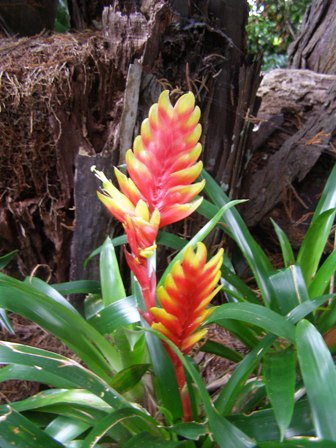
Bromeliads - a vriesea

Bromeliads - a vriesea

Bromeliads
Generally speaking, I am not a fan of prickly, spiky plants (I have always felt that yuccas in particular were aptly named) but I am willing to make an exception for the bromeliad family even though it means donning protective gear when it comes to working amongst them. We use them extensively in dry woodland conditions and for much of the year they just sit around being extremely undemanding, bar the occasional clean up to remove accumulated debris.

It is when they flower, that bromeliads look exotic. The range of blooms is extraordinary and there is nothing quite like them. Some of them have strange, flattish flowers which might be cast out of thick wax, dyed in parrot colours. What is more, the flowers last for ages. I haven’t timed them but we are into months, rather than weeks. This one is a vriesea of some sort but we have never become experts on the genus, despite growing a range of different ones. Our cool, frost free, high shade conditions keep them looking particularly lush. With some of our plantings dating back to the early 1950s, we would rate them as one of the lower maintenance garden plants.

Bromeliads are readily available and many are easy to multiply for the home gardener. If you want to learn more about bromeliads, check out “Bromeliads for the Contemporary Garden” by Weekend Gardener writer, Andrew Steens.

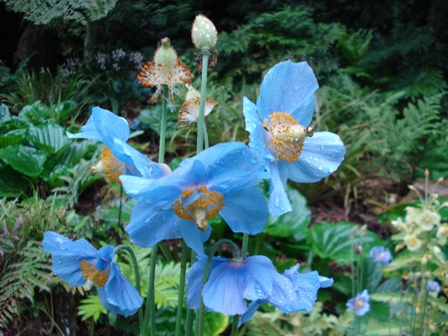
Meconopsis

Meconopsis

Meconopsis
The simplest poppy form – a mere four petals surrounding a ring of golden stamens – is always charming, no matter the colour. When it comes in pure blue, it enters a league of its own.

Coming from the Himalayas, these are plants which are happier in much drier, colder conditions. We have to work at keeping them going here, where we have high rainfall, high humidity and generally mild conditions. They certainly don’t seed down and naturalise for us as they will in parts of the South Island but when they come into flower each spring, it is worth every bit of effort.

We don’t generally let them flower in the first year because if they put their effort into setting seed, the young plants tend to die. If we delay the flowering, we have more chance of some at least becoming perennial, albeit still comparatively short lived. Fresh seed is easy enough to raise but best done in seed trays and not merely broadcast to the ground with a wish and a prayer.

Meconopsis are available in New Zealand both as seed and as plants. If you have a choice, Meconopsis x sheldonii shows a little more vigour than either grandis or betonicifolia. All come in blue, though there are also white, pale yellow and red meconopsis which are nice to add in to a garden but no replacement for the beautiful and eye-catching blue.

Magnolia Felix Jury

Magnolia Felix Jury

Deciduous magnolias
How could I be a Jury and not put deciduous magnolias in my top favourites? These trees are surely one of the most spectacular on the planet when in full flower, though it has to be said that the bigger the flower, the better in terms of impressive display.

Magnolia trees just get better with size and age which seems entirely appropriate for a genus which is ancient – so old that it does not even have proper petals. What we usually call petals are in fact tepals. They evolved before bees so originally adapted to be pollinated by beetles – hence the fact they have pollen but no nectar.

To get maximum flowering, select a variety which sets flower buds down the stem rather than just on the tips. Some varieties like the purple Lanarth can take your breath away but only for about 10 days. Others, like Iolanthe or Felix Jury, flower over many weeks, extending the display. Indeed, spring flowering on Iolanthe extends over at least eight weeks from first to last bloom and there is the bonus of random flowers over summer.

Daphne genkwa

Daphne genkwa

Daphne genkwa
A daphne with no scent? Yes, but it is so spectacular in flower that the absence of fragrance does not seem to matter. It is also deciduous, which we do not expect from a daphne and it flowers before it comes into leaf so all that is visible is a mass of graceful whips smothered in lavender blue flowers.
I think you can never have too much blue in a garden. It is a colour that complements all others and while I will admit that genkwa is not a pure toned blue, it is still blue enough for me.

D. genkwa is not easy to propagate and is generally increased from root cuttings. Neither is it easy to get established. In fact it is definitely on the touchy side. This plant was a particularly fine specimen but outgrew its allotted space so I pruned it after flowering, as you do. It promptly died, to my great disappointment. I am trying again, but this time as specimen shrubs with plenty of space to grow so they will not need to be pruned. Daphne genkwa is available in New Zealand but is not standard garden centre fare so you may need to find an obliging operator to order it in for you. It is a Chinese shrub and, being deciduous, it is generally rated as hardy.

Narcissus cyclamineus

Narcissus cyclamineus

Dwarf narcissi
In a large garden with some enormous trees, we love the tiny treasures that give detail to the bigger picture. We also have more success with the baby narcissus than with their larger cousins. They don’t seem to be quite so vulnerable to the dreaded narcissi fly, possibly because many of them flower earlier in the season.

These little cyclamineus seedlings always make us smile. With the reflexed skirt of petals, they are rather reminiscent of floppy eared dogs with the heads out the car window and ears streaming behind in the wind.

We grow a whole range of different dwarf varieties – species, named hybrids and unnamed seedlings, tucked into positions around the garden. The first to bloom are the Narcissus bulbocodium citrinus or hooped petticoat types which can show colour as early as late April while others continue the display through to late September. The best known dwarf variety is probably Tete-a- Tete, but there are innumerable others which are offered for sale from time to time.

Cyclamen hederafolium

Cyclamen hederafolium

Cyclamen species
These little treasures mostly hail from southern Europe and northern Africa but some varieties are particularly suited to New Zealand gardens.

The most widely available variety is Cyclamen hederafolium (formerly known as neapolitanum) which puts its first flowers up in our garden in January and flowers through until May or even June. After that, the marbled, heart-shaped leaves are attractive in themselves. C. hederafolium comes in shades of pink and pure white. Following on from them, we have a lot of success with C. coum in winter and C. repandum in spring.

Cyclamen are particularly successful planted in drifts on woodland margins in dappled light but they are pretty adaptable in a range of conditions as long as they have good drainage. They are easy enough to raise from fresh seed if you know of anybody with plants and they grow to form tubers which are like round, flattish discs.

Rhododendron Yvonne Scott

Rhododendron Yvonne Scott

Rhododendrons
Unfortunately, the glory days of rhododendrons have been and gone in this country, but we would not be without them in our garden. Our particular favourites are the nuttalliitypes with their large, waxy trumpet flowers, most of which are scented. Combine that with big, heavily textured leaves (the technical term is bullate foliage) and the most beautiful cinnamon brown bark which peels off in long tendrils leaving a shiny trunk behind.

Add in the fact that these plants show generally healthy characteristics in warmer climates. They can get a touch of thrip but nowhere near as much as colder climate plants and they are not susceptible to the brown crisping round the edges of the leaves which disfigures so many varieties.

If I could only grow one rhododendron, R. sino nuttallii would be my first choice. Sino just means it comes from China (there is another Himalayan form). Fortunately we can grow many so we have a fair range of the nuttalliis and their hybrids, including the lovely and distinctive Yvonne Scott. Huge lime green buds open to lime flowers which fade out to white within two days, but keep the green flare in the throat. Mi Amor is probably the most widely available nuttallii hybrid on the market. While we might not rate it as the best, nuttalliis are not readily available so you might have to grab whatever you can find.